Jay Papasan:
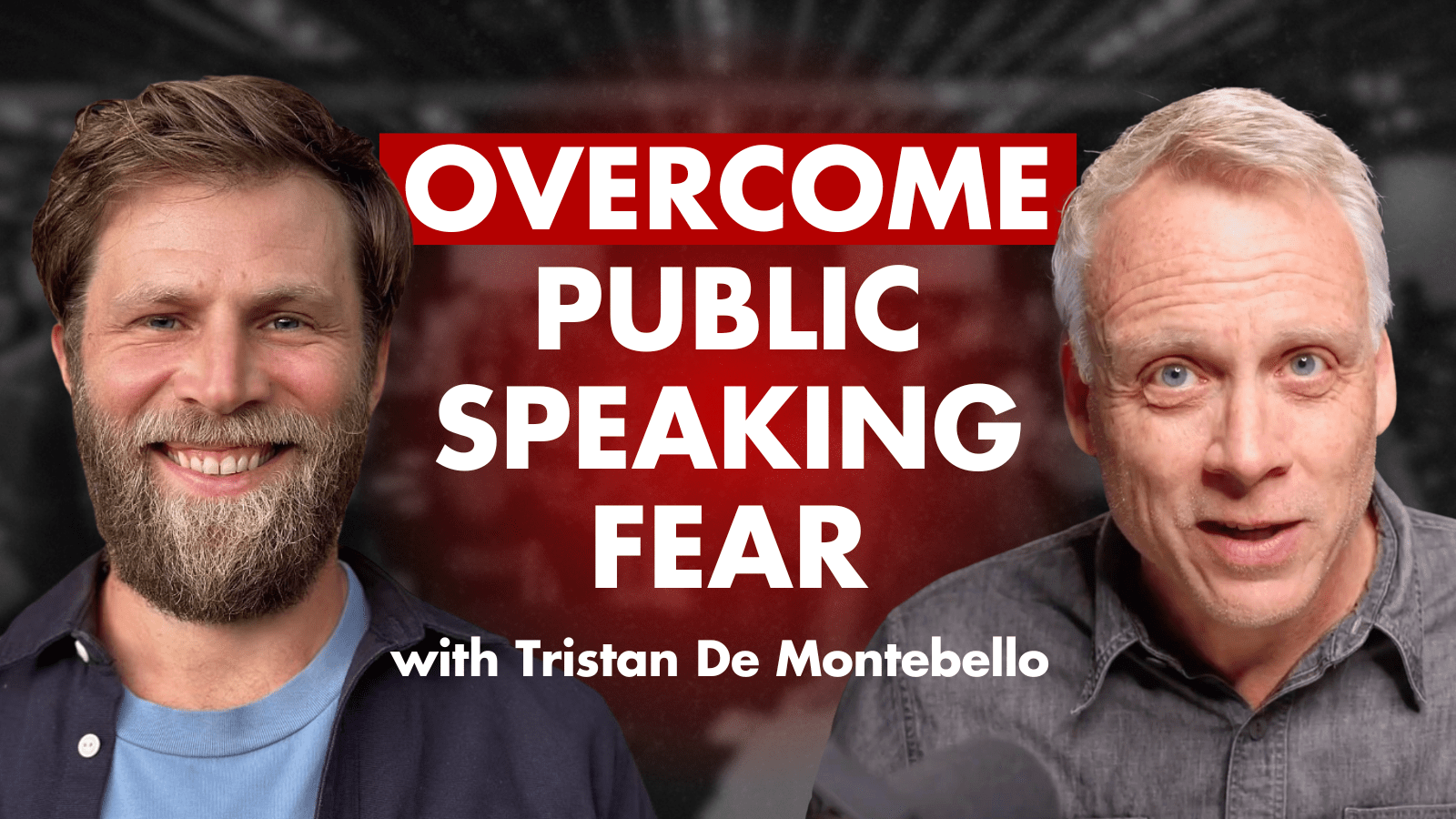
Hey there, ONE Thing family. My guest this week is my friend Tristan de Montebello. He’s one of the co-founders of a really innovative company called UltraSpeaking. And they help people become more powerful and confident communicators. And while a lot of it is around public speaking, it’s really about communicating in every facet of our lives.
And what I love about them is like, this is not your father’s Dale Carnegie class. They’re going deep into coaching. They’re going deep into how what’s happening inside of us is usually spilling out on wherever communication platform we’re on and how to fix that stuff on the inside, so that what comes out feels so much more confident and better. So, no matter how you choose to communicate, whether it’d be on a big stage, or a small one, or just hanging out with really close people and having an important conversation, there’s something useful for you there.
I do think the bigger background story here, if you’re listening, my ONE Thing fans, is the story on the journey of mastery. So, whether you’re interested in public speaking or just what it looks like to be on the path to mastery, I think this is a great episode for you.
———————-
Jay Papasan:
I’m Jay Papasan, and this is The ONE Thing, your weekly guide to the simple steps that lead to extraordinary results.
———————-
Jay Papasan:
Tristan, welcome to the show.
Tristan de Montebello:
Thank you, Jay. Good to be here.
Jay Papasan:
Ever since I first saw you deliver your message around Ultraspeaking this past June, I was so excited to hear you at our own conference and just get to know you better because there are people who we say, you know, game see game, you know, that old saying, like you’re clearly on the path of mastery in what you do, you’re committed to it, and others recognize you in it. And you’re tackling, you shared – I won’t steal your thunder – one of our greatest fears. So, how do people rank public speaking in terms of things they’re afraid of?
Tristan de Montebello:
It is often the biggest phobia in America, at least often before death. I think Jerry Seinfeld has a funny joke there. He says people would rather be in the casket than given the eulogy.
Jay Papasan:
That’s pretty good. So, it ranks higher than an unexpected visit from your in-laws?
Tristan de Montebello:
Debatable.
Jay Papasan:
Debatable. Okay, got it, got it. So, you’re helping people kind of overcome this fear, so that they can share their message. And is this just about being on big stages?
Tristan de Montebello:
No. I think, I mean, most of us, if we’re lucky enough to be on big stages, that’s 1% of our time communicating at best. So, that’s a mistake I made. The mistake I made is I went and focused on prepared speaking and tried to get really good at that thinking it would spread to everything else I was doing.
Jay Papasan:
Yeah. If I can do it on a big stage, I can surely do it in all these other places.
Tristan de Montebello:
Well, it’s just two completely, almost, disparate skills. And so, I tried to figure out what are the other skills that I can learn that can make this feel comfortable?
Jay Papasan:
Than this being the podcast.
Tristan de Montebello:
This, the podcast, going out and talking to the barista. When I walk in and be in a group of friends, meeting strangers, leading a team meeting at work, all of those where I don’t have a luxury of extreme preparation.
Jay Papasan:
Right.
Tristan de Montebello:
Those matter. And the spectrum of speaking just to call out what you said on anxiety and people, the fear of speaking, to me, it’s just a spectrum. If you are out of practice and you’ve been avoiding this most of your life, then it’s probably very scary, and you probably get all kinds of horrible symptoms in your body that make you want to avoid it even more.
But the journey of speaking may start around there, “This is awkward and unpleasant.” But as you get better, you’re gonna go from avoidance to actually looking forward to speaking. And that’s when all of the effectiveness of communication, “How do I get better at this? How do I get more effective and have more influence come into play?” But you have to do them in order, in my experience.
Jay Papasan:
So, if I can just unpack that, having also seen your speech, like the first thing we have to do is not focus on all of the hacks and tricks and don’t point, hold your hand like this. And there’s all of the techniques of speaking, but we have to start by maybe quieting this inner critic, feeling comfortable in the moment, so that we can do those things. Am I getting it right? Partially?
Tristan de Montebello:
If you do it backwards, if you look at the… say you watch somebody speak, and you look at them, and you think, “Wow, that person’s so dynamic. I love how they’re using their hands when they speak.” And then you say, “I want to use my hands like they’re using their hands.” And so, you try to analyze how, “Okay, he’s lifting his right hand about chest level. And then, his other hand’s coming out like this. And I noticed when he makes a point, he actually puts his finger in this position.” And then you go, and when you’re speaking, you’re trying to think, “Okay, bring your hand out here, point your finger,” you’re making a point.
That is not what got the person to move their hands in the first place. What made them dynamic is that they got excited about what they were talking about, or they were really into a state of flow, and suddenly, their hands are moving. And so, we don’t want to copy what we see on the outside. We want to copy what got the person to do the thing that we’re seeing on the outside. And that’s all of what our training in Ultraspeaking is about. It’s kind of the inner game of speaking. Once you have that, now we can play the other and do everything else.
Jay Papasan:
Have you read the Inner Game of Tennis?
Tristan de Montebello:
Yeah.
Jay Papasan:
This comes up a lot.
Tristan de Montebello:
Yeah.
Jay Papasan:
Right? Is it performance equals skills minus friction or interference?
Tristan de Montebello:
Possibly.
Jay Papasan:
I think it’s something like that. I’ve got it written down and stuck like on a post-it note, but like the interference is all the noise and discomfort. So, your skills could be high, but if the interference is higher, it doesn’t matter. Right.
Tristan de Montebello:
Think about it. Speaking is a skill that everybody has been practicing all of their life. So, you can pair that with the 10,000 hours of Malcolm Gladwell and everybody has those 10,000 hours. What is blocking us from all being exceptional communicators? It’s very much up here. It’s very much the interference. So, let’s start by getting rid of all the gunk in the gears. Let’s get rid of all of those interferences that are choking us. And from that place, you’re already making leaps and bounds in your effectiveness. And now we can fine tune.
Jay Papasan:
So, I’ve had the privilege of seeing you deliver two keynotes. That’s one of the things you do in addition to corporate training and all the other stuff that y’all do in Ultraspeaking. And one of the things I love, and people, even if they’re on YouTube watching us right now, they don’t get to see the slide, but you show a map where you get to see all the places where we communicate. It might be at a birthday lunch with friends where you have to make a toast with your close friends, it might be in a boardroom, it might be on a big stage. And you have all of these circles, and yellow means I feel confident, and the red means I don’t.
And my big takeaway the first time I saw that is that’s so true. I know people who say, “Oh my gosh, I can never publicly speak,” but when we’re hanging out with a group of people they feel really comfortable and safe with, they’re the best storyteller I know. They start to tell a story and everybody’s like, “Oh, there David goes again. He’s telling a fishing story. Let’s wait for the punchline.” And so, that lives in everybody. We all have that space. How do we find that space wherever we are? So, I love that, and I love that y’all are going to, basically, the root cause.
Tristan de Montebello:
Exactly. Root cause before the symptoms.
Jay Papasan:
Root cause before the symptoms. Inner game determines the outer game. And that’s not unusual for people who listen to this podcast, right? We gotta start with what’s inside, and that’s usually what spills out outside. And I said the word spill, and part of when you’re sharing and teaching, you talk about that stain on your shirt. And this is a big part of it. Will you kind of unpack that for me? You know where I’m going?
Tristan de Montebello:
I know where you’re going. The concept of leaking, it’s this idea that when I fumble in my speaking, if I say something wrong, if I start rambling, if I feel like I’m not being clear, it sounds like to me, my experience of being the speaker, those mistakes sound giant. Like that little stain I have on my shirt that I’m convinced every single person around me is paying attention to is focusing on. I think you call it the spotlight effect.
Jay Papasan:
The spotlight effect. Yeah, we all feel like we’re re walking around with the spotlight and everybody’s looking at us, but the reality is we’re all walking around in our own spotlights wondering if everybody’s seeing our stain.
Tristan de Montebello:
Yes.
Jay Papasan:
Or pimple or whatever it is that’s on our brain right now.
Tristan de Montebello:
Exactly. So, what happens is because of that effect, when people make a mistake, when people feel like they’re not being clear, they leak their insecurity now. And it a very unconfident behavior and it’s basically the equivalent of shooting yourself in the foot because in saying, “Oh my god. I’m sorry. I think I’m not making sense right now. Please excuse me for existing,” when you say those things and that could look like just be a physical grimace, or it can be words, you’re forcing a filter on your audience. You’re forcing your audience to reinterpret everything that you have said from the lens of, this person is not very confident in what they just shared with you. You’re almost automatically discarding what you just heard.
Jay Papasan:
Wow.
Tristan de Montebello:
Whereas if you were to stay in character, so stop the leaking, then people will take it at face value and nothing happens and you get to keep going. And that’s a very confident cycle that gets into place. And it may be the lowest thing for it when speaking.
Jay Papasan:
I remember someone coaching me when I was on the journey, I would look at my watch. He said, “If you look at your watch on stage, people are gonna assume it’s the timing.” They’re asking the question, “Are we on time or not?” And every time you do, no matter what goes on inside, you have to say, “Right on time.” And it felt like, “Am I gonna lie to a thousand people right now ’cause I’m behind?” but you say, “Right on time.” And ’cause you can’t avoid. Sometimes, you’re like, “Where am I?” if you don’t have a countdown timer. If it’s not one of those venues, you have to know, “Where am I in this space of time?” So, you look, but now you don’t realize the effect you just had on the audience.
Because they have that fear too. They’ve had a moment where they didn’t realize the time and they ran out of time. Do you know what I mean? So, we’re all in our own heads, and we see that, and we start to fill the gap with not the best stuff.
Tristan de Montebello:
What are you doing when you’re saying “Right on time”? What you’re doing is you’re telling your audience, “Relax, I’m still confident in my leadership,” because what happens when you see somebody start to unravel on stage? You tense up, you hold, you grasp the sides of your chair, “Uh-oh, uh-oh, this is going bad. Oh, no. Oh, no. Oh, no. We’re about to crash land.” That’s the feeling of somebody having a little bit of anxiety. The moment you look at your watch, I go, “Uh-oh, is something wrong? Are they late? Are they messing up? Are they not in control?” And you say, “Right on time,” really, you’re reassuring, you’re saying, “Hey, you can relax. I got this.”
Go back to that state of presence that you can be in when you’re listening in comfort, where you allow your mind to wander and build context and everything that it needs to do.
Jay Papasan:
I love that.
Tristan de Montebello:
I love that example.
Jay Papasan:
Do you have any phrases like that that you use when you screw up?
Tristan de Montebello:
My philosophy is, “Ride whatever wave I’m on.”
Jay Papasan:
Okay. And you’re from Maui, so like’s probably… and I know how to surf, dude.
Tristan de Montebello:
Exactly. I have a lot of friends, but this one for me is like when, at the conference a couple days ago, was it yesterday? Yeah, I spoke two days ago in Europe. Incredible conference. And my slide that was the punchline of my joke showed up without me noticing. And I just looked up at the screen, and I see my punchline before I even had to set it up.
And I could have crumbled.I could have said… And I think I… I don’t know exactly what I said. I was too in the moment to remember, to be honest. But I just remember writing that and just saying it out loud like, “Oh, this is the punchline of my joke,” and people laughed at that. And then, I still was able to say my joke and got that as the laugh, anyway. So, I got an extra laugh. I actually won one more laugh because it didn’t work out the way it worked out. But that came from not crumbling, and instead just riding it, just being with it and saying, whatever comes is part of the music that I’m playing.
Jay Papasan:
One of my friends says it all the time, and he does it jokingly, he’s like, “Just like I planned.” And because everybody’s like, “Oh, you didn’t mean to spill your water bottle over the stage. You didn’t mean to do that thing,” but it just dispels it. It just says, like, “I’m okay.”
And I don’t know about you, like I was telling my team and my wife was there with me, we were watching The Studio. Have you ever seen The Studio? There’s an episode of that where the main character – I won’t spoil it – is stepping in, and they’re worried he’s gonna mess it up. And he is messing it up progressively through this one whole episode but he doesn’t know. And Wendy looked over, my wife looks over, and I’m in the fetal position. And it’s brilliant television, and I can appreciate the art, but I cannot stand to see people fail. Like it hits every insecurity that there is. So, those people who go and watch barstool sports with people faceplanting and think it’s funny, that is not me.
And so, what we’re talking about, it’s like there are people out there that empathize with us. They don’t want to see us fail. And if we take these little techniques or just the attitude, the mental attitude, they don’t know what a real mistake is, a recoverable mistake or an irrecoverable mistake, and if I just communicate that this is recoverable, everybody relaxes.
Tristan de Montebello:
It’s simply the contrast between sharing something in confidence, like confidently, or sharing an insecurity, which is an unconfident behavior. You can do the same. You can spill your water, “Oh, my goodness” and be rattled about it, or it doesn’t matter what you say, it matters how you say it, it matters where it’s coming from of, “Oh, that’s funny. This is literally the worst thing that could have happened.” We probably don’t even have a light right now. It doesn’t matter what you say. As long as you’re writing it, and you’re telling everybody, “Guys, it’s…”
It’s like being with your kids, and they fall down, and the first thing they do is they look at you, “Am I okay?” It’s the same thing. And it’s not what you tell them, it’s how to behave. You can say, “You’re okay,” but if you’re crying, and you’re…
Jay Papasan:
If you’re looking concerned, or like my dad, “Rub some dirt on it and go back.”
Tristan de Montebello:
Exactly. I don’t care what you say as long as you’re embodying your confidence, because people cannot see what you feel.
Jay Papasan:
Yeah.
Tristan de Montebello:
So, embody confidence, keep it going, and you’re in character, no leaking.
Jay Papasan:
All right, I’ll do my last geeky thing. Then, we have to go to break. I remember reading, I want to say, Blink. It was a Malcolm Gladwell book, I’m sure. And he was talking about these people that were doing a study of human expressions. And all of the combinations, like thousands of combinations of all these tiny muscles in our face, and they described they had to go through this period of time over two weeks where they were doing all of the sad and frowned faces.
And there’s this idea that when they were doing it, people started reporting sick, having more headaches. And the connection between the inside and the outside are very strong. So, what we believe inside often reflects outside. And when they say, “Fake it until you make it,” what I do also believe is, sometimes, our body language and how we act can reflect back inside. So, when we practice these things of, like, even if you don’t feel it, “Just like I planned,” or “Oh,” and “There’s my punchline,” we’re doing it on the outside, and it creates a positive cycle. Both on the inside and outside, you create this positive cycle versus like swirling down the vortex of your self-consciousness.
Tristan de Montebello:
In our training, if we see anybody go through a rep, where all of our training is through games, and if somebody is going through a set of multiple reps within a game, which lasts say 20 seconds, and we see that they’re doing it unconfidently, then nothing else matters until they’ve done again and done it confidently. Just do the same thing, but now maybe I’ll say, “Now, do it at a six or a seven in energy, instead of the five where you were at,” or “Come again.” Sometimes, just saying, “Can you do the same thing? But now, do it confidently.” And then, the person’s communication transforms.
Jay Papasan:
Wow.
Tristan de Montebello:
Because when you’re in a confident state, you have access to all of your being. You can think, you can project, you have access to memories. So, it sounds so simple that you might want to discard it if you’re listening to this and say, “Give me a framework, give me…” No, no, no. This is it. This is where it all starts.
Jay Papasan:
Well, I mean, any parent listening that’s ever said to their child, “Can you say that again in your nice voice? Can you say that again in your confident voice?” knows that, like, sometimes, that simple… like it’s almost a command, but it’s a request, actually works. It just triggers something where we go, “Okay, I’ll do that,” and we get out of our own head.
All right, we’ve got to take a break now. Obviously, I’m gonna keep running over if I’m that careful, but it’s just like we planned. We’re right on time, Tristan.
Tristan de Montebello:
Right on time.
Jay Papasan:
Let’s take a quick break and we’ll see everybody on the other side.
————–
Jay Papasan:
All right. Welcome back everybody. I’m here with Tristan de Montebello of UltraSpeaking. We’ve talked through some of the inner to the outer game of speaking. That’s true of any kind of performance, if I’m honest. Like you’re focused on one element of performance, but it’s true everywhere. Can we hear a little bit about your journey? I know that in 2017, you went on your speaking journey. Can you tell us what that looked like?
Tristan de Montebello:
I stumbled into this by accident.
Jay Papasan:
What were you doing before?
Tristan de Montebello:
I was trying to figure… Honestly, I was an entrepreneur ever since I can remember. Before finishing my master’s, I had started the company. I need my own path. There’s no other possibility for me. But at this point, I was really trying to figure out where can I clip my attention that I will want to continue for more than a decade.
Jay Papasan:
Right, looking for that thing you’re really passionate about.
Tristan de Montebello:
Yeah. And I was teaching guitar online. So, I had an online guitar course teaching adults how to reach independence in guitar, a place where I felt like, now, you can do whatever you want to become. You want to become a professional, you can. If you just want to sing songs with your friends, that’s up to you. And strangely enough, so, I got bored of that because the only way to grow that would have been, in my mind, for me to become the guitar guy. I have to build my YouTube channel and teach guitar for the rest of my life. And that wasn’t enough for me. I didn’t have that passion.
So, I was looking for something different. And I thought, “I’m gonna be the learning guy.” So, I’m gonna learn another skill very fast, very intensely. And I’m gonna do that very publicly.
And that’s gonna become my marketing for this next skill that I’m gonna teach beginners. I love the zero to one between the skills. And very long story short, I ended up choosing public speaking as the next skill, not piano, which was my first choice. And I ended up discovering the world championships of public speaking and become the fastest competitor to make it to the finals of the World Championships.
Jay Papasan:
In seven months is what I remember, you went from just getting started to being on the stage, like in the top five or something crazy, in the world in public speaking.
Tristan de Montebello:
Yeah. It was very, very… I signed up for the world championships because it sounded like a great forcing function. I almost didn’t qualify because you needed a certain amount of speeches to qualify, and I discovered the world championships in 10 days. I needed five qualified speeches. Most people would do that over the course of three to six months. My last speech was at 12 p.m. on a Thursday and the qualifying competition was at 7 p.m. that same day. I was qualified hours before the cutoff, and I just kept winning. But I became completely obsessive about it. I had a-
Jay Papasan:
What was your speech about? Were you doing the same one again and again?
Tristan de Montebello:
So, for the first half of the competition, it was the same speech. And then, the second half. So, the first three months, I was allowed to use the same speech. And so, I just approached it like a comedian would, building their special. So, I booked a VA online, virtual assistant who would book me speeches almost every day. I would go give my speech, then I would record it. I would watch the recording. I would take notes. The next morning, I’d meet Michael, who I met early on, who became my coach. And we’d meet at 6 a.m. in the morning before he started his workday. And we’d watch the video, cringe and work on the script. And then, I pick up my phone and say, “Okay, where’s my next speech?” Go to the gym, learn my script by heart, and then go perform it and record. And just repeat. And I did that over and over and over. Just try and do things out.
And my speech, the first speech was about overcoming your fear of other people’s opinions. And then, the next one, once I qualified for the semi-finals, I needed to, now, write the speech that could win me the world championships of public speaking. And I had three months of experience. And now, I have a blank piece of paper, and I have to write the best speech in the world. That was not a great experience. That was a horrible experience, in fact. I’ve never had stronger waves of anxiety than just feeling like-
Jay Papasan:
It’s just so much pressure, especially the blank page.
Tristan de Montebello:
Yeah. So, the only way unblocked was to… because of that convenience approach, I said, “Okay, I’m just going to write a speech. And I’m not going to write the best speech, I’m going to write a speech, and then I’m going to make it better every time.” So, I’d go out without knowing what I was going to say. That became the biggest… to me, that’s the true inception of Ultraspeaking happened when I met Michael in the morning after having qualified, and working on this new speech, and I had a midday speech on my calendar, which was unusual. And I met him, and it’s maybe 7:30 in the morning and I don’t have a new speech.
So, I was confronted with this idea, “Do I give this speech that I’ve given 50 times already that I don’t need to give again for a while, or do I give this other speech that I don’t have, or I just have an opening line, a joke, and someone of the few bookmarks?” And Michael convinced me to go give the other one. Then, I went out there with no speech. And I blanked for 14 seconds in the most important part of the speech but I stayed in character. I didn’t leak. I had to practice by that time.
Jay Papasan:
They just thought it was one of those pauses.
Tristan de Montebello:
First person to give me feedback, they said, “Before I say anything about your speech, that was the most amazing and impactful pause I’ve ever seen in my life.”
Jay Papasan:
I love that. Did you mean that time that I was completely blanking?
Tristan de Montebello:
I died 17 times internally. It was horrific because I set myself up, I said, “And the silent killer is…” And I forgot what the silent killer was.
Jay Papasan:
How nice that before you went silent, you said the word silent. So, it really looked purposeful, but you didn’t leak.
Tristan de Montebello:
I didn’t leak and nobody noticed. And not only that, but I learned a bunch of things because Michael kept telling me, let’s find out what your brain comes up with under pressure. And if you are confident that your brain will come up with something, I developed this idea that we all have a personal butler in our subconscious mind.
Jay Papasan:
Okay.
Tristan de Montebello:
And any time, at any given time, your butler is right there.
Jay Papasan:
Jeeves.
Tristan de Montebello:
Yeah, Jeeves in their butler position or detail work, and they have their next best idea, the insight they’re looking for, the story, the anecdote, the next word, and all you need to access your subconscious is presence, confidence, being in a certain state. So, I would go out there.
Jay Papasan:
I’m just imagining you ringing a little bell.
Tristan de Montebello:
Yes. Jeeves, where are you? And so, to blank and you have that confidence. No, butler’s there. I have to unclench my nervous system and the snow in my snow globe will fade, will settle, and I will see what’s behind it. I’ll see what the butler has for me and that’s what the three months became. I would walk out there, and there were always holes in my speeches on purpose because we wanted to find out what’s the magic that’s in your brain that we can’t get out in our practice sessions that we’re gonna get out when you’re on that stage. And that opened up the road to what Ultraspeaking became. That’s, like, kind of the foundational idea that most of our speaking is improvised. It’s spontaneous speaking in the moment. So, what if you could feel, you could show up unprepared while feeling completely prepared?
Jay Papasan:
I love that. So much of how I learned to speak is from outlines. Most of my speaking journey has been co-presenting with Gary. And so, he’s been doing this for 45-47 years. And so, I look up there. And basically, I don’t ever know exactly where he’s going. So, very early on, I just had to learn, it’s like, “If I go in with the script, I’m sunk.” I have to go in with an outline of kind of like a lot of butlers standing around. If we go in this direction, I’ve got that butler. If I go over there, I’ve got a footman. If I go over there, I’ve got all of those. I just have to go in with options and be focused enough in listening to be present. “Gary, when you said that, I think about this.” That serves me well. Instead of memorizing things, just going in knowing I need to hit these notes. Doesn’t really matter when I hit them, as long as I hit them. And in the moment, they show up.
You’re talking about your journey. There’s so many things I want to unpack. You run a coaching company. And fundamentally, you train, but you coach.
Tristan de Montebello:
Yeah, that’s the-
Jay Papasan:
So, what we-
Tristan de Montebello:
We’re building the communications for the future. That’s our aspiration.
Jay Papasan:
I love that. That’s a great aspiration. And who knows how big it can become when there’s such… I call it deep felt need, is the way I describe it. When people have so much fear around something that they probably will have to do in their lives, it’s a great place to be as a business. But I look up, you have practice. So, Michael is coaching you to, basically, live in, kind of, deliberate discomfort. You’re gonna expose yourself progressively to these moments where I actually have a blank spot, and let’s see what shows up. The more often you do that, deliberate discomfort, right, going to the gym, it hurts the next day until it doesn’t hurt and then you have to go to the next level. That’s where all the growth happens out of the sight of discomfort.
And your practice, like you’re describing it, a lot of people go, “Oh, I have my notes in there. I have them on the screen. I went through it in my head three or four times.” You’re forcing yourself to watch the video or listen to the audio, and you’re kind of dissecting yourself, which I find… like I can’t listen to my own voice on an answering machine, but I have to listen to these podcasts and I have to do the same thing. So, there’s practice at a level that kind of pushes our comfort zone, and that’s always a signal that we’re in a place where we can really grow and grow fast.
So, that, I’m just going to highlight because we preach and teach that in our coaching and training.
The other one is you had a coach. You had a coach. What made you decide to get a coach? Did someone say you should get a coach?
Tristan de Montebello:
I wanted to achieve something extraordinary. And you can’t do that alone.
Jay Papasan:
No.
Tristan de Montebello:
It’s as simple as that. One of the biggest surprises that I’ve had as I’ve grown older, and I’ve kind of climbed some of the rungs of entrepreneurship and through our coaching, we’ve been coaching more and more impressive people, people who’ve had extraordinary careers, what I find out is that the people at the top all work with extraordinary coaches.
Jay Papasan:
Yes.
Tristan de Montebello:
Every single one of them. And if it’s not a coach, they’re working with contractors. They’re working with people who are exceptional at what they do. I can’t tell you how many times I’ve had a client come to me who wants to specifically work with me. And I hear them speak, and I’ve watched their podcast or their keynote, and I ask them, “Why are you here? You’re an exceptional communicator, why are you here?” And the answer is always a version of, “I know there’s more for me. I’ve learned this along my career that if I work with the best, there’s more to unlock.”What a mindset.
Jay Papasan:
I know. And it comes from a place of humility. The moment you think you know it all, you won’t learn anything. And if you believe you’re in a place where you have much to learn, you become a student again, again and again.
And I told this story this weekend, the guy who founded judo, his last name is Kanō, I don’t know how to say it. He’s the best in the world, the guy who invented this martial art. When he’s on his path to passing away, he gathers all of his top students. And his last message to them is, “When I’m buried, bury me in a white belt.” He wanted to go in to turn as a beginner.
People who master their game take the attitude of the beginner. I need a coach. “I need training. I need this.” That is the path to mastery, is that I have a ceiling. We call it entrepreneurial versus purpose sole approach. Entrepreneurial is like your natural ceiling of achievement. We talk about naturals in your training. Well, everybody has a ceiling doing it by themselves. But there’s usually a bigger model for performance that someone else has unlocked. And we can do all of the, by banging our head against that ceiling to try to figure it out ourselves, or we can just go to those people. It’s actually really convenient and fast when you work with an exceptional coach.
Tristan de Montebello:
Changed everything for me.
Jay Papasan:
And your coach became your business partner.
Tristan de Montebello:
Yeah, he’s remarkable.
Jay Papasan:
Yeah.
Tristan de Montebello:
I remember way before even thinking he could become my business partner, I would walk around the… When people would ask me about Michael, I would say, ‘Sometimes, you meet people where you know it doesn’t matter what they do, they’re going to go far.”
Jay Papasan:
Yeah.
Tristan de Montebello:
And Michael gave me that feeling. This guy, there’s something. And it was funny, he was a… I think he was… yeah think it was a project manager at Hulu. So-
Jay Papasan:
His side gig was being a speaking coach.
Tristan de Montebello:
Yeah, and it was just this little, you know, but yet that there was something. There was something so powerful already and there was an assertiveness to how he thought about these things. It was really huge for me. He challenged me tremendously as we grew. But then, after a while, we were both in a place that neither of us had ever been in. So, now, we were kind of side by side trying to figure it out together. And that’s kind of what put us… it became obvious when we worked together, “Okay, this is the best partnership I’ve had by far with anyone.” There’s something special when we work together and we’re doing it right.
Jay Papasan:
I think all great coaching relationships feel like a partnership. You’ve got someone who is serving as your partner for you to keep your promises and reach your potential. That’s their job. And it’s a partnership. And if we treat it like a partnership versus like an accountability relationship, we get the most out of it. And I just love, that was one of my notes, I was like, wait, he had a coach. The coach not just served as his partner on the journey, but literally became your partner in the end. To me, just says everything you need to know about coaching and why people seek it out.
Tristan de Montebello:
Interestingly, for the first two years, 100% of our coaching, we would do together. So, it was two coaches for one student. And two coaches for four when we ran masterclasses. But I learned more in those two years than I would have in 10 years had I been on my own because you watch… I mean, that kind of reminded me about when you were sharing your experience, you watch the other person take it in a direction that you never could have thought of or be assertive in a moment where you would have been timid and you just learn from that. And then, when you have an intuition that something is missing or that we could take it in a different direction, you learn how to do that in a way that is not leaking.
What if Michael says, “I want to go in this direction,” and I think that’s a mistake, we should go in another direction. How can I do that in a way that drives… that seems like it’s purposeful. And then, when I don’t know what to do in a moment, I trust that Michael will step in and grab the baton without it being visible in any way. And that back and forth, like they’re magical.
Jay Papasan:
I love that. That’s been my experience as well, co-presenting as its own gifts, it’s very hard, own gifts. We have a rule, we call it the interrupter rules. And it just means if I’m on stage with Gary or anybody else, I talk to them about it, and I say to them, if you see something that our audience or students needs, I want you to start talking. Don’t wait for me to have a gap. Just interrupt me. And I’m going to turn to you, not going, “Why are you stealing the spotlight?” I’m just going to look to you because we have to have trust that you’re seeing something that I’m missing. And it goes both ways.
And I cannot tell you how many times I’ve been co-presenting with Gary or one of my other partners, Jordan, and they interrupt me, and I have this massive learning in that moment. They were seeing something because I was so focused on the message that I was not seeing. Maybe I’ve left the crowd behind. I’ve gone into the clouds, right? And I just learn, learn, learn.
All right, I’m geeking out because I’m a student of this too. We probably have to wrap this up. And if everybody puts in the comments, “Oh, my gosh, you got to have Tristan back,” we will bring you back. And I may just do it selfishly anyway. But what our tradition here at The ONE Thing is we like to give people a small domino, a little challenge for them to take on. So, kind of based on everything we’ve talked about, what kind of challenge would you offer to our listeners that they could maybe take on to maybe take the first step on this journey?
Tristan de Montebello:
I would not be here had I not stepped into the void. I think we all naturally contract ourselves out of our zone of discomfort because it’s a little bit uncomfortable. When it comes to communication, people play it too safe. And because they play it safe, they don’t have access to the butler. They don’t have access to their genius. So, my challenge for the audience, if you’re gonna do something this week, is can you volunteer? Can you raise your hand? Can you do something? Put yourself out there without knowing what you’re going to say beforehand. It doesn’t matter. Just take a little risk. Raise your hand when you wouldn’t have. Volunteer for the presentation that you would have let somebody else take. Ask the question that you’re thinking that you’re not sure you should ask. In those moments, do the thing and you will not regret it.
Jay Papasan:
I love that. And I can’t tell you, I learned a long time ago that if I’m going to learn, I have to be willing to be the dumbest person in the room. And I was literally like in a board meeting with all of these executives, and one of the CEO was saying something, I just raised my hand, and I said, “I don’t know what that acronym means.” I had six executives come up and go, “I didn’t know either.”
Tristan de Montebello:
If you allow yourself to feel like the dumbest person, you end up looking like the smartest person.
Jay Papasan:
Yeah.
Tristan de Montebello:
You know, people are scared to pause in speaking. Pausing may be the most important the most powerful thing you can do. Only confident speakers pause. So, if you feel uncomfortable pausing, but then you realize, “If I pause, I’m going to look more confident than if I didn’t,” it’s kind of the same idea. I love the idea of being the dumbest person in the room.
Jay Papasan:
Here’s your challenge for this week, folks. Be the dumbest person in the room.
Tristan de Montebello:
Remember that that actually makes you look very smart.
Jay Papasan:
I love it. Thank you for being here, Tristan.
————-
Disclaimer:
This podcast is for general informational purposes only. The views, thoughts, and opinions of the guest represent those of the guest and not ProduKtive or Keller Williams Realty LLC and their affiliates, and should not be construed as financial, economic, legal, tax, or other advice. This podcast is provided without any warranty or guarantee of its accuracy, completeness, timeliness, or results from using the information.