Jay Papasan:
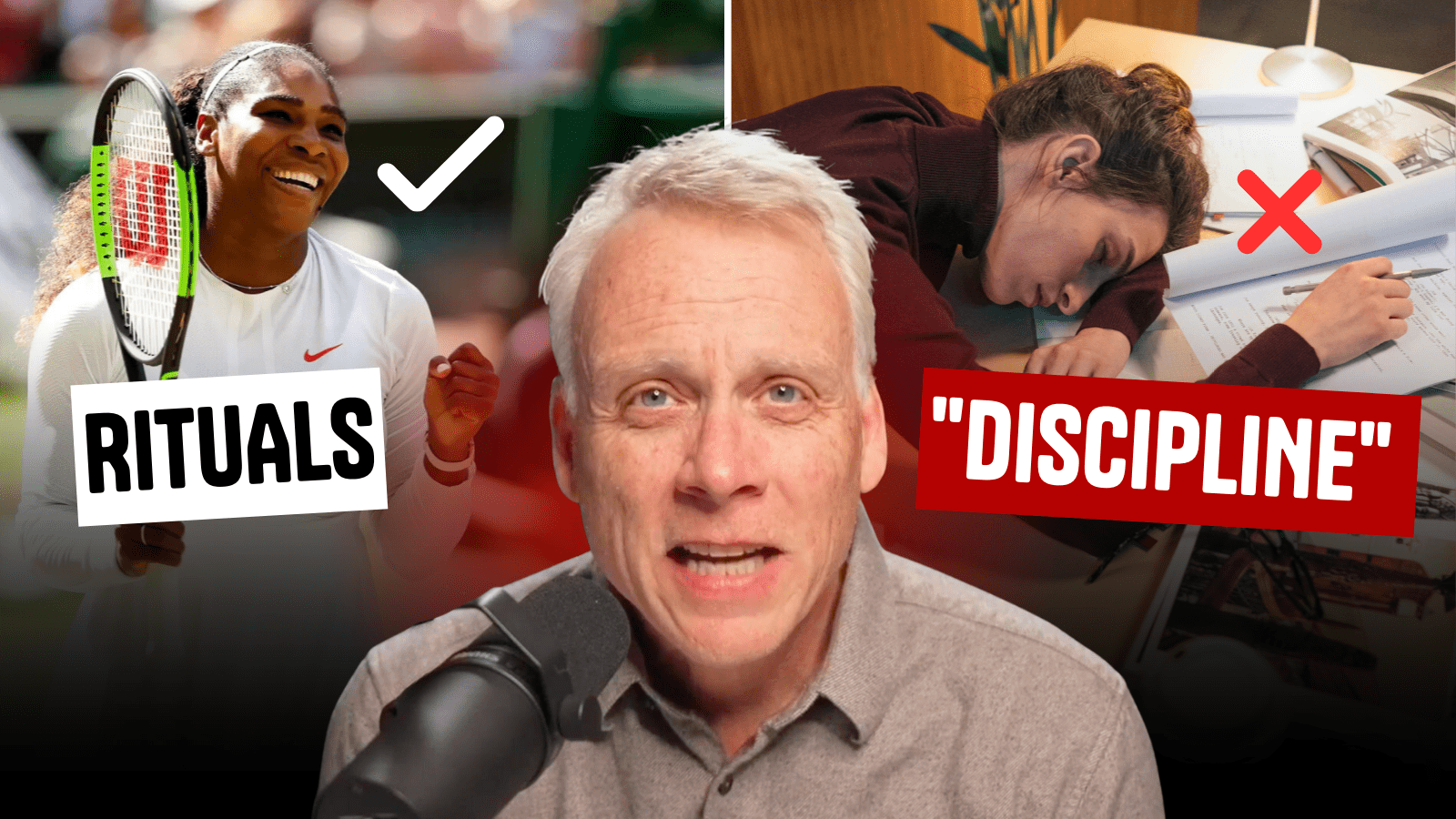
Today, we’re going to explore rituals; specifically, rituals of performance and recovery and how they’re interrelated. So, there was a study done of elite tennis players, and they compared their resting heart rates and active heart rates to other athletes in the same field. And what they noticed is that the world’s best tennis players, between points and those small gaps, serve, ace, there’s a break, it’s usually 15 to 20 seconds, their heart rates would drop 15 to 20%; whereas, less elite performers would still be riding high.
What those elite performers had were rituals of recovery. They would stare at the strings, they would play with them. Imagine your most favorite tennis professional and all the little quirks. Are they playing with their headband? Are they messing with the strings? Are they stepping back and forth and swaying side to side? They tend to do the same thing almost every time between every single point. I think it was Serena that would always bounce the ball five times. So, they have these little rituals, right?
Maybe baseball’s your sport, your favorite batter that steps in the box, and they step out, and they pull one glove on, then the next glove, and then they mess with this and that. They do these little rituals because they actually bring a tiny bit of recovery between elite performances.
And I wanna explore today how we can take some of those ideas from the world of elite athletics and bring them to the world of elite business performance. So, all you business owners out there, you probably are neglecting rituals in your work life that would help you perform at a higher level and let’s dive into that today.
—————-
Jay Papasan:
I’m Jay Papasan and this is The ONE Thing, your weekly guide to the simple steps that lead to extraordinary results.
—————-
Jay Papasan:
This all started because I was reading one of my favorite articles. It’s also an article that Coach Jordan, who’s appeared on this podcast, who’s our head coach in The ONE Thing, he and I, both love this article. And it’s called The Making of a Corporate Athlete. It was published in Harvard Business Review all the way back in January of 2001, a long time ago. But the authors, Tony Schwartz and Jim Loehr – pardon, Jim, if I’ve misread your name – they’re both performance coaches, one is a psychologist, and they did this intense study of elite athletes, compared them to the habits of elite business people, and they started to notice the gaps.
And I like to reread this every few years as a reminder to myself, and like so many of you other business owners out there, we’re always striving, we’re always wanting the best for ourselves and our people, what are maybe the rituals, habits, systems, you name it, that we’re neglecting that would actually increase our performance? Counterintuitively, as I hinted at the very intro, the biggest thing that’s missing for most people are rituals, particularly rituals around the idea of recovery.
How do we kind of rest, so that we can bounce back better and stronger? Doesn’t sound sexy, but what we want is the outcome of doing this. What are the things that we can incorporate into our daily lives that will increase our output and our results? It might also just make us feel a little bit better about our everyday existence.
But before we dive into the rituals that we wanna explore, I wanna just talk a little bit like this forced me to examine, what the heck is a ritual? How does that compare to a habit, a system or routine? And I started cataloging all of mine and I’ll share some of them with you, some of my routines and systems and rituals, especially that I use to maybe make the things in my life more meaningful and better.
And so, first off, think about a graph where you have things that require more intentionality for you to do, and they also have this idea of kind of automaticity, right? How automatic are they in your life? And so, like a habit is something that requires very little intention from you, and it’s very automatic, – that’s the point – you work for the habit and it just happens naturally. That’s behavior. Systems are kind of that way too. You build systems into your workflows because you want things and repeated outcomes to happen kind of automatically. So, there may be automations, there may be checklists, there are things that you can do to get repeatable, predictable results. Those both happen kind of low. You think them through, you work for them, you build them, and then they create these, kind of, predictable outcomes in your life.
Routine is a level up. A routine is a series of things that happen that create a desired outcome, feeling, or benefit. And at the high end of intention, like you really have to be thoughtful, we have rituals. And so, the way I like to look at it is, like, habits are really driven by being automatic. Systems are automatic, but are really driven around outcomes. I want a system for X, right? How do I collect information? How do I write my newsletters? How do I answer the phone at the business? Like you can have systems for everything. We can’t have habits for everything, but science would tell you only about 40% of your daily existence is by intention. You’re thinking it through. Almost everything else is routine and habit. So, we have to be careful about the habits we build. We wanna build them purposefully.
Habits are about automatic. Systems are about outcomes. Routines is about sequence. So, think about your morning routine, your bedtime routine. You have routines around the way, maybe, you approach your work. Those are routines. It’s a sequence of activities you do often around time. Rituals are meaning-driven. That thing is the distinction here. I think of a ritual as something that you do on, kind of, an emotional level to prepare yourself for your maximum performance level.
And that’s something that the authors talked about. They wanted people to get into their ideal performance state, IPS, ideal performance state. You can again, go to some of your favorite athletes. They had rituals for doing this. What does LeBron James do before every NBA game? Can you see the puff of chalk? Right, you can see him hitting his hands together with the chalk. They have rituals that get them into the zone faster, and so do professionals.
So, what are the rituals? They’re done with some intention, but they have more meaning attached to them. They’re not logic-driven. And a lot of times, they’re coming from a feeling, but they’re very, very effective, but they do require us to think about them, which is kind of makes them on the opposite end of the scale from systems and habits, where once you put them in place, they’re kind of like set it and forget it kind of activities. Rituals are on the opposite end and they don’t get as much attention in business.
So, I wanna walk you through what the authors and what I’ve discovered, some of the areas where we would benefit from building meaningful rituals and give you some examples of my own. So, let’s dive in and we’re gonna start kind of at the bottom foundation of the pyramid that these authors created. And that’s around your physical capacity. That would be, in my mind, your health, your mental health, and your physical health. So, let’s dive into that now.
—————–
Jay Papasan:
So, when we think about our health, particularly our physical health, what are the rituals that we can build? Routine systems and habits, if we want to go there, but what are the rituals we can build to maintain peak performance? I’m going to focus on rituals here, because the rituals, just like those tennis players staring at their strings that lowers their heart rate, just like the batter that steps out of the box and ritualistically adjust both of their gloves in a certain order, and then digs their left foot in before they’ll plant their right foot in, they do all of these rituals because the enacting of those rituals gets them into this ideal performance state. And a lot of times, it literally will calm their heart rate. They will lower their heart rate. They will be more focused. They will be incredibly intense.
As Coach Jordan would tell you, if you’ve ever seen Pat Mahomes step onto a football field, he transforms from this guy who might be a friendly teammate into this intense competitor, and it happens in a moment. And there’s all kinds of rituals out there. I think, it’s the Michigan State, they have a sign, and every single player is going to touch that sign on the way out the door. It’s a little bit like Ted Lasso. If you’re not actually a sports fan but you like Ted Lasso, what sign did they have above the door that they would touch? And then, when it got torn up, they had to rebuild it. Believe. They had their rituals that set their mind up for performance.
And so, I would ask you, in your physical realm, we are running, running, running, what are your rituals? Maybe you’ve built a habit or a routine around exercise. A lot of top performers do it in the morning. But what are your rituals?
So, here’s some that I can share. I know some people, we’ve talked about it here before, who use the speedy meeting setting in Google. And what that will do is it will shorten a lot of your meetings automatically and people are like, “Well, what am I going to do with turning a 30-minute meeting into a 25? What is that five minutes for?” It can be a ritual of recovery. It gives you a moment to maybe breathe, right? Do a little box breathing, lower your heart rate. Just think for a second, can I just sit and be still?
Personally, I like to take a walk. I try to do it two to three times a day. I will get up from my desk. I’m focused, I’m intense, I’m going from Zoom meeting to presentation, you name it, and that intensity, I’ve got to have an outlet. And there’s a lot of research that says moving your body for as little as 10 minutes is kind of like a total reset. Your body goes into a different mode, you get a freshness to your brain, and that little reset is like, boom, you’re ready to go back in and perform it at a higher level versus the kind of slow waning focus that you get without it.
So, 10 minutes, I like to walk outdoors. I sometimes will do a walking meeting with my chief of staff, Carly. “Hey, let’s do a walk-and-talk,” right? That’s code. I might need it just because I need to get the heck out of the office. It’s a little bit of relief from the intensity of the business environment, gets me out in nature. It’s a reset code. What are some of the things that you can do during the day that will allow you to reset? These little moments, it can be as little as 30 seconds, a little meditation, a little focused breathing. It could be 10 minutes to take a walk.
I, sometimes, will get up and just like, “You know what? I need to refill my water bottle.” It gives me something physically to do. Take it from my office to the kitchen, refill it, drink some. Like I know people who line up empty bottles, so that they can drink a certain number of glasses of water a day. Guess what? You drink water, it lowers your appetite, you tend to eat healthier, you also process energy better.
So, most of this stuff, we know what to do, but can you build rituals around it? And a ritual would be every 90 minutes, I get up and walk around. You could set an alarm to do that, right? It might become a habit at a certain point. I try to do it at least two to three times a day. There’s a little circle around our office and people often see me walking around it. That’s me getting relief. I need to physically move my body. If it’s too cold or too rainy outside, I can do it in the building. Most of the time in Austin, it’s too hot by the way, but I also bump into people. I get to have a little friendly chit-chat. I might see my friend David or my friend Joy on different sides of the building. We have a little chit-chat, then I can come back.
And I’ve had this moment of release where the intense focus of the business-owner life, doing the things, you are running the show, you know, the buck stops with you, whatever cliche you want, a little bit of motion, a little bit of breathing, maybe eating the right thing can be that reset.
I’ll give you one more example. I had a coworker, he had dealt with anxiety and stress over the years. And I remember he had a ritual that almost every day at lunch, there would be sometimes ways he couldn’t avoid it, he would close his door, he would open up his lunch that he brought from home, he would turn off his computer, and he would read a physical book for 20 minutes while he ate his lunch. That was what he needed to physically reset during the day.
So, rituals around physically resetting. What can you do so that you’re not just striving, striving, striving? Now, if you look at a professional athlete, in the most extreme examples, their season might be seven or eight months, but they usually have three to four months of off season. What do they do in that? They rest and recover, right? Most corporate athletes, business athletes, at best, they might get three to four weeks of vacation. They are not getting recovery time en masse.
And the US has horrible stats. We do not take enough vacation. We do not take enough time off. If you heard my conversation with Jen Davis, giving ourselves permission to pause, that is another placeholder here. How can you build the habit of maybe taking one three-day weekend a month. And if you can do that, maybe you can start doing maybe one longer vacation once a quarter, and at least once a year, escape the work world for a week to two weeks.
Start where you can. It might be that I’m going to take a half day every Friday. My world is so full. Start where you can and start building in these moments of rest, so that you can recharge and recover. Athletes do it. We know this from the weight room. If you work out with weights, and you don’t give yourself time to rest and recover, the muscles will break down instead of get stronger. It’s the same for us. And corporate athletes, business athletes tend to work longer hours in many cases, we train less, and we recover far less than our counterparts in the athletic world.
So, number one, are we taking care of our rituals around physical recovery, so that we can perform at our highest?
Number two, emotional capacity. So, how are we dealing with all the feelings? If you can remember my first conversation with Dr. Robyne, blew my mind. When you feel an intense emotion, the ritual for her is you need to experience it for as little as 30 to 60 seconds. “Oh, I’m so angry right now,” named it. “I’m so frustrated right now.” Sometimes, you can just step and go into the bathroom. “Excuse me, I need to take a quick break, I’ll be right back.” You have a flash of some intense emotion, you need to deal with it, because she would teach us that it will live in your body for as long as seven years. When we don’t process these intense emotions, they stay in our bodies. There’s a great book called The Body Keeps the Score, if you want to go crazy deep into this, but it is a real scientific fact.
So, what are your rituals around dealing with the big emotions that we sometimes feel? It can be a roller coaster business. You have the highs and the lows. You have a big win, you make a big sale, you close a big deal. And you also have the days where someone turns in their resignation, a client fires you, or the market just goes tipsy-turvy on you and everything you thought to be true is now false. That’s life, folks. It’s going to happen.
And as I shared in the opening, it seems like it’s happening more and more frequently. If you’re living a big life, you’re going to deal with big challenges. How we manage our emotional state matters much more than you think. We do not operate well when we’re in these intense emotional states. In fact, we can break ourselves down. You would not let your kids step into the classroom angry. Like you would want them to calm down. You don’t want them in that state because they’re not processing things properly. So, what are some rituals that you can do to transition emotionally from one place to the other?
So, I think it’s about time. I’m just going to interrupt the show right now. I’m going to dive into a story about a friend of mine that worked in a high stakes military position, and he built a ritual into his daily routine that helped him transition. So, I’ll catch you with that story on the other side of this break.
——————-
All right, welcome back folks. So, I have a friend, he worked, I think it was maybe Air Force Intelligence, I cannot remember, but I remember the ritual. I was asking him like, “How does he transition? “You’re a business owner, you’re running this huge team, and then you got to come home, and you’ve got small kids.” Like, “How do you go from the intensity of your day to being calm and present in their presence?” And he said, “My rituals become this. When I come home, I’m in uniform. The first thing I do, I might kiss my wife, but she knows the ritual. I will then walk into my bedroom, and I slowly will take off my uniform. And in the process of shedding my uniform,” that’s a ritual, he’s also shedding his work life. He is moving from his work life to his home state. And in today’s world, where we’re always connected, do you have a ritual?
I worked with another entrepreneur, we were coaching him. He ran an amazing investment business, but he worked at home and he even shared with me, he’s like, “I’m always working. Like I’ll have the laptop up until the food hits the table. I’ll be at the island in the kitchen working on a spreadsheet, and I’m irritating my family.” And the thing that we talked to him about is like, “Can you just place limits?” So, put a lock on your door if you have to, but when a time goes off, six o’clock, you keep your work life in your home office, and it doesn’t leave it. You can’t take your work to the couch, you can’t take your work to the backyard, that’s home life. Create a transition ritual.
And what I followed up with him like six months later, I said, “How’s that working for you?” And he’s like, “It’s been transformative. When I knew that I had to get my work done in my office and I had to end by six o’clock,” he goes, “I was so much more focused. I had, actually, more intensity because I didn’t have the liberty to let it bleed throughout my day. And then, I would close my laptop, I would shut my office door, I would lock it even though it’s kind of ridiculous, but it was a ritual, and then I could be wholly and physically present, internally, emotionally available to my family where I hadn’t been before. So, not only am I not causing strife in my family, I’m also more emotionally present for them, and I’m performing better.”
That was the irony, by creating this ritual of transition, just like my friend in the military did, they were able to emotionally shift from one mode to the next, be more available to their loved ones. And frankly, it also, because it lowered the strife and the anxiety in their whole personal life, increased their business performance.
So, we keep going up. We got physical, we got emotion. The next stop in the pyramid is going to be kind of your mental energy. And I’ve got rituals around this, like how we can turn off our brain. I once shared this with Gary. I said, “Gary, I don’t think you’re a workaholic, but you might be a thinkaholic.” Like we’d gone to see a Spider-Man movie, and he’s walking out with business lessons, and I’m like, “Do you ever turn it off?” And he kind of laughed, but he was like, “I love what I do, so I’m always seeing it in the world. I see it wherever I go.”
Now, it might sound like you, like how do you turn off the work brain? How do we build space into it? And I believe that happens through intention. And so do the authors, like rituals that we can build, whether it be meditation, which would be a very formal way to quiet our minds, or other rituals. I know that Gary, my co-author on the book, if you’re wondering who this Gary guy is and you’re new to the podcast, that would be Gary Keller, co-author of The ONE Thing, he has a ritual that he does around making tea. It’s a mix of black and green tea. And the moment he says that he puts that cup in his hand, his heart rate will drop, his focus will return, and he’s able to bring mental clarity to the moment. He’s built a ritual of making the tea that allows him to enter a different mental state where he has more clarity and he has more presence. So, what can you do to do that?
We’ve built some habits in this company. You’ve heard me talk about it. I love the intention of the morning before you get into social, before you get into text and email, of just looking at your goals, taking a moment and asking the question, based on my goals, what’s my number one today? Goals before phones. And when people do that, they start their day with clarity, not the noise of the world. And that clarity allows them to put up better shields around all the noise, the junk emails, the weird texts that come in sideways, because they know what they’re saying yes to that day, it makes it easier for them to have clarity about what they should say no to as well. So, what would be your rituals?
I’ll give you one more that we use. My wife and I have a ritual around the goal-setting retreat. I know intellectually, because we teach it, that I need to be setting long-term goals that could lead back to my annual goals, that lead to my monthly and my weekly goals. We have a whole process called Goal Setting to the Now. And we teach people, and we’ve done it now for close to 20 years on how to go out with your business partner or your life partner and set goals together.
My wife and I built rituals around that, so that we will do the things that we don’t always want to do, but because it has more meaning to us. So, our rituals around our goal setting is we always leave town if we can, or at least we leave our home because we know it’s kind of a treat. We’re going to get a hotel. We’re going to take a short trip. We’re going to do something like that that’ll be fun, and that fun will be married with the hard process of the goal setting. And we almost always start that process day one with having dinner, recapping our highs and lows for the year, mostly highs, and planning our vacations. Those are the things that we really enjoy. We talk about where we want to go. And then, the bookend, at the very end, is we calendar our vacations, which are the high points that we expect for the next year.
I cannot tell you how many times when we sit down to dinner, what are your favorite memories from this year? It’s usually the travels that we’ve done. And then, when we sit down at the end of the process to plan our next year, we’re also ending on a high. So, those are little rituals that we have bookended our habit, our system for setting goals. Rituals can surround the things that we already do and imbue them with more meaning and more fun or feeling. That’s what they’re designed to do.
So, how can you build rituals that give you mental energy? Like habits around reading are one thing, but what are the rituals that you can do? Just taking a calm moment. Can you build a little space into your life, whether it’d be to meditate, to breathe, and just have a little simple presence.
Lastly, spiritual capacity. So, that’s the language they use in the article, and that’s fine. But I come back to what we talk about here, core values and purpose. When we connect the things that we have to do to a truly meaningful thing, our core values and our purpose, we are so much more likely to go out and do them, right?
The authors, going back to the making of The Corporate Athlete, they were telling a story of an executive that had struggled to quit smoking, and the moment she found out she was pregnant, she quit cold turkey, did not smoke a single cigarette or have any side effects until she had her baby, and then she picked it up again. And then, she got pregnant again, and the same thing happened. And when they were working their way through there, what they realized is that when she was pregnant, her core values was the health of her child. It became very clear for her where the lines were drawn. But the moment her core values were removed from the equation, that line became blurry for her.
So, the challenge becomes is, like, how do we introduce that very clear black line around our boundaries and our values into everyday life? And even though they don’t tell the whole story there, I’d like to believe they found it because, hey, mom, if you’re out there as a reformed smoker myself, like setting a good example for your child is another good reason to quit those bad habits, because they see you and smell you, even if you’re not doing it always in front of them. So, how do we build our core values into our life?
My wife sets all of her goals around her core values. If you looked at her goal sheets, she’s got them categorized around her core values. I have my core values on my phone, so that every time I need a reminder, all I have to do is glance at my phone or conversely, if I’m glancing at my phone because I’m distracted, I’m reminded of my core values. These are little systems and rituals that we can build that will remind us.
Like once a year, sometimes twice, one of my rituals is to revisit my core values. I’ll get out our core values deck, I’ll work through it. And sometimes the order changes. I will define my core values and the meaning can change. That little ritual of revisiting that, that has meaning to me. This is deeply important. I want my life to be about these values. Therefore, I need to check in with them and make sure that they’re still relevant. Am I still making decisions based around that? When I do, am I happy or do I have regrets? Checking in on things that are truly important. If we build rituals around it, they actually will serve us in the future.
So, that ritual to me is connected to our goal-setting retreat and sometimes to my mid-year reset. Both of those are occasions when ritualistically, maybe superstitiously, I’m like, “I wonder if I should check in on my core values.” And about half the time I do, which means at least once a year, I’m revisiting my core values, getting an update and making sure that my compass for my life is still in order. So, purpose, how do you put it around you?
There are so many athletes that you would read about, like what do they do? They put a vision of what they want in their life, they put it on their mirror, they write it on their environment, they put it in places around them, so that they’re constantly surrounded by the things that they most want and why it’s important to them. That is how they achieve at a higher rate than almost anyone else.
So, to recap, I would just ask you and invite you, look at those four foundational things like your physical health, right? You have your emotional health, you have your mental health, and then you have your, call it your spiritual health, I believe your values. Do you have rituals around any or all of them?
Once I started thinking about it, like, I created kind of a long list. I love building rituals and you can build them into your family. If I want rituals of connection with my family, for many years, we had a ritual of Friday night movie night. For the kids, it we had a ritual of Friday night for movie night. For the kids, it was a reward. It was the only time that we could have dinner with a screen on. But it also became a chance for me to introduce them to movies and my favorite things, and also to experience things together. It became a fun ritual for the family.
Some people do that in the form of a game night. You call it what you want, but where can you build rituals into the things that are important to you? Because while they do take a little bit more planning than say a habit but habits are hard to build. Rituals can be established. That’s the beauty of them. They do take more thinking and planning, but they are just as effective. And you can start there, and often what began as a ritual could become a routine, could eventually become a system or a habit.
Just think about that spectrum, the things that take a lot of focus for us to do, but create predictable results. On one end, you have things that having been formed a system or a habit are very automatic. And then, on the other end, you’ve got the things that maybe you have to think about, that you have to plan for and do, but they have meaning, therefore we’re more likely to do them. They also yield this higher performance.
But if you wanted to take a theme of all of this, if I’m wrapping it up, almost every ritual that I’ve talked about, maybe it’s the meaning that’s inherent in rituals, what distinguishes them from a routine. It’s a ritual, right? A family ritual, a personal ritual, a performance ritual. Maybe because they have meaning, they tend to recharge our batteries. They tend to, as a whole, be things that are restorative, which comes back to the beginning. If you want to build rituals of performance, ironically, the thing we need to have more of in our life are rituals of recovery. These little things that we do that refill us when we are putting it out there for our clients, for our teams, for our business, day after day, we have to build in these rituals so that we can make it a great career, not just a great year.
So, I’ll leave you with that, and I’ll give you a challenge for this episode. My challenge for you is not to go read that long article. I do. I like it. It’s a good rush reminder that these rituals can serve us better. But I would also invite you to build a ritual for yourself. So, what is one ritual that you could design to build a little bit more white space in your life, right? A little recovery for your physical self, a little recovery for your mental or emotional energy or something that can introduce ritual and meaning into your life, that spiritual component.
Those are the four big areas that come from the article. We also have the seven circles in the book, but just pick one. What’s one ritual that you can think about adding to your life? I’ve given you some examples. Maybe one of them spoke to you. Think about that thing. What would it take for you to put that on your calendar and just say, “You know what? I’m going to start a new ritual in my family. I’m going to start a new ritual at work. I’m gonna add this ritual to my morning or my evening or my day, because by adding it, right, it is one more thing that I do, but it’ll make everything I do better.”
So, anyway, I hope you’ve enjoyed this exploration. I learned a lot. I didn’t know a firm answer on the differences between systems and habits and routines and rituals. And I do feel like I got a better framework for that today. I hope that you will build some rituals of recovery that are actually rituals of performance in your life based on this episode, and we will see you next week.
—————
Disclaimer:
This podcast is for general informational purposes only. The views, thoughts and opinions of the guest represent those of the guest and not ProduKtive or Keller Williams Realty LLC and their affiliates, and should not be construed as financial, economic, legal, tax, or other advice. This podcast is provided without any warranty or guarantee of its accuracy, completeness, timeliness, or results from using the information.