Jay Papasan:
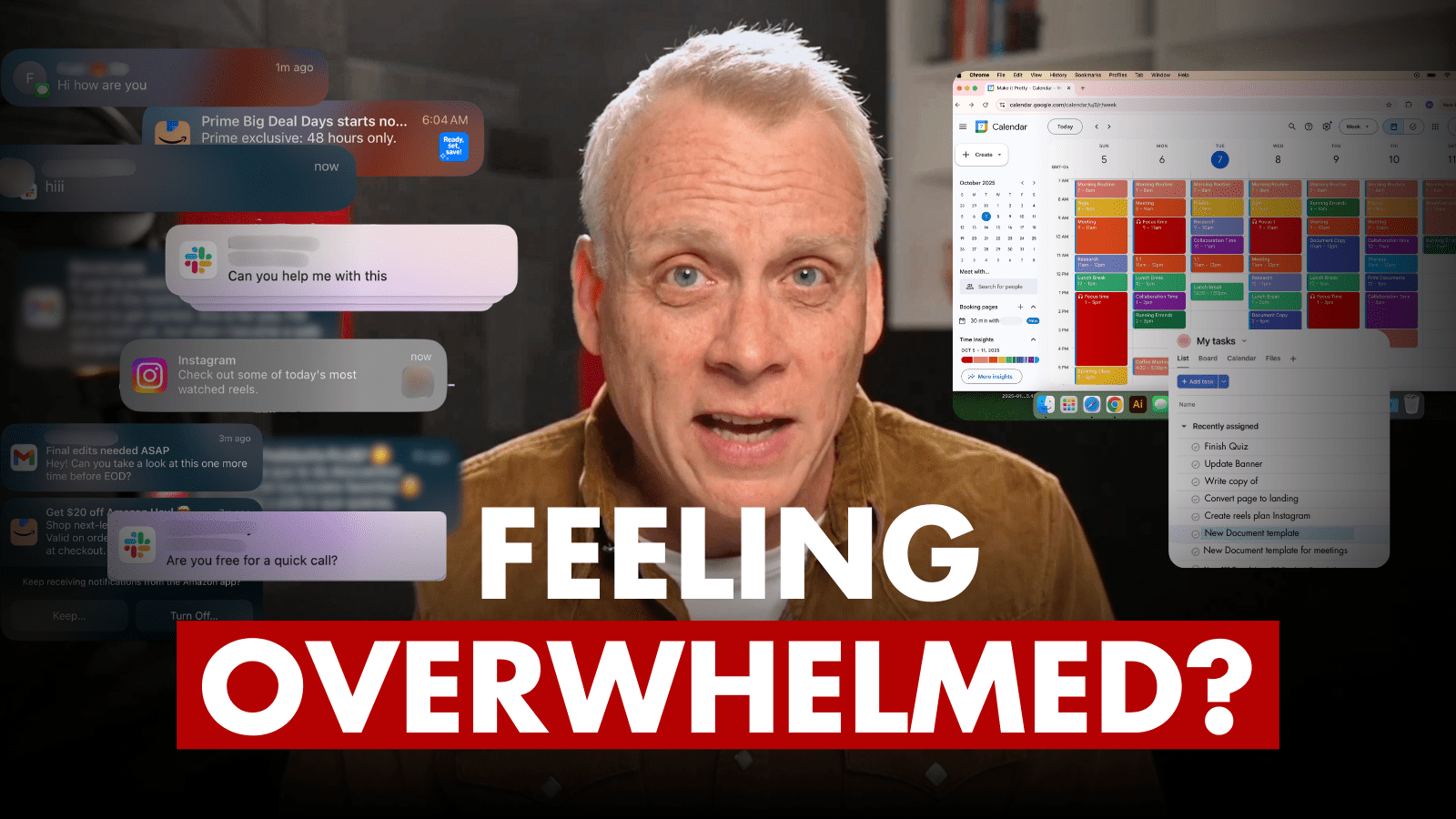
The reason you’re feeling overwhelmed is not what you think. Right now, you probably have about 30 browser tabs open in your brain. You’ve got to email that proposal. You’ve got the kid thing after work. You’ve got that marketing project that you’ve been working on whenever you have a spare minute. You’ve got that design for that really cool carousel you’re going to put on Instagram that you started in Canva, but you haven’t quite found time to go back and really give it the time it needs. You’ve got all of these open loops and they’re just kind of taking up processing power in your brain.
I’ve talked about this before, but it’s a real thing. We tend to focus on this idea that we have a capacity problem. I’m not good enough. I should be able to do more. You don’t have a capacity problem. Most likely, what you have is a workload problem. You’re putting too much on your plate every single day. And I get it, business owners, it happens to us all the time.
So, in this episode, we’re going to explore a little bit about how this happens, how we get into this overwhelm, and how we get out of it, the science behind it, and some good strategies and some good stories about people that have narrowed their focus and escaped this sense of endless overwhelm. So, remember, it’s not a capacity issue. It’s your workload. It’s your approach to what you’re agreeing to do and how you’re doing it. That is the way out of overwhelm.
———
Jay Papasan:
I’m Jay Papasan, and this is The ONE Thing, your weekly guide to the simple steps that lead to extraordinary results.
———
Jay Papasan:
In our training and our coaching, pretty much every business owner at one point or another has talked to me a little bit about this feeling of overwhelm. They always have too many projects than they have time to do, and they always feel like they’re behind and letting people down. And it’s kind of a chronic problem. And this almost always signals that they don’t have a capacity issue, they have a clarity issue. Are they picking the right things to do and the order in which to do them? And this is about your approach to your work.
Now, I’m just gonna acknowledge, as a fellow business owner, like if you don’t have an EA, if you don’t have a salesperson, if you don’t have a marketing person, if you don’t have a web designer, if you don’t have fill in the blank, you are one, until you’ve earned the right to hire one. So, we tend to have to wear a lot of hats every single day.
So, it’s not like this idea of all of these things coming at us all at once is just a product of our own poor judgment. It’s about the nature of the work. Leadership, business ownership, they come with lots and lots of facets. It can be very stressful, and it can be very, very hard work, but there are approaches that help us break out of it.
And I go back to this idea, it’s not about your capacity, it’s about your clarity. When you lack clarity, you tend to set really poor boundaries. You haven’t established clearly in your brain what your one thing is, what your focus should be. Maybe not for, like, all of eternity, your life, but I’m talking about what is your one thing today? What is your one thing this week, this month, this quarter? It’s about that level of clarity.
And when you have poor boundaries, you start to say yes to a lot of stuff. And when you say yes to a lot of stuff, guess what happens? Your time disappears. All of your time is already allocated to tasks and you have more that are piling up all around you. It’s kind of like your work has become a giant inbox where every time you feel like you get to inbox zero, there’s 70 more that come pouring in overnight. That’s the nature of a lot of our work, but we have to adopt a different approach.
So, we lack clarity, we get poor boundaries. Poor boundaries, when we say yes to too much. When we say yes to too much, we have too little time to do anything. And that’s where we end up in this state of stressed anxiety and overwhelm. I’ve been there. I’ve been in seasons where I literally felt like I had to do everything in the business. And frankly, I’ve been in and out of it over the last couple of years when I’ve stepped back into the CEO role of this company. And I’ve got to write a newsletter every week. I’ve got to do a podcast every week. I’ve got to lead the team. I’ve got to check the box again and again. I’ve got that new hire I’m looking for. I feel that. But your approach to the work can allow you to tackle the nature of leadership and business ownership in a sustainable way.
So, if any of this sounds like you, this state of coming in and out of overwhelm and overload, then I really think that the rest of this episode is going to help us unpack some strategies to hopefully get you past that and into a better place.
———
Jay Papasan:
So, let’s talk a little bit about the science of what’s going on. And I’ve mentioned these, but they bear repeating. So, there’s a couple of psychological, kind of, biases that we have, and they create two things that kind of come together as the perfect storm.
So, I’m going to start first with what’s called – and I may not be getting this right – the Zygorek effect. And so there was a fellow, a psychologist named Bluma Zygorek, and he discovered that we tend to remember unfinished tasks about twice as well as things that are finished. So, when we finish things, our brain goes, “Whoop, I get to close that tab.” When it’s unfinished, that tab in our brain stays open, and it takes up some of our capacity, holding it up there, waiting for it to be done.
So, this is something that you just can’t change in yourself, right? It’s our nature that unfinished work occupies a lot more of our brain space than we would like it to. So, our strategy here is gonna have to be around, how do we redefine what’s finished and what’s not finished, or how do we actually close more of those loops, so those tabs can be closed and we can free up that space.
So, I look up and I have a problem on Chrome, right? I look up and I have my Chrome and I’ve got like 30 tabs, right? I’m a writer, I see something interesting, I click, I open it and I say, I will read that later. And I tend to accumulate tabs. And maybe you’ve experienced this. You’re launching your Zoom, and you’re like, “Oh, I need to take notes in Google Docs.” So, you open up your Chrome browser, and everybody looks great on your Zoom until you do that. And then, all of a sudden, all of those tabs are trying to load at once. Guess what happens? It crashes. Everything freezes. Your audio stops, your video stops.
That’s actually what’s happening in our brain. A lot of times, every morning, or sometimes worse at 2 a.m. at night, when we think of all the things that we have to do, they all come crashing down, and that’s not a fun feeling. So, this ability, which is maybe a superpower, but it sure doesn’t feel like it sometimes, is that we’re twice as likely to remember the work that is yet unfinished.
So, I want to talk a little bit about what this does to us. If you remember the story we shared in The ONE Thing, Baba Shiv did a study. He asked students to memorize a seven-digit number or a two-digit number. They had to walk down a hallway and regurgitate the number. Now, there’s a 100% success rate. We all know that we can memorize. You have as long as you want to memorize either a phone number or two digits. So, it wasn’t really about our memory capacity. The experiment was about what happened between the time they memorized it, walked down the hall to repeat it to the other researcher. They had a little desk set up and on it said, “Thank you for participating in our study. Please select one of these two free treats.” And they had a chocolate cake, not good for you. And they had a fruit selection, good for you.
And what he realized is if you memorize seven digits instead of two, just five more numbers in your brain for about 15 minutes, this is not a lot of capacity, you were more than twice as likely to choose the unhealthy snack. And it kind of shows that when we’re trying to take up, we’re letting our brains occupy with these things that aren’t finished, that capacity can impact our decisions. And the impact of poor decisions on what we choose to do and how we choose to pursue our work can create a bit of a vicious cycle.
And here’s kind of the hammer blow at the end of this. You look up and you know that our brains are designed to remember unfinished tasks. And those unfinished tasks are actually taking up some of our limited ability to think and process and reason, and therefore, sometimes undermining our very decision-making power.
The other thing that’s kind of complicating matters is there was a guy, and I have to look at my notes here, named Leidy Klotz, and he discovered something that he called the additive bias. And it’s a cognitive bias that when we’re faced with a problem, our default answer is to add steps, to do more. And he did this again and again, and he published it. That’s where I looked at it in Nature Magazine, is that he realized that we have this absolute bias when faced with a problem, instead of looking for what we can subtract to make the situation better, we start to do more.
So, here we are, we’re faced with this giant problem, and we know we have a problem, but instead of subtracting, our instinct is to heap on more. And that creates this kind of vicious cycle where we have open loops, and then we add more open loops, and then we add more open loops, and then we end up laying on the floor at 2 a.m. going, how the heck am I going to get through this?
But that’s a little bit of the science, right? These two things play in our brains all the time, and if we don’t approach our work, the things that we know just aren’t gonna go away. Our email, our messaging, the tasks that come, and the duties that come with business ownership and leadership, you don’t get to have long seasons where it’s easy, folks. That’s not the nature of it. And most of the people I talk to who love that journey are in it for the challenge and the opportunity to grow. What we have to do is approach our work a little bit differently.
To sum it up, here’s the science, folks. There are two things happening in your brain. One, we’re twice as likely to remember unfinished tasks. So things that we haven’t finished, these tasks that we start but don’t finish, they occupy more and more of our brain space.
The other one is called the additive bias, is that when we’re faced with a problem, our instinct is not to subtract from the equation to reduce the things that we’re doing. Our instinct is always going to be to add more steps. And those two add up to kind of a vicious cycle. Unfinished loops that we’re adding new unfinished loops to until we get into this place that can feel very out of control.
Now, what does The ONE Thing have to say about this? If you remember, we talked about this right in the beginning. Extraordinary success is sequential, not simultaneous. Extraordinary success is sequential, not simultaneous. What does that mean? What it means is if you’ve got 10 things to do, if we’re trying to multiple task, if we’re trying to knock them all down at once, essentially we’re dividing our effort, our energy and our time among 10 things.
Imagine, if you had to do 10 things in an hour, if you evenly distributed your time, now you’re looking at six minutes per task. Can you really knock those out that fast? Are you really going to get through that sequence? Are you going to close those loops or are you effectively going to give 10% effort to each of them and therefore increase the likelihood that they’re not going to close those tabs.
So, we need to think about sequential. What’s the order in which we do them? And the tools that we use for that is Pareto’s principle. When we look at our day, when we look at the task ahead of us, we have to identify using The ONE Thing, what is that first domino? What is the first domino that if we start lining them up, they start building momentum in our lives. So, by doing 100% of our effort to not go over the first, it leans into the second, creates a little extra leverage for us, and then we attack that one.
It is a really strange thing. We do it all the time in our live training. We’ll do like a multitasking exercise where we ask people to do 10 letters of the alphabet and 10 numbers, right? So, really quickly, if you just wanted to take the test yourself, you’d have to time yourself, you would go, the first 10 letters of the alphabet and then 1 through 10. And what you’re gonna do is do the alphabet first and then the numbers. And you can run through that really quickly. A, B, C, D, E, F, G, H, I, J, right? Boom, boom, boom, boom, boom. You knock those out and then one through 10.
Well, the second time you time it, you have to go A, one, B, two, C, three. You have to alternate, that’s multitasking. And when you start dividing your efforts, in general, whenever we run this test, no matter how fast someone thinks they are, it usually takes about twice as long when we’re alternating between our work. So, when we divide our efforts, we divide our focus, we feel like we’re doing more things at once. We’re actually just slowing everything down, right?
Multitasking, dividing our efforts, it’s just an opportunity to screw up more than one thing at a time. It’s not a great way to get stuff done. So, we wanna go in sequence. That’s how we go from linear progression to geometric. That’s how those dominoes get bigger and bigger and we build momentum. It’s a big theme of The ONE Thing. The sequence of our work, where we start, what we focus on first, when we have our willpower, when we have our energy early in the day, when people aren’t calling us and texting us to disturb us, where we start matters a lot. And that selection process is a little bit of art. It takes practice. It’s a muscle that we get to use again and again to figure it out.
So, the discipline that we need is not to increase our capacity, to be able to carry more at one time, the discipline we need is around selection. What is the task? What is the chore? What is the work that we’re choosing to do first this day, this week, this month, this quarter? And can we give it all of our energy for a period of time before we distract ourselves to go to the next thing?
This is one of the reasons when we’re working with our clients and in our coaching, like you have lots of meetings and most of them don’t require as much time as you’re giving them. We tell people to move to speedy meeting setting on Google. That hour-long meeting will become a shorter meeting of 50 minutes, those 30 minutes meetings become 25. They give us a little bit of processing time between our meetings and frankly, there’s never been an hour-long meeting that couldn’t be done in a shorter amount of time. That’s just how it works. If we prioritize and actually do the work that we’re supposed to do, instead of talking about our weekend, we would get in and out faster.
So, in general, we want to not give most of the things that we have to do too much time, right? Because work will increase to fill the size of the time we give it. It’s just a law that’s out there in the universe.
Another thing that we wanna think about though is for our one thing, we wanna do just the opposite. When you identify that place that you wanna start, you wanna give it about 50% more time. This is another science little thing that we know is that we tend to overestimate how fast we will get work done, right? And we overestimate it by quite a lot. So, in general, when we say, “Oh, it’ll take us an hour to do that,” we generally on average need about 50% more time.
So, for our first domino, for that first priority of the day, of the week, of the month, we need to actually allocate more time to it. Why? Because I don’t want to go into that hour optimistically thinking I was going to get that carousel done, that marketing proposal done, whatever that is, that task, that most important task done, and then get halfway through it, and then have to find new time to go back to it. And when you go back, you’re starting over. Where was I? Where did I leave off? You’ve lost all of your momentum.
So, I would rather allocate about 50% more time to my number one priority for the day, so that best case, I’m gonna knock it out early and I get some time back to transition to whatever my number two priority is, or worst case, I will use all of that time, but get it done. I’m gonna close that loop by allocating our time around our true priorities a little bit better, the big things that could be occupying our mind because we didn’t finish, we’re gonna get done more frequently.
So, we don’t wanna think about overwhelm as having too much on your plate, right? It’s not about this idea that you’re trying to do too much, it’s you’re trying to do them in the wrong order. And a lot of times, a lot of them won’t ever have to be done. If you prioritize correctly and start with the right thing, you’ll look up and go, “You know, that doesn’t matter.” That was performative work. That was stuff that actually doesn’t get there.
So, with that in mind, let’s go through some real-world examples. I’ll give you some examples from really, really big corporations, like Fortune 500 kind of companies. And then, we’ll also look at some small sole proprietorships, businesses that are small or growing. How does this principle of applying and approaching our work differently show up? And what are the results that you get?
But first, let’s take a quick break, and I will see you on the other side.
————-
Jay Papasan:
Welcome back. So let’s talk about some real-world examples of how this can play out when we approach our work differently. So let’s go through some of the famous stories, and you’ve probably heard these. We got an In-N-Out burger a few years back here in Austin, Texas. My kids were super excited. And so, you know, every couple of weeks, the boys say, “Can we get some In-N-Out burgers?” Yes, animal style every single time for me. Thank you very much.
But if you look at the menu, Harry Snyder, right? When he opened the first one, this is like 80 years in going, he had a very simple principle. They were going to do a few things well, and they were going to make fresh ingredients and they were going to do those things really well. The menu has not really changed in 80 years, folks. They have focused on doing those things well, and that has led to an enormous part of their success, right? You’re not going to go there and ask for a noodle bowl. You’re not going to go there and ask for like, they have shakes, but they don’t have other desserts. It’s a pretty narrow range of stuff that you expect in a burger hut. And they do that really, really well.
Another example of Southwest Airlines. I remember the first time I heard this. When they were looking up and they were really, really struggling, one of the things they did is they sold one plane and then they kept two that were identical. They made a decision that they were only going to fly one model of airplane. Now, what does this do? Well, it simplifies maintenance. Everybody that works on those planes knows where everything is because it’s the same at every single plane. Everything got streamlined. You don’t need to have five different sizes of carts because the carts all fit in the same airplane the same way. Everything became more repeatable and easier to do. T
hey streamlined by choosing one plane that allowed for easier maintenance. They could store fewer spare parts, they could turn things around faster. Everything got better by that simple narrowing, subtraction, instead of always buying the best new plane that became available when they needed a new one, they focused on a fleet that was identical. And right now they’re just moving to the new ones and bravo to them, because I like them a lot better than the old ones, but I respect the business model.
The last one, I’m trying to think, is it Raising Cane’s? Same thing. I saw just recently, they were talking about, they call it One Love. They do chicken. Someone was saying, “Why don’t you do these desserts?” And it’s like, “No, we do chicken. That’s our one thing.” They even have it on their website because that’s their thing, their one love. And that’s one of the biggest chains out there, folks.
So, these are big companies that through subtraction have grown huge. Subtraction was the key to getting them to go forward.
Now, let me give you a couple of examples on the other end of the spectrum. So, there’s a young lady named Deya, and she is out of Berlin, and she runs a creator business on YouTube. And I found her because she did a book review on The ONE Thing, and it was absolutely exceptional. I was like, “Man, this lady is awesome. She’s teaching this book better than my team does.” And I sent her a compliment and we got to know each other.
And if you follow her story, she discovered the book and she started making changes. She was trying to figure out how can she get more video content out across all of these platforms, and she just made the decision, we’re gonna go all in on YouTube, right? And she focused on YouTube for a period of time, and it led to a number of things.
Well, first off, it started networking opportunities. People started noticing that she was getting really good on this platform and reaching out to her. It started opening up doors. She focused, she got better at that one thing, and it started to show up and people started to recognize it. “Hey, Daya, you’re pretty good at that. Let’s hang out. Let’s connect.” Well, that led to brand sponsorships, which ended up adding more revenue to her pipeline. That created community and connections. And you start to see this momentum building around her doing this one thing.
Eventually, she got press and even got a book deal, right? All by focusing on one channel instead of many. And you look up and she shared this very publicly. Her results in a very short period of time, she went from making a hundred grand to 200 grand. She went from selling a thousand things, products to 2000. She literally doubled her business, not by doing more, but by subtracting, right? She focused on doing the one thing.
Now, there’s a podcast that you’ll be hearing in a few weeks by my friend, Courtney Johnson. Her story is very similar. If you are a millennial or a Gen Z and you’re looking for a job, you’ve probably found her videos and her stuff on LinkedIn. She was helping ghostwrite as a part of a part-time job, LinkedIn content for top executives. And then one day she realized, “Dude, I could do this for myself. Why am I getting paid by the hour when I could just do this to promote myself?”
Well, she went all in on LinkedIn. She read the book. She said, “I have to narrow my focus. I can’t chase all of these cats all around. I’m going to narrow my focus. I’m going to focus on LinkedIn and really build my reputation there.” Same thing happened. Her audience started to grow exponentially. Her results started to grow exponentially. She also got a book deal, which will be coming out later this year, and then she used the book principles to create space to actually write the book that was the product of her one thing work.
So, when you focus and subtract all of the noise, you have to ask the question, what matters and what doesn’t matter? How do we do that? We use the focusing question. And it doesn’t feel like everybody’s like, “Well, I won’t know the answer. How could I possibly know?” In my experience, 99% of the time, you could narrow it down to one or two things day one. Your instincts will say, “I know it’s got to be one of these two,” and trial and error could get you there in a few weeks. But in my experience, most people, they know what their one thing is and they walk around with a fair amount of guilt for not giving it more time, effort, and focus. What they haven’t given themselves permission to do is just to abandon or just leave the rest on idle, so they could really give their first energy, their first time, and their first focus to the thing they should truly be focused on.
So you can see the spectrum. Massive multinational corporations focused on a narrow range of results to get huge, huge outcomes in their business. Same things happens in small business, both Deya and Courtney subtracted to identify what mattered, focused on that. And then, the results went from linear to exponential. That’s what can happen for you.
Next, I’m gonna walk you through just a couple of core principles on how to make this practical.
————-
Jay Papasan:
All right, so how do you do this? You’ve read the book, you’re listening to this podcast, but you haven’t yet jumped into our training or coaching and be like, “I wanna know, Jay, just tell me how to do it. You’ve been teasing me this whole episode.” I’ll give you three simple steps. It’s not the whole thing, but this is definitely get you on the path.
The first thing is what we call download. If you’ve attended our First Domino, it’s often the first step we do to make sure that people are gonna recapture up to 10 hours per week. That’s about the average when they do this exercise. But we start with download. What are all the open loops right now? What are all the things that you are responsible for in a given week in your work?
And it’s not just at work, it’s also at home. Right, yes, at work, I’m responsible for sales, I’m responsible for marketing, I’m responsible for X, Y, Z. Great, you’ve got your job description on one side. And then, you’ve got your life, right? I have to go shopping. I have to do meal prep. I have to drop the kids off or pick them up. I have to go to soccer practice with them. Blah, blah, blah, blah, blah. I’ve got older parents. I have to check in on them. You’ve got a long list on both sides of the ledger, folks. Get it all down.
Now, we’re gonna go what we called and wrote about in the book, Extreme Pareto. Of all of the things that you could do, what is the thing, the number one thing that you know you must do? If you look at that list in this season of your life, what is the true priority? Most people can go through there, they can put stars by the things that are not just tasks, they’re not just things that have to be checked off because we’re living human beings that have to happen. There are things that will happen and we have to make happen, but they’re not the real priority, right? We have to pay the bills, we have to feed the dog, but do they really need to occupy so much of our brain space? No, they don’t. What is the real priority that’s hiding in this giant tumbled up haystack, right? How do we look at it and find it?
Extreme Pareto, of all the things that I could do, what’s the one thing that I can do that makes everything easier or unnecessary? In my experience, most people will readily say, that’s my number one. And then you can quickly prioritize. And by the time you ask that question, if you look and say, what is the true 20%? The 20% that makes 80% of my results happen, right? I’ve got to do these things in my personal life, in my professional life, most people end up with a list of three to seven things, on average about five. And they go from 25 to 30 to this very narrow list.
Now, all of those things can go onto your calendar, you can give them a little extra time, so that you don’t create more open loops, and you can knock out the truly important stuff. And here’s the thing. If you are focused on the thing that matters most each day, and you are making real, meaningful progress, or better yet, knocking it out, no matter how many unfinished tasks you have at the end of the day, you will go to sleep knowing it was a good day.
It is tremendous psychological relief because you’ve done this clarity exercise, you’ve gotten clear about the things that actually matter that are being hidden by all of this loud, urgent stuff that doesn’t actually matter. You won’t remember it a year from now. The things that truly matter are hiding there. We get clear about what they are. We put them on our calendar. We knock them out. And here’s kind of the final technique. I talked to you about this. You can increase the time you give those limited few things that matter more. That is one way to not create more open loops.
The other thing is that you can redefine what closed means. Now I’ll tell you what I mean, because I’ve done this with a couple of my clients and we’ve seen it and it’s really impactful. A lot of people will say, “Hey, I’ve got to create a brand new personal brand.” And that is like a multi-week project with a consultant, blah, blah, blah, blah, blah. We have to break it in to different segments that can be completed. So, we break down the work into milestones that can be completed as we go.
So, maybe we had to go three or four times this week to work on it, but by the end of the week, we can close that loop saying, “Great, I’ve got my personal brand foundation. I kind of know what I wanna be known for. Next week, I’ll try to work on an implementation plan and prioritize where it needs to show up in the world. Does it need to show up in my personal website, my professional bio? Does it show up in my social? That’s for next week. I’ve completed job one.” We have to redefine what finished means.
Now, I write books, like I don’t get to complete some of these things for years. And my family will tell you it occupies a lot of mind space. I talk about these books that I’m writing all the time, and it can be charming or annoying depending on who you are, right? But one of the ways that you have to play with these longer games, these multi-year projects or multi-month projects, is sometimes you just have to say, “If I can put good work in for this amount of time, that gets a checkbox. That gets an X on my 66-day challenge calendar, where I’m trying to build a habit of doing this one thing. That is how I earn completion, by showing up to do the work for a set amount of time and being pretty much focused while I’m there.”
And I’m actually working with someone, and they’re, instead of judging how many words they wrote or how many pages they output they got, they’re trying to look for this really hard metric that says success. They’ve changed it to just a focused amount of time, and they start to trust the process. If they keep showing up and giving that thing an hour or 90 minutes, they will actually, by doing that, and consistently doing it, they will get there faster than people who approach it differently.
If you remember Gary’s phrase, and I love it, consistency is intensity. Instead of trying to do it all in one day, which will probably do it poorly, it still end up with a million unclosed loops, how do we break it down and redefine what finished means?
So, again, let’s recap that. You’re going to download all of your open loops. What are all the things in your personal and your professional life that you know that you’re going to be responsible for?
You’re, two, going to prioritize. We call that exercise Extreme Pareto. It’s in the book. You line them up and you identify of all of this junk, what actually matters, and now I have to put them in order of priority. If I could only do one thing this week, what would it be? If I could get two, what would be my second thing? If I could get to three, what would be my third priority? You go from 30 or 40 things that you know need to get done to the handful that must be done and done well, and by focusing on them first, you complete the loops that matter.
And the last little hack is, can we redefine what finished means to our brain by either allocating time or milestones so that we can close those loops as we go, free up our brain space, and make better decisions. It becomes a virtuous cycle when we approach it this way.
————-
Jay Papasan:
Okay, we’ve come to the end of the episode where we get to do a challenge. I’m going to do a different challenge this week. The thing I’m going to do is I’m just going to give you permission. I’m going to give you permission to leave a lot of things undone and maybe unattended that in the past you felt compelled to constantly be checking off. You’ve harried yourself by chasing all of the meaningless work, the 80% stuff. Some of it has to get done. Those emails do have to get answered eventually, but they don’t deserve your first attention and your first energy. What I’m giving you permission to do is prioritize. I want you to identify the things that matter most so that you can give them your first energy and your first focus.
Now, we’ve all been there. I’ve talked about it. As business owners, it’s never ending, right? As leaders, it can feel like overnight, even if you got to quote, inbox zero, you closed all of the tabs, a whole new suite of new things to do will show up. That’s the nature of some work. I get it. But what we learn to do is build the muscle of approaching our work differently. I want you to stop trying to play these games that you’ve played again and again. You’ve tried all of these time management systems, these productivity systems, and you end up feeling like, “Man, maybe I’m just not good at productivity. Maybe I’m not good at time management because they never seem to work.” They don’t work because they’re not actually subtracting. They’re not helping you prioritize. They are time management systems. They are productivity systems in the traditional sense. What they’re trying to do is make you more efficient at doing too many things, right?
I’m gonna teach you how to do email faster versus not even looking at email when it doesn’t matter. Right? I’m gonna teach you to speed read instead of reading something that matters. I think that instead of focusing on efficiency, doing things faster so we can do more, which is actually a great recipe for overwhelm, we’re gonna go the opposite direction. Efficiency can come later, and it often does as we refine our work, but the first thing we’re gonna do is what Peter Drucker told us. We wanna be effective. We wanna be effective before we’re efficient. Being efficient at meaningless tasks is the worst use of our time ever. We wanna first start by doing the tasks that make us effective, that make us productive, by working on the true priorities.
And we have a system for doing it. Those things that you’ve tried again and again and again, and you keep trying, remember, most of them are aiming you at the wrong target. They are trying to get you to be able to do more in the time you have versus figuring out what you actually need to do. That’s one of the reasons we created The ONE Thing OS. And if you go to the1thing.com/OS, you can check it out. It is a suite of courses taught by yours truly, walking you through the methodology to build your foundation of where you’re going.
I use that and your core values to identify the things that truly matter on the grand scheme, so that on a week-to-week basis, you have an amazing compass for deciding what it is that matters, what it doesn’t matter, and you start to build process around being effective versus this endless efficiency loop that leaves you harried, tired, and exhausted. I want to give you permission to step out of that game and start playing a new game. I want you to stop worrying about your capacity and start focusing on clarity.
That’s what we deliver with the OS. That’s ultimately what I believe The ONE Thing’s all about. Like I said last week, this is a purpose book, not a productivity book. We get clear about what matters and what matters drives our priorities and our actions. When we do that, we live a life of no regrets, folks. And guess what? We also get to escape this endless cycle of overwhelm.
That is my challenge for you. Check it out. I give you permission to stop doing the meaningless stuff and identify, first thing, the things that matter most. I hope you’ve enjoyed this episode. I know I have. We will see you next week. or other advice.
————
Disclaimer:
This podcast is for general informational purposes only. The views, thoughts and opinions of the guests represent those of the guests and not ProduKtive or Keller WIlliams Realty LLC and their affiliates and should not be construed as financial, economic, legal, tax or other advice. This provided without any warranty or guarantee of its accuracy, completeness, timeliness, or results from using the information.