Jay Papasan:
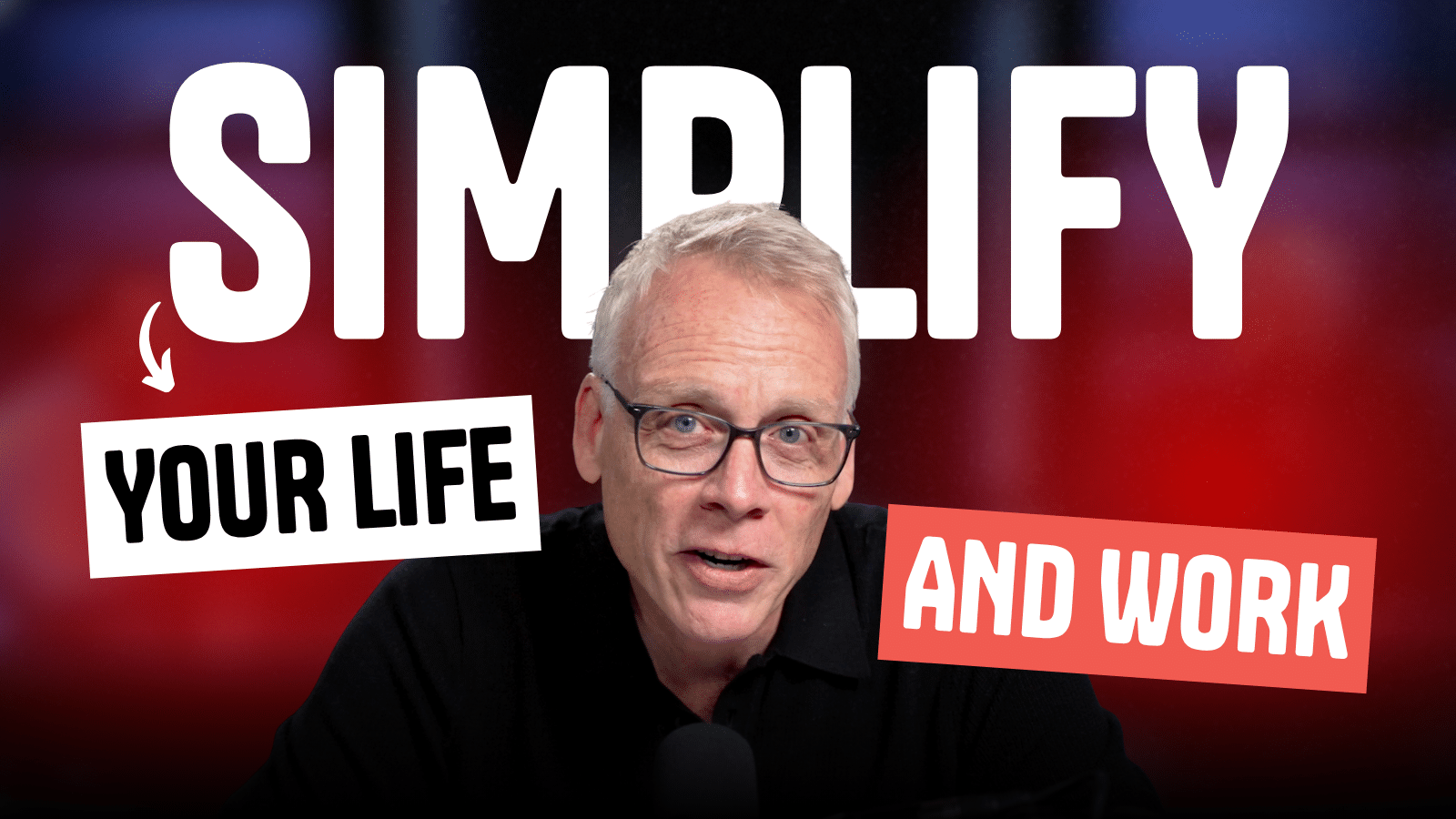
As you may have heard, on August 1st of this year, I left Keller Williams after almost 26 years. And people keep asking me, “What’s it like since you left?” Well, for starters, I’ve barely worn long pants in over a month. I’ve taken quite a few naps. But the truth is, I’m still in that season of addition by subtraction. I’m not quite sure yet what this new world’s gonna be like. Maybe ask me again in six months.
What I can share today is how I’m thinking about recentering my life, how I’m thinking about simplifying my life, and give you a few tips if you happen to also be in a season where you’ve been carrying too many things from a season in the past. And also, please hang around to the end. I’m doing a little subtracting right here at The ONE Thing, and you might want to stick around and hear all the details
—————————–
Jay Papasan:
I’m Jay Papasan. And this is The ONE Thing, your weekly guide to the simple steps that lead to extraordinary results.
—————————–
Jay Papasan:
So, let’s turn back the dial back to the year 2000. That’s when I started right here at Keller Williams on September 2nd, the day after Labor Day. And it’s crazy to think about all the changes that have happened since then. When I joined Keller Williams, there were just 27 employees. We were in a small building off Bee Cave Road. And at that time, there were only about 6,700 agents, and I think we were only in 14 states and one part of Canada. So, it was a really small company that most people hadn’t even heard of. But over the years, I got to experience all the changes that came both in the world and right here in this company.
So, think about the year 2000 if you’re old enough to remember. There were no smartphones. Social media wasn’t a thing unless you were on MySpace. We didn’t have video calls. I think Skype hadn’t even happened yet, and there was no streaming media. We still got our DVDs by mail from Netflix. It was a completely different world at work and at home.
If you wanted to navigate, we have lots of real estate agents here, you probably remember this, you go to MapQuest, you plot out your course, and then you’d print the pages and set them in the passenger seat. That’s how we got around. There was no general use of GPS. The world was very different, and so was this company.
So, over the years, I probably had about five careers. I was mostly working on the book side. We wrote 11 or 12 books, a lot of them bestsellers. And of course, The ONE Thing that’s become a big part of this podcast. I also ran education three separate times. I had a stint in marketing, research, you name it. Lots of careers over more than 25 years.
But the best part was growing. If you wanted to stick around in this crazy, fast, chaotic company, you had to be committed to personal growth. People often ask me, “What was the biggest gift you got from Keller Williams?” And I can tell you that definitively. This is the place that taught me to think bigger than I was willing to think for myself and encouraged me to grow every single week, day, and month that I was here because there was just no other way to stick around. We were growing so fast.
For one period, I remember doing the numbers because I worked with Dave Jenks and Gary. Before I was doing the vision speech, I was helping them prepare for it. That was our big speech on the State of the Union every year. We grew by forty percent year over year for something like seven or eight years in a row. At some point, you just think you cannot sustain this level of growth. At our apex, and I can’t tell you the exact number, so don’t hold me to it, but I remember we were at about a 185,000 agents, and I think we’re in over 60 countries today. It’s an incredibly different company, but it all started at that little place, that little shop off Bee Cave Road back in the year 2000. That’s when I joined this team.
So, that’s been my journey here. And so, when you ask me, “What’s it been like since you left?” just do some quick math with me. I’ve been at KW for over 13,051 weeks. That’s a lot of work weeks in there. That’s over 311 months. That’s just crazy to think about. So, just under 26 years to the day is when I left. Man, that’s a long time to live in a world that was chaotic, a little bit stressful at times, but so full of growth and learning, which is the reason so many of us chose to stick around. Lots of growth, lots of development, and some amazing people that I got to work with.
I’ve only had roughly, recording this today, about 40 days on the other side, so it’s still very much an adjustment in process. So, over those 40 days, I’ve still been running ProduKtive, this company behind The ONE Thing. I’ve been working with Wendy and spending more time with family, but I’ve been busy. It’s not like I’ve been taking naps and just running around. I still had other work to do.
So, that was the realization. I remember at one point realizing, “Dadgum it, I don’t think I’ve worn long pants but three times in the whole month of August.” To give you perspective, when we started at Keller Williams, Mo Anderson was our former vice chairman and CEO, things were a little different back then. There was no remote work. Everybody went to work, and you dressed for success. We had to wear dress pants. You couldn’t even wear blue jeans. I can remember the first employee leadership council where we took a vote, and if you donated 20 bucks to charity, you got to wear jeans on Friday.
The culture’s changed a lot. This is Austin, Texas. People dress kind of more work casual today, but still, you don’t see shorts very often around the office, which makes it a real luxury if you’re in Austin, Texas, and the average temperature in August was close to a hundred degrees. Yeah, you can actually not just dress for success, you can dress for the weather, too.
I also have always been a napper. So, the fact that working from home, working from our remote office, I could look up at two o’clock when you get that lag and say, “You know what? I’m gonna take a break. I’m gonna walk the dog. I’m gonna lay down and close my eyes.” Man, it felt like an incredible luxury. I was joking with Coach Jordan Freed, who you know who’s been on this podcast many times. I was like, “Maybe I’m gonna do a 66-day challenge around napping. Wouldn’t that be something?” And he agreed. I think napping is one of the most underrated luxuries there is, just the ability to take a little pause in the middle of the day.
So, how does this tie to The ONE Thing? One of the most important but often overlooked parts of the book is called Unclenched, and it opens up the second big half of the book. Coach Jordan actually told me it was one of his favorite sections, and it was about a younger Gary Keller growing this company and doing all the things that you’re supposed to do. He literally dressed for success. If you go back and search the archives or through YouTube, you can find pictures of him wearing a tie and suspenders and pleated pants. He was also an on-time person. He jokes, sometimes, about his former self. If people showed up for a late meeting at work, they might find the door was locked ’cause he was an on-time professional.
In the book, he referred to it as he was like a card-carrying member of Overachievers Anonymous. He was checking all the boxes on what most people said you have to do to be successful. The problem was he wasn’t listening to his body, and it was having an effect. All that stress, all that work, all that trying to please everyone all the time and meet their standards wasn’t adding up to a good life, and that’s when he became unclenched. He started dressing the way he wanted. He started wearing his now signature all black. He started being a little bit more simple in his approach to his days. He would do his one thing, and then he would let the day unfurl as it went.
There was a lot of times a lot of us have sat in a meeting waiting for Gary to show up because he was refusing to be stressed out. If his one thing was somewhere else, he was gonna be there until that thing was done, and then he would join that meeting. And we just learned to roll with it, and we made adjustments. But that was a big part of his journey is untethering himself from all of those other standards.
And I’ve been thinking about that a lot this last month. What are my new standards gonna be? Who’s gonna hold me to them? How can I establish what this new chapter of my professional life will be? Maybe you’re in the same spot. Maybe you’ve gone through some big changes, or maybe you just wanna make big adjustments because what you’re doing isn’t working for you. All I can tell you is after a very small sample, I’ve enjoyed the liberty of choosing my own timetable to take breaks and also to dress my own professional way. Welcome to my new era of athleisure. That’s what I’m gonna say, and I’m gonna stick with it, at least for now. Again, ask me in six months.
So, to kinda sum it up, absolutely zero regrets about my 311 months working at Keller Williams, growing, learning, trying new things, getting to explore multiple careers while also discovering my one thing, which is words, which is writing. I love writing books. And one of the things I’m most committed to in this new chapter is making more space so that I can do more writing, ’cause I believe that’s how I will live my number one value, which is impact. When I get space, I get creativity. When I get creativity, I write better stuff. I read better stuff.
And ultimately, the words that I write and the books that I’ve published and the books I hope to publish, that’s where most of my impact is going to be. It might change in the future, but right now I’m leaning in to a big body of evidence over 25 five years that’s my one thing, and I need to give it more space to breathe, so I can have a bigger impact and feel even better about the next 25 years. Throughout this season of transition, I’m still committed to being my most productive self. I’m just leaning a little harder on the purpose part. What does it all mean? What is the work I’m meant to do, and am I prioritizing it properly?
Sometimes, we can get so productive we’re able to do a lot more stuff in the time we have, but the question remains: are we doing the right things? And so, if I go back, I could trace this journey to some reflection I did in the summer of 2024. I was coaching with Jordan back then, and I was really trying to figure out what’s my next chapter. And you’ve heard me talk about our someday letter process. And a quick shout-out to my friend Craig Zuber. He actually wrote a book about that process. He was one of the people who helped invent it. His book is called The Ten-Year Letter, and if you really wanna go deep, that’s a great place to start.
That aside, Jordan was on me to do my letter, my someday letter, my ten-day letter, and I was just resisting it. You’ve heard me talk about it before. For some reason, I was so good at setting those five-year goals and tracking them back to one-year goals and what that meant for my month, my week, and my day. There was something that I was resisting about allowing myself to dream big, to completely untether myself from my current today. That was a big part of my journey.
I finally wrote that letter. I completely untethered myself from my present. If you go out ten years, you’re not thinking longitudinally, “Based on what I’m doing today, what will I be doing in ten years?” You just gotta flat out dream, and it allows you to break free from a lot of the standards that you may be clinging to that you’re not even aware of.
If you go back to Gary’s Unclenched and some of my journey, one of the big questions we have to answer is, whose definition of success am I living? Is it mine or is it someone else’s? Is it someone else’s entirely, and will I recognize it when I get to the finish line? I think it’s very easy if you’re a doer and you’re constantly in the cycle of doing, doing, doing to not look up and make sure that you’re going in the right direction. That’s what this season is about for me, and I’d like to equip you, if nothing else, for your goal-setting season to look up and ask, “Am I where I want to be based on where I want to go? And frankly, do I know where I want to go and why?”
So, in the next section, I’m gonna equip you with some of the questions I’ve been asking, besides a someday letter, to get clear about what I should be adding and what I should be subtracting, so that this next season truly lines up with the future and the person I’m committed to becoming.
—————————–
Jay Papasan:
So, how do you apply some of what I’ve been learning to your own life? Well, as usual, I’m gonna lean hard on questions, folks. Questions are a great way to unlock it. So, you can listen to it here. We’ll put these questions in the show notes, and maybe you can dedicate some time to asking and answering them for yourselves. If you don’t have enough time or the space to do your own someday letter, I can tell you this is a good place to start. These are some of the questions I’ve asked every year at the end of the year when I do my annual reflection. Some of them are new, some of them are tried and true.
The first two come from my friend Jordan, and the first one is this: What do I have that I don’t want? We all have a lot of stuff in our life that if we stop and think about it, it’s like, “How did I end up doing this stuff?” Now, don’t get me wrong, work is work. You go to work, and there’s stuff that you just have to do. That’s why we call it work and not play. But if it’s meaningful work, a lot of times it doesn’t feel as hard or we’re willing to do that boring stuff anyway.
So, you look up and ask, “What do I have that I don’t want?” What are some of the commitments that you’re holding onto that maybe don’t belong in this new season? Did you make a commitment to your local school where your kids go that you were gonna serve and on some committee, maybe your church, maybe you’re volunteering somewhere. Maybe you just raised your hand at the office to do some work that at the time seemed like a great idea and, now, it’s just eating up your time. So, what are the things that if you think about it, that you have that you don’t want?
In my experience, this is the one where people can just start writing right away. We’re usually a lot clearer about what we don’t want than what we do want, which brings us to our second question. What do I want that I don’t have? Now, there’s a lot of things that we want that we don’t get if we work for someone else. That’s just part of the recipe. You walk in, and the standards were set by that organization. And don’t get me wrong, there’s nothing inherently wrong about that. If you run your own business, you’re the one setting those standards. But sometimes we forget.
So, what do you want that you don’t have? For me, I wanted more margin. I wanted more control of my days. It’s as simple as that. I spent a lot of time as an executive here going from meeting to meeting. That’s just part of the puzzle of leading an organization and being a part of a larger one. There’s lots of communication that has to happen. What I found is that was stealing some of my creativity, and that was one of the reasons that I leaned harder into this season and tried to make it happen when it did. I wanted more margin so I could have more creativity, so I could write more freely and hopefully have a bigger impact.
What does that mean for you? What is it that you want that you don’t currently have? It starts with getting clear about it, folks. I would then invite you to ask a follow-up question. You’ll make your short list. This is usually about half as long as the things that we have that we don’t want, by the way. And just ask, “Why is that important to me?” If you can line it up with your values, you’ll find that a lot of the things that we want that really feel like they’re missing, the ones that really sting, are the ones that are lining up with who we truly are and who we truly want to become. Those are the ones you need to prioritize, not just the stuff that would be nice to have, like a bigger house or a fancier car. Yeah, those are great. That’s not what I’m talking about. I’m talking about how you spend your time, the activities that you do.
Number three. Does my calendar reflect my values? However you calendar, whether it’s on Google or a paper calendar, open it up and look at the last month. If someone looked at your calendar, what would they say your values are? It’s a pretty tough test. You say you love your kids. How much time are you spending with them? Is the proof in the pudding? You say that you love your spouse. Do you have dedicated time to go out there and spend time with your loved ones? What about your friends? What about the you time that might be missing?
In my experience, it certainly was true for me. I prioritized the work. I prioritized my family. The things that I let go of were Jay time and friend time, and you’ve heard me write about that and talk about it as well. In the last few years, I’ve been focusing really hard on reclaiming some of that because as Simon Sinek at our last big event, I got to hear it from so many people, you can go your whole life without getting married. You can’t go your life without having friends. Friends are a huge part of the journey. It’s who we surround ourselves with. It’s where a lot of our standards and our growth comes from, the people who we surround ourselves with by choice. Are you doing that? Does your calendar reflect your values? Maybe something different is missing for you than it was for me, but that’s what it was for me.
Number four, am I clear about where I’m going and why? This gets us down to the someday letter. What is it that you’re yearning for? What are you striving for? What are you working so hard for, and do you really know why? One of the great why questions you could ask is, what would happen if I fail?
Now, you look at your big goals, the things that you’re striving for. If there’s no pain of failure, it might be that this is an aspirational goal. It’s not something that’s really truly close to your heart. We can ask that in so many situations. What would happen if I fail? If you feel a little pang of advanced regret, you know that there’s something important there, and your job is to figure out why. What is it doing for you? Is it part of your process of becoming? Is it part of taking care of the people you love, and it’s really important to you? But you have to ask and answer the question. Are you clear about where you’re going and why?
The last question is the sum of all the parts that have come before. Am I clear about who I’m becoming? The journey to how you spend your time and who you spend it with is all part of the formula that makes us who we are. At the end of our life will be the sum of how we’ve invested our time and who we’ve invested it with. Are you clear about what that journey looks like for you? We talk about resume items, the things that go on our LinkedIn profile that might go out there when people introduce us on a stage. They’re not the same things that people might say about us at our own funeral, right? Those are the obituary items that sometimes people talk about. What do you ultimately want people to say about you when you’re gone? Are they gonna remember your accomplishments?
I hope they don’t just talk about the books that I’ve written. I hope they might talk about what the books did for them, right? Jay made an impact on my life. Jay helped my family. Jay helped my marriage. Jay helped my you fill in the blank. Those are the kinds of real contributions that matter to me. Not the external validation of them, but the personal fulfillment within them.
So, what does that mean for you? Who are you becoming? What will people say about you when you’re gone? And are you clear about what you’re doing between now and then to make that true? Those are big, heady questions. But at least once a year, I try to ask that question, and sometimes the answer comes back, “Hey, I’m not clear.” And guess what? It’s time to get clear.
So, who can help you on this journey? I can tell you I started with my coach, Coach Jordan. If you’ve got a coach in your life, a therapist in your life, they’re great people to pose these questions together with. I’ve also leaned hard on my friends and my family. My wife knows me better than anybody. She knows me better than I know myself. I’ll sometimes try to make a statement, “I think this is where I’m going and why,” and she’ll call BS on it because she can see through the stuff that maybe I’m not clear about.
So, who’s around you on this journey? You don’t have to ask these questions by yourself. You can do ’em with others, and the first places I go, if you’ve got a coach, lean on your coach. Get them to ask you even harder questions through the journey. If you’ve got friends or a loved one that truly knows you, ask them, “Hey, why do you think I’m working so hard? What do you think I’m working for?” The answers might surprise you. But what’s not negotiable is that you do the work. Doesn’t have to happen on a frequent basis. This is not a quarterly exercise. This is at best an annual one, or when you look up and you find you’re in a season of hard and you wonder, “Is this the battle that’s really worth fighting? Is this the thing that I truly want to do?” ‘Cause sometimes we don’t have to fight the battle if it’s not in alignment with who we are becoming, where we’re going, and why we wanna do it.
That’s it. Just five questions. Ask them, answer them, journal on them, run ’em by your friends and family, and see if you don’t see there’s some room for you to do a little addition by subtraction yourself. When we simplify our life around the things that matter, all I can tell you is that everything feels better. Even when you’re at the beginning, just knowing that you’re in process, you start to feel a little lighter, you start to feel a little more hopeful, but it is a great feeling to unlock in yourself, and all you have to do is a little bit of reflection.
All right. As promised, I told you that we’re doing a little bit of addition by subtraction right here at The ONE Thing company called ProduKtive. I looked up and I knew that this industry was facing a lot of challenges, that we’ve had a tough three or four years. I’ve been working full-time here without pay for a while, just trying to make it work because I’m so passionate about what we’re building and who we’re serving. But I had to ask the question, is this really the battle I wanna fight right now?
Someone once told me there’s three kinds of people when presented with challenges. They see the wall, they lower their shoulder, and they just charge it. They love a challenge. They don’t really reflect, but they just attack that problem. Some people will just accept it and say, “Hey, there’s a wall there. I can’t go that way.” And there’s a third kind. They’re the kind of people who go to the wall, they try to look around the edges, maybe they get on a ladder. What’s on the other side? They simply ask the question, “Is what’s on the other side worth fighting for?”
That’s what I was looking at. Are there ways for me to fulfill what I’m trying to do with The ONE Thing in other ways than the current battle we were fighting? And the answer I came back with is yes. So, we’re simplifying things, and I’ll break it down for you really quickly into the categories of what we’re subtracting and what’s staying.
So, first and foremost, we’re getting out of the one-on-one coaching business. We’re getting out of the corporate training. Both of those endeavors require a large staff. They require a lot of technology and mechanics to make it happen. If you’re serving companies and people all around the globe, lawyers get involved, contracts get complex. Even the accounting gets really crazy at times. They’re just complex, tough businesses. And in the world with AI, they’re harder than they’ve ever been right now. I’m not saying I’m surrendering. What I am doing is pivoting. So, we’re choosing to get out of those businesses.
Now, if you’re a client, if you’re a coach, you have already heard this news because we’ve already communicated it to you. But if you’re on the outside and you’re just hearing this and want to know more, go to theonething.com/faq. The link will be in the podcast notes for this podcast, and we’ll answer all of your questions there. But those are the two big pieces that we’re removing from the organization to truly simplify it around our mission, which is helping people live their one thing.
So, what’s staying? This podcast is going to stay. I’m still going to write my Friday newsletter, The Twenty Percenter. If you’re not subscribed to either of them, I hope you will, so that you don’t miss a beat as I continue to interview people and write about living your one thing in this world and all of the other crazy things that we get to explore around the idea of The ONE Thing itself. I enjoy both of those activities, and as I’ve talked about on this podcast, I find that they add to my creativity, not subtract from it. So, why would I subtract them right now? I’m not. They’re going to stick around.
I’m also going to keep a handful of coaching clients. I have my executive coaching practice. It’s one of the things I’m most thankful for of this journey is I got to discover along the way, I’m not just an author and a writer and a teacher, I’m also a coach. And I enjoy that journey, and I want to do more of it, and it also tends to be additive. I find after a coaching session, I have better ideas and better questions to explore for my writing. So, again, I’m not subtracting that. But that’s a vastly simplified business. A podcast, a newsletter, a small executive coaching practice.
Now, don’t worry if you still wanted to be connected to the old services, we’ll have a place for you to inquire, and I’m gonna connect you to our certified trainers and coaches, and I’m gonna let them serve you. We’ve worked hard these past 11 years to build expertise in what we do, and we’ve got some of the best coaches and trainers in the world working for us. They just won’t be on this team. They’ll be running their own businesses and certified to teach those things.
So, it’s a big change for me, maybe not so much for you and how you experience it, but it’s a big simplification on what I do every day so I can get more of what I want. So, those are the big changes that are coming down the pipe.
And in the meantime, I do have one more ask. We’re gonna host our final goal-setting retreat and The ONE Thing Summit on November 13th and 14th. It’ll be virtual. We’ve made the decision to make it as accessible as possible. We’ve been serving people around the country for almost 11 years, and I want everyone to be able to attend if they want to. So, if you’re curious about our last hurrah, where we’ll be sharing what we’ve learned on this journey and, more importantly, setting you up for a successful 2027, like we always do, how do you find your clarity? How do you find your focus? How do you develop your plan so that you can walk January 1st into the new year confident on what you should be doing and what your one thing is? That’s the goal, and we’ll be doing it at this year’s last and final virtual goal-setting retreat and summit. If you’d like to know more, go to theonething.com/summit and we’ll answer all of your questions there.
So, that brings us to the end of this episode. I’ve shared a lot. I’ve shared my journey. I’ve shared the journey of The ONE Thing. I’ve given you some questions to examine, and I hope you’ll go through all of those. But the simplest challenge I can think of is to ask and answer this question: What do you need to let go of, so you can make room for what’s next? Super simple. The answer probably popped right in your head. Go ahead, take a little time, answer that question, and then be brave and courageous enough to create a plan to let go of it.
I promise when you find that space, you may not know exactly what’s coming into it, like I don’t right now, but you’ll feel lighter, it’ll feel easier. Just creating space opens up new opportunities, and then you get to see what walks in through that door.
So, one last thing about The ONE Thing team. I love the people I get to work with here. I’m so proud of them. Some of them are going to become full-time trainers and coaches. Some of them are moving on to their next opportunity, and we’re working hard to find that for them. We want this transition to work for everyone, not just me. So, with that said, I just want to say how grateful I am for the chance to work with them and to also serve all of our clients and customers over these past decade. We’ve hosted events. We’ve done goal-setting retreats. We’ve built this podcast. We’ve done so much over the years. We’ve even served Fortune 50 companies all around the world. It’s been exhilarating and fun and very impactful. Hopefully, a lot of that will continue, just in a different way. But I just have to say how thankful I am for this team and for you for being a part of that journey.
———————————
Disclaimer:
Warning: You must comply with the TCPA and any other federal, state, or local laws, including for B2B calls and texts. Never call or text a number on any do not call list, and do not use an auto dialer or artificial voice or pre-recorded messages without proper consent. Contact your attorney to ensure your compliance.
Disclaimer:
This podcast is for general informational purposes only. The views, thoughts, and opinions of the guest represent those of the guest and not ProduKtive or Keller Williams Realty LLC, and their affiliates, and should not be construed as financial, economic, legal, tax, or other advice. This podcast is provided without any warranty or guarantee of its accuracy, completeness, timeliness, or results from using the information.