Jay Papasan:
So, what’s the best way to learn something if it’s really important for you to learn it? I’m gonna posit that one of my favorite ways is also maybe one of the best ways, and that’s to step to the front of the classroom and teach it.
I remember reading the shareholder letter from Berkshire Hathaway back in 2022, and Warren Buffett wrote about something that Charlie Munger had shared with him, and it goes like this: If you sit down with an orangutan and teach it one of your most cherished lessons, you will leave with a very confused ape, but you will walk away clearer yourself. And the idea is that the best way to learn is almost always to teach. So one of the questions I hope you ask at the end of this episode is, where is my orangutan?
———————————————–
Jay Papasan:
I’m Jay Papasan. And this is The ONE Thing, your weekly guide to the simple steps that lead to extraordinary results.
———————————————–
Jay Papasan:
I grew up on a street named Seneca, which also happens to be the name of the famous philosopher. And many years ago, he wrote, “When one teaches, two learn.” And that idea has held true. If you start to take on the role of the teacher, it forces you to understand things in ways that you didn’t understand before. It also lends a kind of vulnerability. You’re now in front of the room. You can pretend to be an expert, or you can share exactly where you are.
In my experience, again and again, you will be revealed at the front of the classroom. As you share, students will ask questions, and they will unlock new answers. Sometimes, you discover stuff that you knew but weren’t ready to articulate. And sometimes, you’ll discover that you didn’t know it as well as you thought you did, and that’s time to go back to the drawing board and teach it again. Every time I’ve stood at the front of the room, I’ve learned just as much, if not more, than the people in the classroom. So, I believe in this very firmly, whether you believe in Seneca or not.
It’s also been a huge kind of fundamental belief here at the company I grew up with, Keller Williams. Gary Keller always defined leadership as teaching people how to think. The long version was teaching people how to think so they could do what they needed to do when they needed to do it, so they could get what they want when they want it. It’s a mouthful, but if you really parse it out, it makes a lot of sense. If you want to lead others, it helps to teach them how to think, so that when you’re not there, they’ll know how to act. That way, you’re not just directing traffic, you’re actually leading people so that they can go where they want to go, whether you’re there or not.
I’ll also dive into Richard Feynman, the famous physicist, and he was famous. He could have done anything he wanted, but he would never accept any sort of job unless he could also teach because it became so clear to him that if he was teaching, always, it kept him at the edge of his knowledge. It always revealed where he suffered from the curse of knowledge, and I’ll dive into that too, where you think you know the truth, but you’re not explaining it in a way that a beginner can understand it.
And I’ll walk you through the Feynman technique, as it’s been called, of, if you really want to understand something, teach it to a young person. It’ll force you to simplify it and simplify it until it becomes truly clear to you. When I think I’m clear about something, I’ll then write about it and realize how I wasn’t clear. After I write about it, then I think I’m clear, and then I’ll go teach it, and then I’ll realize all the new places I wasn’t clear or I wasn’t making sense.
Teaching, just like on this podcast, it forces me to step out of my own head and say, “How would a stranger receive this information?” And that’s an opportunity for all of us. You don’t have to be a professor. You don’t have to have a PhD to teach. We teach our kids. We teach our friends. You can even teach a total stranger if you set it up in the right way.
If you dig into the Latin roots of the word “for educate,” it actually means to lead, right? It means to lead out. So, going all the way back to the definition of education, what it means to be a teacher, leadership was baked into the meaning from the very beginning. So, one of the things that Gary and I decided a long time ago, because we realized this about ourselves, and he fundamentally described himself not as a founder, not as an entrepreneur. Those things were true. He always thought of himself as a teacher, as a coach.
And when he was building Keller Williams, he made sure that he was building through teaching. I remember him saying that early on when it was just one office in Austin, Texas, he knew that if he could teach a room of a hundred potential real estate agents or existing real estate agents, at least one or two would walk out of the back and ask, “Tell me about this company, Keller Williams.” It wasn’t a great average, but it gave him something predictable. So, his goal became, “How can I teach more people if I want to grow this company?”
And ultimately, if you look at our career together, we ended up writing books. What is a book? It’s just a classroom with an infinite audience that can last for ages and ages if you treat it that way. So, it’s been a core part of the success of this company. When I first joined this company, we would often describe it as a coaching and training company masquerading as a real estate franchise company because we understood how teaching and education was part of the fabric of who we were and how we planned to grow and when. And that could be that way for every business owner out there.
So, I think that we often hear, it’s attributed to Truman, “Not all readers are leaders, but all leaders are readers.” I’m not quite sure that was Truman. It’s attributed to him. I would flip it, and I would say, “Not all teachers are leaders, but all leaders are teachers.” That’s how firmly I believe in this. And if you wanna lead yourself, if you wanna lead your family, if you wanna lead your business, I think we all need to lean into teaching.
If you take all of these ideas and tie it to my career here working with The ONE Thing, working with Keller Williams, as Gary and I got clearer and clearer on the value of teaching for getting clear and learning something, we made it a commitment. We called it the teach first, publish later rule, and that would be even though the book was finished, even if it was at the publisher, we would not go to print until we had taught it a certain number of times.
I can remember when we just had the manuscript for The ONE Thing, driving down to Houston and teaching to a market center of about 20 different realtors. And I, just, was trotting out the big ideas of the book. And I remember learning right there in the moment that the lies were something that got people’s attention. It was intriguing. It was science-based. Some of the stuff that we thought would really land, I had case studies in health and in business, kind of people glossed over, right? It wasn’t something that I could tell that they were responding to because when you’re teaching, right there you get real-time feedback. The students either perk up or they look at their phones. They ask questions, or they will let you know right there, “This is really interesting,” or “This lands with me,” or “You lost me. I’m out behind the barn.”
So, we were getting that real-time feedback, and I remember coming back to the writing room and saying, “I think we need to work on these chapters. I’m not sure they belong,” because the classroom, it validated what we thought was a great idea. It just wasn’t landing with our intended audience. So, it might be really cool to us, but was it clear in the sense that it’s what people needed to take this idea and run with it?
So, one of the last benefits I’ll give you before we dive into what has been called the Feynman technique, like how you actually execute this and make it simple and get clearer, is that teaching can be a forced function. So, there’s areas of my life and in my life with Wendy where we were very committed to not only learning something, but getting better at it over time. And so, we made a commitment not just to learn it up front, but to continue teaching it.
So, one example is, I think it’s been close to, gosh, in twenty eighteen, we started an investment club, and Wendy being my wife that’s much more extroverted and fun, she didn’t want to call it an investment club. She called it the Hot Millionaires Club, because who doesn’t want to be a hot millionaire? And every month, we would gather with some of our staff and people that were in our close network that were interested in building wealth. We would take turns reading books. We would take turns teaching those books so that if there was a big book on finance, we didn’t all have to read it, just one person did, and they would teach it to the group. We would raise questions. What do you know about life insurance? What do you know about trust and wills? And then one person in the group would take on the task, go out and get the best information they could, and then teach it to the group. It became a forced function for us to stay engaged with our wealth building and continuing to learn so that we didn’t lose the wealth that we’d already built.
Now, remember, I’ve helped author three best-selling books on investing. I’ve probably read, I don’t know, hundred and fifty books on investing across all the disciplines. So, I’ve done a deep dive, but there’s a half-life of that knowledge. Reading all of those books in the early 2000s doesn’t really help you investing today. There are fundamentals that don’t go away, but I have to stay engaged. So, that practice that we started in twenty eighteen and continue to this day has forced us. It’s a forced function, right? It’s that thing that you commit to that actually makes something else happen. It’s a forced learning pattern for us.
And I say it’s teaching even though we’re hosting because whenever someone shows up and doesn’t do an assignment, because we’re the host, guess what? One of us has to pivot, dive into our PowerPoints and slide decks and say what can I teach this month so we can keep the momentum going?”
Another way that we’ve done this is with our goal-setting retreat. We started setting goals together back in 2003. It was pretty hilarious. Wendy dug up some pictures from that first time we set goals, and she’s the first goal document that she has with my name on it has zero professional goals. Who was that kid that just wanted to have goals around fly fishing and reading, right? But we had health goals, we had some finance goals, but no professional goals back then. We started doing a retreat in two thousand and six, and you heard about that in one of our other podcasts. We’ve covered it, where we would get out of the house and follow a pretty systematic process to get on the same page as a family and set goals for the next year, the next five years, and someday. And we built that out, and we wanted to continue doing it.
Originally, people would ask us, and I think it started as a Word document. Here’s our process,” and we would just email it to them. Then, it became a Google Doc, and eventually in 2017, I had to look at the date, when we were launching this company around the one thing, we decided to make it an annual event. And that became something that we would formally host for hundreds of other people, and during COVID, thousands of people. Here’s how you, as a couple, as an individual, as a team, can set meaningful goals using the one thing structure. So, that became a forced function to make us live what we preach.
There’s good research that says if you give someone advice about something, you’re a lot more likely to want to follow that advice. It’s about being concentric. We don’t want to be hypocritical. If we tell people, “Oh, you should really invest 10% of your salary,” the next time you look at your 401K, you’re saying “Well, there’s a 4% match. Maybe I should invest 6% so that I’m investing 10%,” right? Because that’s what you’ve been telling everyone else. Otherwise, you might either be forced to tell a fib about it or reveal that you don’t actually practice what you preach. So, it is a forced function, not just for learning, but also for doing the things.
So, pick that vein. What is that area that you want to continue learning? I think there are some good areas that we look up. I want to continue learning about my health and fitness because I want to live a long time. I want to continue learning about relationships and how to get along and communicate better because that’s one of the most important things in life. Already do it for wealth. We already do it for goal setting and staying on the same page. What are the areas that matter to you? If they really matter and you think they’ll matter in the future, there might be an opportunity for you to commit to becoming a teacher. How can you lead the discussion at the next book club? How could you lead a group in your office and start a little club around the topic that you’re passionate about learning?
Whatever it is, maybe teaching, not just one time, which will help you, but on a regular basis, can become a commitment to you mastering it over time.
————————————
Jay Papasan:
Okay, folks, a quick PSA here. You just heard me talking about how Wendy and I started setting goals together back in the early 2000s. By 2006, we had turned it into a retreat, a process where we would get on the same page, set goals for our family. As The ONE Thing came into being, we started adapting the principles of The ONE Thing, setting someday and five-year and one-year goals in all of the areas of our lives, and we built it into a process that we’ve been teaching other people to do since 2017.
Here’s the thing. On November 13th and 14th of this year, we’re gonna teach this process probably for the last time, certainly under The ONE Thing brand. It’s gonna be two days of virtual training from 1:00 PM to 4:00 PM Central Time. And you’ll get our complete goal-setting guide. It’s over forty pages to walk you through doing this on your own wherever you are.
So, wherever you are in the world, you can tune in to this ONE Thing Summit with a goal-setting retreat attached and get this asset. So, whether you’re doing it that weekend or later, you’ll have it. I promise you, it’s one of the things that has changed our marriage more than anything else. By continuing to set goals together, get on the same page, we’ve been able to support each other and stay connected and do things that wouldn’t have been possible on our own.
Again, it’s The ONE Thing Summit, November 13th and 14th. You can register and reserve your ticket at the1thing.com//summit. I hope to see you there.
————————————
Jay Papasan:
There’s this thing I learned called the curse of knowledge, and it’s one more reason why we should think as professionals, especially as business people, why we should maybe think about following this practice of teaching. The curse of knowledge is something I learned from Dan and Chip Heath’s book, Made to Stick, and it’s the idea that when we become an expert, we forget what it is to look at something through the eyes of a beginner. We see this whole world with all of its nuance and detail, and we forget how rough and primitive it can look to a beginner. And because of that, we tend to use jargon and language and explanations that are totally appropriate to where we are, but also very inappropriate to where the person receiving the information is.
One example I see a lot in the real estate industry, inside the industry, we call it a CMA, a competitive market of analysis, and you may have sold enough homes that makes sense to you. But when we start making offers on the internet saying, “Would you like a free CMA?” A huge percentage of the audience doesn’t understand what we’re talking about. What we should be offering is, “Would you like a free home valuation?” Hey, I own a home. I want that, but what’s a CMA, right? Because we might have the curse of knowledge, we aren’t explaining things in a way that people could even accept the offers that we’re giving.
So, I’m in the real estate brain right now, but I think about, if I was a CPA, “Hey, do you know about cost segregation or ten thirty-one exchanges?” All of those are the technical names. If I’m wanting to give, “Have you explored a 501(c)(3)?” What? What are you talking about? All of those things are vehicles to create an outcome. Maybe it’s to defer taxes. Maybe it’s to give more without the government taking less. Whatever it is, we have to get out of the curse of knowledge where we understand the technical definitions and explain it in a simple way that regular people can understand.
So, one of the best examples I’ve seen of research that backs this up, there was a researcher, and I’m gonna look up her name, Elizabeth Newton in Stanford in 1990. She wanted to design a test where people would tap out a very common song like Happy Birthday, and she believed that just by tapping it out, right? Happy birthday to me, and they would tap it out, right? That they would be able to identify that song. They guessed that as many as 50% would understand the song that they were hearing tapped out, whether it be Yankee Doodle Dandy, Happy Birthday, or The Stars and Stripes Forever, whatever it might be, some super common song. Great. Guess what? Only three out of 120 people guessed correctly.
When you know what song you’re tapping, I said Happy Birthday before I tapped it, you probably heard the tune. If I just tapped it out, you’d have been like, “What the heck is going on here?” No. That’s the curse of knowledge in action. When we bring knowledge that we know to the equation, we forget what the audience doesn’t know.
So, let’s get to the Feynman technique, break it down, where it comes from, how to do it, and I’ll give you a quick example, so that whatever it is you’re trying to learn or teach, you can use what I think is a best practice for doing it that avoids the curse of knowledge and hopefully gets you to your answers faster.
So, Richard Feynman was this, again, renowned physicist, and people knew him also as a teacher because he would never take a job without a teacher role being attached ’cause he believed it was so valuable. He wrote about it extensively. Now, he never coined this, the Feynman technique. That wasn’t his style. But a guy named Scott Young named it, wrote about it in a 2011 post. It got taken up by one of my favorite blogs, The Barnum Street Blog, and I think it’s Shane Parrish is the author of that. I remember reading it going, “This is genius. I’m gonna take it and run with it,” and so did a lot of other people, which is how the Feynman technique became a thing.
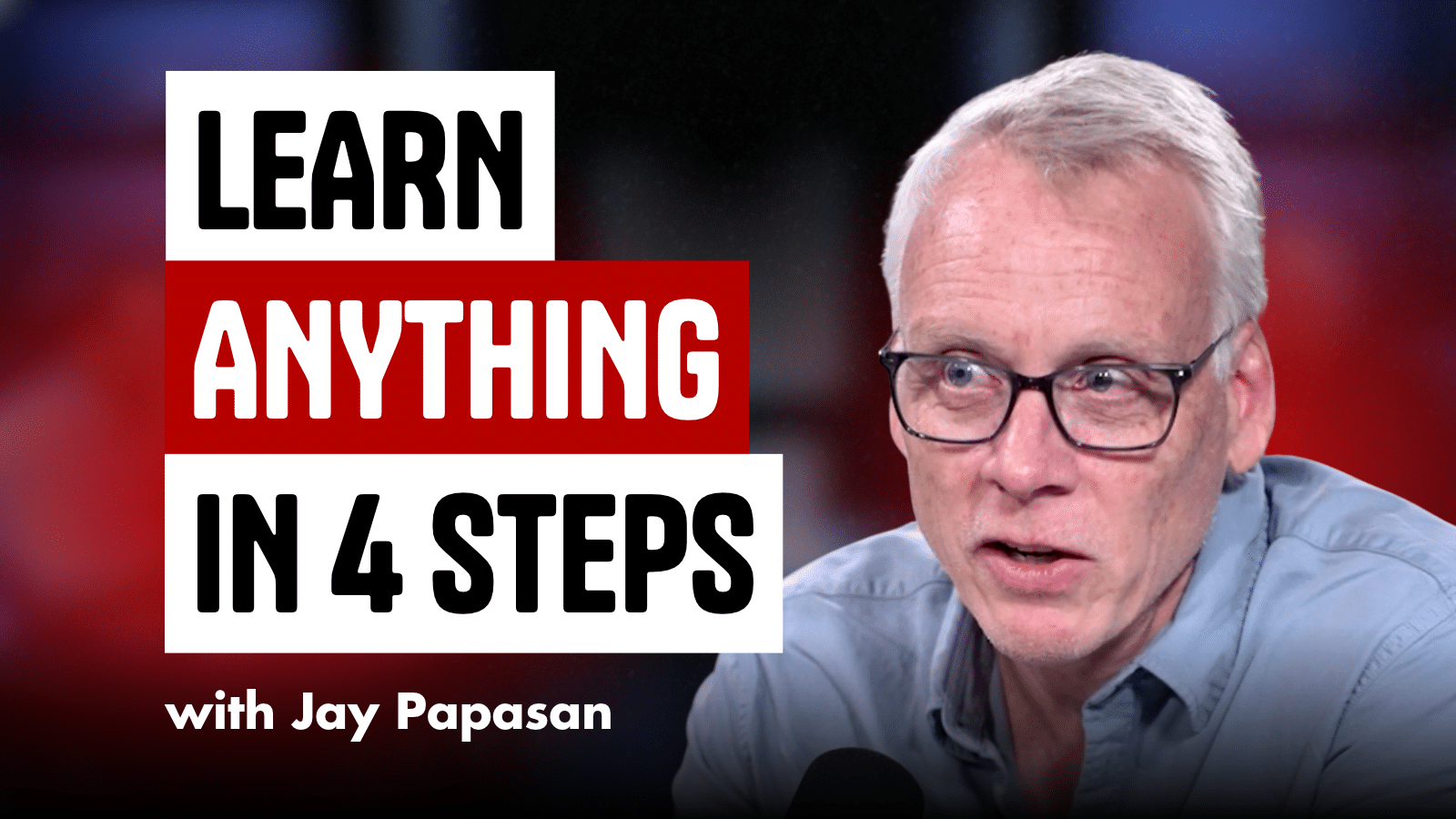
But it’s four simple steps. Pick a concept and write down everything that you know about it. That’s step one. Two, teach it to a child. Gary and I will often say, “Explain it to me like I’m eleven years old.” Not a little, little child, someone with enough vocabulary, but you still have to simplify it. The thing here is jargon is useless here. An eleven-year-old doesn’t know jargon. They don’t know company speak. They don’t know business speak. They need stories and metaphors to help them understand what they’re talking about.
After you teach it, find the gaps, right? Your orangutan, the child that you’re teaching, whatever that student is that is you’re teaching, basically they’re gonna identify the gaps. So, go back to the drawing board, simplify it, and then do it again. After you’ve done this two or three times, guess what? You will have found the perfect way to explain that complicated idea that you’ve always struggled to explain.
So, I’m gonna give you a quick demonstration of what I was thinking about. A concept that I’ve been kicking around with a lot of my clients and a lot of our coaches and a lot of my friends is this phenomenon where people today are taking advice from AI and using it in place of hiring an actual expert. So, they will take a contract, run it through their favorite AI platform instead of taking advice from an actual attorney. And I’ve got friends who are attorneys, I’ve got clients who are attorneys, and they will tell you some of that information is directionally true, but largely it’s garbage. And it’s not just self-serving. This is like a private conversation where they’re not trying to earn money but the question all of these experts have is: how can I explain it to a potential client why they should invest in my advice instead of, “taking the free advice from an AI?”
My theory on this is we would rather hear personalized generic information from AI than actual expert advice that is also delivered impersonally, right? The expert doesn’t know me like my ChatGPT knows me. It is not there to please me the way my Claude account is. It knows everything about me, so when it gives me that average answer, it couches it in such a personal way, it feels perfect to me. So, it’s a bit of an illusion.
So, when I was thinking about how would Richard Feynman teach this, I would just go to this story. Have you ever been to a carnival, like the county fair, and there’s one of those people walking around to either read your fortune or guess your weight or tell you things that are supposedly secrets about yourself? Well, what they’re actually doing is they’re tapping into what’s known as the Barnum effect.
Long story, I didn’t until I sat down to teach this to you, my podcast audience, I forgot that years ago, I read a whole book on cold reading. And cold reading is what the people who read palms and tell fortunes, that’s what they’re doing. And it all comes back to P.T. Barnum, the original carny. He didn’t know anything about the people he was reading, but he knew people. What he would do is based on a very small subset of information, tired-looking man, wedding ring, briefcase, he would surmise some general probabilities and then throw multiple out at the same time.
You’re probably dealing with a financial burden. Maybe you’re feeling trapped right now in your current work environment. Maybe you’re feeling underappreciated. And what happens is three gross generalities, we tend to hear the one that actually lands and forget that the other two didn’t apply to us at all.
And that’s called the Barnum effect. And it’s our tendency to take vague, generic, personal descriptions and assume that they are uniquely accurate. This is why a lot of zodiac readings work. This is why so many of those things work, because they’re written in such a way to be vague and generic enough, but also there’s enough opportunities for one to land that we latch onto what we believe to be true and take it as some sort of seer or oracle that’s talking to us.
Barnum made a lot of money doing this. A lot of other hucksters at the carnival fair have done it. And then there’s actual research that backs this up. They had a research, I wanna say it was in 1949. It was called The Fallacy of Personal Validation. A researcher named Bertram Forer gave thirty-nine students the exact same personality test and answers. They all took the test, but they got the same answer, generic. They all rated it an average of a 4.26 of 5 for accuracy. So, even though it was a completely generic answer generated before they took the personality test, all 39 nine people believed it was four point two six out of five accurate for them. So, that’s the Barnum effect in reality.
And I believe that’s what’s happening a lot of the time with AI, right? We go to get our general answer. “Hey, here’s my situation,” and because it actually does know facts about us, it is able to couch a generic series of options or answers, maybe even just validating answers in such a way that we’re like, “Dang, this thing knows me so well.”
Well, if I’m an expert, I need to be able to explain this. I’m gonna go to the carny, say, “Look, there’s this thing called the PT Barnum effect. Here’s how it works. Here’s the research behind it. Now, you use ChatGPT a lot, don’t you?” “So when you asked it to review this contract, it didn’t just tell you about the contract, it told you about how it applied to you and your business, right?” Great. Would you take advice from a carny at the carnival fair about your legal what matters? I think that’s what in fact you’re doing.”
We need to bring it… The metaphor here is most people have experienced some sort of seen it on TV, the fortune teller at the carnival. We know that is a bit sketchy. How do I associate that with this other? Now, people don’t attack me. I’m not saying that all AI answers are wrong. What I am saying is AI is designed to give you the top of the bell curve, but it does it in a highly personalized way that makes us feel like it could actually be expert information, and we’re not there yet, folks. Will we get there? Maybe, but that’s not where we are.
So, it can help move you forward, but it is not the same as a replacement for an expert. So, all of my experts out there, I hope you’ll take this out, give it a whirl, and tell me how it works because I believe I’m getting close to finally figuring out, like, why is this happening? Why do people look at someone who has spent eight, ten years getting degrees to be an expert, decades of experience, and they’re discounting that in favor of something that’s free but highly personalized but not nearly as accurate in the long run? For little low-stakes things, it doesn’t pay a high price, but for medical, legal, tax advice, even the AI will tell you, “I am not a tax advisor,” “I am not a medical doctor,” but sometimes we take the advice as well.
So, there’s an example of the Feynman technique in action. I’ve role-played it with you once. You give me the feedback. Did that land? If not, I’m gonna simplify it and simplify it again until hopefully I can get close to my answer.
So, all of this I’m gonna recap. If you want to learn something, start teaching it, right? Find your orangutan, whether it be an actual child that you have to explain your complicated idea to. Maybe it’s some peers. Maybe it’s a stranger standing in line at, waiting for coffee. “Hey, I’ve been struggling with something. Can I get your opinion on an idea I have?” Doesn’t matter. However you feel comfortable, can you practice explaining it in the simplest way to a non-expert to see if it lands, learn what didn’t, and then refine it again and again. That is the simplest way I can explain how you can teach so that you not only teach better, but you yourself get clearer.
And if you really wanna make a commitment, find something you’re passionate about and commit to teaching it regularly. Hold a book club. Do whatever it is that you would teach it once a month in your office, in your market center, wherever that might be. Volunteer, raise your hand, step out of your comfort zone, and you will grow not only as a subject matter expert, but you will learn how to explain it better and better as you go.
So, your actual challenge for the week, pick something that you’ve been struggling to understand and go try to explain it to a relative stranger. It can be a friend, but just mimic what I said earlier. “Hey, I’ve been struggling to explain something. Can I try it with you?” That’s all it takes. Just practice once and see how it goes, and see how much you can learn from that small interaction.
I promise you, if you commit to teaching more, you will learn more, you will grow more, you will be clearer in your thoughts, and that will make you, at the end, a better leader. Hope you’ve enjoyed this episode. If you can’t tell, I’m a little bit passionate about this topic. Go teach to learn, folks.
——————————
Disclaimer:
Warning: You must comply with the TCPA and any other federal, state, or local laws, including for B2B calls and texts. Never call or text a number on any do not call list, and do not use an auto dialer or artificial voice or pre-recorded messages without proper consent. Contact your attorney to ensure your compliance.
Disclaimer:
This podcast is for general informational purposes only. The views, thoughts, and opinions of the guest represent those of the guest and not ProduKtive or Keller Williams Realty LLC, and their affiliates, and should not be construed as financial, economic, legal, tax, or other advice. This podcast is provided without any warranty or guarantee of its accuracy, completeness, timeliness, or results from using the information.