Jay Papasan:
So, the question I get more than probably any other, and it’s one of the ones that kind of drives me crazy, is what’s your favorite book? And I have to say, “Well, give me a category.” I have favorite books in categories. But for me to go through all the books that I’ve read and not pick a favorite book, no, I can’t do it.
If you went into my office, I could point to a couple of shelves. They’re kind of my sacred shelves. Those are the books that have had a really deep or meaningful impact in me. Maybe they helped me as a writer, maybe they helped me as a leader, maybe they helped me as a human being. And on those shelves are the books that I tend to either give away or recommend the most.
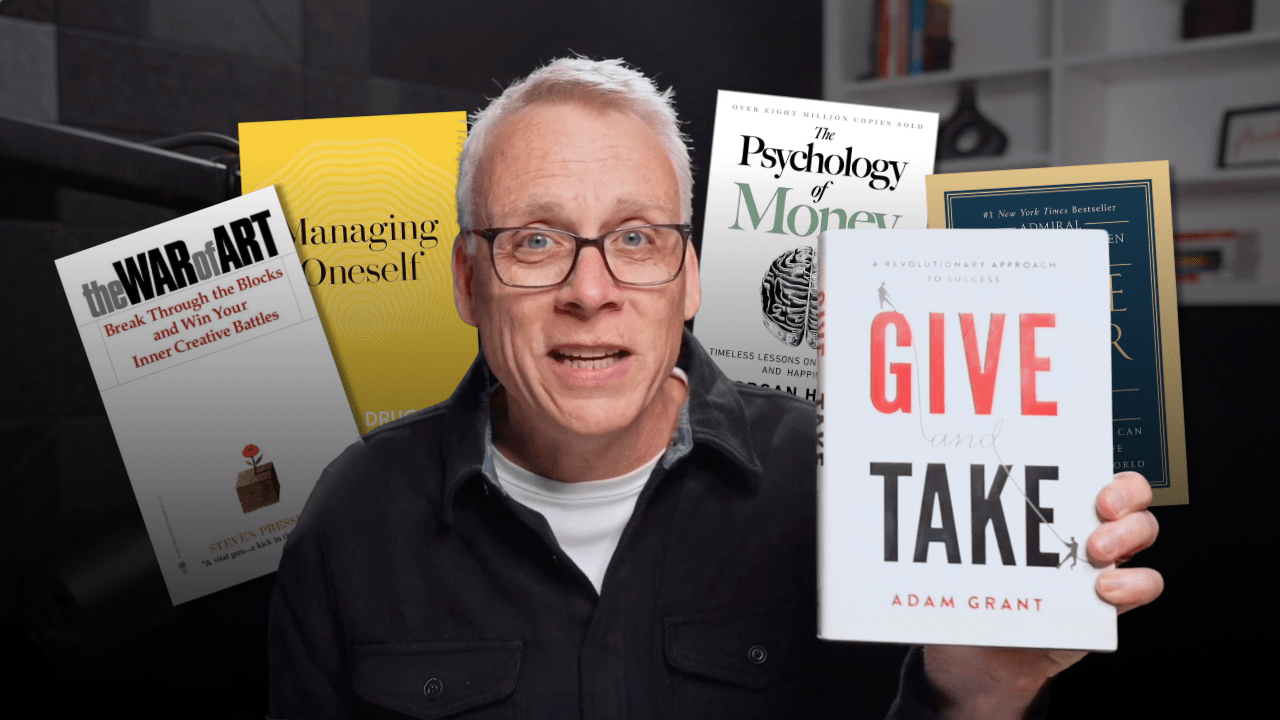
So, today, for this episode, I picked 10 that I really feel like, over the last decade, I’ve either recommended or given away more than any other. I’ll walk you through those titles, why they made an impact on me and why I recommend them to other people. So, let’s dive in and take a look at 10 of my favorite books.
————–
I’m Jay Papasan and this is The ONE Thing, your weekly guide to the simple steps that lead to extraordinary results.
————–
I’m gonna kick it off with the first book. And I’ll just tell you that doesn’t mean it is, of all of these books, the number one most recommended, but I wanted to start with a good one. These are all great, but the bookends of any list, so the first and the last tend to be the ones that we remember. So, I’m gonna start with one that is good for all writers. It’s also good for entrepreneurs.
A lot of people are like, “Why would you recommend that to an entrepreneur?” And I’ll tell you why. So, we’re gonna kick it off with my man, Steven Pressfield. He wrote a book called The War of Art. You may have heard about it. I know that it’s in high circulation among artists and also entrepreneurs. I was first given this book by an entrepreneur, wasn’t someone saying, “Oh, you’re a writer. You should read this book.” It’s like, “Oh, you’re an entrepreneur. You should read this book.”
And the idea of the War of Art was Stephen Pressfield’s journey to becoming an author. He spent a long time living the life of a writer without actually doing the work of a writer. In another book of his called Turning Pro, which I also like, he calls that shadow work. He’s doing the work of a lifestyle without actually doing the hard work. And he got really, really clear at a certain point in his life about what it meant to truly be a professional at what you do. And he talks very eloquently about the things that we have to do and the battles that we have to fight.
So, the big theme, and you’ll hear people talk about it, that are fans of this book, is the resistance. And he talks about the resistance, whether that’d be procrastination, perfectionism, however it is that you self-sabotage as this kind of spiritual battle that lies between who you need to be and all of the resistance that’s fighting it. And I think the bigger the calling, whether it’d be in business or in art, I think the more resistance you will feel. And he says it very eloquently. And it’s kind of almost a book of affirmations. You can just open it up to any page and just kind of read.
So, one of these is a list. He just made a list. And in no particular order of those activities that most commonly elicit Resistance with a capital R. One, the pursuit of any calling in writing, painting, music, film, dance, or creative art, however, marginal or unconventional. Two, the launching of any entrepreneurial venture or enterprise for profit or otherwise, any diet or health regimen, any program of spiritual advancement. And he goes on like lists seven different things but basically, the Resistance, this urge to kind of go off track, to self-sabotage, it never sabotages us when we’re going down a level, only when we’re trying to level up.
And there’s great stuff in here about how we can battle it, how we can think about it. So, those urges that stand between us and what we know we want to do and we dream about, how do we battle them? And he listed in one, and I’ve got this underlined, and a little explanation part, he lists out 10 different ways that he defined himself as a professional. And he says, “How do we define the qualities as professionals? One, we show up every day. Two, we show up no matter what. Three, we stay on the job all day. Four, we are committed to the long haul. And he goes on and he talks about just the basics. LIke you know all of this stuff. But the way he communicates, it is magical.
So, if you’re thinking about this book, definitely give it more than like 10 pages ’cause you’ll be like, “Wait, is this for writers? Is this for entrepreneurs? Who is this actually for?” It’s one of those that the parts don’t feel as significant as the whole together, but I know so many people that read this book every single year just to refresh their kind of sense of how they personally will battle the resistance between them and their dreams.
So, that’s book number one. Stephen Pressfield. Amazing author. I’ve read a bunch of his other stuff too, but that’s where I would tell people to start.
Book number two. This is by Peter Drucker, the management guru. If you only had to learn from one management guru, you would learn from Peter Drucker. He’s kind of the OG. And he wrote an article in the Harvard Business Review called Managing Oneself, and they turned it into a little book. It drives me a little bit crazy because this little book is like 30 pages. I think they charge like 10 bucks for this. And you’re like, “Really? Really? You charge that much? And it’s gonna get lost on my shelf.” But it’s one of those that you can give to young people, people going to college or maybe you just need to read it for yourself, but he walks through not how to manage others, but how do you really learn your strengths? How do you learn how to manage yourself?
And he goes through a bunch of questions, but like one of them, I just opened the page to this is, “The only way to discover your strengths is through feedback analysis. Whenever you make a key decision or take a key action, write down what you expect will happen. Nine or 12 months later, compare the actual results with your expectations.”
And that feels like, “Wow, who would ever do that?” Well, the guy who gave me the first book, Mitch, actually keeps a journal of all of his investments, whether he says yes or no. And I can remember walking into his office, ’cause one of the companies I wanted us to invest into, we had passed on and I said, “Ah, did you read the news? That company just went public. If we’d put a hundred grand in that it would be worth like 2 million.” It was some crazy multiple that we had missed out on.
And he goes, “Well, hold on a second.” And he grabbed his journal, he grabbed it by year, he flipped through it. He goes, “Okay, here is what we knew at the time.” And he rattled off his notes. “Here was our decision making process.” And he kind of walked me through it. And he goes, “You know what? It wasn’t the right call, but I think given the same information today, I would make that same call again.” Sometimes, you make a good call and get unlucky. Sometimes, you make a bad call and you get lucky. In this case, he was tracking his decisions to see which ones were benefits of luck or just great wisdom. But that habit of just checking in on what you expect to have happen and what actually happened, it’s just one of the gems inside this like little tiny book.
I often tell people he had a habit of just kind of journaling at the end of the day about his energy and what he loved. And if you do that for like 30 days, you will get the pattern of the days and the activities that actually fill your cup versus the ones that drain you. And it almost always carries some surprises for people. So, this is like the shortest book on the list, Managing Oneself by Peter Drucker, and unfortunately is only marginally the cheapest because of great entrepreneurs in the publishing world.
Okay. Book number three is from my, now, friend Ryan Holiday. It’s the Obstacle is the Way. And I’ve read almost everything he’s written. I think he is an amazing researcher, an amazing storyteller. And obviously Ryan Holiday is pretty much single-handedly kind of brought stoicism back to life. And at a time when emotions are running high in the world, he’s a good person to be listening to and a good person to be reading ’cause he’s talking about the things that make great character, and how we can interact better with ourselves in the world.
The Obstacle is the Way was the book that kind of really made me a super fan because it’s where he really unveils kind of the journey of Marcus Aurelius, and how this idea that when you face a challenge, the goal is not to run away from it, but maybe to lean into it because challenges almost always offer us the greatest lessons. They’re where we get our strength from in the end. And to run away from them might be to run away from our destiny. I’m doing a horrible job of summarizing it. But there is story after story after story about how people overcame obstacles. And if you’re gonna do something extraordinary – and that’s the theme of the one thing, like extraordinary results – you are gonna run into a lot of obstacles. How we think about them, how we adapt to them, how we tackle them matters.
And I just love hearing it. Not just always written out as pros, per se, but written out in stories again and again, that kind of reinforce the point that the people who achieve extraordinary in this life, none of them got there on the easy path. A lot of them had to face and overcome challenges, and that’s what makes this story great. That part of the journey may not have been fun but it’s what, at the end of the day, makes you really proud of what you’ve accomplished.
One of the lines – I’m just opening it at random here – “You will come across obstacles in life, fair and unfair, and you will discover time and again that what matters most is not what these obstacles are but how we see them, how we react to them, and whether we keep our composure.” Anyway, just a small nugget from this great book, the Obstacle is the Way.
All right. Now, for my writers, ’cause a lot of people are like, “Oh, what books do you love about writing?” whatever. And there’s so many to choose from. So, I think we’re on number four here, and this would be Stephen King’s book On Writing. And a lot of people kind of turn up their nose at Stephen King. Isn’t he a popular writer? Isn’t it kind of a pulp writer? And they don’t appreciate, one, how prolific he is and how many copies of his books have been consumed around the world? The guy is an amazing storyteller.
And he actually is a devotee of his craft, but he makes it look easy. A lot of people underestimated Hemingway too. He writes at a fourth grade level, but it’s so sophisticated what he’s doing. And when you read this book, you realize that Stephen King is not just someone who is really good at commercial art. He’s a master of his craft. He tells in the first half his story of being a writer. And in the second half, he walks through some of the tips and tricks of the trade, how he edits, how he cuts the whole process.
And the story I remember from this is his journey, and I don’t have it bookmarked because I think I read this one online and then went back and bought the book, so that I could stare at it and remember the lessons. He talked about the journey to kind of opening himself up to a world of fiction, and he would sit down at his typewriter or at a computer and he talked about looking through a tiny pinhole on the screen, and that was the only thing he could look through to see the world he was writing about.
But the more frequently he showed up and the more regularly he showed up and the longer he sat there, the more it would open up. And the pattern became that when he had a habit of writing, he became a pro, as Steven Pressfield would say, he started showing up the same time every day, sitting there and doing the hard work of showing up. Like it’s work, it’s not just fun. That little pinhole would open it up as an aperture, larger and larger, faster and faster. And that’s the power of building habits than anything.
And I read this book long before we had studied habits for The ONE Thing and the benefits of practice and being regular. So, I looked at this and it was one of the first things I was like, “Oh, that’s what a professional does.” That’s how they get to where they need to go every day that it’s hard. It’s getting a little bit easier. But if you fast forward a month or two months, it’s a lot easier, but we can’t feel that progression in the moment. Anyway, if you aspire to be a writer, don’t overlook this great one, On Writing by Stephen King. He really is a master. It may not be the perfect book for every poet out there, but if you wanna write books that a lot of people will read, he’s got lessons to teach you.
Now, speaking of books that a lot of people read – we’re almost to the midpoint here – I’ve got Morgan Housel’s book, the Psychology of Money. And this is a fantastic treaties on how we think about money. The games we play in our heads around it. And I remember reading this in COVID, we got to interview him, and I read it on a Kindle, and I was trying to figure out like, “What are the best quotes to read?” And I looked up, and I had typed up 11 pages of quotations from this book. That’s how significant it was for me.
And again and again and again, if you just open it up to any chapter, there are nuggets of wisdom around our financial life that are hard to beat and hard to compare to any other book. I would say that Morgan is as good of a researcher and a storyteller as Ryan Holiday. They both are incredibly thorough around their craft. They source these stories from places you’ve never heard of, and the stories almost always tell exactly the lesson that you need them to.
So, let me open it up. I was opening this up at random to a few places. Here’s the one, and I’ve actually written about this. He told a story, the chapters titled Never Enough, and it’s this idea financially that the worst challenge that you can face is to move the goalposts on yourself. This idea of never having enough. And he tells the story of Kurt Vonnegut and Joseph Heller, both authors, going to John Bogle, the founder of the Vanguard Group. They went to a party of his on Shelter Island. And while they’re sitting there, Vonnegut is teasing Joseph Heller. And Joseph Heller wrote a book called Catch 22. It was a runaway bestseller. And he teased that Bogle, this founder of this huge investment firm, would make more money that day than his bestselling book would make in its entire lifetime. And the response from Heller is just priceless. He responds, “Yes, but I have something he will never have – enough.”
And it opens up this whole idea that in order for us to ever experience success, we have to define it for ourselves. If we take our definition of success or enough from the world, from anything around us, other than inside of us, we will actually never have enough. And we go through this idea of the hedonic treadmill. You think that that new house will be better, but then you live in it and it becomes a normal house. And then, you look at a better house. You can get on this treadmill that never ends until you decide enough is enough. But that’s like one of about 15 lessons from this book. If you only had to read one book about money, I would probably hand you this one.
All right. Now, back to my writers. This is a book that it took me forever to actually go buy a copy of because originally I read it on Kindle. Gosh, I must have read it. I didn’t even know when this book came out. Maybe the early 2000s. 2013. But it’s by my friend Tim Grahl, and it’s called Your First 1000 Copies.
So, Tim is a web developer turned book marketer. And now, he runs a company that’s called Story Grid, that’s all about helping people write novels. But this is a guy who understands the book business about as well as anybody I’ve ever met. And at one time, he had five clients – not one, not two, not three, not four, five clients on the New York Times bestseller list at the same time. That’s how effective he was and the kind of talent he also attracted. But he worked with some of the biggest names you know to help them market their books.
And so, when I heard that he had written a book on, first off, how to sell your first 1000 copies, even though at that time we had sold hundreds of thousands of books, I was like, “I wanna learn from this guy.”
And some of the biggest takeaways here, and this is good for any business owner, is that whatever your direct marketing channel is, it can’t be social, it can’t be anything that you can’t ultimately control. And he backed it down. And ultimately, like your ultimate weapon as a business owner, as an author was your email list, because that’s where a lot of the action is taken. People click links. You control the relationship. There is not something that happens other than them, “I’m subscribing,” you have a two-way conversation in a place that if people are actually opening your emails and reading them in this day and age, that’s a high sign that they’re interested in what you’re offering.
And I remember looking at that and going, “Wow. The foundation of all of our businesses needs to be our email list. That is ultimately how we will control, and be able to contact them until the world changes radically.” The email inbox is dated. None of us love it, but there is nothing that’s really standing up to replace it. So, it is that way that we can electronically quickly and at scale, connect with all of our customers. And he gave a really good argument that compared to a lot of the other things we do, and in the author world, it was like social media and stuff like that, email outperformed some about 50 to one.
This might be like a little drive for my entrepreneurs out there, but the big lesson I just gave you, the foundation of your marketing plan needs to be capturing people into your list, so that you can have an ongoing conversation with them, and he gives you tons of good strategies. Anyway, Tim did a great job. I actually think he’s updated this book a couple of times, so there’s, probably, even newer version that you can go grab.
Now, a lot of you are scratching your head. It’s like, “I’m an entrepreneur, not a writer, Jay.” I’ve already hinted at it. I think a lot of times, the best ideas we will get for our businesses are gonna come from other industries. If we look up and we’re just chasing and following what everybody else is doing, we’re jumping into crowded marketing strategies, we’re doing the things that everybody else is already doing, which makes it even harder to stand out from the crowd.
So, always be looking at industries that have a lot of parallels but that operate based on some different principles ’cause there’s lessons that we can borrow. So, that’s a lesson I borrowed from the world of marketing authors to see about marketing other businesses, and that’s been one that I’ve carried forward.
Since we’re at about the midpoint, we probably should take a quick break. I will catch you up on the other side.
————–
Okay. Book number seven is Give and Take by Adam Grant. And this is a hefty book. And when you open it up, you’re gonna notice that the type is a little small, the pages are full ’cause he did a lot of research for this book. But it is absolutely surprisingly readable. I would put it up there. The book that I was fighting back and forth, which one should I recommend here, but if I really talked about the ones that I’d given away or handed out more in terms of the highly researched, like books like this, give and Take Beat Out Grit by Angela Duckworth by a hair.
But the thing that I love about this book and why I recommend it is it gave me a different framework for thinking about giving. And I’ll summarize the research that he tells very, very early on in the book, but they did research in the workplace across thousands and thousands of people about what kind of person gets ahead. And they categorized them in three categories. You’ve got givers, takers, and matchers. Givers of those people, exactly what it sounds like, that love to help other people. Then, you’ve got takers who are looking for everything that they can gain. And then, we all know our matchers, and matchers are fine, just fine, but they’re the kind of people that I will give what I receive and I kind of keep score along the way. Those are the people that when you go to split lunch, they’re happy to split the tab or if you got it last time, they will offer this time. If they got it last time, they kind of expect you to get it this time. We all kind of know our matchers.
So, they identified all these people and then looked to see how they had done in their career. And I remember when he originally crunched the numbers, it looked like takers were on the very top of the scale. The people that were the most aggressive at getting what they want were the ones who were getting the most promotions and earning the most money. And then, you had the matchers, and at the very bottom of the pile, the givers.
And a lot of the research lined up that way. It’s like if you are always helping other people, a lot of times you will be neglecting your own career, your own work, your own business; and therefore, you might actually not be going as far or as quickly as these other groups. But that’s also very discouraging when you think about, what do I want to teach my children? What kind of team energy do I want to have? But then, they looked at the data a little bit more closely, and at the very, very top right, when you really started diving into that top percent, the very top of the pile were all givers.
And so, he looked very hard at them. And the difference he made is there are people who kind of give without restraint and without boundaries, but the people at the very top were strategic givers. They would give in ways that allowed them to be great human beings, to support others and to pass it along, but not in ways that actually undercut their own performance, their own family, and their own health. And so, this is a great book and it’s a little bit deep, but it is absolutely worth it where you can kind of, if you aspire to be a giver that succeeds, you can then look at what does it mean for you to be a strategic giver.
One of my favorite ideas I took out of this was the idea of a five-minute favor. Some of the most successful people in the world have systems for doing little things to help other people out. They see a pattern of people, they continually ask them the same thing, and so they make it so that they can, in just a few minutes of their time make an answer happen for that person. “Hey, I actually recorded a video. Can I send that to you?” or, “I’ve got a masterclass, I’ll give you free access.” Whatever the leveraged thing was, “I wrote a PDF around this. So many people asked me, I just created a little document. Let me send it to you,” they found ways to say yes without giving tons of their time.
And if you’ve heard me over the years talk about strategic giving in the context of even how we say no to people, it’s a fabulous strategy to have in your back pocket. So, kudos to Adam Grant. I’m a huge fan. I did get to interview him a long time ago, but we never got him on the podcast. So, if you’re listening out there, Adam, we’d love to have you.
Okay, next up is another COVID book. This would be book number eight. It is the Simple Path to Wealth by JL Collins. And just before we went into COVID, my wife and I run a millionaires club where we teach some friends and coworkers how to invest and build their wealth, and we always have a reading list around it. So, I assigned this to myself and I read it. We presented it, everybody loved it. And then, over the course of COVID, I think my wife went back and read it again because this book had the best explanation of how compound interest works. This idea that your nest egg will grow on its own. There’s the money you make, and then there’s the money your money makes, and that keeps making over again and again and again.
And it’s really crazy because our brains, exponentially, we can’t do that math in our head. It confounds us. I think it was described by one person as the eighth miracle of the world, the wonder of the world, compound interest. JL Collins does a fabulous job of simplifying basic personal finance. He wrote it for his daughter who was gonna get her medical degree and just wasn’t interested, even though he’s kind of a nerd about it. I got to interview him with Gary. He’s one of the nicest, most sincere people in the world. He just wanted to write a guide for ordinary people who are really busy to have a simple path to building wealth.
And we have implemented a lot of this. In terms of the traditional investments we make, one of his big recommendations is to get a low cost. He’s a very specific Vanguard fund for the S&P 500, and just pile it on into there. Keep your life simple. Don’t be a day trader. And he gives you all the stats for why you should or shouldn’t do these things. But that simple path is the kind of path that Wendy and I took for our traditional investments, and it has paid off incredibly well for us. Can’t guarantee that for the future. And there’s always gonna be the disclaimer at the end of the podcast. But I can tell you I highly recommend this book. And I even scheduled time with our CFO. I made her read it. I said, “Will you talk through this book with me?” because I wanted to tap into [0:24:27] knowledge as well and get a better, better understanding.
So anyway, if you’re looking for a simple roadmap for how to invest things traditionally, like in the stock market and how to manage for your retirement, this is by far the best book I’ve ever read. Super practical, super accessible, and it changed our world in terms of finally getting us to understand exactly how compounding worked and how to think about it in our lives and plan for the future.
Okay, we’re down to our last two. Book number nine is Make Your Bed by Admiral William H. McRaven. And this is a book that was originally a keynote address to the University of Texas. And I remember just stumbling across this keynote on YouTube and loving it. And then I got my wife to watch it. And ,then I went down and I got my son to watch it with me. And then, we watched it. Gus and I, I think every year for like three years, and each year he had a different takeaway.
So, it’s a really great tool, this keynote itself, because he kind of walks through every lesson that’s in this book. And I remember when I was watching the video, I kept thinking as a publisher, I was like, “I should reach out.” And I actually wrote a letter to the university asking if he was considering to write a book. He didn’t reach back out to me. But sometime after that video has got like 30 million views, of course, I saw that the book was coming out. I bought a ton of copies. We actually bought a copy for everybody here in our company, and we read it as a book club.
But it is a series of simple lessons that Admiral McRaven learned by becoming a Navy Seal. And the opening lesson was on the power of just making you bed. As he wrote, “It was the first task of the day, a day that I knew would be filled with uniform inspections, long swims, longer runs, obstacle courses, and constant harassment from the SEAL instructors.” And he talked about how it had to be done perfectly. It would be inspected. I think it had to have a four-inch fold. And if it wasn’t exactly that, they would tear up the bed and make you do it again. But right to begin your day, you had to do this exacting task and do it perfectly.
And he said that one of the gifts that he got from that, starting his day by doing one small thing with excellence is that no matter how bad or how horrible his day was, if they were rolling in the surf with a log or doing something just absolutely absurd during hell week, he would come back and he would be confronted by the fact that that day wasn’t a waste. He had done one thing extraordinarily well.
And I can tell you here at The ONE Thing, after this book came out, back when Geoff Woods was still on the podcast, we decided to do a Make Your Bed Challenge. And we did 66 days to build the habit of making your bed. My wife and I did it, and we continued to do it. And it was amazing how that simple act of just the first thing that you do, instead of getting on the phone, instead of going to run to the coffee machine or doing whatever it is that you do in the morning, just stopping, turning around, folding back the sheets and making your bed. We did not do a four-inch fold. We were not militaristic about it, but we did make our bedroom neat and it created this amazing halo effect, so that we had done one thing well. It created, kind of, this sense of agency in other places in our life and all of the people, we probably had four or 500 people take that challenge with us, they all reported the same thing. This simple act of making their bed had made so many other things better in their life.
So, this, another tiny book that is a gift book for sure. I think back when I bought it, it was like 18 bucks. I’m sure it’s more now. It’s a quick read. It’s a book that you can also give your young people in your life. It’s full of great lessons from someone who has served our country, and I think continues to distinguish himself.
All right. So, we’re at the end. Book number 10, and this is gonna be The Boy, The Mole, The Fox, and The Horse by a guy named Charlie Mackesy And I’m sorry, Charlie, if I got your name wrong but I believe he’s Scottish or Irish and I can’t quite nail it. This is a beautifully illustrated book. It came out in 2019 and it exploded during COVID. I cannot remember who it was that first recommended it to me, but I remember ordering it and getting it and then reading it in one sitting.
And it’s just these beautifully illustrated pages where he has hand watercolored these pages, and then writes out these little dialogues between this young boy, and, at first, a mole that he encounters and runs around, a fox, and a horse. And they kind of give him little moments of wisdom, but it turned out to be a lot of wisdom that a lot of people needed at that moment in time. And some of it was funny, and some of it’s touching. “‘Do you have a favorite saying?'” asked the boy. ‘Yes,’ said the mole. ‘What is it?’ ‘If at first you don’t succeed, have some cake.’ ‘I see. Does it work?’ ‘Every single time? .'”
And there’s little bits of humor, there’s little bits of wisdom. “‘What is the bravest thing you ever said?’ asked the boy to the horse? ‘Help,’ said the horse.” And so, you can go through this book and find little bits of inspiration, but I was reading after the fact, maybe a year later, how many hundreds of thousands of copies he sold and the letters he got became kind of a phenomenon. There were people that read this book and reported that, basically, it saved their lives during COVID.
So, that was a tough time for all of us. But it’s a beautiful book. It’s a book that’s appropriate for young and old, and it’s full of timeless, timeless lessons that we all need to be reminded of about being kind to others and being kind to ourselves.
So, that’s my top 10 most recommended or given away books. I believe that last one, The Boy, The Mole, The Fox, and The Horse, we bought for every single one of our clients one year, hundreds of copies and mailed them. And the thank you notes we got after the fact were absolutely incredible. So, these are all books that I’ve read that moved me or changed me in some way, and that I recommend again and again, and I’ve given away hundreds if not thousands of copies of them.
I hope one of them speaks to you. And then, the tradition of The ONE Thing, my challenge would be for you this week, if you could only do one thing after listening to this episode, what is the book that you need to read in this season? One of our coaches, Chris Dixon, likes to say, “Read for what you need.” Don’t just go grab something off the shelf because it looks interesting. What is the thing that you need? Do you need to dive into your finances? Maybe you need to read The Psychology of Money or The Simple Path to Wealth. Are you thinking about doing the tough parts of growing a business? Maybe you need to read the War of Art or The Obstacle is The Way.
There are different books that I would prescribe for different reasons, and you need to do that for yourself. What is the thing that I need to learn in this season? And is there a great book? Think about the investment. You can go online, you can buy an audiobook, you can buy an ebook or a regular book for, what, $30 at max and you get the wisdom of the world. Go find a book and then dive into it, and see if it doesn’t gift you something, and then you will gift it down the road.
All right. One final thought, folks. I would love to hear from you. Let me know what are the books that you recommend most? What are the books that you give away most? What are the books that have had the biggest impact on you? I would love it if you would share that with us. I will be checking out the comments and checking out your DMs. I can’t wait to hear from you and add to my own personal library.
Thanks so much for listening. We’ll see you next time.
Disclaimer:
This podcast is for general informational purposes only. The views, thoughts and opinions of the guests represent those of the guests and not ProduKtive or Keller Williams Realty LLC and their affiliates, and should not be construed as financial, economic, legal, tax or other advice. This podcast is provided without any warranty or guarantee of its accuracy, completeness, timeliness or results from using the information.