Jay Papasan:
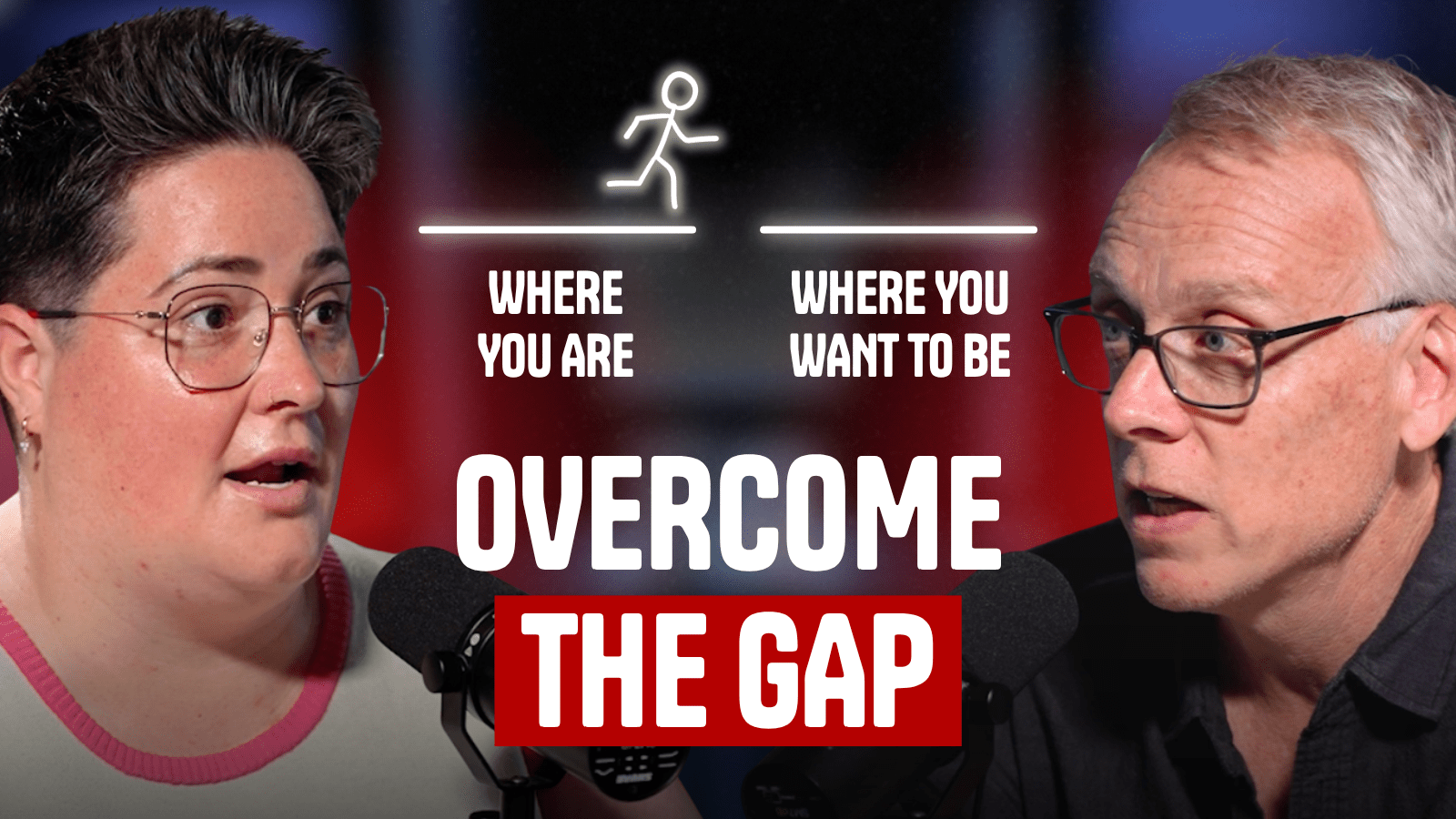
Hey there, ONE Thing family. Today, I’m talking to my friend, Hannah Soto. She’s a five-time entrepreneur and also an executive coach. And we’re exploring the gap. The gap is the distance between where you are and where you ultimately want to be.
And she and I have both observed some tendencies that high achievers and business owners have when they face the gap. They can try to chase it down compulsively. They can hide from it, right? An avoidance technique. Or they’re gonna use it as a tool to judge themselves. And we’re gonna knock out the thinking behind all of those and how you can move to a more healthy, becoming focused kind of attitude with all three in this episode.
Enjoy.
————————-
Jay Papasan:
I’m Jay Papasan. And this is The ONE Thing, your weekly guide to the simple steps that lead to extraordinary results
————————-
Jay Papasan:
Hannah, welcome to The ONE Thing Podcast.
Hannah Soto:
Thank you for having me. I’m really excited.
Jay Papasan:
We were chatting around about the gap, which is a hot topic for entrepreneurs and business owners, and high achievers in general. Where did you first start a relationship with learning about the gap and what it means to high achievers?
Hannah Soto:
Right smack in the middle of it.
Jay Papasan:
Okay.
Hannah Soto:
So, I was in a gap myself, and I had worked with a coach, and he kinda talked me through what a gap meant. I’d never related to-
Jay Papasan:
And this was Yohan? Is that how you say his name?
Hannah Soto:
Yohan.
Jay Papasan:
Yohan.
Hannah Soto:
Yes.
Jay Papasan:
Okay.
Hannah Soto:
He’s Puerto Rican, so you would think it would be Yohan, but he’s also Persian, so Yohan.
Jay Papasan:
So, you were in the gap. Let’s define, what does the gap mean to you?
Hannah Soto:
So a gap is the space between where you are and where you want to be. So, that middle in between.
Jay Papasan:
Which is a place where a lot of high achievers have gotten a lot of their accomplishments. They’ve gotten a reputation as people who have closed the gap, closed the gap, right? Here’s the target, go hit it. They hit it. They do that again and again. And eventually, they’re like “I should do this for myself, not for the man,” right? “I should start my own business.” That’s how a lot of us got started. So, you were in a gap. Was it a gap that you weren’t able to close, and that’s why you were working with a coach?
Hannah Soto:
At that point, it was a gap that I wouldn’t have called a gap. I would’ve called it a problem. I would’ve said, “This needs to be fixed, solved. Something’s wrong.” And so, I came to my coach saying, “Here’s a problem I need to fix, and I need your help to do that.” And since I’ve learned that you can also just change your relationship to the gap because the truth is that even if I close that gap, there’s gonna be another gap in the future.
Jay Papasan:
Always. So what was the nature of this gap? Was it a leadership gap? Was it a skills gap? Was it a knowledge gap?
Hannah Soto:
The gap that I came to Yohan in the beginning was one in my business. And so, I had a lot of external success, but I was feeling a lot of friction personally. Now, I say, wildly successful and yet wildly unhappy, and the gap between external performance and internal peace.
Jay Papasan:
That’s really something I think a lot of people, until they’ve experienced it, don’t know what it’s like for people to say, “Oh my gosh, you’re so successful,” while the things that you’re failing at aren’t visible. And so, that’s where the imposter syndrome shows up and self-doubt, but they don’t see all of my mistakes. While in reality, everybody who’s kicking butt out there has got a million gaps going on.
So, you said something really interesting. You said it’s all about your relationship to the gap. What does that mean to you?
Hannah Soto:
So, we can’t control our circumstances, always, but we can control how we experience them. And so, there was this really pivotal moment, and I’m gonna be vague because it has some personal details, but-
Jay Papasan:
Of course
Hannah Soto:
…. there was a moment personally, where I was experiencing my family in this particular way. And the analogy I was using is it’s like I’m in a pool drowning, and they’re all just standing around. And why won’t someone throw me a raft, or why won’t someone jump in and help because I’m drowning? And then all of a sudden, I said, “What if I just stand up? What if there’s only three feet of water?” And it radically changed my relationship to the situation. No one else changed around me. My relationship to the situation changed.
Jay Papasan:
Okay, I laugh, not at your situation, but everybody’s seen that meme of the little kid who’s screaming and crying until he realizes he can just stand up, and he’s in knee-deep water.
Hannah Soto:
Yeah.
Jay Papasan:
Got it. And so, your relationship to the gap changed. I go all the way back to Viktor Frankl when you think of things like that. There’s what happens to us, and we get to choose in that space, in that gap. It’s a different kind of gap. Instead of reacting to it, which is almost always at the emotional level, choose a more rational response to it. I kinda distinguish between reacting and response.
Hannah Soto:
Yes. And I would probably in a similar way say, “Am I being reactive or proactive?”
Jay Papasan:
Okay. Reactive or proactive. So, you shared with me that in your work as a leader and your work as a coach, you see three patterns. Business owners, high achievers, whatever we’re gonna call them today, our listeners on this podcast, they either chase it, right? “I’m gonna hunt that sucker down ’cause that’s what I do,” they hide from it, or they use it as a tool to judge themselves.
So, let’s tackle those maybe one at a time. So, I think the chasing the gap is the one that I see a lot. It’s maybe the most common form, right? Here’s the gap between where I am and where I want to go. That’s where a lot of coaching relationships start, right? That’s the thing that you want to decide. You sit down with someone, what is my job for this six-month period or whatever it is? What is my job when that employee walks into your office, says, “Can we close the door?”
Hannah Soto:
Right. We all know that feeling.
Jay Papasan:
Yeah, right. Do you have time for a quick Zoom? And you’re like, “Are they quitting? What’s happening?” You have all those moments. But generally, they perceive it to be something, there’s this gap between them and the outcomes about how they’ll look at themselves. I usually think of that chasing it, I’ll be happy when. I see that a lot. It’s like, “I’m miserable right now, but I’ll be happy when we get to a million in revenue.”
Hannah Soto:
Exactly. And the problem with that is that you get to a million in revenue, and then there’s something else. There’s always gonna be a, “When this happens, I’ll be happy.” And so, it’s understanding that what you’re chasing is fulfillment, and that if you aren’t clear about that comes from inside, like that’s an inside job, then you’re always gonna be chasing. You’re always gonna say “If I hit this,” “When I arrive at that,” “When someone gives me this acknowledgement” you’re giving away your agency, and you’re saying, “I’ll feel fulfilled when this happens.” And so, you’re experiencing the gap as something to chase as quick as possible, and it’s very fear-based.
Jay Papasan:
You’re making your fulfillment conditional, right? And ideally, it should be unconditional. And we did a ton of research, like dove deep into Seligman and all of this achievement. And one of my biggest ahas when we were writing The ONE Thing all those years ago, 13 today, in fact, as we’re recording, that fulfillment happens along the way. That, actually, when we close the gap, we actually get to that milestone that we’re chasing, that big one, there’s usually a letdown. It’s the opposite of what we expect ’cause there’s this, “Now what?” I had this purpose. This was getting me up every morning at 4:00 AM to chase, chase, chase but now the chase is gone.
But the happiness or the fulfillment, which I think is a better word than happiness, I think happiness can be a little bit more fleeting, whereas like, “I can be miserable at work. It’s hard day. I am in the trenches. I’ve got a trowel. It’s 110 degrees,” that kind of work. I can still come home and feel incredibly fulfilled and proud of my day, even if it wasn’t a fun day, right? But the milestones along the way, those are the places where we feel the fulfillment. And at the end is where it actually could be disappointment.
Hannah Soto:
I think if you talk to professional athletes, let’s even take football players, you talk to them the day after winning the Super Bowl, and I think most of them are gonna say, “That was fun, but what’s next?” There’s that drive of falling in love with the pursuit of something if we choose to relate to the gap with love.
Most people in these three stages are relating to the gap in fear. And if you can instead say, “How can I be curious? How can I fall in love with it?” then, the pursuit of it can actually be where you have the most fun.
Jay Papasan:
I’ve found I had a great, very casual conversation before I was in front of a microphone. Actually, James Clear came to town and wanted to talk to us about how he marketed The ONE Thing before his book came out. And we were talking about… He’s a very physical creature. Have you ever met him?
Hannah Soto:
I have not. Not yet.
Jay Papasan:
He’s a former top athlete in great shape, and he’s imposing like, I think, he’s six-foot-four or something.
Hannah Soto:
Oh, wow.
Jay Papasan:
I’m not used to looking up.
Hannah Soto:
Okay, right, ’cause you’re tall.
Jay Papasan:
And we were talking about stuff, and I think at that moment in time, I had been chasing different achievements in my health and tracking everything, and I’d just done a 100-pushup challenge. And his little flex around it was so good, but it was such a precursor to what we now know in the Atomic Habits. He said, “I’ve found that I just chose to be the kind of person, identity, that goes to the gym every day and works out. And I find whenever I choose to do something, like run a 10K or do 100 pushups, it’s never very far away because of who I’ve chosen to become.”
So if our identity, like how do we manage our identity while we’re chasing? Can we fall in love with the things that are a part of the pursuit? I’ve heard it a million times as a writer, “Fall in love with the craft and the product will show up.”
Hannah Soto:
Yeah.
Jay Papasan:
Is that a true statement to you?
Hannah Soto:
I think so. And I actually got to experience it in a brand new way last year. I walked the Camino Santiago. So, for anybody that’s not familiar, it’s a 800-
Jay Papasan:
Spain?
Hannah Soto:
Spain.
Jay Papasan:
To Portugal? Is it all the way to Portugal or is it just in Spain?
Hannah Soto:
There are eight different routes. Okay. One is in Portugal. We started in France, and walked to the coast of Spain. So, it’s 800 kilometers-
Jay Papasan:
Wow.
Hannah Soto:
… which is about 500 miles.
Jay Papasan:
How long did that take?
Hannah Soto:
46 days. Normally, it takes closer to 30, but I did tear my quad at week one and a half.
Jay Papasan:
Right in the beginning.
Hannah Soto:
Exactly. And so, it really changed my relationship with suffering and with arrival because my goal wasn’t to just get to Santiago as fast as possible. I could take a car and get to Santiago, but I wouldn’t have become a pilgrim. And so, I think if we think about our gaps, I’m not interested in getting to the destination because, then, I bypass the becoming. And who do I need to become? And the gap actually is the place to do that.
Jay Papasan:
I love that. And there’s something poetic about suffering on a pilgrimage, right? More than a blister, right?
Hannah Soto:
Correct. Yeah.
Jay Papasan:
You were carrying your quad as you went. Oh, gosh. Okay.
Hannah Soto:
And also many blisters.
Jay Papasan:
Okay. And many blisters. I’m gonna set aside my curiosity about how you tore your quad hiking, which is not gonna go there. Let’s go back to this identity and becoming. Like, when you’re working with someone, maybe it’s an employee, maybe it’s a friend, maybe it’s a coaching client, and they’re in this chase stage, do you lean them into the identity part? Do you lean them into the “Let’s respond, not react”? Where do you go with that?
Hannah Soto:
Yeah. So, I always take the position of curiosity because to each client, it’s a different path. And so, the first thing is helping them be aware. Are they aware that they are relating to the gap in this way? And so, asking a lot of questions and then sharing some feedback if they’re open to it, and then also asking them what else could be possible.
And so, if someone is relating to a gap, let’s say that, “It feels heavy,” is something they would say, I might ask them, “Well, what if it were really light?” And it’s questions that are probing for their own experience to stand up in the water.
Jay Papasan:
Right. I mean, it’s just like the pilgrimage suffering thing. If you just had blisters, it wouldn’t make a great story, right?
Hannah Soto:
That’s true.
Yeah, if it had just been blisters. What if it had just been blisters, Hannah? I know you would have traded that for a torn quad and-
Hannah Soto:
I actually wouldn’t
Jay Papasan:
…700 kilometers. No?
Hannah Soto:
I wouldn’t, no. So, I’d wanted to do this pilgrimage for 15 years, and I had really high expectations going in, and they were totally blown out of the water because it wasn’t just about the physical aspect or being in this beautiful country. We walked through villages that had 12 residents. So, just these small parts of Spain you would never otherwise go to. But the best part was getting to transform myself. People, when I came back home, would say, “Did it change your life?” Everybody wants to know. And I would say no, because it actually changed me. And that feels more powerful.
Jay Papasan:
What was your transformation?
Hannah Soto:
The relationship to suffering is one. I think that I had always seen suffering as something to fix. There’s, “I’m a really great doer. I’m great in chaos, and so give me something to fix.” That’s a mission. I can go full send on that.
Jay Papasan:
Identity fixer.
Hannah Soto:
Exactly. Exactly. And on the Camino, there wasn’t anything to fix because I woke up every day and I was choosing to spend the first 90 minutes with a really aggressive limp, because that’s about how long it would take for me to warm up to walk normally. And people along the path just knew me as the girl that limps. And when we finished-
Jay Papasan:
That was your trail name?
Hannah Soto:
It was.
Jay Papasan:
Okay.
Hannah Soto:
It was.
Jay Papasan:
Got it.
Hannah Soto:
And there were folks that volunteered at some of the spots that we stayed that we ran into in Santiago, and they legitimately thought we wouldn’t finish. And so, it was just, I got to fall in love with, what can I learn from suffering, and when I stop trying to fix, who am I becoming?
Jay Papasan:
Gritty is the first word I come up with, right? That was, like, you were finding the depths of your grit in that moment, and that serves you in the future. You may not tear your quad next time, but maybe you get a bad note from the IRS. Maybe you suffer a life loss while in the middle of business happiness. These things happen. But when we learn that our limits are greater than we believed, and that the things that are between us and our limits aren’t things to be fixed but explored, what a liberating thing to learn about yourself.
Hannah Soto:
It really is. And you have that resilience. And then, when something does go wrong or you perceive it as going wrong, it doesn’t have to mean anything about you.
Jay Papasan:
Right. Well, I wanna dive into that, but before we go to break, I was gonna say, your next trail name, let’s just go with True Grit or something, right?
Hannah Soto:
Amazing.
Jay Papasan:
Instead of the Limping Lady.
Hannah Soto:
Great.
Jay Papasan:
Okay, I love it.
Hannah Soto:
More empowering.
Jay Papasan:
All right, let’s go to a quick break, and then we’ll catch everybody on the other side.
Hannah Soto:
Great.
—————————
Jay Papasan:
Welcome back everybody. We’re unpacking three ways that high achievers, business owners relate to the gaps in front of them. We started with this idea that their default setting might be chase it down, close the gap, which is what got them there. I get it. The second one is hide from it. That’s like an equal and opposite measure. How does that manifest?
Hannah Soto:
So, most traditionally, you would see avoidance. They want to pretend that the gap isn’t there, or they want to keep themselves really busy so they don’t have to acknowledge the gap because if it’s not there, then they don’t have to deal with it, and they may not feel equipped to deal with it.
Jay Papasan:
I’ve experienced that too. And when I work with someone who’s really busy, one of the internal questions I may not articulate right away is what are they hiding from? Because when you’re really busy, and you’re tasking like a 1% of one percenter, it creates this illusion of immense efficiency, effectiveness, and productivity, even if they are not working on what we would call the one thing.
Hannah Soto:
Not at all.
Jay Papasan:
The thing, right? This gap that they’re hiding from, the fact that they’re hiding from it is usually pretty significant. It might mean that it is very related to their one thing internally or externally.
Hannah Soto:
Right.
Jay Papasan:
All right. So, someone’s really busy. I see that in the forms of tasking. I see that in over-planning like, “I’m gonna prepare to prepare forever.” Like “Look at my amazing 78-point business plan.” And my fellow coach, Jordan, who was my coach for many years, Jordan, he’s in our mastermind, at one point, he helped me see a lot of times when people are doing this, they’re preserving hope. Because if they can avoid actually doing the thing, they haven’t failed yet.
Hannah Soto:
Correct. Correct.
Jay Papasan:
So, where do you go when you see someone, they’re hiding from this gap, they’re maybe busy planning whatever else is showing up. Where do you go as a coach?
Hannah Soto:
Yeah. So, I would first want to check in on what the original vision was. Why was this something that was compelling to them? And when you’re really clear on why you want something, it’s a lot easier to move through the how or the what of it.
Jay Papasan:
That reminds me of a Nietzsche quote I love. “He who has a why to live for can face almost any how.” And it’s just the power of a big why.
Hannah Soto:
Exactly. Not my original idea. But to your point, someone, if they are working on this 72-point plan, they can spend more time on that, they don’t actually have to spend time being messy and swinging and missing. And often, I will ask clients, “What’s the difference between playing to win and playing to not lose?”
Playing to not lose is self-preservation. You’re protecting, you’re swinging at what’s safe, you’re swinging at what you can win. And that will get you something, right? It’ll feel safe. It’ll feel predictable. But what most people aren’t asking is what it’s gonna cost them. And we are moving through life not showing up for the vision and the dreams we have because we’re afraid what’s on the other side. But it’s also costing us something. And usually, when people actually sit with that, then they’re willing to swing and miss.
Jay Papasan:
So, not getting it, not pursuing it is going to cost them. So funny, my brain goes in both directions. You’ll also cost you something to get it.
Hannah Soto:
Correct.
Jay Papasan:
What are you willing to say no to say yes to this thing? It goes both ways. But I think you’re tapping into the why.
Hannah Soto:
Yes. Yes.
Jay Papasan:
So, you said if you do this, you’ll be able to send your child to Julliard. Isn’t that important to you? You remind them. You can’t motivate people, in my opinion.
Hannah Soto:
It’s got to come from them.
Jay Papasan:
But we can remind them of the motivation they’ve shared with us.
Hannah Soto:
Yes. Yeah.
Jay Papasan:
All right.
Hannah Soto:
But if you don’t pursue building this idea that you have or replacing yourself within your business and learning to delegate in a more powerful way, it is going to cost you something. And being able to sit with that cost that’s usually further out in the future, people want to think about what I get in the immediate time but thinking about it from a longer perspective.
Jay Papasan:
So many people, almost all of us, because we don’t get, maybe, VC funding, we don’t start with a team, right? We start as a sole proprietorship. We have to wear all the hats, right? We have to be the person who takes all the sales calls, and we have to be the person who manages the budget and pays the quarterly taxes. We have to wear all the hats.
And one of the things that I see people hiding from, and it’s sometimes from one bad experience, is you just said they’re not delegating. “It’s faster for me to do it. I’m better than someone else.” And they don’t see the cost, right? That one hour a week that it would take them 10, 15 hours to train someone else to do, they look at the 10 to 15 hours as the cost, not the difference between that and the 52 hours they’ll spend doing this task that they could just invest 15 and not ever having to do again.
Hannah Soto:
Right. And I think the true cost is the 52 hours.
Jay Papasan:
Yes.
Hannah Soto:
And Dan Martell says somebody doing something 80% well is 100% awesome.
Jay Papasan:
I agree with that 100%. Yeah, that’s a great… Oh, what’s the name of his book? The Blue Book.
Hannah Soto:
Buy Back Your Time.
Jay Papasan:
Buy Back Your Time.
Hannah Soto:
Yeah.
Jay Papasan:
That is like a… it’s a manifesto for getting help in your life, right? How do I delegate? How do I succeed through people, systems, and other things versus always having to have my hands in control? That, again, comes back to the identity. If their identity is the one that closes the gap, what happens when they don’t have to do that anymore? It’s someone else on the team.
Hannah Soto:
Yeah. And that’s the truth about gaps is we’re always telling ourselves stories. And so, I started my business at a dining room table, an Ikea dining room table that somebody gave me. I couldn’t even afford that. My first apartment, and I’m building it, and it’s all me. I am sales, delivery, all of it.
Jay Papasan:
You even built the table you were working on. We’ll point out.
Hannah Soto:
Actually, I did assemble it, yes.
Jay Papasan:
Yes, with Allen wrenches, we know.
Hannah Soto:
Exactly, unfortunately. And when I hired my first replacement, I had all kinds of stories about why I was the only person that could do this and why no one could do it to the level that I was able to. And all that was, was a story I was telling myself. It was the way I was relating to the gap. I was afraid to let go. It was very fear-based.
And when we’re afraid in the gap, we’re usually not making decisions that are in most service of our vision. And so, if we can instead be curious and actually fall in love with the gap, “What can I learn here? Who can I become in this moment?” that’s when we can find a better relationship with the gap.
Jay Papasan:
Yeah. Can I become the kind of person who succeeds through others and celebrates them?
Hannah Soto:
Exactly.
Jay Papasan:
Which is a really… like, once you get to the other side is maybe the most rewarding part of being a business owner, is watching your people struggle like you did, encouraging them to find their gifts and show up differently.
Hannah Soto:
And then, some people are actually doing it better than you ever could.
Jay Papasan:
Almost always. Well, that’s the nature. Like the metaphor I always use, if you go into a doctor’s office, how much time do you actually spend with the doctor?
Hannah Soto:
Yeah, not that much.
Jay Papasan:
No, they have a team of specialists. Someone comes in, and they will do your blood pressure. They will do your charts. If someone has to draw blood, the phlebotomist, she’ll go do that. Like, a surgeon could do all of that.
Hannah Soto:
Certainly.
Jay Papasan:
But they don’t.
Hannah Soto:
But they know it’s not a good use of their time.
Jay Papasan:
Because the surgeon is really good with the scalpel. They’re really good with this. So, they are preserving their one thing because they know that if they give that more time, they bring more value to the whole enterprise. And it takes a certain amount of faith to believe that’s possible for us, right? In a service or product industry, how do I show up that way?
Hannah Soto:
Right. And that’s how I’ve experienced the power of working with a coach. We, as entrepreneurs, are so focused in the immediate and the problems to solve now that it’s with the relationship of a coach that they invite you to say what’s the long term? What is the cost of this current behavior? How are you experiencing the gap? If it does feel heavy, how would it be to experience it as light?”
Jay Papasan:
Love that.
Hannah Soto:
And having that outside perspective.
Jay Papasan:
Yeah, the famous question, I think Tim Ferriss gets credit, what would it look like if it were easy?
Hannah Soto:
Yeah.
Jay Papasan:
When we’re making everything difficult and complicated. Great coaching questions when you learn to recognize them. They are everywhere around us if we’ll just listen to them and ask ourselves the answer.
Before we go to the third way people deal with the gap, how long have you been personally working with coaches? Like you, was Yohan your first coach?
Hannah Soto:
He was. So, I’d been part of masterminds, but everything had been in group dynamics. So maybe you would call that group coaching, but Yohan was the first coach that I hired one-to-one. And the difference of that feedback and him knowing me and working with me on what is my vision, what do I want, what are the gaps that I’m experiencing, was really powerful.
Jay Papasan:
Yeah. It’s transformative as a business owner. And just so many people don’t really understand what it is. How do you even define coaching when someone’s like, “Well, what is it you actually do?”
Hannah Soto:
It’s a great question. So, the first distinction I like to make is between coaching and consulting, ’cause a consultant will tell you what to do. They’re the one with the answers. They have the plan. And I think a lot of people think that’s what they want. And there’s a time and a place for that, of course.
But consulting, if I use my pilgrimage example, would be similar to saying “Well, I can just drive to Santiago and I’ll have arrived,” but I didn’t become. And so, working with a coach is what allows you to become the leader that can run a $10 million company. You become the leader that can empower a team.
And so, coaching work, it starts first with the founder, the entrepreneur. It’s the internal, we call it the soul line. A lot of times people talk about the goal line. What is it you want to accomplish? What do you want to achieve? And that’s important. You have to have an anchoring vision, but it needs to be balanced out by the soul line of who is it that I’m committing to becoming or who do I need to become to make that vision a reality? And coaching is working on the becoming.
Jay Papasan:
Right. Like, how do you become the kind of person for whom the outcomes I’m seeking are just the natural outcome of who I am?
Hannah Soto:
Yeah. And then, they’re easy.
Jay Papasan:
And then, they’re easy. I love that. That lines up perfectly with my definition of coaching versus consulting. I think of consulting as almost a dependent relationship. When someone’s always giving you the answers, so you’re never really learning. And I learned a lot of the lessons we’re talking about as a parent.
Hannah Soto:
Sure.
Jay Papasan:
In my hurry to get my youngest, Edward, to school on time and me to work on time, I would be very frustrated watching him knot his shoes And I remember my wife just going to me and saying, “Every time you tie his shoes for him, you’re teaching him that he can’t do it. You’re building a dependent relationship,” versus our job as parents is like a coaching role to help them become adults that are fully functioning and can thrive in the world.
And so, I really had to tap into my inner patience to become a lace-tying coach for my son.
Hannah Soto:
Right.
Jay Papasan:
Yes.
Hannah Soto:
And in some ways, Wendy gave you that feedback, and that’s a role even that a coach has is, are you aware that this is how people are experiencing you? Are you aware that this behavior is contradicting what you say your vision is?
Jay Papasan:
I love this. We could go so many places, like the spotlight. The spotlight is always on us in our heads. And so, it’s really hard to understand that everybody else is dealing with their own stuff, and just getting that outside perspective, that’s just huge. Just huge.
The last one, I think you used the word shame. I used the word judge. We look at the gap, and our first reaction to it is some form of, “I’m not good enough. I’m not enough.” Where do you go with this?
Hannah Soto:
So, when people are looking at the gap like there’s a problem, either with them or sometimes with the situation, and there’s emotions like anger or frustration or “I don’t feel good enough,” maybe even imposter syndrome, it’s important in that moment to distinguish that person and the gap as two separate things.
The gap is not a reflection of who you are. The gap is actually a sign that you have a compelling vision. The gap is an indicator that you have something really exciting that you’re working on, and how can we celebrate that?
And so, that’s the falling in love with the gap. You don’t see it as a problem. You don’t see it as something to fix, right? My initial start of the Camino, I saw it as something to fix. But you get to say, “This isn’t a problem. There isn’t something wrong with me, and I actually can celebrate that this is evidence of me becoming the person that I want to be.”
Jay Papasan:
I love that. Of all of the three, chasing it, hiding from it, judging from it, this one is the one that probably gets you to the soul line conversation the fastest, ’cause that’s where they’re starting, right? They’re starting with a false sense of identity or a false judgment of their identity- Yeah … and you’re helping them reframe that.
Hannah Soto:
And helping them ’cause some people aren’t even aware that’s where they’re starting from. They think that’s how everybody relates to a gap, or they think that’s how they should relate to the gap. They should themselves into, “Well, of course, I should be mad at myself because I want this thing and I’m not there yet,” or, “I reached five million in these many years, so now I should be able to reach 10 million in X number of years.” And we just should ourselves into a hole. And you’re certainly not gonna be creative in that place.
And our brain, when we’re in a place of fear or judgment, it’s much more challenging to be creative, and it’s also not a lot of fun. Like we-
Jay Papasan:
No.
Hannah Soto:
We built these businesses because we had something that we were excited about. And if you spend enough time in the fear and the judgment and the shame, it’s gonna strip all the fun out of it, and then you’re really gonna get burned out.
Jay Papasan:
Wow, okay. That’s some big stuff. So, someone’s there, they’re judging themselves. I think a lot of times, one of the things that I try to explore is, like who said that going from 5 to 10 million would be as easy as one to five? I wanna try to figure out what’s the avatar they have that they’re holding up in the mirror instead of looking at themselves.
And my finding is almost always, we all have our heroes, right? So, you have a skier comparing themselves to Lindsey Vonn. Not fair. No. I’m an amateur, this person is a professional and an Olympic athlete. Is that something you witness that people are just picking the wrong role models too soon?
Hannah Soto:
Yes, and there’s also… I mean, social media has made it even more accessible to compare ourselves. And you’re looking at someone’s highlight reel, and they also might not be someone that’s a peer. It could be someone that you admire, that you respect, but to expect yourself to be at that same place without paying the cost of entry, which is typically failure, swinging and missing, and getting up and trying again.
Most people are not willing to do that work for the vision that they want. And so, because they expect it to be easy in the sense of easy meaning, “I don’t have to mess up,” easy meaning “I don’t have to look bad,” and we have these things that we’re more committed to, “I’m more committed to looking good, to feeling good, to being right, to being in control,” and then that is actually keeping you from realizing your vision.
Jay Papasan:
Well, is that a point where we bring it back to the why? ‘Cause sometimes, I ask people “Is this an aspirational goal or is this an internally driven goal?” Because you said it earlier, like if we can connect it, we sometimes call it the big why, purpose, whatever, fill in the blank, then they can find a deeper level of willingness to suffer through it.
Hannah Soto:
Correct.
Jay Papasan:
Right?
Hannah Soto:
Yeah.
Jay Papasan:
But how do you diagnose whether someone’s chasing this gap that they’ve created for themselves? It could just be an excuse to judge themselves.
Hannah Soto:
Sure. Yeah.
Jay Papasan:
And it’s aspirational. That’s not even a goal that they should be pursuing but someone else has told them versus, how do you walk someone through that journey? Is this really your goal or is this something you just took from your parents?
Hannah Soto:
Right. So, usually, in that moment it’s some really deep questions that I don’t know the answer to, and sometimes initially they don’t even know the answer to. But I call it turning over rocks. So, we just turn over rocks and see what’s under there, what shows up, and sometimes the initial response is “Oh, that’s not me” or that, “This is definitely something that I want.” But the more that they sit with it, that as a coach, it’s really important to be able to hold that space and sometimes share feedback, sometimes share observations, and also give them permission to say, “It’s all right if you don’t want that anymore,” or, “It’s all right if you never wanted that.”
And so, it is common in coaching where someone will change their vision. They may have thought that they wanted 10 million, but then they name, “I just thought that’s what I was supposed to want.” And actually, it’s more compelling to me to have this team dynamic or this level of profitability or time freedom, whatever is actually more compelling to them that may still get them to 10 million, but that is no longer the primary goal.
And when they’re clear on what is a really compelling internal why, then they can pursue that more authentically.
Jay Papasan:
The tell, I think we said it earlier, when someone starts shitting on themselves, should is almost always a sign, right? It’s a word that brings shame into the conversation just almost every time. It’s almost always a sign of some outer expectation versus inner, right? That’s the only time we use it. “I should have been there by now.” Based on who? This is your journey.
I interviewed a woman named Courtney. She’s got a great book called Career Cheat Codes that’s coming out. And she talked about she imagines an infinite ladder. And when she’s in this place and she’s should-ing on herself, so she sees people should-ing on themselves, and it’s ’cause they’re looking too far up the ladder. And she tries to remind people, “Look down between your legs. There’s a whole line of people that are looking up to you.”
So, don’t aim too far. We wanna aim high but in terms of judging ourselves, we should be judging ourselves against the next logical stage. We’re in this learning journey. We’re gonna be screwing stuff up. That’s just the nature of learning and growing. It’s usually a sign that you’re in the learning zone, in the growing zone. That might be the most important identity for someone to take on as the person who learns from their failures and is willing to embrace them for what they are versus some sort of deterministic sentence.
Hannah Soto:
And even then, to focus on my vision for being rather than my vision for doing. We can’t always control the outcomes, but we can control the way that we show up. We can control who it is that we are becoming and being even in those moments. So, it’s the difference between showing up to a vision and saying, “I’m committed to this identity,” versus this outcome.
So, the outcome is I need to do, achieve, and arrive at X, Y, or Z, versus the identity is I’m committed to becoming this person. I’m committed to this habit of being, and that you do have control over.
Jay Papasan:
We used to do this thing called the annual goal-setting retreat for couples. Did it for eight years, and I shared an observation I had about my partner, Gary Keller, and the co-author of the book. He’s all about becoming goals, identity-based goals, and when he sets goals, usually really big ones, his whole thing is, “How do I become the person?”
And so, the moment he feels like he becomes the kind of person for whom that’s a natural outcome, he moves to ask “What else can I become?” And someone raised their hand and said, “But wait, does he not celebrate?” And he’s “No.” Like-
Hannah Soto:
Oh, interesting.
Jay Papasan:
And it just blew their minds. Like, this room full of high achievers, some of the top business people in our industry were there, and they just could not get their head around the idea that you could write down a goal and not actually celebrate or focus on crossing that finish line before you diverted it.
But I remember, like him, he saying in coaching, and it’s something that we say when we’re working with people on their wealth building, when you truly internalize the identity of what it takes to be a millionaire, and those are the kind of person who naturally lives on less than they earn, that sets aside money to invest, that there’s only a handful of habits that really matter for wealth building. And you’re already a millionaire, but the measurement just hasn’t shown up yet.
Hannah Soto:
You’re already showing up as that person.
Jay Papasan:
Yeah, that becoming if we could just get more anchored in who we’re becoming and get less judgmental about all of these finish lines and goalposts, ’cause my sense is these high achievers, all they do when they hit, they just move the goalpost every single time.
Hannah Soto:
Correct.
Jay Papasan:
So, let’s focus on the becoming and get out of this lifelong chase.
Hannah Soto:
Yeah. And I would add to that, that we can still also celebrate the becoming because… so I focus with clients to have a celebration practice, ’cause I think as high achievers, we’re always focused on what we want to do or who we want to become, and having an acknowledgement of self for showing up, even if you’re still in the middle of the gap. The acknowledgement doesn’t need to come with the Super Bowl. The acknowledgement can come because I’ve continued to wake up at 4:00 AM to go to practice before the team starts.
Jay Papasan:
Yeah.
Hannah Soto:
Celebrate that.
Jay Papasan:
We naturally are always looking at everything we did wrong versus celebrating the little things. And so, in my practice, I sometimes ask my clients, “I just want you to start on your phone, I just want you, at 5:00 PM, whenever you wrap up your day,” for a lot of them it’s 7:00 or 8:00 PM, “can you just set an alarm and for five minutes ask the question, ‘What did I get right today?'” Can you just focus their mind on the wins? Hey, I showed up to do my lead gen. I showed up to write my book. Maybe the output sucked, but I showed up again and again, and it starts to actually change your identity ’cause you’re just… it’s an evidence journal is what I call it. You’re already collecting evidence of the transformation, but you’re not giving yourself credit for it, so let’s create the evidence and just build that habit.
Hannah Soto:
And the beautiful thing about that approach is that when you are looking for it, you’ll find it.
Jay Papasan:
Yes.
Hannah Soto:
So, my husband and I have a practice every night. We share what were five seemingly small things today that brought you joy. And then, you just spend your day looking for the smallest thing that maybe you wouldn’t notice otherwise, but when you’re looking for it, you find them.
Jay Papasan:
I love that. I will tell you, I have a feeling that when people listen to this, they’re gonna be texting me saying, “Your conversation with Hannah brought me joy today.”
Hannah Soto:
Aw.
Jay Papasan:
So, you can tell Eric tonight-
Hannah Soto:
Amazing.
Jay Papasan:
… we did a good thing. A lot of our listeners, they love to have a small, tiny, manageable challenge. What’s one challenge we could give them before the next episode to maybe take action on some of what we talked about?
Hannah Soto:
Yeah. So, I think, first, identifying which of the three stages of the gap, – relating to the gap that you’re in.
Jay Papasan:
Chase it, hide from it, judge from it.
Hannah Soto:
Exactly. So, which of those you relate to, and then saying what would self-compassionate Hannah say here? What would self-compassionate Jay say here? And even just accessing that alternative side that’s still you and noticing how, could I fall in love with this torn quad, with suffering, with swinging and missing, with my third no of the day, whatever the gap you’re experiencing, how could I fall in love with this, and it will completely change the way that you relate to the gap.
Jay Papasan:
Love that. Thank you so much, Hannah.
Hannah Soto:
Thank you.
————————-
Disclaimer:
This podcast is for general informational purposes only. The views, thoughts, and opinions of the guest represent those of the guest and not ProduKtive or Keller Williams Realty LLC and their affiliates and should not be construed as financial, economic, legal, tax, or other advice. This podcast is provided without any warranty or guarantee of its accuracy, completeness, timeliness, or results from using the information