Jay Papasan:
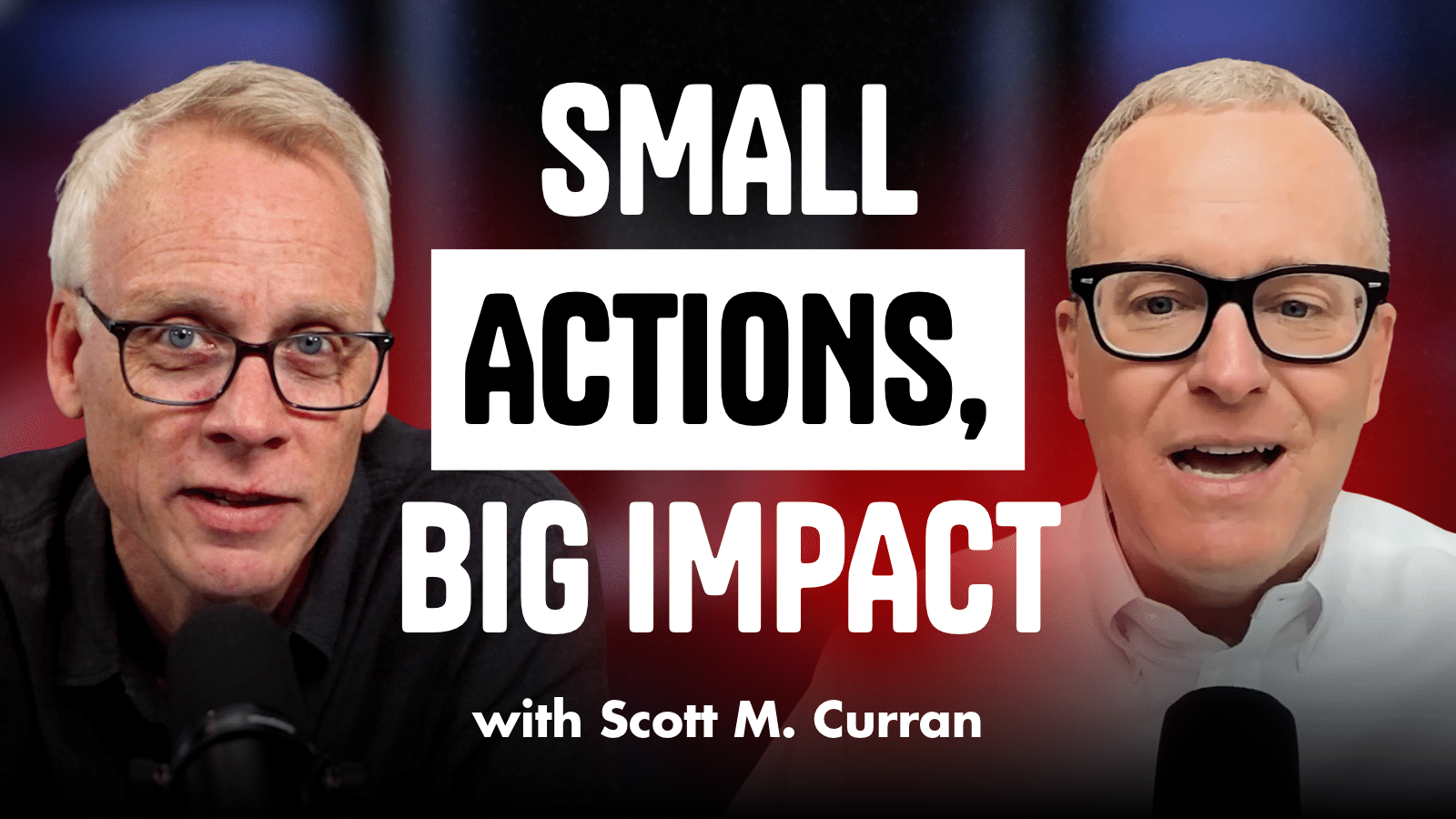
Hey gang, this week we’re talking to my new best friend, Scott Curran, the author of the bestselling book Better Good. Scott is a social impact attorney and adviser. He runs an advisory for foundations, large and small, and individuals on how they can do more good in the world through their work and through their donations. He’s the former general counsel of the Clinton Foundation. So he has literally learned from billionaires and presidents around the world, and he’s applied it in a way that all of us can take action.
So it’s a simple framework. We’re going to break down what I think are some of the best parts right here on this podcast. You will walk away inspired, realizing that you’re already doing good in the world, and you can do even more good whether you have any time to give or not. I hope you’ll enjoy this episode. I hope you’ll share this episode because the world needs more good in it, and we can all be the people who create it.
————————————-
Jay Papasan:
I’m Jay Papasan. And this is The ONE Thing, your weekly guide to the simple steps that lead to extraordinary results.
————————————-
Jay Papasan:
All right, Scott, welcome to The ONE Thing podcast.
Scott M. Curran:
Jay, thanks for having me. It’s a pleasure to be with you.
Jay Papasan:
You wrote a book about one of my favorite topics, giving, and one of the commitments I made years ago with my wife is not only to give more, but to teach people to give more. So you’re actually playing into one of my life missions right now. If I can get people maybe to dip into your book, or listen to some of your podcast and teach people to give, we can create exponential scale around the world.
It’s your story of starfishes, right? I like the alternate ending, right? You can’t save them all. But maybe you can teach other people to save starfish. And together we can save more.
Scott M. Curran:
I love that. I love everything about it. And you’re so right.
Jay Papasan:
I can’t say this without you telling the story, but you kind of open up with a story of maybe your first professional giving of your talents around a ferret organization of all things. So why don’t we start there and then I’m going to follow up with another question. So this is one of the first stories you tell. And people should know that Better Good has got a lot of stories and a little bit of humor in there. So you are a ferret aficionado. Is that the right thing to say?
Scott M. Curran:
I don’t think I qualify as aficionado. I am a former ferret owner. As I unpack a little further very early in the book, one of the axioms that I hope people take away from it is the ability to find your ferret, and whatever that might be in your life and in your world of doing good. But I basically shared that I went straight from undergrad to law school, and I had no intention of being a practicing lawyer when I went to law school. That’s a different conversation about how that all worked out. It worked out well is a very short version of the longer story.
But I was 24. I was practicing corporate law. I felt like I had no extra anything, and I knew I wanted to do good in the world. And so I was like, gosh, I don’t have any extra time. I’m still learning how to be a young lawyer. And it turns out it’s called practicing for a reason, because you have to practice a lot to get good at it. You graduate law school, but you wind up having to learn how to actually be a lawyer still. So you’re back at the bottom of a bigger mountain.
And I was like, I don’t know anything extra. No extra time, no extra ability, certainly no extra money. I had law school loans and rent was high. All the things. And one day I got a phone call from a sweet guy named Norm. I described him as like a tall, skinny, gentle Santa Claus figure with a white beard. And he said, hey, Scott, I know you’re a lawyer and you’re a member of our association, the Greater Chicago Ferret Association, the membership community that you join when you are a conscientious ferret owner, which I was in college and through law school.
And at the time, he said, we’re having a challenge. We have a volunteer that went rogue, a volunteer that was disappointed for some reasonable reason and then started acting unreasonably about it. And usually most people should move on. But she really dug in and kind of went to war with them in a small way, but in a problematic way. And he said, I know you’re an attorney. Can you help? Wow, I don’t know, can I? I am an attorney. Can I help? And, long story short: does the firm allow it? Right? Am I qualified to help? Like, there’s all of those questions going through your head.
Can we do pro bono for ferrets? Like, how does this work? You know, obviously a nonprofit ferret association, which is still alive and well today and doing great work, you know, rescuing ferrets and getting them adopted to loving homes. And so I went down the hall and I talked to an attorney who sort of worked in this space, and I said, are we able to help? She said, sure. And so that was the experience. My first, 24-year-old young corporate lawyer Scott. I’m now over 50. So it was a long time ago, but it was an eye-opening experience.
And it wasn’t just that I realized we could help. We sent a letter. It was sort of the right mix of, you know, a cease and desist letter without using the harsh words and sort of saying, hey, we understand you’ve got some issues, but you’re creating some problems that are making these things worse. And really, it’s the best way to move on. And everybody sort of came to an understanding and awareness that we should move on from this. And it worked out beautifully.
And it opened my eyes that even in times when we might not think we have anything to contribute across all dimensions of contribution, and that’s a core part of this book. It’s not just about checks or checkbooks or money at all. It’s about what we’re capable of doing to help someone else or a cause we care about. And the more I saw it, the more I saw it. It was like sort of Wizard of Oz, where it goes from black and white to color.
And I started seeing opportunities all around me, that it didn’t matter that I was so busy as a young corporate attorney, that I didn’t have a lot of financial resources. Opportunity abounds, and the more we see it, the more we see it. And that was the story that kind of opened it up for me in my professional life.
Jay Papasan:
I love that, and we get to talk about ferrets. I had a friend in college with a ferret, and I just remember white fur, kind of red eyes and… Albino, got it. Don’t let it around anybody’s pet bird. That was one of the other lessons. Really fun. All right, so you brought me down memory lane. That was your first professional experience. It opened your eyes. When you think back, growing up, was there anybody in your life that kind of taught you to give?
Scott M. Curran:
Yeah. And it’s funny, I ask that as the opening question. So if you’re kind enough to reciprocate and join me on mine, spoiler alert, the first question I ask every guest is, if you think about the concept of doing good, what is your earliest recollection of coming to an awareness that doing good was a thing that people did, and/or something you might be able to do? And nobody’s turned that question on me. So you just did.
And mine would be an experience. I vividly remember a teacher stopping me in my elementary school and saying to me, it’s such a good thing that your mom volunteers at the school so much. It was normal for me to see my mom volunteering at school, and in fairness, other people’s moms too, and parents and grandparents and aunts and uncles. But it was interesting to me that that teacher found it noteworthy enough to say something, because what was normal to me was noteworthy to her, and I thought about why that was a thing. And my mom did volunteer a lot at my school. She was there often in many different roles. And so that was my first awareness that it was something different than just normal or expected.
Jay Papasan:
I love your play on words, right? You thought it was normal. She thought it was noteworthy. That helps me remember it. I think a lot of people might default to like a lesson in church, right? The collection plate goes by, or they’re taught to tithe or whatever. That’s different. Right? I think in the beginning, for a lot of us, we were instructed to do good. Where we learned it is often where a role model like your mom, someone you love and respect, showed you a path or opened a door and you realized, okay, there’s something here. And that might have been the germ that started you down the path of exploring it.
So thank you for sharing. And I’ll just say on the record, since we’re recording it, I would love to be on your podcast. I’d love to talk about giving. Like I said earlier on, it’s something my wife and I take very seriously, and we try to be very intentional about. And if I can help your audience, I’d be happy to.
Scott M. Curran:
Thank you, Jay.
Jay Papasan:
So your framework for the book, right. As I mentioned in the beginning, you worked for one of the largest foundations in the world. So you don’t just go about this willy-nilly. And I know that y’all probably had a specific process at the foundation, but I often find that people who excel at things for a long time often develop a framework, a method that they can articulate, if they take the time, for their madness that they create in the world. It’s like, yeah, that guy really knows what he’s doing, and it’s intuitive until you write it and document it, and then you realize, oh, wow, there’s this thing.
So right in the middle is the familiar time, talent and treasure. But you bracketed it with three Ps and three Ss. I don’t want to go super deep. We can’t cover all of them. I do want to just give people a sense of the scope of what you’re covering, and showing people what’s possible in the book. So the three are…
Scott M. Curran:
Profile, platform and passions. Who we are and what we have is the profile, platform and passion. Everybody has a profile, everybody has a platform, and everybody usually has lots of passions.
Jay Papasan:
Yes. And then on the other side of time, talent and treasure, you’ve got the three Ss.
Scott M. Curran:
Scale, sustainability and storytelling, which are the advanced tactics of a social impact footprint, which are sort of how people go from good to great with it. I’ve had the good fortune of working with both the foundation where I spent a decade, but the hundreds of other partners that we worked with around the world and across the US, and the many hundreds I’ve worked with since, are all following some version of this framework.
And those who are doing it the best, the ones that wow us and excite us, are the ones that are doing some version of those three Ss: focusing on scale, which is just doing more of what works, focusing on sustainability, how do I do it over time? And then storytelling, which is so important, especially these days in a crowded and noisy environment everywhere in the world, online and in our scrolls and our newsfeeds.
Telling a great, compelling story does two things. Tells people what you care about and signals to the world, and then two, creates an invitation for them to join you on that journey. So storytelling, super important, easily overlooked.
Jay Papasan:
I think it’s one of the ways you scale. There are stories that are so shareable, so repeatable that they become part of the fabric of an idea. Right. And I think that sustain is how you keep from not scaling. Right. I think you gave some examples of organizations that maybe didn’t start on a firm foundation or kind of spread out, and all of my little Spidey senses around The ONE Thing started tingling around that one, for sure.
Scott M. Curran:
Understandably so. Exactly right.
Jay Papasan:
Let’s dive into a couple of those. One of the ones I think our readers need to hear is this idea of no extra time and time. People need to understand, I went through this book. It’s actually quite funny. You’ve got a great sense of humor in real life, and it actually comes through in the book. And I told you that while we were preparing, I love a book that’s how-to or self-help that still has a sense of humor, right? Because it makes the whole journey so much better.
But in each chapter, you take those big ideas, all nine of them, and you break them down into practical pieces. And I’ll just throw this out. It applies to the individual, it applies to a business leader. And you also talk about leading nonprofit organizations. I can’t remember the brackets you put around that, but you do takeaways. Here’s the idea and here’s how you would employ it as an individual and your business or organization or as a nonprofit. Did I kind of break down how you taught these ideas in the book accurately? Is my memory accurate?
Scott M. Curran:
It is. The way I love to read books. I always say that if I open a book, I’m usually front and back cover, table of contents. I want to understand everything within a quick view of the table of contents. And then I love a good chapter heading with a quote or some bolded stuff throughout, and if I can learn from that. So I try to write it that way for the casual skimmer. But at the end of each chapter, I also took key takeaways and action items because knowledge without implementation is useless, right? It’s an interesting book, but I can’t put it to work.
And so some of the stuff gets pretty deep, especially in the time chapter, right? Time management is something we all struggle with. So when I talk about how people use their time for good, I break it down a little bit and there’s key takeaways and action items. And my thought was if people just read the table of contents, skim the chapters, I at least want to give them in every chapter the ability to know the quick takeaway and then the action items.
And in many of the chapters, I break it down by type of organization because it gets granular. What might work for a for-profit business, like a Starbucks or a Chobani, or a United Nations Foundation in the philanthropy context, might not work for a smaller, you know, solo or hometown nonprofit. And so I wanted to make it super tangible, easy to understand, and actionable for all of the above.
Jay Papasan:
And for people at every level, like on treasure, the small givers who drive everything. They don’t need to learn about a donor-advised fund, right? That’s so advanced. But I like that you address all of your audiences. So just, you know, as a book writer to a book writer, I love the organization. It was very readable, but it also felt like something I could tap a page and go back, like, hey, I’m going to go back with my CPA and look at this one section around tax-advantaged giving. And it became kind of a practical resource as well. So all of that to say, now I’m just getting my book geek out.
No extra time. The people who listen to this podcast, a lot of them are listening because they’re trying to be better investors of their time. They run a business, they might have a family, they might be caring for young children, aging parents, or both. And so they really have to make hard decisions about what they’re saying yes to, which is one of the things we try to teach, and more importantly, everything. They’ll have to say yes if they really want to keep that commitment.
So you have this whole idea of you can be doing good with no extra time, which is how most of them feel. Can you walk us through that and maybe give an example so they can kind of hear? Otherwise they’re just going to roll their eyes like, what do you mean, how do people give with no time?
————————————-
Scott M. Curran:
Yeah. One of the core tenets of the book is that this is not as grand as it might seem. We have this tendency to think, when headlines are big and maybe heavy and headwinds are strong, or we see things that make the news with novelty-size checks and huge donations or MacKenzie Scott or major philanthropies, foundations or others, that it has to be something big to matter. That goes away very quickly. Finding your ferret, helping an association, your local community.
Also, one of the other things that I make clear is how the best in the world do good, and how you can too, is a line I use often. But the best in the world don’t mean the biggest. Some of the best in the world are in our own hometowns. And I talk about, you know, street corner nonprofits, and I talk about hometown heroes whose entire life of incredible doing of good occurs in one little community. And so the best in the world are you, you and me, every listener here, you’re among the best in the world too. And you can do everything they’re doing, including with your time.
And it doesn’t have to be transformative time. You don’t have to quit your job and get a new one. You don’t have to go on a Peace Corps adventure. Those are things we tend to think of when we think about doing good in the world. You don’t have to volunteer hundreds of hours. You don’t even have to have any extra time at all. Like the ferret example, it was a minimal amount of time, right? Somebody called me at work and asked me something that was directly work related.
One of my other colleagues and collaborators in the world is an executive leader at a wonderful nonprofit, but with a high-profile founder. And she told me, she said, you know, Scott… I’m now giving you the really tangible example any of us can do. All of us can do, and we should all think about how the world is better if we all just did the following. Now she works at a nonprofit. She lives a life of purpose, and her work has purpose baked into it. But she said, I’m struggling with the world around us today and knowing whether or not I’m making a difference. So I’ve decided to take calls like the one we’re on right now, Scott, and take a walk and pick up every piece of trash I see, because it makes me feel like I’m doing something that matters in the community where I live.
This was not a volunteer shift at the local humane society. This wasn’t a purchase of a product that does good in the world. This wasn’t an impact investment. This was simply using the time she already had doing work for a nonprofit, which I already think is pretty awesome. Yeah, to find more fulfillment by doing a little extra something with no extra time.
Jay Papasan:
We call that lining up your dominoes, right? People are like, oh, I know I need to attend to my friend relationships, and I need to attend to my health, and so… Well, why don’t you go for a long walk with your best friend, right? You can talk while you walk, or you can go to class and grab a coffee after. You can line up things in ways that surprise us. It just takes pausing and thinking and asking the question.
Funnily enough, my wife and her best friend do that. They’ve done it every weekend for as long as I can remember. They go to the local town lake here, they walk around it, and at one point they bought each other those little picker-uppers.
Scott M. Curran:
Grabbers?
Jay Papasan:
Yeah, grabbers. They look like old people, like I’m going to put on my socks, but they are walking around and they just decided they’re going to pick up trash. They just made it another thing that they can do with the time they already were investing in one activity. They can make it more meaningful for many. So that would be a challenge for people who think they have no extra time, is that there’s probably something you’re already doing that just by tweaking your approach, you can create some good around it. And I like the example of trash. It resonates for me, but there’s a million other ones out there.
Scott M. Curran:
There’s so many. There are so many. And again, the more you see it, the more you see it, the more it works, the more it works. Look at the story that we just told about what your wife and her friend do and the ripple effect of all of this, which is that that is something each of us can do. And momentum begets momentum, and the empowerment of knowing that we can do something and it does make a difference, and we can see it. In this case, it’s tangible and visible.
It takes the burden down and provides some relief. And that should empower everybody to know that what you do matters. It is the small acts that matter exponentially more than the single noteworthy, newsworthy headline. Those are important too, but it’s not exclusively reserved to that in the world of doing good.
Jay Papasan:
I can’t quote the research that you quoted. When I teach giving, I usually go out and just kind of refresh my memory, but I think it’s around page 200. You kind of talk about the impact of small donors. I seem to remember like 75% of all giving, it’s like $50 or less.
Scott M. Curran:
The majority of giving in America is by small-dollar donors. It is not the big giving. You know, people think, oh, corporate philanthropy must be the biggest. No, it’s barely 4%. It’s actually ticked up in the past year and a half or so, which is actually a great sign too. But there’s room to grow. And even so, most gifts in the billions and billions that are given every year in philanthropy alone, the vast majority, 60 to 70%, come from individual givers. And then here’s another thing for the development directors, or for those who are wondering where big gifts come from: the vast majority of major gifts started as small gifts under $250.
Jay Papasan:
I underlined that.
Scott M. Curran:
Yes. And by the way, if we can play in the novelty-size check space too, just in recent weeks, you know, the billionaire Ken Griffin made a huge contribution to Carnegie Mellon University of $3 billion, which is important and noteworthy in an age where we’re wondering about the bargain between, you know, society that helps create the conditions for people to succeed and then what we expect of those people once they have succeeded.
And there’s a tradition in history in the United States and around the world where those for whom they’ve achieved great success tend to give back. We have, you know, Rockefeller Foundation, Ford Foundation, we have Carnegie, we have libraries and museums and arts and institutions built by these folks. Ken Griffin didn’t even go to Carnegie Mellon. So development directors of the world, be aware, there’s great news out there. A compelling vision and a well-nurtured relationship with Carnegie Mellon and Ken Griffin resulted in the largest contribution in education’s history, even adjusted for inflation, over Vanderbilt back in the day and others since.
So yes, there are some big ones and they’re noteworthy and they’re interesting, but they remind us that we are compelled by these visions of a better world and our desire to contribute to them at whatever level, whether it’s financially related or not. But you don’t even have to be an alumni to secure a $3 billion gift now. So that’s what we’re seeing in this space, is that there’s this opportunity to explore what’s possible at any level, and that even the big ones start with small dollars and sometimes no relationship at all.
Jay Papasan:
The idea that these big donors often started with a smaller donation, as little as 250. I remember the first time I stroked a $250 check that wasn’t paying for groceries, gas, or, you know, something that we needed. It felt big at the time, and I can only imagine if that’s the journey. Wow. Can we afford to give this much? And then you feel the vibes that you get afterwards. And you make a good case. We are very much wired to help people. You know, I don’t remember, was it the oxytocin? You walked through all the good hormones, right? We get all the good hormones when we do acts of good and even when we witness other people. And so you get that reinforcement that that thing was good. And then some people don’t necessarily get addicted to it, but they get committed to it.
And I do remember the first time that we thought we can just give 250. We have a thing called the Say Yes fund. When we were small givers, I asked my wife how often coworkers came to her to ask her to donate to causes, whether it be, oh, will you buy some popcorn for the Scouts or cookies for the Girl Scouts? Right. All those things or whatever. And sometimes you just want to close your office door if you have one and hide, right? Because you’re like, oh God, here they come again. They’re going to ask.
And I just said, what would it look like for us just to be the people who always said yes? And she goes, oh, 25. And I said, yes, if we’re really being generous, 25. If we were going to give 50 times as a family, how much could we afford to give? And we agreed that we could give $25 a pop. So that was our 25. But that adds up, I think, to $1,250. So we had to budget for it. But we just agreed, without permission from each other, we could just stroke a check for whatever cause for this much. And then each year we started raising that amount a little bit as we got more comfortable.
But that’s just an example. Start where you are, right? You don’t need to put giving on a credit card. That’s probably not a sustainable path, but there’s probably loose change or something that we can do, and it adds up to a huge percentage of all giving. These foundations that do good in the world depend on everybody, including you. So I’m preaching now.
I just said the word sustain. That one rang true for me because once people start getting addicted to this and committed and they build plans around how much are we going to give as an organization, a lot of times that ambition can actually undermine the mission, and that’s where they either try to do too much too fast, or spread themselves too thin. So what have you learned about these individuals and foundations that have built sustainable operations that maybe we can all learn from?
Scott M. Curran:
It happens by design, not by accident. So, you know, Jay makes a really great point, which I start very early in the book. Explain why does this matter? It matters because we’re wired for good. Humans are. It’s dopamine, oxytocin, serotonin and endorphins flowing through our bodies, and always have been. And so we’re wired for this. So we should never bet against human nature.
We take that wiring with us when we go to work, which is why it’s great for employers to care about what their employees care about, and do great things together to make the world a better place. It increases retention, which reduces the need to… it’s expensive to hire new people and train new people. We take it with us when we go and make purchases of products and services, and that’s why businesses that do good grow faster and sustain longer.
So for each of us individually, though, we have that wiring in us all the time. But to the point you make, Jay, we can flame out quickly if we’re not aligned with a passionate cause, or we try to do something that isn’t really core to what I call our Goldilocks zone: what we really love the most, our crawl-through-glass passionate causes, and what we do best. That’s the single greatest way to sustain. Do something you deeply, deeply care about and are really, really good at. That’s the best way to keep going through all the seasons of life.
And that’s a key point. Remember, life changes, right? I moved on from ferrets, but I’m still in animal rescue. We went from, you know, ferrets in college and law school to dogs. And now we’re a dog rescue family. And we have lots of those stories. But it’s still under the umbrella of animal rescue, and we still care deeply about it. And for a while we were a foster family. We’re not a foster family right now because our kids are 15 and 17, and we’ve got all the activities and a ton of travel that doesn’t lend itself to fostering. But we’re still involved with dog rescue.
So being thoughtful about what it is you care about, what you’re really good at, and then going with the flow of the seasons of life, but staying committed to the causes that really drive you most and how you can uniquely contribute over those times. So sustaining is just doing more of what works. The ones who do it best are always mindful and attentive to understanding that what works changes over time, and then changing with that. And so there’s organizations that have sustained forever and there’s organizations that haven’t sustained forever. And we learn as much from the failures and those that don’t as we do from those that succeed.
And so that’s really the course. Stay focused on your Goldilocks zone of what you love the most, the passionate causes you would crawl through glass for, and what you’re best at, and then go with the flow and understand that the seasons of life will take you in different directions. But as long as you stay committed to the causes you care about most, or doing the things you are best at, you will still find new ways to contribute over time.
Jay Papasan:
I love that. And the passion, I think, is what leads some people to get over their skis a little bit and get out of their gift zone, and that can kind of lead them down a path. We work with a small organization here in town called Red Oak Hope. We’ve known the founder for a long time. She was overseas. A woman approached her and said, can you help me escape? She was being trafficked. That led to this whole organization that originally started with getting people from overseas.
And I remember as a donor watching their results, and they were good at helping the women find their footing and reenter life. But staging rescues in different countries around the world is an incredibly complicated feat. And when they passed the torch to the new executive director, they refocused their mission. Same passion, but they just said, well, what if we just did it in Texas? Well, guess what? There are more trafficked individuals in Texas than any other state in the United States.
So right here in their backyard, where they don’t need passports, they don’t need international organizations to help them, they have an opportunity to extend their mission and build relationships. And we’ve seen the magnitude because they found their Goldilocks zone, as you put it, and they found this intersection of their passion and what they were really good at, without overextending it. And they’re actually doing more than their, quote, more ambitious mission used to.
Scott M. Curran:
On the cover of the book, it says, start where you are, use what you have, make the world a better place. And that sounds overly simple, but simple is elegant and wonderful and beautiful. We all prefer simplicity. Simplicity is hard. Simple is hard.
Jay Papasan:
It’s easy to do, hard to find again.
Scott M. Curran:
The more it works, the more it works. And just starting, there’s such power in that. The story you just shared reminds me of the Nancy story I shared, who also was half a world away, discovered people living in darkness without access to reliable electricity.
Jay Papasan:
Love this story.
Scott M. Curran:
And using kerosene or batteries, which would cost 30% of the household budget, the equivalent of a US mortgage. Imagine what you could do in the world if you didn’t have a mortgage to pay. And so she saw, well, wait a minute, we have the ability to solve this problem. But it was half a world away and she was a mom of five boys. You want to talk about not having
Jay Papasan:
No time.
Scott M. Curran:
Or anything else for that matter, being a parent of five kids, much less five young boys at the time. And again, the empowering message here is just take the next right step. And years later, over 20 years later, now Watts of Love is this great nonprofit, this solar lighting nonprofit that has delivered light, love and economic development and empowerment to some of the hardest-to-reach places in the world and some of the hardest-to-serve communities, including leper colonies that still exist in the world, living in darkness.
And these stories abound, Jay, and this is the space we get to live in. Even in a world with heavy headlines and even heavier headwinds that result from that, and the feelings of disempowerment we get from it, these opportunities are around us. These examples: you just shared one from your community. Nancy’s is in my home community. I literally walked in their nonprofit’s front door one day and a little bell rang when I opened the door and we introduced ourselves. And that was 20 years ago. And now they’re a global nonprofit doing this amazing work.
These things are still out there, and they are wonderful stories. But the best thing is that they’re wonderful examples of what people can do when they just take the next right step, and that is the opportunity available to every single one of us, every single day we’re fortunate enough to wake into.
Jay Papasan:
All right, I think you’re leading us to the challenge. I think that people need to buy this book. I think we also need more of these stories in our lives. I hope that I can curate my feed someday to just be puppies and stories of people doing good in the world versus what I sometimes see. But there are days where it really does kind of line up. This person helped that person. You just see it and it’s touching and it hits those emotions, and it makes us want to see more of it and do more of it.
So on your website, if people go to BetterGoodBook.com, they can navigate. You actually have an action plan for people to do an inventory of their three Ps, their three Ts, their three Ss. Does that help them find their Goldilocks zone? Like where to start?
Scott M. Curran:
Absolutely. It’s a simple tool and it’s available. It’d be great if you get the book and you want to go to the advanced tactics, but if you just want the action plan, you want something you can do today, grab the action plan and start. And if you don’t want to even take that step, just grab a Post-it note and start writing down what you already care about most, your passionate causes, the ones you’d crawl through glass for. Inventory your profile, your platform, and those passions, how you contribute your time, talent, and treasure. Start there and you will see what you’re already doing and then grow from there.
You don’t have to do anything extra. You don’t have to wait for some other set of assets or resources or some other someday. Someday isn’t a day in the week. Someday is today. And so just take that next right step and start inventorying where you are and what you can do next, whether that’s just on your own as an individual. Perhaps it’s with your family, maybe it’s at work, or if you’re a leader of an organization, whether it’s a for-profit or nonprofit, do the same for yourself and with the people you lead or serve and support.
Momentum begets momentum, and there’s incredible power in that action. And even in just communicating with the people around you about what you care about, it is so important. And when you scroll that feed, by the way, share an example of something good in the world. That’s another no extra time. Just hit that one little button that allows you to share to your feed something good. And that will send out a message and a signal to others. And it’ll curate more of that for you. It costs nothing extra, no extra time, but it delivers goodness to that feed and you can share that with others.
Jay Papasan:
I listened to the best podcast today about giving and doing good. There we go. There’s a suggestion for us. I’m going to count that as our weekly challenge, Scott, which we always give. I think in less than 30 minutes people can either inventory, they can remember those ideas, like what is my profile, platform, my time, talent, treasure? Like, where am I? And what am I able to do? Or they can use your action plan to help get them started if they want to take a little bit more time. But I like the idea of figuring out where I am, if I’m going to start where I am, so I can take the right next step.
Scott M. Curran:
Awareness and intentionality are the two things that I hope people take most from this book. If you’re aware of what you’re already doing and intentional about what you do next, you are on the path to Better Good.
Jay Papasan:
Scott, thank you for being on the podcast, and thank you for making such a positive impact on the world. It’s really inspiring. I love this conversation. I love the book and I hope it finds a really, really wide audience.
Scott M. Curran:
Thank you so much, Jay. And thank you for all the good you do in this world. And thanks for having me.
————————————-
Disclaimer:
This podcast is for general informational purposes only. The views, thoughts, and opinions of the guest represent those of the guest and not ProduKtive or Keller Williams Realty LLC and their affiliates and should not be construed as financial, economic, legal, tax, or other advice. This podcast is provided without any warranty or guarantee of its accuracy, completeness, timeliness, or results from using the information