Jay Papasan:
Hey, gang. As we dive into this episode, I want you to ask you a question. Think of at a time in your life when you were navigating a big change that required you to become something kind of new, maybe you were a little scared, maybe you were a little uncomfortable, maybe you lacked in confidence because the transition was pretty fundamental.
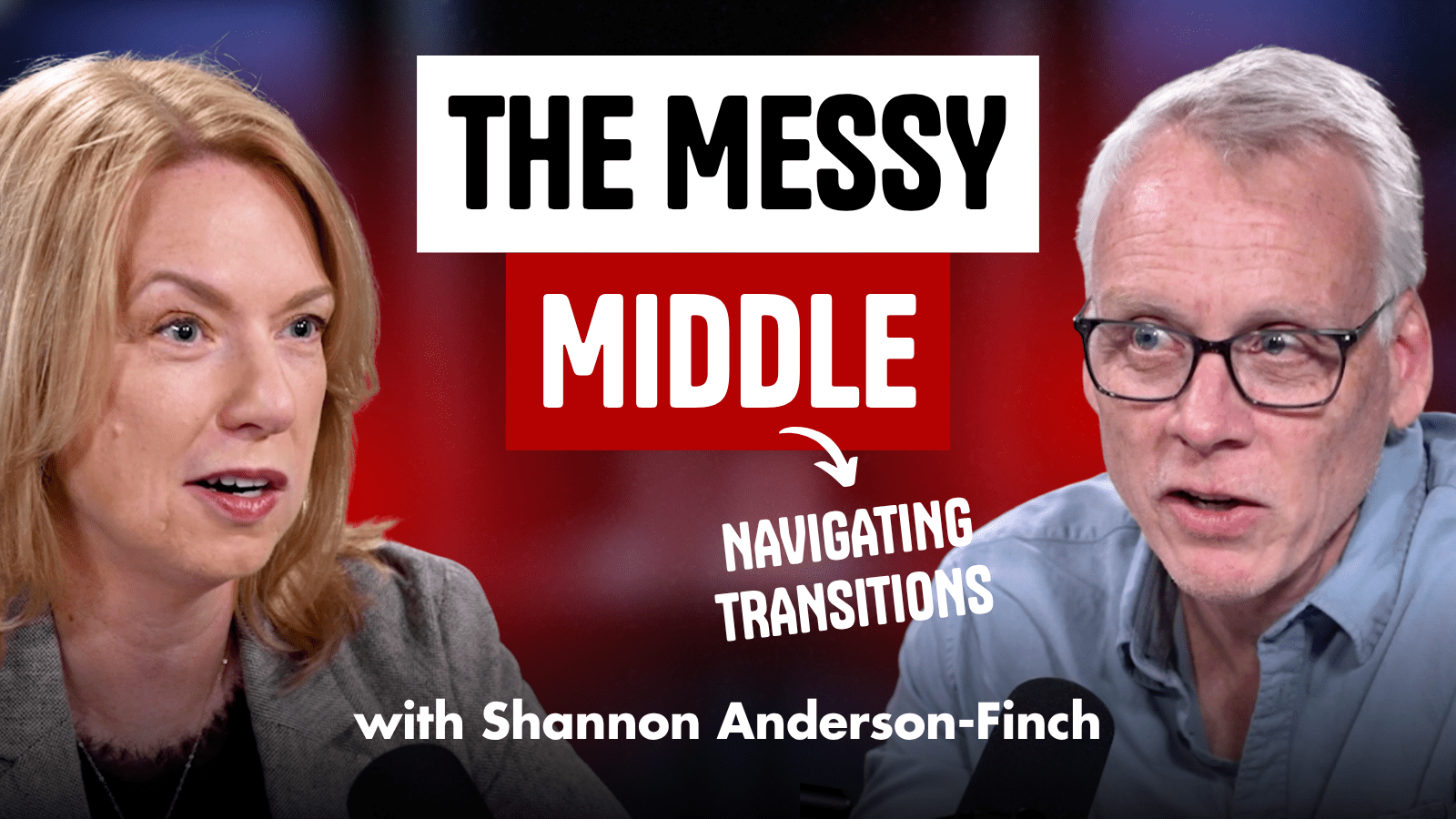
Well, our guest this week, Shannon Anderson Finch, a high-level and experienced executive coach, she calls these transitions. It’s not just a change, it’s a transition that requires us to level up in a way that we take on a new identity. We’ll talk about what it means to let go of the old, how we embrace the new, and how we navigate the messy middle. There’s lots here to learn from if you or someone you care about is going through a transition in life, enjoy.
—————————————
Jay Papasan:
I’m Jay Papasan. And this is The ONE Thing, your weekly guide to the simple steps that lead to extraordinary results.
———————————————-
Jay Papasan:
Shannon, welcome to the show.
Shannon Anderson Finch:
Thank you, Jay.
Jay Papasan:
You’ve been coaching for a while now. You’ve got an experience as a consultant and a coach over many, many years. You specialize a lot in transitions.
Shannon Anderson Finch:
That’s right.
Jay Papasan:
So, when we were chatting beforehand, first off, I think a lot of people, myself included, think about transitions backwards, and they get some things wrong. So, when we think about transitions, what are we talking about?
Shannon Anderson Finch:
First of all, we have to know whether we’re talking about a mini transition or a major transition. So, mini transitions, I think of them as kind of the glow up, like maybe you start a new job in your same company, or you have your same job in a new company, right? Or maybe you go from one business you’ve started before to a similar business, right? Those are-
Jay Papasan:
Kind of applying the same skills you already have at a new level?
Shannon Anderson Finch:
Yeah, yeah. That’s a good way to think of it. So, sort of one element changes, right?
Jay Papasan:
Okay.
Shannon Anderson Finch:
Now, in a major transition, and we only have a couple of these in our lives, it’s much more fundamental. It usually requires, kind of, a reinvention of who we are, a shift in identity, and it can include things like making a major move across the world, maybe starting a new company for the very first time, leaving corporate. So, it’s really something much more fundamental and a bigger process.
Jay Papasan:
So, it goes beyond our skillsets to more of our beliefs and our identity.
Shannon Anderson Finch:
Absolutely. Identity.
Jay Papasan:
I think a lot of people who’ve listened to this podcast, maybe they were working a job and they’ve started a business, or they’re starting a new business, and those are pretty fundamental. Like working in the security of a job market versus being self-employed or an entrepreneur, fundamentally a shift in your identity and how you have to operate.
Shannon Anderson Finch:
Yeah, that’s the core. It requires things that you’ve never done before, thinking about yourself in an absolutely new way. I think I see when people make a transition, say from corporate to entrepreneur, like, they kinda hesitate at first to say, “I’m an entrepreneur,” or “I’m a coach,” or “I’m a…” whatever thing they’ve stepped into. They’ve gotta really try it on and wear it for a while before they’re comfortable.
Jay Papasan:
Got a friend, she got a big publishing deal from one of the big five publishers. She had a great launch. The book was selling well. She’s, like, six months into it now, and she still couldn’t call herself an author.
Shannon Anderson Finch:
That’s it.
Jay Papasan:
And I was like, “What? What are you talking about?”
Shannon Anderson Finch:
Yeah. Right. You are.
Jay Papasan:
You’ve got what everybody dreams about. Who else gets to call themselves an author? Like, where do you get to cross that line? And the good news is, with some help from her friends, she started taking ownership. Like, when someone asks, “What do you do now?” She’ll say, “I’m an author and an entrepreneur.”
Shannon Anderson Finch:
Without the hesitation.
Jay Papasan:
Yeah.
Shannon Anderson Finch:
Yeah. That’s it. You know, I was just talking to a friend yesterday who has really developed as an artist. She’s still in her corporate role, and I asked her, actually, “Do you call yourself an artist?” And she said yes without hesitation. But it took her a while to get there. So, she started to live into the community of being an artist. She had a residency at a place in Champaign, which sounds absolutely fabulous.
But really part of it, I think, and that’s part of the identity shift that comes with these big transitions, is changing your community as well. So, really starting to hang out with other artists, or hanging out with other authors, or hanging out with other coaches, so that you can understand what it really means for you to be part of that.
Jay Papasan:
Well, that’s interesting, ’cause that gives us something proactive to think about, right? If we’re thinking about shifting into a new skin, right? Like, I want to go from being an employee to an entrepreneur. I wanna go from being X to an artist, or an author, or whatever that is, it sounds like one of the things we could proactively do is to start hanging out with those people more.
Shannon Anderson Finch:
Absolutely. And people talk a lot about feeling strange kinda trying to get their entry point to that community, right? But it’s walking in and finding out that you are welcome, that you can belong to a new community, and then start to see yourself that way. But that is actually, I think, one of the really important proactive things, as you said, is to start hanging out with the people, meet other authors, coaches, artists.
Jay Papasan:
So, you’re working with me and I’m like, “You know, I’m really wanting to step into my new identity as a whittler,” right? A professional shaper of wood-
Shannon Anderson Finch:
There you go.
Jay Papasan:
… whatever that’s gonna be. Great. Like, what would be the things that you might encourage me to explore, to take that, put those robes on, and be a little bit more comfortable in them?
Shannon Anderson Finch:
Yeah, it is actually. You said put the robes on, and I also think about it like putting a jacket on, right? Like, trying it on for size.
Jay Papasan:
A uniform.
Shannon Anderson Finch:
Yeah, yeah, right. You’ve gotta sort of act your way into the new identity, and not act in the sense of being fake, but do the things that people in that identity do. So, like, maybe there’s a whittlers club, right?
Jay Papasan:
I gave you the worst possible example.
Shannon Anderson Finch:
I know, it’s a funny one, yeah.
Shannon Anderson Finch:
Yeah. The whittlers club but really, there usually are associations or clubs where people come together to hang out and I think people often find more often than not that they’re welcome.
The same can be actually just… I mean, take it back to leadership is, I’ve been coaching a president of a hospital recently, a large hospital, and this is the first time for that person to be in the president role of the hospital, and the person doesn’t have a lot of friends or people who are presidents of hospitals. So, that’s one of the things I actually encouraged her to do, was to go out and start to network, activate her network, figure out who else is a president of a hospital, and understand what they’ve gone through. Being able to tap into them for assists when you encounter things that you haven’t encountered before and starting to really step into that identity.
Jay Papasan:
I’ve found people, like, if I was trying to connect, I’m stepping into a new role, president of a hospital, we could generally either reach out directly or through LinkedIn or one of these places, and if you say, “Hey, I recently have stepped into this role. I was wondering if I could have a virtual coffee.” If you’re willing to be a little flexible on finding time on their calendar, I’ve found most people who’ve already attained the place that you’re now stepping into to be incredibly welcoming, ’cause someone did it for them.
Shannon Anderson Finch:
People are really eager to pay it forward, right?
Jay Papasan:
Yeah.
Shannon Anderson Finch:
They know that somebody helped them along the way, and I think they’re more than willing to help others along the way. Yeah, I think that it’s just getting me really thinking about the fact that we can’t underestimate the identity piece in transitions, especially these more major ones.
Jay Papasan:
Well, like, we can go into more of the way you think about just holistically, but you dropped into… like the moment I hear pragmatic and actionable, like, if someone listening to this is struggling stepping into the new shoes, like I was working with someone who was an amazing salesperson and grew their business by basically being the rainmaker, as they called them, I can bring the deals. And now that the company was a certain size, they were like, “I have to be a CEO now, and I have to start being the face of the company.” And they were thinking that there were a lot of activities that were required that may or may not be true, but that was their impression of what they had to become. And they were also uncomfortable in the new roles.
So, like this is where you were sharing beforehand, when we think about a transition, what are the three stages?
Shannon Anderson Finch:
Yeah. So people think about a beginning, middle end normally, but in transitions, there’s an end, there’s a middle, and there’s a beginning. So, the end ends up being really, really important that we close out what came before and let go of behaviors that aren’t serving us or skills that we no longer need. Maybe even connections, right? Sometimes, communities change.
The middle to me is the super fascinating part. That’s the part where we really do that work of letting go, where we’re in what I call the messy middle, right? It’s that liminal space, that space that’s neither here nor there that we have to work through.
Jay Papasan:
You haven’t completely left and you haven’t completely arrived.
Shannon Anderson Finch:
Exactly. And then, the beginning is when you start feeling like, “I’ve arrived.” Like, “Yeah, I’m a CEO,” and you say it without hesitation, or, “I’m an artist.” But yeah, that middle is where I’ll say the magic happens, right? The real work happens that allows people to make the move into that new role successfully.
Jay Papasan:
Well, let’s, let’s go through them in the correct order. Let’s talk about if we’re going through a transition, the first step is have we truly ended what was, so that we can fully embrace what’s going to be. Like when I was sharing, like the executive I was talking to was incredibly comfortable. They had decades of success on the old identity. So, how do we walk people through and help people understand. You’ve talked about some of the activities, like do the work that someone in that role does, hang out with the people they would hang out with. Like, some of those things help us kind of wear the robes or the uniform more comfortably. How do we help people let go? ‘Cause that’s gotta be kinda terrifying for people.
Shannon Anderson Finch:
It is terrifying. And there’s that moment, I think like a good metaphor is when the trapeze, right? I’ve never swung on a trapeze, but I could imagine there’s a moment when you’ve let go of the first bar before you’ve caught the next bar, and it’s gotta be absolutely terrifying, right? That’s the middle, right?
And so, some of the work, I think, a couple things that come to mind… Well, you know, we’ve talked about this before, but I’m a big proponent of strengths-based approaches to self-development, to leadership. And so, I think, taking stock really of-
Jay Papasan:
You know, let’s unpack that just in case someone’s listening like, “What the heck does that mean?”
Shannon Anderson Finch:
Okay. Sure.
Jay Papasan:
So, if we say strength-based approach, what does that mean?
Shannon Anderson Finch:
Yeah, so the idea is that… and there’s ample evidence for this, that if you double down on your strengths, that you will go further faster than you will by focusing on fixing your weaknesses, right? That’s the basic idea. And I mean, we’ve got 30 years of evidence for this accumulating. We can talk about that if you want to, but there are weaknesses. You know, fatal flaws that do have to be fixed, but that’s not what we’re talking about. We’re talking about really knowing what your superpowers are and using those to propel yourself forward.
Yeah, so I think on this, what we were talking about is taking stock, right? Really taking stock of your true strengths and superpowers, the things that really do set you apart from others, and also figuring out what the weaknesses are that need to be addressed or can be mitigated, right?
Jay Papasan:
My feeling, and you can tell me if I’m wrong, is most people are not very good at knowing themselves.
Shannon Anderson Finch:
Yeah.
Jay Papasan:
So, like, I mean, I can go take the StrengthsFinders, but how will I know what strengths that served me in the past could serve me in the future, and try to identify maybe some of the strengths that in the new role, that’s what we’re talking about I’m going from individual contributor to leader in whatever facet that is. My ability to do the work can often hamper my ability to lead-
Shannon Anderson Finch:
Absolutely.
Jay Papasan:
Right? If I’m overusing a strength. So, is there a process you get people to do that if you’re coaching them to help them take stock of where their strengths are and how that could serve them through this journey?
5Shannon Anderson Finch:
Yeah. So, I’m a big fan of assessments. I use the Hogan assessment just as an example ’cause it’s a great one that really looks at reputation, right? Sort of how other people see you without having to do a 360. I think 360s are incredible.
Jay Papasan:
I love that you said that. I’ve done a few of those and that’s actually really going… Just explain it for people. A 360, as I’ve experienced it, is you go to your peers or someone goes to your peers on your behalf and you ask them, “Hey, in working with Shannon, what do you think her strengths are? Where do you think she needs to be coached?” You get kind of a view of how other people not only see you, but experience you in the workplace.
Shannon Anderson Finch:
That’s it. And I think that’s the magic. And 360s can be sort of quantitative with surveys or interviews are much more powerful if you’re able to do them. But I think going out and getting this kind of honest assessment, ’cause with 360s, the themes are extracted, it’s confidential, so people really do open up and share what you said, which I think is the most important part. What is the experience of working with Jay? What’s the experience of working with Shannon? Because your intention may not be the impact that you’re actually having. And I think through a process like this, you get some really, really honest feedback because we know also the higher you go, the more filtered the feedback is.
Jay Papasan:
I know. And that’s where we get to, I’ll share and you just either corroborate or share how you do it. If someone doesn’t have the resources to hire someone or to do that, like the do it yourself model is often, who are the people who’ve known you for a long time and know you very well, that you also can be vulnerable and hear both the good and the bad from? And usually, people can list two or three people that they can go and have a real conversation. And as leaders, sometimes that may not be in our building.
Shannon Anderson Finch:
Right. And the interesting thing is that how we show up at work is actually how we show up in life typically. We like to imagine it’s not. But time and time again, I see, like, a debriefing, an assessment with somebody, they’re like, “Oh, yeah, ask my wife about that.” Right?
Jay Papasan:
If someone’s gonna call my BS, the first person is gonna be my wife, Wendy.
Shannon Anderson Finch:
Absolutely.
Jay Papasan:
Right? She’s gonna be like, “No, you’re not.”
Shannon Anderson Finch:
Absolutely. Right? But what you said’s super important. You gotta set the frame for the honest conversation. Tell people what you’re after, that you really wanna get an honest take on your strengths, your liabilities, and also untapped potential. I mean, that’s the third category that, what am I not even noticing that might be a strength? And people around you are in a good position to play that back to you.
Jay Papasan:
I love the question, what would you do if you were me?
Shannon Anderson Finch:
Yeah.
Jay Papasan:
Right? And it’s great to ask a mentor in general. But a lot of times, people see you and they’re envious of qualities that you have that you don’t give yourself credit for at all.
Shannon Anderson Finch:
This is it, yes.
Jay Papasan:
And it’s a blind spot on our strengths. And so, they’re looking at you and like, “Ah, Shannon, you’re so good with languages, and you’re so good…” Like, I mean, I say this from a… Like you traveled all over the world and lived all over the world. So, I’m cheating, but, like, you’re so good with fill in the blank, and that might be something that you’re comparing yourself to a peer that’s 10 years down the road, and you see that as a weakness, not a strength.
Shannon Anderson Finch:
Right. That’s that’s that untapped potential. And I think especially in transitions, there’s a lot that just hasn’t been explored yet. And it really takes some time to explore and examine the possibilities for yourself as you are making the move to go forward to the next thing.
Jay Papasan:
So, how do we know that we’ve ended it? So, like, the end part, we’re gonna maybe take stock. Sounds like that’s gonna go into the middle.
Shannon Anderson Finch:
That goes into the middle, yeah.
Jay Papasan:
We’re gonna start, like, if we’re assuming this new identity, start doing the things and hang out with the people, that’s gonna go in the middle. How do we know that we’ve moved out of that first phase of ending?
Shannon Anderson Finch:
It’s a tough one ’cause I don’t think it’s as clear as we would like it to be, right? We would like it to be sort of linear. We would like the end, the middle, and the beginning to be clear. But I think unfortunately it’s much cloudier than that. And that’s actually, I think, the trick of it all, or the opportunity of it all, is to use that middle space as the place to practice dealing with uncertainty, navigating ambiguity, spending time and exploration to see what emerges.
So, it’s interesting. I did a series of interviews with about two dozen people last year about transitions and asked them, “Actually, how do you know that something has ended?” I’ll take you back to what I said at the beginning is there’s a change, which is kind of the external thing, and there’s a transition, which is more the internal thing. So, people know clearly when the change has happened, right? Like, “I no longer work at this company. I have officially founded the new business.” And they know when the sort of new beginning has started, right? “I’ve started at the new job. I have the new title.” But that’s the change, or, “I live in this new country.” The transition is that inner part that we were talking about, the identity part, and that is a little less clear. We often hold on to our identity way past the end of something.
Jay Papasan:
I think until you let go of it, you can’t say you’ve begun.
Shannon Anderson Finch:
Exactly. Like we see this with people moving out of corporate, for instance, really hanging on to their corporate identity, especially if they’re associated with a big brand, right? Like, they almost lead with, “I work at Apple,” or whatever company, big-brand company that they’re associated with. But until they have that kind of new identity, and that’s the transition. It’s much less clear. It’s difficult. And that’s where the place I really like to coach because it is so ambiguous. It’s a place that having a guide really does make a difference and to support people working through that middle.
Jay Papasan:
All right. Well, let’s take a quick break, and on the other side, you’ve just led us to the middle, and that’s where you shared that’s where a lot of people try to rush through that, and that might be the biggest mistake they make in a big transition. So, let’s take a quick break, and on the other side, we’ll kind of help people manage the messy middle.
————————————–
Jay Papasan:
All right, Shannon, I’ve let go of the old as best I can. I have started to do this process of managing towards this new identity, this new opportunity that I have. What are the things you look for as a coach on helping people navigate this middle? You said earlier that when people try to rush through it, it’s maybe the biggest mistake you see.
Shannon Anderson Finch:
Yeah. It’s kind of the missed opportunity. Like, I was thinking about your author friend potentially kind of rushed through what was really happening in the middle because when sort of wasn’t able or ready to adopt the author identity on the other side. And so, I think, we have the credentials, we have the track record. Like, we have expertise, experience. We’re used to kind of achieving, right? Moving forward, getting to the next thing. But especially in a major transition, if we skip this middle work, it often takes much longer for us to settle into the new role.
So, coaching somebody, like I work with a large retailer coaching VPs. They’re new VPs, and at that company, that’s really a threshold level, right? Right. We-
Jay Papasan:
Big transition.
Shannon Anderson Finch:
Big transition. I would consider it a major transition for them because it’s sort of… I often joke with them, you know, it’s the bottom of the top, right? The curtain peels back, and they get to see what’s really going on. They’re considered a leader, almost an owner of the company. And that’s very hard to step into. And if they rush into it and try to, say, use the authority of being a VP to do the work, it just doesn’t work. They haven’t taken the time to kind of explore and settle into what does it actually mean to be a VP? What does it mean to be a VP here?
I often talk about expanding your range, right? Like, what do you need to add to what you do to be successful at the next level? And taking a bit of time to make sure you align who you are with how you lead can make a big difference.
Jay Papasan:
I think, in my interview with the friend you introduced me to, Simone, so it was often he was talking about, like, in a crisis, one of the most important questions we can ask is, who do we wanna be in this and how do we wanna show up? So, if you’re assuming that new role, there is the… I don’t know, the blocking and tackling. What are the skills I need or have? What does it mean to be this role in this organization? What does it mean to be that role if I’ve never done it before?
Some of that is usually discoverable, right? We can talk to people who’ve gone there before us. But how we wanna show up in that role often is a question that we have an opportunity to go a little deeper on.
Shannon Anderson Finch:
Yeah, absolutely. And sometimes when I start talking with clients about expanding their range, adding new skills, talking about what’s required of them, they start to get really uncomfortable. Like, “I don’t wanna do… I can’t do that. I’m not that person. I’m not the rah-rah leader,” right? And so, we get into a really, really good discussion around core values as a foundation for deciding how you want to lead, how you want to show up as a leader. And so, really doing that work of integrating the new role or whatever the transition is with who you are, but not using…
It’s one of my favorite authors, Herminia Ibarra, who wrote Working Identity, talks about. She calls it the authenticity trap, right? We sometimes can use the idea of authenticity as a way to sort of hide from the discomfort of making the changes that we know we need to make, right?
Jay Papasan:
So, give me an example of that.
Shannon Anderson Finch:
Yeah. So, you might say, “Oh, I’m just not that kind of inspirational leader. That’s just not who I am,” right? Instead of taking the time to lean in and see how you might use your existing strengths to actually inspire people, you kinda hide from being the inspirational leader and don’t do the work, you know, the uncomfortable work that would help you progress toward inspiring people in a way that’s really, truly authentic to who you are.
Jay Papasan:
I think a lot of that’s got to do, when I’m working with people, is they only have one model for having an outcome be achieved. So, when they think of an inspirational leader, they’re usually thinking of one or two very specific examples in their lives, maybe of people that they look up to or just felt like, “That person’s an alien. I’m just not at all like them. I love that they can do that, but that’s not me.”
The better question is, if your role requires, I’ll just go with inspiration, just ask the question: What are the ways that leaders inspire their employees? And there’s usually a menu. It’s not a one path to get there. If there was, like, then all leaders would be struggling, right?
Shannon Anderson Finch:
Right. They’d all be struggling. They’d all be robots. Yeah.
Jay Papasan:
So, that’s where you get to kind of, “Oh, If that’s something that I have to do in this role, then how do I do it in a way that feels like me?” And there’s a little experimentation that might have to happen.
Shannon Anderson Finch:
The experimentation, right? That’s part of the trying things on for fit. And that’s not being inauthentic. That’s how we kind of, as I said, you know, sort of act our way into new ways of being, is to try it on.
I was gonna share that when I was training to be a coach at the Hudson Institute of Coaching, the grande dame of coaching, Pam McLean, who co-founded it along with her husband, Frederick Hudson, was there. And her coaching style, I mean, she’s been coaching, first of all, for 50 years or something, right? I don’t even know how long. But her style is very intentional, very slow, very soft, very grounded. And I thought, “If that is the model of coaching, then I’m in the wrong business,” right?
And so, through this work, through the coach training, we actually did a lot of work around figuring out who we actually are as coaches. So, how do we show up as what it means to be a coach that’s still true to who we are? ‘Cause I mean, as a person, I’m more energetic, I’m more… I mean, she’s high energy, but it’s a kind of quiet energy. I’m a more forward, outgoing sorta energy, and like to have some fun, and levity, and play for my own brand. But having the license to figure out what that looks like for you in alignment with your core values is the unlock.
Jay Papasan:
When you say core values, like our audience, like we teach people to kind of identify their top three. Are we speaking the same language when you say core values?
Shannon Anderson Finch:
Similar. Yeah.
Jay Papasan:
Okay.
Shannon Anderson Finch:
So, I have some other ways that I get at it in addition to kind of listing. I think, for instance, you can go back to peak experiences, is one way to get at core values to more deeply understand them. But yeah, we’re speaking the same language. I think of your core values as being your, kinda, guiding principles.
Jay Papasan:
Yeah.
Shannon Anderson Finch:
Yeah.
Jay Papasan:
Also, they create some boundaries for me about where I go, how I get there, that are very helpful, right? So, instead of having a million choices, mine’s impact family and abundance. If I’m gonna honor all three in doing something, like it creates some boundaries ’cause those are the constraints. Like what are the ways I could do this that might honor what those words mean to me specifically?
So, there’s this messy middle. We’re asking a lot of questions. What am I good at that transfers? What am I good at that I may have to tap the brakes on? Where are my gaps? How do I wanna show up in this new identity and new role? What am I missing? What are the other questions that we would want to try to find some answers?
Shannon Anderson Finch:
Yeah. So, I think in the messy middle, there’s also how I wanna show up, but there’s also, I think, a question around how others need you to show up in the new place, right? So, I think taking some time to be with the folks that you’re leading, the folks that you’re interacting with in the new context to really take the time to listen and learn from that context. So, finding out what people really need.
Actually, one of my questions that I frequently ask in interviews and 360s and so on is, “What do you need from this person?” Because I think a need gets much more specific than talking about skills. It starts to give you hints to how somebody needs to show up. And in fact, I sometimes do calls with or meetings with folks, with the leader, a sponsor, it could be the chair of the board, or it could be a manager or somebody who’s sponsoring them through the engagement, and me, and I ask them each, “What do you need from each other to go forward?” And then, I think taking the time with your team.
You know, Michael Watkins, who wrote The First 90 Days, which many people call the onboarding bible, and it’s not just about onboarding, but all about transitions. He points out that a failure to transition well is almost always a failure to learn well. So, not taking the time to learn about what is happening in this new environment as well.
Jay Papasan:
I mean, I had an almost 26-year career in one company, so I got to see a lot of different leaders come in and out. And how they showed up in the beginning often set the tone. Were they at all curious, or did they come in as the experts trying to fix everything? And I know sometimes, that is called for. Like, trying to think of the famous Giants coach. They would bring him in when the system was broken-
Shannon Anderson Finch:
Yeah, right, when something’s completely broken-
Jay Papasan:
… to set a new tone.
Shannon Anderson Finch:
Yes. Yes. We need that.
Jay Papasan:
But to assume that it’s broken just because they’ve hired you is probably a mistake. And so, to do some interviews with the people who are on the ground to get a clearer sense of, one, the culture, the communication. And I like your question. What do your people need from you? What do your peers need from you in this new role? And then, your boss hopefully is gonna tell you what they need from you. Like, you have-
Shannon Anderson Finch:
They don’t always. This is the surprising thing to me is, sometimes, the conversation needs to be made explicit, right?
Jay Papasan:
Oh, yeah. Well, that’s usually the gap. I, I was just imagining when you were saying that question, it’s like probably the number one thing people want is more clarity and more information. And most people feel like they’re kind of in a place where they don’t have enough information to operate, and most organizations, even small ones, they want and crave more clarity.
Shannon Anderson Finch:
Yeah. Yeah. And you know, something I was gonna bring us back to, we’re still actually talking about the middle. So, if you go back to that model of change being external and transition being internal, the change has happened. You’ve started the new job, but I don’t think the transition is complete, right? You’re still settling into who am I in this role? What do people need from me? How am I going to show up?
Jay Papasan:
How do we then get from the middle to the beginning, right, which is-
Shannon Anderson Finch:
Yeah.
Jay Papasan:
So, what does that look like?
Shannon Anderson Finch:
You know, it’s really interesting. I notice when I’m coaching clients that over a series, over these transitions, I’ll come in, and typically it’s about six months, plus or minus. There will be a shift in people. They start to say, “I think I know what it means to be a VP,” or, “I think I know what it means to be a business owner,” or, “I think I know what it means to be an artist or coach.”
And then, that’s really ripe ground for probing, right? Because you’re starting to be able to capture, kinda, their thinking about their identity, about the role, about the change, about the transition. And it’s sort of this moment that just inevitably happens. And I have seen for people who do not do the work in between, like the hard work we’ve been talking about in the messy middle, that sometimes comes much later, right? That sense of settling in takes a lot longer.
And this is super counterintuitive, especially for high-achieving people who I think many of your listeners are, the people I coach are, is they’re used to kinda plowing through things and quickly arriving at the next thing. But that’s the trap here. I think that’s the misstep here. And I can say that in my years of coaching and working with onboarding-
Jay Papasan:
But the plowing through inherently sounds like you’re holding onto the identity that had the plow.
Shannon Anderson Finch:
That’s it. I love that.
Jay Papasan:
I mean, so-
Shannon Anderson Finch:
You’re still that same person, right?
Jay Papasan:
Yeah. Yeah. ‘Cause you’re using those tools to try to get there faster, which is maybe how you got there, but not how you get to the next level.
Shannon Anderson Finch:
That’s right.
Jay Papasan:
Okay. Yeah. I interrupted you. I’m sorry.
Shannon Anderson Finch:
No, no. I love the metaphor because, yeah, the plowing through, I think, really strikes a chord because you’re just plowing through as who you always were, right? And not stopping to look around, to explore, to ask, to be curious about what’s going on.
Jay Papasan:
In one of my biggest transitions, the coach I was working with identified a pattern in my behavior that wasn’t serving me in the new role, so he helped me see that. And then, he invited me to start every coaching call, and I had on my desk this kind of affirmational statement that I’m committed to becoming this in this role, and it was just me saying it.
And it was weird ’cause you said six months, and I started doing the math in my head, and I think it was really close to six months later, I’m sitting there, we’re starting our coaching call, and he goes, “Hey, before we start, would you mind just kicking us off with your affirmation?” And instead of, “I am committed to becoming,” “I am committed to being,” came outta my mouth, and I was like, “Whoa, what just happened?”
Shannon Anderson Finch:
Whoa! You just gave me goosebumps seriously.
Jay Papasan:
I know. ‘Cause, like, I heard it in real time and I was like, “Oh, that just came out of my mouth.” So, wow, that’s the identity shift. I’ve been wearing the clothes, I’ve been doing the work, I’ve been saying the words, and then suddenly, like my friend, “Hey, what do you do?” “Well, I’m an author.” It shows up, and it feels natural, and that’s a real moment where hopefully we at least recognize it, that we’ve now maybe finally let go of the old so that we can fully embrace the new.
Shannon Anderson Finch:
Yeah. I love that. You know, I think one way to think about it, too, is taking time to catch up with who we’ve become. So, in that moment, you realized, like, you had become, so you didn’t need to say, “I am becoming.” You shifted to, “I am being,” and that’s an example of kinda taking that pause to catch up with who you’ve become.
Jay Papasan:
All right. Well, we probably have to bring this to an end. We’ve kinda covered the end, the middle, and the beginning, the counterintuitive path of a big life transition. But I think even hearing that framework is helpful for me, ’cause it immediately defines the fact, we can’t begin until we’ve ended.
Shannon Anderson Finch:
That’s right.
Jay Papasan:
And I can’t tell you how many times I and the people I serve have tried to hold on instead of being willing to let go of the trapeze to grab the next.
Shannon Anderson Finch:
That’s right.
Jay Papasan:
If someone’s listening to this, and maybe they’re contemplating a transition or in one, what’s one small challenge we could give them, maybe something they could do in 30 minutes, that they could do between now and next week’s podcast to help them in their transition?
Shannon Anderson Finch:
Oh, I am a super fan of the experiments in between, right?
Jay Papasan:
Okay.
Shannon Anderson Finch:
So, in coaching sessions, give people tasks or experiments in between. I think that one here is to just simply try on the new identity in a new way. So, like, if you took the author example, like, go out and introduce yourself as an author, right? And see how people respond. Just practice saying it, right? Really, really stepping into it.
So, what actually happens in coaching is typically co-create these experiments with people. And so, I think it’s hard to give something general, but I think that anything that allows you to embrace the curiosity, to kind of embrace the messy middle, to go out and explore what it means to become this thing that you want to be is good.
Jay Papasan:
I like where you started, though. Like, so if you’re thinking about a transition, whether it’d be an author, an entrepreneur, or an amateur whittler, whatever we take from this conversation, try on just announcing when someone asks, “Hey, what are you up to?” It can be the soft, “I’m thinking about,” or, “I’m in the process of,” if you wanna soften it, of doing the thing and naming it.
I find it interesting when people say that out loud in front of a witness, just check in with their body. How do you feel when you say that? And just realize, like, it’s not gonna be comfortable until you’ve said it, and then you will naturally, because you’ve said it, want to start doing the things and hanging out with the people that will make that thing more real.
Shannon Anderson Finch:
We can’t underestimate the power of the words. When I was doing the transition interviews last year, I actually came up with the idea that the words are part of the work. And in fact, on transition, it’s called narrative integration, right? The idea that you have to kind of go out and tell your story again and again until you fully integrate it into who you are and it, it feels like the new natural story.
Jay Papasan:
I hate the phrase fake it till you make it. But by putting it out there in the world and announcing that this is the journey you’re on, what I’ve found, and there’s a fair amount of research, if you invite others to do things or you say that you’re doing things, you then want to be concentric with what you’ve said.
So, that creates some energy for you to actually live it just a little bit more. Because you know the next question is, “Well, great, what are you doing as an author? What books have you written?” And you’ll want to be able to start backing it up. “Well, I’ve started writing. I’m writing in the mornings,” or, “I’ve started writing on Saturdays when the kids are in camp.” Whatever it is, you start to kind of make the dots line up a little bit.
Shannon, I’ve thought of, like, five other stories we could go down on this path, because that’s a lot of my work, too, is with people in transitions. Thank you for coming and sharing your experience today, and thank you for offering such an interesting challenge for people ’cause everybody either has had one or they’re gonna go through one, and if we understand transitions and the one thing, or in this case maybe the two or three things that we need to get right, what a helpful skill to give people.
Shannon Anderson Finch:
No, thank you so much, Jay. It was my pleasure to be here today.
——————————–
Disclaimer:
This podcast is for general informational purposes only. The views, thoughts, and opinions of the guest represent those of the guest and not ProduKtive or Keller Williams Realty LLC and their affiliates and should not be construed as financial, economic, legal, tax, or other advice. This podcast is provided without any warranty or guarantee of its accuracy, completeness, timeliness, or results from using the information.