Jay Papasan:
Picture this: You’re walking out of one of the most important meetings of the year. Maybe it was a sales pitch with a huge client, an interview for your dream job. You close the door or shut your laptop and immediately think, “I really wish I could go back and say that differently.” If that just triggered a vivid memory or maybe a trauma response, then this episode is for you.
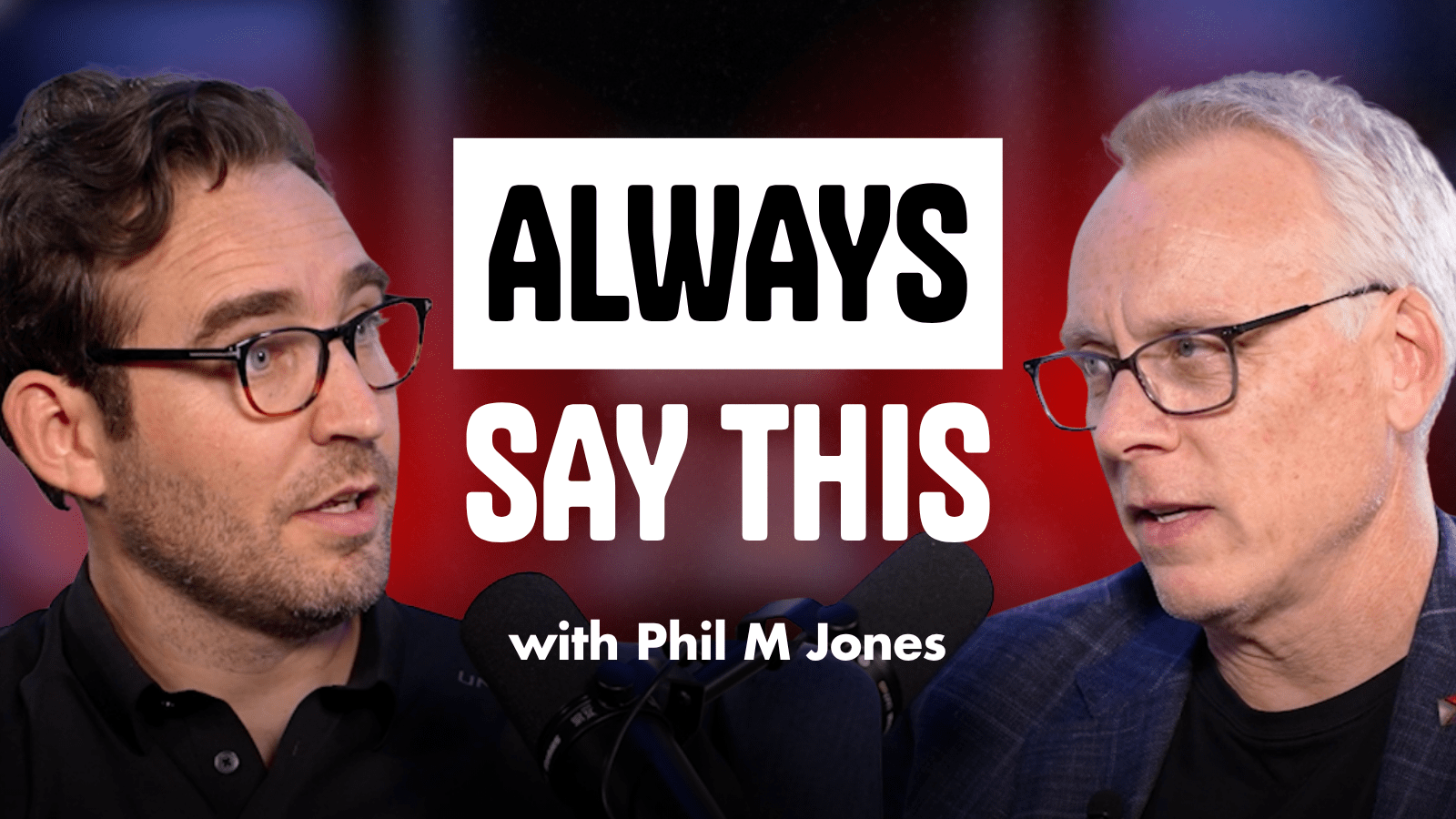
My guest today is Phil Jones, the author of the best-selling book Exactly What To Say. Phil has spent his career teaching millions of people how to excel in communication and to always know, well, exactly what to say. In this masterclass, Phil breaks down some of the most common mistakes we subconsciously make in high-pressure conversations, as well as the four principles that can turn anyone into a great communicator.
Here’s the big takeaway. The worst time to think about the thing that you’re going to say is at the exact moment you’re saying it. If you’ve ever walked away from a conversation wishing you’d handled it differently or felt maybe that your mind went blank when the stakes were high, you don’t have a communication problem, you might have a moment problem.
—————
Jay Papasan:
I’m Jay Papasan. And this is The ONE Thing, your weekly guide to the simple steps that lead to extraordinary results
—————
Jay Papasan:
Phil, welcome to the show.
Phil Jones:
Great to be here. Thanks for having me.
Jay Papasan:
I know. We’ve known each other for quite a while. I have admired your work. I’ve gotten to see you speak and share your message. And now, we get to share you with The ONE Thing audience. I’m super excited.
Phil Jones:
Let’s see if we can make this conversation count, eh?
Jay Papasan:
Oh, I know. I know we will. I know we will. Your brand is Exactly What to Say. And I listened to your book. I remember someone recommended it. And I remember I listened to it in just one sitting. It was one of those where I’d be like, “Okay, I’m gonna keep walking. And now, I’m gonna go walk the dog.” And it was hypnotizing because I was like, “Well, this applies to sales, and it applies to life.” It’s so broadly applicable. Can you tell us how in the world did you end up with this as your lead brand? And you’ve been running the same thing. It’s your one thing. You’ve been a living example of how to live ONE Thing. So, let’s maybe go back to the beginning?
Phil Jones:
I mean, if we go back to somewhere near the beginning, I’ve been asking for things my entire life, and I learned this whole power of being able to ask for things kindly and what could happen is that you could make more happen. I, then, found myself in a senior leadership role at the age of 18-19. I was running big sales teams, 40, 50, 60 people, multimillion-pound turnover, department store businesses back in London
Jay Papasan:
Wow.
Phil Jones:
And the trouble with being a senior leader at a young age is you get a lot of age prejudice. Most of the people that I was in the duty of serving as a leader were, at least, double my age and way more in terms of tenure. So, the puzzle I got is I could never directly invite somebody to do anything without getting resistance.
Jay Papasan:
They wouldn’t accept your authority because of your age.
Phil Jones:
Yes. And this was frustrating until I realized that instead of me saying, “Hey, Jay, here’s what I think you should do,” is I’d look to somebody like Meg, who was crushing it in a particular area that you were concerned about being able to get better at, and I’d say, “Hey, Jay, I’ve been watching what Meg does. And through observation, there are three or four actions that she takes that are different to what you do. And I wondered if you’d be intrigued to know what they are. They might help you be able to raise your game.”
And people would like this approach to me to be able to offer new insights to what they could change. And it made me obsess around just peak performance in any given area. It’s to go looking for the role models of who is it that’s excelling at a level. And remember, this is department store retail, and then furniture retail, and then big transactions of volume happen on repeat.
The commonality I’d find between anybody who did good and then the ones that would really crush it is the ones that crush it wouldn’t just have hard work and hustle and product knowledge, they’d also have this efficacy within their word choices. They would come back to word patterns on repeat. In high-stakes moments, they’d be able to not be flustered. They’d be able to get the outcome they’re looking for with a level of brevity that was beyond what most other people would do. There were amateurs that were getting into overcoming objections, but then there was elegant grace in others that were not getting the objection in the first place. This blew my mind.
I, then, started to document some of these patterns. And in the environment that I’ve grown up in, very similar to your world is if you naturally find yourself a trainer regardless of what your job is. So, I’m delivering micro-trainings in these environments about how to sell in a more efficient way without being salesy. I’m, then, giving people advice and insights, and they’re saying, “Yeah, Phil, but what exactly do I say?” So, this was a question I’d be asked on repeat, and we’d give people back responses.
I launched a little coaching training consulting business in 2008. And it came from-
Jay Papasan:
Just in time for the great recession
Phil Jones:
It’s perfect time. But what I was helping people do was to navigate out of recession and to be able to generate more business, self-create opportunities, convert more of what they had. And I wrote a one-day sales training program that supported that. In that one-day sales training program, I’d deliver sequences of what I would call magic words, just littered in.
Jay Papasan:
That was your first book too, wasn’t it?
Phil Jones:
Before it was a book, it existed in my programs. And then, I’d meet people long after the fact, a year after, two years, three years after coming to a program, and they’d say, “Phil, I’m still using your magic words.” I didn’t matter what I taught them about other big overarching principles, that was always the takeaway.
What, then, happened is I found myself in a mastermind group with a group of coaches, consultants, trainers who were talking about how hard it was to publish a book. I said, “It’s not that hard. If your life depended on it, you could get a book out in, I don’t know, maybe six weeks.” And they said, “Really, Jones?” And I said, “Yeah, sure.” And they said, “Put your money where your mouth is.” And now, I’m in trouble, right? I’ve gotta deliver on this promise. And two weeks earlier I’d delivered a training called Magic Words: 17 Sequences of Words to Sell Without Being Salesy. I took that two-page PDF, I padded around it a little with some words, I sent it off to a e-book designer on fiverr.com, I paid a fiver, and I got back an EPUB. I uploaded it to KDP, I plugged it into lulu.com at the time, and I got a manuscript back, which is a pamphlet, but it had an ISBN on it. It was a book. And I came back to the mastermind and I said, “There you go, I did it.” I plugged it into KDP, and I put it into its marketing engine for free that was like we’ll juice this thing in some way.”
Jay Papasan:
This wasn’t even a serious effort to, like-
Phil Jones:
No, it was a joke.
Jay Papasan:
… design a book.
Phil Jones:
No. It was just like, “I’m gonna win the bet.”
Jay Papasan:
It was like, “I’m gonna win the bet.”
Phil Jones:
I wake up-
Jay Papasan:
Were there any stakes here, or was it just pride?
Phil Jones:
Pride and buying a round of drinks, right?
Jay Papasan:
Okay.
Phil Jones:
And maybe seven, 10, 14 days later, I go into the Kindle portal just for interest. There’s 40,000 downloads. I’ve got hundreds of five-star reviews and dozens of one-star reviews, nothing in the middle. People are like, “This isn’t even a real book.” I’m like, “It was free,” but hey, that’s another argument. And I’m like, “Maybe I’m onto something.”
Jay Papasan:
Just for perspective I know this, I don’t wanna have the curse of knowledge here. You’re in the book business, too. The average book sells 150 copies.
Phil Jones:
Correct.
Jay Papasan:
And that’s after haranguing every relative you have-
Phil Jones:
There you go
Jay Papasan:
… and it’s a ton of work. To have 40,000 people download it even if they weren’t paying for it, that has some intent.
Phil Jones:
It’s phenomenal.
Jay Papasan:
“I think I wanna read this thing.”
Phil Jones:
Fast-forward to me going through my geographic move to the US in 2017, I thought I’m gonna write a new book. It’s gonna provide some thought leadership and some platform for me to no longer be so international in my speaking and consulting business, to be more regional. I wanted to be North America based. I’m gonna write a new book. I’m gonna write a new book. And then I realized, “You fricking idiot, Phil. Why on earth would you write a new book when you’ve got this great body of evidence out here that the marketplace loves, that you really did half-ass? Why don’t you go back and do that properly? Take the lazy EP and turn it into a full album?” The question that we’ve been asked most often and the reviews from our workshops were, “Thank you for teaching us exactly what to say.” So, bingo, that became the title.
Jay Papasan:
It’s one of those things where the evidence is all around you, but sometimes we’re too blind to see it. And that made a big difference.
Phil Jones:
Huge. We bring that book to market 2017. And now, as we stand here today, I have a book that has now reached more than 3 million people around the world, translated into 29 different languages. I got a book that legitimately outsold Fifty Shades of Grey and Harry Potter for one whole day. But I’ve got the screen grabs to prove it, right?
Jay Papasan:
There you go.
Phil Jones:
There it is in Amazon. It’s for real. And it’s changed my life. In its entirety, we now have over 35 different revenue streams that come off the back of that book’s existence, and it’s gone from being a cute little idea to my entire body of work.
Jay Papasan:
But then, 2017, it all comes together.
Phil Jones:
Correct.
Jay Papasan:
I think a lot of people, when they think about what you’ve done, they’ll only look to 2017, right? They’ll go, “Wow, in 10 years, you’ve sold 3 million copies. That’s amazing.”
Phil Jones:
But also, you’re talking about a book that did better year two than it did year one, better year three than it did year two.
Jay Papasan:
Yeah, which is hard to do. Most people do better in the first three months, and then everything after that is going downhill.
Phil Jones:
And then, most people start working on what’s next. I’m doing an interview today about my brand-new book called Exactly What to Say.
Jay Papasan:
Right here.
Phil Jones:
And I think too many people give up on their greatest hit too early. And that’s why it doesn’t become a greatest hit, because they get bored with it, and then they’re not playing that material often enough, that they don’t give it a chance. You also then distract your audience as to what you’re really known for. And if you’re gifted by an audience to say, “We like you with that,” it blows my mind why people would fight it.
Jay Papasan:
Well, you said one thing. I think a lot of entrepreneurs get bored. And I think a lot of other people give up too early. And maybe let’s tackle both of those, ’cause you’ve experienced, I’m sure, both of them. And probably helped other people through them.
Phil Jones:
100%.
Jay Papasan:
Let’s do the give up too early. There’s language, like I look at, there’s all this effort to do this thing that you’re passionate about. And we’re waiting for the evidence to show up that we’re successful to get that feedback back in the world. Then we give up before that shows up. How do we encourage people to maybe… Like, when do I know when should I quit and when should I keep going, might be the right question.
Phil Jones:
I think it goes back to when you should start. I don’t believe that you should start something that you know is gonna be hard unless you’re gonna be prepared to live with it for a significant period of time. I I see it now that people will jump on things like, “Oh, I’m gonna try going on YouTube,” or, “I’m gonna start a new Instagram page,” or, “I’m going to write a book,” or, “I’m going to become a speaker,” or, “I’m going to get a real estate license,” et cetera. And they don’t commit to the bit.
Jay Papasan:
I don’t think they know how hard it is. I think a lot of people underestimate how challenging it can be to own, start, and run a business.
Phil Jones:
But you have to fall in love with the idea. And you have to be somewhat committed and convicted to the fact that I’m gonna stay true to the passion of chasing this idea for a sustained period of time. And it’s not necessarily the how. It’s the what or the who. And we all know Simon’s great book, Start With Why. I think it often really should start with who and who is it we’re really in service of. And if you can commit to an audience of people that you are really passionate about, saying, “I wanna help X achieve Y.”
And in my sales career, I teach sales skills, but not really for salespeople. Have you noticed? I’m not a big sales kickoff. I’m not with-
Jay Papasan:
Your subtitle is In An Un-Salesy Way.
Phil Jones:
Yes. And I teach sales skills to people who don’t see themselves as salespeople that need to get commercial results, which is a lot of people.
Jay Papasan:
A lot of people.
Phil Jones:
A huge amount of people. But they don’t wanna be in the go bro, high five, you can do it, like boiler room.
Jay Papasan:
Dan Pink tells we’re all in sales whether you want to or not.
Phil Jones:
Of course we are. Of course we are. But finding the people that you’re in service of, and then creating a how that you’re committed to for a period enough of time to say, “I’m gonna keep working that,” and working that, and working that. Every musician will tell you the exact same story. Every actor will tell you the exact same story. Anybody who’s achieved anything that’s meaningful in their life, one of the common threads with somewhere near, like, all of them, other than the handful that got fortunate for one reason, is they kept showing up even when nobody cared.
And at some point in time, something clicked. But it didn’t click and it got fantastic. It clicked and it moved a bit.. And then they still kept showing up, and then it clicked and it moved a bit more, and then it clicked and it moved a bit more again.
Most people give up because they think that there’s some form of catalystic moment that turns it from it’s really hard to then it gets really easy. And the number of times people have asked me the question, Phil “What was the one moment where it…” And I don’t have an answer for it. There’s probably thousands of them that have just compounded up over a period of time that have started to make it easier. So, it’s how do you just commit to it for long enough? And that’s a choice you make early enough.
Jay Papasan:
So, it’s a commitment from you. We talk about there’s the power of why, which we’ve all heard. And it’s also who is it you’re really committed to serving?
Phil Jones:
It’s a who, right?
Jay Papasan:
I love that because a lot of people struggle with the why. You talk about your purpose, your mission, and that feels really big and heavy. But, like, when you’re helping people, like, who are the people you help that really energize you?
Phil Jones:
Look at, even, how this shows up in our real lives, right? We’re both parents. We can have a what, a why, a dreams and goals, but if something happens to one of our whos, look how quick everything changes. So, from a priority point of view, who always comes first? And there’s an inward who and there’s outward whos as well, but if we don’t have clarity on who the people you’re of service of, then you’re only left in service of self.
Jay Papasan:
Okay. That’s cool. We’ve given our listeners, because we’ve talked a lot about the other ones, given them a whole other reason to focus on keeping going, to keep the commitment they maybe have made to themselves, but they’re willing to give up now because there’s something shiny out there. And that actually leads me to the people give up too early, and they also give up because they’re bored.
Phil Jones:
Sure.
Jay Papasan:
And is the idea of being bored, is that just part of the journey, or is that indicative that we picked the wrong thing?
Phil Jones:
I don’t know the answer to that question in its entirety, but I can talk to it from personal perspective. And being bored isn’t necessarily a bad thing. I think boredom spawns fantastic creativity in some of the best of times. But you-
Jay Papasan:
True statement.
Phil Jones:
But you do need to not give up on it. So, that means that you have to find ways to be able to make it more creative. I’ve delivered over 3,000 professional paid presentations around the world-
Jay Papasan:
Wow.
Phil Jones:
… which is a good number. And I’ve told some of the same stories and some of the same jokes and make some of the same beats that are delivered on repeat, but I’ve never delivered the same speech twice. And-
Jay Papasan:
‘Cause you were in a different place, and there was always a unique audience.
Phil Jones:
All of that changes, but also I change the stakes. So, you could take the lazy, it’s a new audience, it’s a different moment in time, et cetera. And then, I look for clues, right? We can take clues from the people that are all around us. And I think if somebody else has done something before, we should learn from them. And if you look at musicians that have had 40 years in the game that were singer-songwriters, how many different relationships have they had to find with those same lyrics as their life has expanded?
Jay Papasan:
Man, when I think about Free Bird, it’s gotta be a lot, right? ‘Cause they had to sing that song a lot, right? Whatever that song is. Your hit song’s the one that you’ve gotta find that.
Phil Jones:
And you’ve gotta keep finding ways of falling in love with your greatest hit again and again. And I think the way to be able to do that is to allow other people to have access to it. Because when you share your greatest hits with others, what happens is they then teach you more about your work than you already knew.
Jay Papasan:
They come back and, “You told me exactly what to say, and this is what happened.” And that gives you a whole new entry point.
Phil Jones:
But I look at my work, right? I started teaching to non-salespeople. I was in Saudi Arabia three weeks ago speaking to the Saudi military. I’ve worked with nurse practitioners and politicians. I’ve helped find language patterns that shorten the time that somebody is waiting inside of a hospital environment, so that the doctors and surgeons could spend more time on patient care and not deal with the conflicts that come from family members that are inside of a hospital unit.
Jay Papasan:
Wow.
Phil Jones:
We’ve looked at how this work incorporates to people who are partially sighted. We’ve looked at how this work can support people who are neurodivergent. We looked at how this work can support in other languages. We’ve looked at how it can work in conflict resolution. We’ve looked at how it can work in marriage and counseling and family dynamics.
Jay Papasan:
And each of the-
Phil Jones:
Now, I wasn’t the expert in those environments, but when I shared my principles and teachings in wider environments, those experts stood up and said, “I think this is similar to blank. How would this work here?” And then, we’ve explored that scenario together.
So, when you go remarkably narrow with your work, it takes you left and right, and then you gain breadth by alternative. I went to ChatGPT the other day and said, “How many different industries are there?” If you’re to go industries A through Zed, how many different industries? And it actually gave me 3,000 different industries.
Jay Papasan:
I was just gonna guess. I had no idea.
Phil Jones:
Thousands. And I went through them, and over 800 I’ve worked with.
Jay Papasan:
Oh, wow.
Phil Jones:
800-plus different industries I’ve had some form of exposure towards, teaching them, finding the right words at the right time in order to be able to improve their conversions and results.
Jay Papasan:
That’s cool.
Phil Jones:
But that teaches me and gives new context. And that’s the biggest point. Everybody has content to share, but content without context is merely noise. And if what we can do is understand that as new context is breathed into your work, then it grows. It’s a living, breathing thing that is never static. You don’t get bored.
Jay Papasan:
I love that. And one of the books we read while we were writing The ONE Thing, ’cause part of it is we call it the Path of Mastery. And there are moments of boredom, but if you push through them, you actually get to see brand-new things. And I was reading this book, and they were doing all these studies of athletes. And one of them, there was this like… it was a really boring paper to read. So, I was definitely in my boredom stage, but then I got a breakthrough, and it was describing Olympic swimmers and how they practice compared to people who are really good, but not gold medalists.
But that mastery level, they were putting in similar hours in the pool, but at a certain point, you’d think, “Oh, God. I have to swim laps again today.” You’d think that would be so boring, but when they talked to them, they said, “No, I spent three weeks, and I was just exploring how to cup my hand.” But because on the path to mastery, you start to see nuance that was never revealed before.
It’s the Dunning-Kruger effect or the Kruger-Dunning effect. I never get it right. But the worse you are at something, the better you think you are because you don’t know enough to know what you don’t know. But the more you know, a lot of times, you don’t think you’re good, and you have all this room to grow. Your eyes open up. You’ve had your eyes opened up, not just on the journey of doing this skill set, helping people with exactly what to say, but now you’ve had 800 different industries where it’s given it new context and new life that creates its own connections.
I find what if I married this thing ’cause I worked with all these cobblers, and then all these other people that we’re working with, whatever the strange industry is, manufacturing this. But then, connections happen that become their own breakthroughs.
Phil Jones:
And you find commonalities as well, right? You actually find that what you thought was unique here and unique here, you then find the pattern that connects them all and allows you to distill your message down to something that’s even simpler.
Jay Papasan:
I love that. We’re models-based ’cause like you’re describing to me what I think is the process of building models. You’re seeing patterns. Some people call them best practices. But you’re seeing the patterns that are independent of the individual, that are independent often of the industry-
Phil Jones:
And they become universal truths.
Jay Papasan:
Yes. And you said principles, and that’s one of the things I love about how you teach. A lot of people go, “Oh, is he teaching scripts?” “He’s teaching us scripts.” And that’s not…
Phil Jones:
[Laughs].
Jay Papasan:
You laugh because you’re not. That if there’s something maybe you’re against. But you’re teaching the people principles, so that they can know exactly what to say. I think people are gonna get mad if we don’t give them at least one.
Phil Jones:
Okay. One principle or one sequence of words?
Jay Papasan:
Either way. I think we have to give them a taste of what we’re talking about. I want them obviously to read the book. It’s, no matter where you are in sales, you have to have influence in order to change your life.
Phil Jones:
The book Exactly What To Say has done remarkably well because of a lot of what’s left out in the book. I think it was Mark Twain that’s most famous for saying, “If I had more time, I’d have written a shorter letter.” So, we were deliberately brief in the book for it to travel, for the modality to be easy to consume, et cetera. But what I left out on purpose was the four cornerstones of conversational excellence, the underlying principles that support the success of every sequence of words inside the book. It becomes like an operating system.
And the first is to remember the worst time to think about the thing you’re gonna say is in the moment you’re saying it. The second is that curiosity is the fuel to great conversation. The third is that people do things for their own reasons, not yours. And the fourth is the person that’s asking the questions controls the conversation.
Jay Papasan:
Those are all really powerful.
Phil Jones:
Now, let’s look at the first one. The worst time to think about the thing you’re gonna say is in the moment you’re saying it. See, people end up preparing their words. They end up thinking about the modality. They end up thinking about, should this be a text message, an email, an in-person conversation? Should this be something that I put into a video format? But the right words at the wrong time are useless.
What we should be thinking about is the moment. And if there’s one thing that I would in- be inviting everybody in this conversation to be working on right now is to find, at least, one critical conversation in their life, that if they could find that one critical conversation in their life, almost everything would get easier. And you’ll see how this aligns a lot to what your book is about.
And you’re probably wondering what is a critical conversation. I’ll tell you. A critical conversation is a moment inside a moment where your success or failure inside that moment has an over-indexing impact on the overall success you’re looking to achieve. You didn’t get it. You didn’t get it either. I know, ’cause you have to hear something 20 times before you hear it for the first time if it’s a new idea. So, I’ll repeat. A critical conversation is a moment inside a moment where your success or failure inside that moment has an over-indexing impact on the overall success you’re looking to achieve. You still have not got it.
Jay, have you ever had an appliance inside your house that was broken?
Jay Papasan:
Plenty of times.
Phil Jones:
So, you disposed of it and you replaced it with a new one?
Jay Papasan:
Yes, ’cause I’m not qualified to fix it.
Phil Jones:
Was the appliance broken or was a component in the appliance broken?
Jay Papasan:
Most likely a component.
Phil Jones:
And because you couldn’t find the component, you replaced the whole thing.
Jay Papasan:
Yes.
Phil Jones:
This is how most people operate in their conversations.
Jay Papasan:
Got it.
Phil Jones:
They say they’re bad at blank.
Jay Papasan:
My presentation didn’t work.
Phil Jones:
Correct. I’m not good at speaking on stage. I don’t know how to overcome that objection. I’m not good in a listing presentation. Oh, I’m bad at meetings. No, you’re not. There are moments inside that meeting you’re a 10 out of 10. There are moments inside that meeting you’re a two out of 10. And if you can find your two and turn it to a six or a seven, then how much mileage do you get out of that change?
And I’ll give a very precise example. I’m a busy guy. I travel a ton, which means I’m away from my home and then I’m back home again, and then I’m away from my home and then I’m back home again. Now, my home life looks remarkably different when I’m away to when I’m at home. In my personal life, one of the most critical conversations that I focus on without fail is what comes out of my mouth in the first 15 seconds when I reenter the home following a trip.
Jay Papasan:
Absolutely.
Phil Jones:
But just that moment. If I get that moment wrong-
Jay Papasan:
Hold on, let me put my bags away. Probably not that.
Phil Jones:
Correct. Let me tell you about all of my baggage, and I’m not talking about the stuff I’m carrying, if I don’t give thoughtful thought to that moment, what are my chances of a good evening?
Jay Papasan:
In my house, pretty slim.
Phil Jones:
Good weekend, good marriage, good life.
Jay Papasan:
Over a long period of time.
Phil Jones:
You could single-handedly destroy your life based on your competency inside that one moment. And the point then is most missed in all of our body of work with exactly what to say, people say to me what should I say in that moment?” That’s not the point. The first point is identifying the moment.
Jay Papasan:
That is a moment of truth.
Phil Jones:
Because if I can help you identify that moment, you know what to say in that moment if you add intention. It’s the lack of intention that then thinks we need some form of Band-Aid or magical miracle cure. If I can just say, “Let’s make this moment matter more than something else,” even with no new skills, you get better.
Jay Papasan:
I immediately go to, “It’s so good to see you. I missed you.”
Phil Jones:
Yes. But there are so many moments that happen in everyday interactions that human beings prove that they are highly incompetent. I’ll give one more example here, is if there’s a child in your life that is crying, they’re upset, they’re five, six, seven, eight years of age, they’ve got tears streaming down their face, in that moment, there’s a no moment that comes, what do most adults ask of that child in that moment?
Jay Papasan:
What happened?
Phil Jones:
They ask, “What’s wrong?”
Jay Papasan:
What’s wrong?
Phil Jones:
They ask, “How can I help?” They don’t ask what’s happened. They’re quick to judge, they’re quick to solve. If the child knew what was wrong, what would they not be doing? But if you ask a more curious question, like somebody with your level of empathy would do is you’d ask what happened, because by recoiling it and looking at actually what the context was that resulted in the outcome of the scenario, you’d get a better answer to this question.
Jay Papasan:
Got it.
Phil Jones:
I’ll give one real estate example.
Jay Papasan:
I’m glad I got one right. I’m not sure I always did that with my kids. That’s good.
Phil Jones:
You’re showing how you’ve evolved, Jay. That’s all right.
Jay Papasan:
There we go.
Phil Jones:
We’re showing how we’ve evolved. But I give a real estate one, and just based on the fact that we’re here, being with some real estate agents here today and there’s an open house environment. There’s a no moment that somebody’s walking into an open house. And many people at the greeting inside that open house, they say something that is less than ideal. They say a version of “What brings you here today?”
Now, my answer to that question would be my car, or I walked. It’s not a great question. It’s the same as like walking into a hardware store and somebody asking you, “How can I help?” And even though you need help, you do not ask that person for the help that they are offering you, even though they were offering it, is because they were asking a bad question in that given moment.
Jay Papasan:
So what’s a better question we could ask?
Phil Jones:
If I asked in a real estate environment at that point in time, “Where have you traveled from to be here today?” Their inside voice would say, “I know the answer to this question.” They’d tell you imminently-
Jay Papasan:
It’s also specific.
Phil Jones:
Very specific, and they would actually add further context.
Jay Papasan:
“I live next door,” “I walked over,” “I came from another open house.” Both of those are very different answers.
Phil Jones:
Yes. I’m from the other side of town because we’re thinking about relocating.” Every answer that you want to be able to add to your who is this person info sheet is unlocked with the where did you travel from question.
Jay Papasan:
What should the salesman in the department store actually ask me? Is that an industry that you served?
Phil Jones:
Well, I do think that there are times where you could ask where did you travel from in that environment. We did this a lot in the furniture environment, right? If you’re coming to a big independent furniture retailer in a strip mall, you’re not there by accident. You’re not really just browsing. Where did you travel from, I think is a fair question to ask.
If you’re running into a Home Depot, a Lowe’s and you’ve got a greeter there, I think it’s okay to say hello and welcome. That will get you a 6 out of 10 response. It’s nice. But if you’re looking to be able to clarify, like again, nobody’s coming by accident. You could ask a version of what are you in for? What are you hoping to find? What do you need help with? Because you know you need help. You can tell somebody walking into a Lowe’s or a Home Depot is on mission, right? They’re not there to browse. They are-
Jay Papasan:
But that’s a true answer. , “I’m just browsing,” but I am hoping to find something.
Phil Jones:
Yeah. So, you ask, “What can I help you find?” or “What are you hoping to find?” Not, “How can I help you?”
Jay Papasan:
Yeah. Love that. I love that. So picking the moments. And then, in those moments being curious, so we can get more context and be even more appropriate in the conversation. Now, we’ve entered this conversation presentation with a whole new set of information.
Phil Jones:
I was with a leadership group for a large financial services organization a couple of weeks back, and I pushed them hard on this critical conversations finding moments piece. And what they mostly gave me was not moments, but outcomes. We’re looking to be able to drive productivity. We’re looking to win market share. We’re looking for more of our sales associates to be able to stay in conversations longer. They gave me this laundry list. And I helped them identify those were outcomes and not moments. And they still struggled to find moments.
So, I said, “Out of all of those outcomes, which outcome is the most important for you to be able to achieve, that if you achieve that outcome, everything else would be downhill?” And they said the daily productivity of our people.” I said, “Where in the moment do you identify or impact the daily productivity of your people?” And what they gave me was a list of too many. They said, “I can’t tell you. There are too many moments.” I said, “Try.” And we stayed on it for about 22 minutes, and they came up with about 22 different moments. There’s the Slack channel, there’s the one-on-ones, there’s the annual get-togethers, there’s the ride-alongs, there’s the morning huddle, and they kept going and going. I said, “Of all of those moments, which one is likely to affect daily performance of your people?” They collectively looked at each other and said, “Probably the daily huddle.”
Jay Papasan:
It’s funny how the beginnings matter so much. And by the way, I know our listeners know this, they’re, like, probably smiling, I am inside, ’cause what you’re talking about now- is what we call the 80/20 principle.
Phil Jones:
Correct.
Jay Papasan:
Like, where are the big moments, the things that actually matter, hidden in all the noise?
Phil Jones:
100%.
Jay Papasan:
And when people build that skill, you’re just applying that to conversations.
Phil Jones:
We’re just saying the same thing.
Jay Papasan:
Yeah.
Phil Jones:
It’s find the 80% mileage points in the 20% effort, and then get obnoxiously brilliant at how you show up for that given moment.
Jay Papasan:
And start on the most important one. So, for those people, the daily hud- huddle set the tone for the day.
Phil Jones:
Correct.
Jay Papasan:
And everything else was secondary if that thing went wrong, ’cause you can start everybody down the wrong– The first words you say at an open house, when you’re greeting someone, when you come home from a long trip, they set the tone for the rest.
Phil Jones:
There’s a fast food retailer that is insanely more profitable than almost any other fast food retailer in the entire United States. It opens six days a week as opposed to seven days a week, and it obsesses over being able to say how does it respond to the reply to the word thank you. You cannot go to a Chick-fil-A, say the words “thank you,” and not receive the response of, “My pleasure.” And it changes culture.
Jay Papasan:
Isn’t that originating from the Four Seasons? But like that whole, I feel like you’re in a fast food joint and you’re getting a Four Seasons response.
Phil Jones:
Correct.
Jay Papasan:
Love it.
Phil Jones:
It’s intentional.
Jay Papasan:
Yes. I love it, intention. Being intentional matters so much. Before we dive out, I wanna ask you to give a challenge. We covered a lot of ground here.
Phil Jones:
Sure.
Jay Papasan:
People are asking the question, what can I do with this information? You shared with me you’ve got some exciting new stuff you’re working on. You’re trying to take these principles and make them more available through technology. Would you just give us a soundbite ’cause I’m curious, and I know a lot of people who are fans of you listening to this wanna know more.
Phil Jones:
I mean, yes. I mean, we’re committed to making exactly what to say our one thing and teaching people not only how to get better in conversation, but to find the conversations they need to get better at. I believe preparedness is a superpower. And if we teach the worst time to think about the thing you’re gonna say is in the moment you’re saying it, it isn’t about having agility when you’re there, it’s about getting ready for that point ahead of time.
So, we’re doing that with technology. We’ve got AI tools that are gonna help people prep and pre-brief, so they no longer have to debrief the result they didn’t achieve. That’s what we’re working on.
But if there’s a challenge that I would give to those that have joined us and are still listening to this part of the show, I’d just come back to this idea of a critical conversation.
Jay Papasan:
Got it.
Phil Jones:
And I would invite you to say, can you find one in your personal life, one as a leader, and one that’s gonna put money in your pocket, so some form of commerciality, and say, “Can I decide a hyper-specific moment that I’m gonna add intention to that I know is gonna have a highly impact in outcome on that?” One in your personal life, I gave you one of mine.
Jay Papasan:
Right, when I come home from a trip.
Phil Jones:
But it could be that you know that you’ve got a family meal that is happening. It could be that you know that you meet on a Sunday, and what really happens is nothing, and you’d like it to be something.
Let’s take a leadership one. I gave you the example of the morning huddle, but you might find the leadership one is that you know that when you’re in one-on-one performance reviews, you crumble and that you don’t give the hard news, and that you give everybody encouragement, but you don’t give them the coaching that they need.
And then look at commercials. I know there are dozens of business owners that listen to this conversation but when somebody says “Is that your best price?” they crumble. Now, if all they could do is take that one moment where somebody says, “Is that your best price?” they don’t crumble, what impact would that have on their pay packet 12 months on?
Jay Papasan:
It would be enormous, right? You’re talking about percentages over time that allows them to scale.
Phil Jones:
It’s huge. And there are some times where people are asked how much they charge. And when they’re asked how much they charge, they stammer and stutter and say things like we typically,” or we usually,” or we normally,” or, “What we look to,” or, “What our standard rates are,” and they put this padding language in front of their pricing that tells the other person this is clearly negotiable. They invite the discount request.
Jay Papasan:
Because they haven’t thought in advance of exactly what to say. They don’t sound confident. They don’t sound strong. And that all undermines their position.
Phil Jones:
But if they could say that every time somebody asks me how much I charge is the moment that I’m going to obsess about for a sustained period of time until I turn my 3 out of 10 into a 6, 7, or 8, and everything else stays the same, they would get better, and their results would be amplified because they’re not trying to get better at communication. They’re trying to get better at moments.
Jay Papasan:
Yes. The moments that matter.
Phil Jones:
Mmhmm.
Jay Papasan:
I love that. I’m excited about what you’re building-
Phil Jones:
Thank you.
Jay Papasan:
… so that we can get more access to your wisdom, and it doesn’t have to be on a random podcast, and we don’t have to reread the book five times a year.
Phil Jones:
That’s it.
Jay Papasan:
But now, I can go in and maybe interact with what you’re building for us.
Phil Jones:
That’s it.
Jay Papasan:
Like I’ve got a problem, and I want to tackle it, so I’m excited.
Phil Jones:
And see the work overlay to the moment that you pre-decide.
Jay Papasan:
I love that. And I’ll just also just congratulate you. You’ve been doing this for a very long time, and I love and I’m inspired when I hear people who’ve been doing this for so long that are clearly so energized with the service they’re delivering to the whos that matter to them.
Phil Jones:
You got it.
Jay Papasan:
I love that. Thank you, Phil.
Phil Jones:
It’s my pleasure.
————————
Disclaimer:
This podcast is for general informational purposes only. The views, thoughts, and opinions of the guest represent those of the guest and not ProduKtive or Keller Williams Realty LLC and their affiliates and should not be construed as financial, economic, legal, tax, or other advice. This podcast is provided without any warranty or guarantee of its accuracy, completeness, timeliness, or results from using the information.