Jay Papasan:
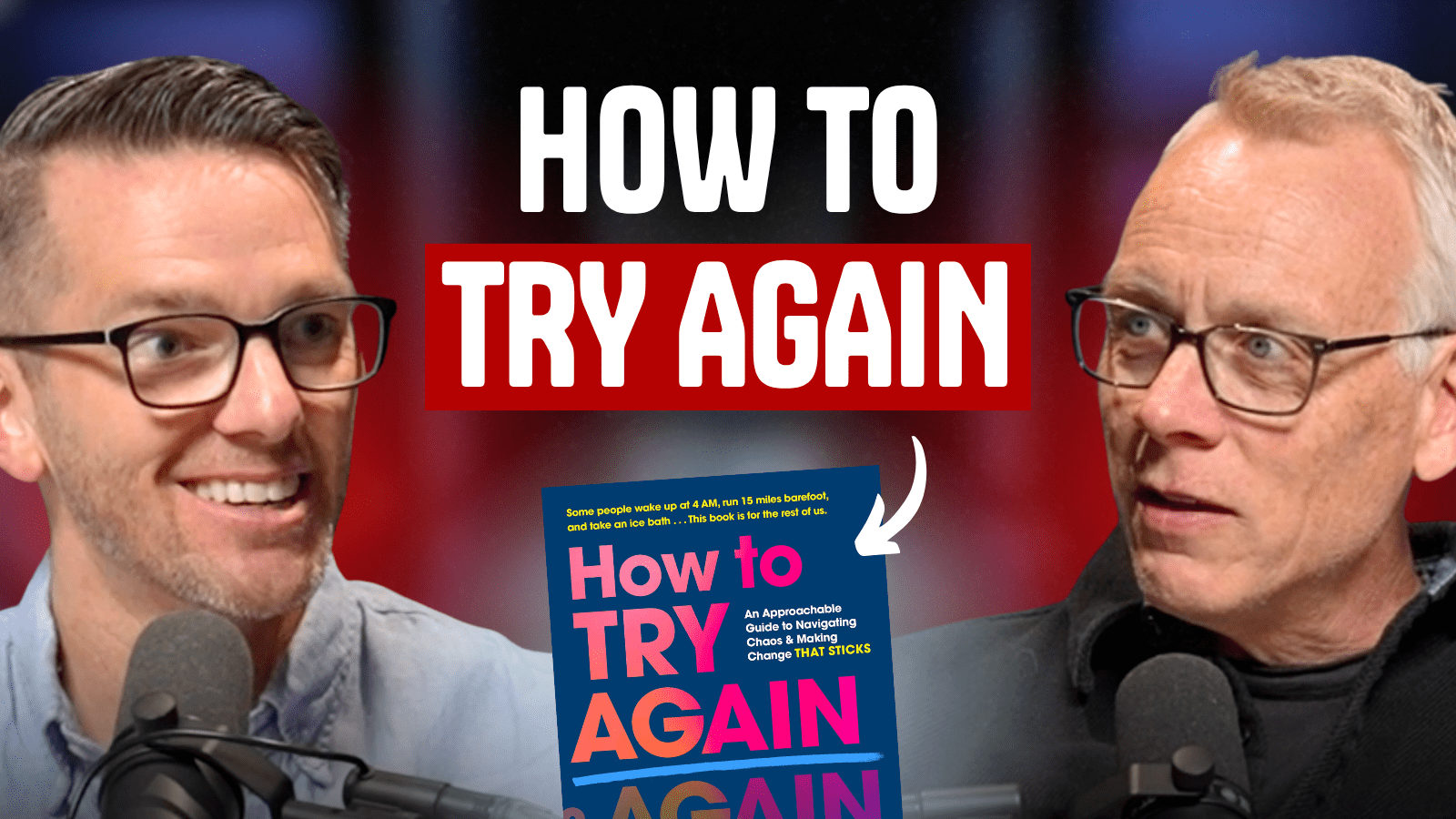
What’s your relationship with failure? Today, we’re gonna talk to my good friend Steve Kamb on his new book, How to Try Again. Steve has had a lot of success, and he’s had a lot of bumps in the road, and he’s become an expert on how we navigate tough changes, bounce back, and get going again.
Steve started as an entrepreneur in the early 2000s. He launched a company called Nerd Fitness. And over the years they’ve helped millions of people get in shape, but not in the kinda drill sergeant way. They approach behavior change with real science and also a little bit of compassion. It’s not that we need more discipline all the time to grit our teeth and do hard things. Yeah, there’s some of that, but it’s more about having more compassion for our tough days, so that we can build a sustainable model for success.
I’m super excited to share Steve’s great wisdom with you today, and we’re gonna dive right into your relationship with failure and how you too can try again.
——————————
Jay Papasan:
I’m Jay Papasan. And this is The ONE Thing, your weekly guide to the simple steps that lead to extraordinary results.
——————————
Jay Papasan:
Steve, I’m so happy to finally get to talk to you about your book.
Steve Kamb:
Hey, Jay. It’s great to see you, man.
Jay Papasan:
I really, really enjoyed your book.
Steve Kamb:
Thank you.
Jay Papasan:
You’ve got a framework. It’s packed. I know that we’ll go through it. It’s a nice and simple one, so I like simple frameworks ’cause people can actually live them versus these really, like, “I need a spreadsheet. Where’s my spreadsheet?” But I think in the beginning, I guess if you’re going to try again, which to me, I keep using the word change, it just means that you failed at something, and that could be, “I picked the wrong job,” “I picked the wrong something, and I need to pick again,” or it could be, “I know what I wanna do, and I just can’t seem to do it.” Which of those would be a better entry point?
Steve Kamb:
The one that that’s most interesting to me, and I would imagine most listeners, is, like, the, “This isn’t working,” and my usual tactic of just gritting my teeth and trying harder is somehow not only not working, but, like, actively making things worse.
Jay Papasan:
And making me feel worse.
Steve Kamb:
Making me feel worse because my one tactic, you know, my tried and true strategy of “Just work your way through this,” is not working anymore. How do we navigate that? And I think that’s what I had to navigate personally while writing it professionally. I love work. I really enjoy writing. It’s so easy for me to just get lost in it. And when that stops working, it’s almost like an identity crisis, right?
You did something well enough to kinda become famous at it. So, there’s the double whammy of being really good. So, when you say your identity, everybody kinda goes through that. They found the thing that they can do well, they start growing. And then, suddenly, this thing just went off the rails. What happened? Am I doing it wrong? And why doesn’t it work? But I’ve also found that’s one of the things we talk about, can you pick the biggest model? I wanna save money. Well, how would a millionaire save money, right? Can we pick a bigger model so that if we learn how to run it, we have so much more runway. But I don’t think we ever imagine we’ll go as far as we do.
Steve Kamb:
Yeah. Once it starts working, then, all of a sudden, that becomes your new normal. And normal’s a word I have a very complicated relationship with, but it becomes your new normal. And then, when it stops working, suddenly, you’ve anchored yourself to this identity of you or the way that other people expect you to behave or act, or they think you’re going to do a certain thing.
And then, when that stops working and you have to go or try a different direction, it’s scary, it’s deeply uncomfortable, and it requires a lot of courage for you to say, “I’m gonna go this way and try this other thing.” Meanwhile, everybody else around you still assumes you’re the old version of you, and are still asking things of you as if that was you, and it’s not anymore. It’s just like the outside hasn’t caught up to the inside. And like I said, it is deeply uncomfortable.
Jay Papasan:
Well, yeah. So, you just hit on two things, so let’s unpack them. There’s this identity crisis, right? You know that you have to evolve into the next version of you. And I know we kind of hold on to that comfortable old version. And then, if you successfully make the transformation, other people have to recognize the new you. So, let’s go through that identity. What was working for me so far is not taking me where I wanna go. There’s all kinds of noise in my head. Coach me. This is where I am. Tell me, talk to me, what do I do, Steve?
Steve Kamb:
So, in the book, I talk about this framework called Make a PACT. Pause, accept, change, try. I think the first step is the one that most people ignore. It’s maybe the most challenging for a lot of people that are high achievers, that sit at the top of a company. Pause, take a second, and ask yourself, “Wait a second, is this working?” It’s the journaling, it’s those early mornings, it’s the conversations with yourself on the walk. It’s taking a breath and really reflecting on, ‘Am I doing the thing that I know deep down, this is the path I need to be on?” or “Is there a different path that I need to consider?”
There’s that great quote from C.S. Lewis. He says,”The second you realize you’re on the wrong path, the next correct step is back in the direction that you came.” So, the most progressive man is the one who turns back soonest. And in my instance, I’m like, well, yes, there’s also a step between there. It’s before you continue stepping, you have to stop and assess and say, like, “Wait a second, am I on that path?” And I realized for myself I wasn’t on the right path.
So, for you, I would say we need to pause. The second step is accept, right?
Jay Papasan:
Well, let’s stop there though.
Steve Kamb:
Oh, sure, okay.
Jay Papasan:
I mean, we may not get past P because so many high achievers, a lot of their identity is around their ability to do things, and they’re doers. So, one of the mantras we have is, like, we serve two groups of people, dreamers who need space to do and doers who need space to dream. And let me just tell you, it’s very heavily tilted toward the doers who don’t make any space to dream. So, their normal, and I know I’ve wrote it down, we have to unpack your version of that, but their sense of normal is being in motion. And so, it is intensely uncomfortable for some people to kind of sit with themselves and have nothing to do. So, what would be a good simple first step? Is it just a journal prompt? Can I do this while I’m walking? Do I really need to be still to pause?
Steve Kamb:
For me, it’s journaling.
Jay Papasan:
Okay.
Steve Kamb:
I don’t write when I have an idea. I write until I find an idea. And whether it’s through a book or kind of working through my life, that’s journaling. I try to be deliberate about it, but I journal often-ish, and especially I journal more when I know that I’m really struggling through something. It becomes the thing that I kind of go back to to navigate that pause or that thing that I’m trying to figure out. So, for me, it’s journaling. For others, it might be meditation, walks, et cetera.
Jay Papasan:
So, I think of journaling as you’re having a conversation with yourself. When you write it out, do you actually go back and read it, or is the writing of it where you find the clarity?
Steve Kamb:
I think the writing of it provides a lot of the clarity. I do flip back through previous months sometimes because, I mean, a book is coming out. There’s a lot of change in my life. So, it is interesting to reflect back on how I was feeling in the moment months ago and realizing, like, “Okay, I got through that. Whatever I’m struggling with right now, like I know I can get through this too.”
Jay Papasan:
So, if that’s uncomfortable for people, I also think you can have a conversation with someone who knows you really well. So, I think journaling, that space, I definitely would start there. I found, and we’re probably super biased here because we’re both writers, that I think it’s really clear until I have to actually put it into words. And when we say things, we don’t scrutinize the words as much. Like if you’ve ever pulled a transcript of a conversation that you thought was just magic, and then you hear all the ums and the ahs and like you’re circling the topic until you finally find it, but that’s kind of what writing can do.
But I do think if you have someone that you feel okay being vulnerable with and you can go to, my first thing is like “Go to a coach.” If you’ve got someone who wears that hat, whether it’s formal and I’m paying them or not, like, “Hey, I’m really struggling here. This thing that wasn’t working isn’t working, and I’m not sure what I need to do.” But if you have to step backwards to move forwards, we need to get that word retreat out of our head.
Steve Kamb:
Sure. I mean, we think the opposite of progress is or if we’re not making progress, rather, we are falling behind, we’re stuck, and it’s actually the opposite of progress is regress, going in the wrong direction, making things worse. And oftentimes, our efforts are we are swimming against the current. We are going the wrong direction. We are throwing ourselves against a brick wall repeatedly and saying, “Why isn’t this working?” when if we were to pause and assess and maybe ask the question like maybe we don’t need to be throwing ourselves against this brick wall when there are other paths available to us. But that’s really hard to do because you have to stop.
Jay Papasan:
Yeah. I mean, in a physical environment, I am literally trying to knock down this door that I can’t get through, you would step back and go, “Is there another door?” Right? I actually think the wisest thing to do is can you step on a chair, look over the walls? Is what’s over there even worth going to? Because we haven’t paused a lot of times when we even pick the goal.
So, we’re gonna reflect a little bit, and I do think that for doers, that’s really uncomfortable, so we just acknowledge that. Let’s just say it’s not gonna feel good, but like a couple of Saturday mornings, maybe a couple of conversations with a trusted friend, a coach, a spouse, I think you will find more clarity than just doing this trial and error thing forever ’cause you can waste so much time pounding on that door, and it could just be the wrong door to begin with.
Steve Kamb:
I think there’s also some comfort for us in continuing to do the thing that we know how to do.
Jay Papasan:
Of course.
Steve Kamb:
… even though we know it’s not working because we then have to reflect on the fact that we have been… I don’t wanna say wasting our time because I don’t believe in wasted effort. I think if we were to pause and say, “Hey, look, I can continue doing this thing that’s not working because it’s comfortable for me,” there’s comfort in that. Or I can make the really uncomfortable decision and give myself some compassion.
You know, we talk about I don’t wanna help people succeed with more discipline, but fail with more compassion. You have to give yourself permission and be kind to yourself and say, “Yes, actually, I’ve been doing the wrong thing for six months.” Or in my case, it was probably more like three to five years when it came to running my business and I had to say, “That’s okay. You had to go through that to realize…” I always would’ve wondered if I hadn’t tried to go down that path.
Now, I know being in charge of a large company is not for me, but it took me years of finally to maybe stop trying to become a less bad leader so that I could finally get to the path that I’m actually aligned with, that I’m good at, that I enjoy, which is writing and having great conversations about writing.
Jay Papasan:
There we go. So, pause. We’ve paused, we’ve reflected, maybe we’ve been going down the right path, it’s time to maybe take a step back. Accept, what does that mean?
Steve Kamb:
I think there’s the reality that we want, and then there’s the reality that we actually live in. We all have things going on in our lives. Maybe we have parents that are getting older. We have kids that have special challenges. There are home renovations that are shockingly behind schedule. You know? Weird, right? Who would’ve thought that?
Jay Papasan:
Yeah.
Steve Kamb:
Maybe all of…
Jay Papasan:
The contractors are behind? What? What’s this?
Steve Kamb:
I remember I had some project done and the contractor was like, “This all goes according to plan, we should be done in about two weeks.” And I looked at him, I said, “Have things ever gone according to plan?” He said, “No, not really.” Six weeks later, he was done.
Jay Papasan:
Okay.
Steve Kamb:
Even with this book, man, I told the publisher, “I need about 18 months.” I was supposed to turn it in in January of 2024. It is now June of 2026, and it’s hitting shelves. So, acceptance here is we’re not doing ourselves any favors when we think of life to be anything other than it actually is. And we keep thinking, “Oh, I can just bust my ass this week,” or, “I can work really unsustainably because next week things will get back to normal” and, “Oh, when I get back to normal, then the clouds will part and the schedule will be aligned, and everything will be great.”
And then, next week rolls around and something else happens. So, like we’ve developed a mantra through our coaching at Nerd Fitness, and then in this book, it’s like, there is no normal. And the sooner you accept that, the sooner you can finally start prioritizing the few things that actually matter. Maybe the one thing that matters, Jay.
Jay Papasan:
Yes.
Steve Kamb:
And then, you can stop beating yourself up that you’re not able to juggle all of these chainsaws at the same time. Like, it’s really hard. Accept this, and then we can finally narrow the focus to the few things that actually matter and stop beating yourself up that you’re not perfect at all of them at the same time.
Jay Papasan:
Well, you’re speaking to a lot of our people here because they have a vision for their life, and it’s just the reality is normal is some form of controlled failure and chaos with tiny moments that we feel really amazing, and I think we anchor on those. And the reality is I mean, just from my writing habit, I can sit down to write, and it’s not like every time you write, “Oh, that’s the best essay I ever wrote,” right? And you’re like, “Okay, that was kind of a dud.” And the next week, but it’s only in doing those, and that’s what you said, those three to five years.
Like, if you’re climbing a mountain, if you’ve ever hiked, and you’re like, “Oh my gosh, it’s gotta be the top.” Then, you get to the top and realize you have to go down and then up again. But you don’t have that clarity until you climb that hill. You just can’t see it.
Steve Kamb:
Or you’re starting your most of the way up the hill, and you kind of realize, like, “Well, okay, I assumed this would have made me feel enough. I made it to the top of the mountain. Where’s my gold star? Internally, why don’t I suddenly feel significant? Like, why didn’t this solve all of my problems?” And I think, a lot of us kind of have to go through that, too.
It’s really easy to say, like, “Oh, it’s the journey, not the destination.” I think a lot of us have to go on the journey, and then give ourselves some compassion and grace when we realize that this thing didn’t solve, magically, every problem we’ve ever had and every insecurity and feeling of being not enough. We have to kind of go through that and to realize, like, okay, if it’s not the journey, then if it is the dest- or rather, if it is the, the journey, then we have to find a way to enjoy it or pick the journey that’s actually aligned with the things that we’re interested in, that we’re good at.
Jay Papasan:
I think when we were younger, we would’ve called it play, just experimenting and goofing off. And then, you mentioned this earlier- me and my friend Juan Pablo were walking, and we have this thing in our head where we start shoulding on ourselves, and we kind of started calling it the should-o-meter. Like, there’s some kind of universal graph of where everyone should be at a certain point in their life in comparison to their goals, and more importantly, in comparison to what they perceive in their peers. I’m behind. I should’ve been farther ahead. And the reality is, like, how many people went to college and picked an actual major that they actually use? Very few. Very few. And some of them are miserable because they got a technical degree that really dictates what they can do to earn their money, and the pivot is harder.
I was wonderfully dumb enough to get a great liberal arts degree, English/French, which was mostly useless in the business world, except that it gave me a breadth of knowledge. So, you have to appreciate the lessons as they come and realize, just like you would tell your kids, “You know what? Hey, you’re gonna probably have to try a lot of things to finally find the journey that you’re happy going on, regardless of the destination.”
Steve Kamb:
Not only that, but I think it’s really easy to look back on our younger selves and say, “Gosh, I wish I would’ve done things differently.”
Jay Papasan:
Oh, with the benefit of perfect hindsight.
Steve Kamb:
I had a conversation with a friend recently who loves philosophy, and I was thinking back to college. Man, like, I majored in economics ’cause I didn’t know what to do. That sounds business. Sure. It sounds great. And I was like, “Man, I wish I had taken… Like, I wish I had done more or taken philosophy classes.” Philosophy probably would’ve been so much more practical to this life that I’m now living.
Jay Papasan:
I can’t even spell Kierkegaard.
Steve Kamb:
Right. But then, for some reason, I had to pull up my college transcript. I did take a philosophy class. And I completely forgot about it. And I remember, I could then place myself back in that class thinking like, “This is so dumb. This is boring. What’s the point? I’m not interested in any of this.” It’s like, oh, okay, I had to go through 20 years of navigating real life to finally accept and appreciate the fact that like, oh, okay, maybe those philosophers, maybe they were onto something about living. Maybe now, you’re actually ready to receive the lessons that they’re teaching.
Jay Papasan:
So, I’m gonna sum up the first steps. We have to pause, right? – It’s basically like, get your head up and actually look around. Where are you going? Why did you think you were going there? Does that make sense still, right? Am I on the right path? You have to accept the fact that we choose a lot of false dead ends and paths in life. And I kind of think of that as how can we give ourselves just a little bit of grace? We don’t have to like it, but we can’t fight the reality of where we are, so let’s just accept it.
And then, we get to actually do the big one that everybody wants is like, how do we actually change? Can you tell the caterpillar story? That’s the thing I’ve repeated more. I was like, how did I live this long and didn’t know that’s what actually was happening? But it also shows the gap between what we believe is happening and what it really looks like.
Steve Kamb:
Sure. So, Eric Carle’s, The Very Hungry Caterpillar. It’s a book every kid reads, and it’s beautifully designed. It’s an amazing book. It’s like, oh, the very hungry caterpillar eats through five apples, four oranges, three strawberries, and then it’s-
Jay Papasan:
You’ve read it recently.
Steve Kamb:
Yeah. I was cramming before interviewing.
Jay Papasan:
Okay.
Steve Kamb:
And then, in the book he says, “Oh, and then the caterpillar knits itself a little cocoon, and has itself a cozy vacation for two weeks. And then, two weeks later, out pops this beautiful butterfly.” What an amazing story. It’s like, oh, this cozy little caterpillar has its little knitting tools and it’s in there and it’s like knitting cute little crocheted butterfly wings, and then it pops out two weeks later and it’s delightful.
Jay Papasan:
I mean, in some ways, it’s great. We’re trying to teach kids, like, you can be one thing and change into something else.
Steve Kamb:
Absolutely.
Jay Papasan:
But the disservice is what that change feels like.
Steve Kamb:
Yes. And to be clear, I’m glad this, what actually happens is not in this children’s book. That-
Jay Papasan:
Yes.
Steve Kamb:
… would probably not be great.
Jay Papasan:
Yes.
Steve Kamb:
So, what actually happens is the caterpillar it’s actually a chrysalis. So, a chrysalis for butterflies. Cocoons are for moths. So, a chrysalis. And I’m sure that was done to keep things simple. Once the butterfly or the caterpillar is inside the chrysalis, it literally eats itself and digests all of its cells with few exceptions. So, at any point, you could open up a chrysalis and, like, caterpillar goo would come pou… it’s disgusting.
So, it turns into this pile of goo, and then it starts to reform and create its new body, its antenna, its wings. It’s so gross, and it’s like the perfect metaphor for how difficult change is. Like, you’re not the old version of you anymore. You had to break that down, and you’re in the ugly, gross caterpillar goop stage in the middle before you get to become the beautiful butterfly with the really beautiful wings afterwards.
But right now, most of us are kind of stuck in that caterpillar goo stage, and we think it should be, “I had this amazing epiphany, and suddenly life is different and everything is great.” It’s like, no, it is ugly, it’s uncomfortable, it’s gross. There are moments of doubt. You are breaking down old you to try to figure out what this new version of you is going to become and that change, I think giving yourself permission to realize, like, change is hard and gross and weird, like, maybe gives you more courage to actually start making those steps.
Jay Papasan:
When we launched The ONE Thing, the first course we did, I think we did Time Blocking Mastery. And we launched the course to launch the company, and it was 10 weeks where people were trying to build this new habit. They were gonna identify the thing they wanted to do. They were gonna do it repeatedly for the 66 days we talk about in the book.
And I remember on the flap copy, we had more clarity, blah, blah, blah, blah, blah, blah, and anchor the last thing. Like, the first thing and the last thing, and what people remember was less stress. And so, I did surveys, and how did people feel about this journey? And I remember getting the first two cohorts back, and I was like, “We are ramping up the stress on these people. We’ve been selling less stress.” But change is stressful. Suddenly, everything’s unfamiliar. Like, “Oh, I’m supposed to drive a stick shift today? I don’t know how to drive a stick shift today. Well, if you’re gonna race cars, you gotta learn how to use a clutch. That’s how it works.”
And so, it blindsided me, and we’d spent four and a half years. But of course, it’s obvious in hindsight. And so, we did change the flap copy. But we were like, “Oh, we have to be a little bit more honest.” And so, then, we start teaching people. It’s like, look, when you’re breaking an old habit or forming a new habit, like behavior change, our brains are great at conserving energy.
Steve Kamb:
So good.
Jay Papasan:
That’s the whole point. We always, like water, we’ll pick the easiest path downhill. And so, to choose a new path consciously, there’s all of these components. And in that journey, which is not horrible, like it could be a few months to kind of ingrain the new behavior, most people quit because it is uncomfortable.
I think we need to take a quick break. So, now that we’ve established goo, on the other side of the break, let’s walk through kind of how you would coach someone through, like, your steps to change.
All right. We’ll see everybody on the other side, and we’ll break down, like, you know what to do, you’re in the process of doing it. How do we actually do it?
———————————-
Jay Papasan:
All right, Steve, let’s get back. We’ve gone through the goo phase. We’ve broken down. Like we’ve admitted that this is a messy process.
Steve Kamb:
Sure.
Jay Papasan:
What are the steps to actually kind of changing now?
Steve Kamb:
So, we’re on C for change. I think about this from two perspectives, detectives and scientists.
Jay Papasan:
Okay.
Steve Kamb:
Detectives, we’re gonna put on a Sherlock Holmes hat, get a giant magnifying glass.
Jay Papasan:
I think it’s called a deer stalker hat.
Steve Kamb:
Deer stalker hat, and, and an inverness cape, right?
Jay Papasan:
Yeah.
Steve Kamb:
So, we have those. We have those, maybe our corn cob pipe, and we’re at the murder scene. We’re at the murder scene of past us or a past failed attempt to change or something that is not working. Fortunately, this is past us that is a version of us that is no longer around. There’s no judgment. We are not beating ourselves up for that failure. It is what it is.
Whatever it is, we can ask some questions. We can ask why. We can ask how. We can ask where. Like we’re trying to solve a mystery of why this past version of us didn’t succeed the way that we had hoped or expected.
Once we have that material, we then take off our hat, we put on our lab coat, and we are now scientists, and we’re gonna think about the next steps like an experiment, like the scientific method. We have our past experience and past data to pull from. We can make a hypothesis for this new version of us, this new path, this new habit we’re trying to build, this new leadership strategy, this new project that we want to try, and we literally think of it like a science experiment.
Okay, what is the hypothesis? What is the timeframe that we’re going to conduct this experiment over? Probably 30 days or 60 days, something that’s tight enough to give us some meaningful data, but not so long that we burn out or give up or it can feel too daunting maybe. So, hey, we’re gonna do a 30-day experiment.
Jay Papasan:
Yeah, long enough to give it an honest try.
Steve Kamb:
Yes. Not only an honest try for did this work, but maybe more importantly, does this work for me? And I think that’s maybe the part a lot of people miss out on. Like, “Oh, I wanna get in shape. Cool, so I went to this class that I hated, and I got in great shape, but I’m miserable, and I was counting down the days for it to be done.” Congratulations. Experiment conducted successfully. We can now move on and say we need to try something else that we’re actually going to enjoy and continue to do.
Jay Papasan:
You’re talking about burpees, obviously.
Steve Kamb:
Oh, God, you couldn’t pay me to do burpees. So, I said I started a health and fitness company 17 years ago at this point, and the thing that broke my heart the most was when people were trying to get fit, and their friend who was really in shape would drag them to some boot camp or some class, and there’s some motivational guy screaming platitudes at them, and they leave that class saying, like, “If that’s what it takes to get in shape, I’m out.” And it’s like, no, no, no, there’s so many other paths available to you.
And I think this is where I struggled professionally. I have no problem watching somebody scale a mountain and say, “Good for them. That’s amazing.” I have no desire to do that. But in work, I will see somebody that is crushing it on Instagram or crushing it on YouTube, and suddenly I’m like, “I’m so far behind. I don’t even want…” Like, those are things that I’m not interested in, but I suddenly beat myself up.
So, in this instance, I’m like, okay, what’s the experiment we’re going to conduct in a way that we’re excited about on a path that actually aligns with our strengths, our weaknesses, that acknowledges and accepts our past normal or our current normal? Cool, let’s do that experiment. We can zoom out and set the parameters of it, and then for those 30 days, we just zoom in and we’re not worried about the outcome. We’re just zooming in and doing the thing. And then, at the end of those 30 days, we zoom back out and say, “Did it work? What were the results? Would I like to continue doing this? Do I need to make changes, or do I need to pick a completely different experiment or path to try instead?”
Jay Papasan:
Have we stumbled into try now?
Steve Kamb:
We are now at the try part, yes.
Jay Papasan:
Okay. I wanna just acknowledge that ’cause I feel like we’ve acknowledged that we’ve broken down, like, that this is gonna be uncomfortable. We’re now trying, which is experimenting. And I’ll just say, I said this to Ann Lahr. I don’t know if you know her or not.
Steve Kamb:
I do, yeah.
Jay Papasan:
Yeah, she’s great. I just like so many high achievers, it’s all or nothing. They have this really big vision, and it’s gonna have to happen fast, and it’s gonna happen with intensity that keeps their interest. And so, their cheat for focus is waiting till the last minute and doing it all in one night, right? They use all these unhealthy ways because they wanna have that vibe of intensity, right?
And so, oh, I’m gonna get in shape. I’m not gonna kinda do the little things on a daily basis and just build the habit. I remember the first time I met James Clear, we were talking about challenges and stuff, and he’s so nonchalantly excellent. It just makes me mad sometimes. But he goes, “I just try to be the person who goes to the gym every day, and I find that most of those goals are usually within my reach.” And he said it with such assurance. But it’s true, right? He just found a way to get himself into the gym and found a routine that worked. And then, all of those, like, quote, “fancy,” sexy things become achievable over time.
But so, like, when we try, I like the stakes of an experiment. It doesn’t have to be this big, hard, 70 Hard or whatever it is that feels good when you announce it on social media because you’re doing this hard thing, but I think we’re actually raising the stakes that we’re gonna fail again by constantly making it, the mountain so tall versus like, “No, I’m really committed to feeling good in my body. Let’s just do some experiments.”
Steve Kamb:
I think a lot of us, we’ve all either internalized if we’re perfectionists, we’re high achievers We hear, “Oh, how you do anything is how you do everything.”
Jay Papasan:
Oh, I hate that one.
Steve Kamb:
So, it must be done with excellence. And I get it. I get what the motivation of-
Jay Papasan:
No, some things do not deserve your focus and attention.
Steve Kamb:
Yes, yeah. I have a E.L. Doctorow story for you.
Jay Papasan:
Oh, let’s hear it.
Steve Kamb:
So, he was my writing professor, and you quote one of his short stories.
Jay Papasan:
I didn’t know he was your writing professor. We were talking about him earlier, but I didn’t realize he was your professor.
Steve Kamb:
He was. I had him in my master’s when I was getting my English degree.
Jay Papasan:
Oh my gosh. That’s amazing.
Steve Kamb:
And I was like, I didn’t quite know I was in the presence of greatness, ’cause I was too young and foolish. But he was making fun of himself because he had to write a sick note for his daughter, because she had missed the day before, to put in her backpack to take to school. And his wife came in, and he was on his fourth draft And she just grabbed the notebook and said, I can’t remember, “Edgar.” She’s like, “Stop that.” And she just wrote, “Write this:” Louise, I can’t remember her name, “had a cold yesterday. We kept her home. Let us know if we need to talk about any homework assignments that were missed.” And she goes, “Now sign it, and then put it in the bag.”
Because, like, we don’t need to gold plate everything. Yes, you’re a National Book Award-winning author, but it doesn’t matter when you’re writing a sick note, right? So, yeah. So, that’s my soapbox for today.
Jay Papasan:
I love it.
Steve Kamb:
I think the problem with all or nothing thinking is that it generally becomes all, then nothing.
Jay Papasan:
Yes.
Steve Kamb:
We go all in until we break down.
Jay Papasan:
Yeah.
Steve Kamb:
And then, we’re left picking up the pieces and saying like, “Why couldn’t I follow through on that thing?”
Jay Papasan:
Show me anybody who’s doing all consistently over time.
Steve Kamb:
Sure.
Jay Papasan:
Show me.
Steve Kamb:
Yeah.
Jay Papasan:
It’s all BS.
Steve Kamb:
And if they are, it’s not for long, or that burnout will come, and it will come fast and furiously.
Jay Papasan:
Or it’s performative. They’re not showing you everything else.
Steve Kamb:
Yeah, get up, get up at 4:00 AM and run 15 miles barefoot, and then I write a full novel, and then… And like, if you’re not doing that, then you’re not trying. It’s like, I don’t know, man, maybe you’re just trying to get your kids to school in the morning. Like, maybe that’s okay.
So, yeah, the distance between all and nothing is vast, and some is like a perfectly acceptable amount for so many things, and we’re just trying to get ourselves to do some of something more often than not over a long period of time. And when we miss the thing or we can’t do it perfectly, like, okay. Like, it doesn’t need to be more than that. Which is so hard for us as perfectionists. We wanna put the X on the calendar.
Jerry Seinfeld even said recently, he was like, “Oh, I, that was like a throwaway line about putting X’s on a calendar.” Like I didn’t realize that became a thing.-”
Jay Papasan:
We put it in a book and sold a lot of copies. The principle of it is that’s why that we call it truthiness, right? There is great truth in it, even though it may not have been, like, how he actually practices art.
Steve Kamb:
So, for me, I once meditated every day for six months because I had a little meditation app and I could create a streak. And like, “Oh man, six months, perfect.” It worked great until it didn’t. I missed a day. I was traveling, I think I had, like, overnight flight, and then I looked at my phone and it said streak zero. I don’t think I meditated for another three years after that, because in my head it was like, “Well, now I have to meditate for 181 days to get back to a longer streak than that one.”
It’s like, what a shame. I’d taken the incentive and combined it incorrectly with the outcome. Like, the goal wasn’t the streak. The goal was to sit with my breath and slow down and pause. But for me it was like, “Oh no, I have to get the…” Like I confused the two. And what a shame that I couldn’t just say, like, “Hey, it’s okay. 180 days out of 181 is pretty good. Maybe just do it again the next day.” So, we’re talking try here.
Jay Papasan:
Can I just jump on that a little bit?
Steve Kamb:
Yeah, sure.
Jay Papasan:
I think when our fitness becomes about closing rings on our watch, when our sleep becomes about our sleep scores, those are great things to figure out how to walk. They’re great for figuring out how to sleep. “Oh, if I have a glass of wine before bed, my sleep isn’t as good,” right? Those are great for learning, but they’re not the point. If they become the point, we’ve lost the thread, right? I think, I don’t know what the law is called, but when the measure becomes the target, it ceases to be a good measure.
Steve Kamb:
Yeah. Or Charlie Munger writes, “Show me the incentive, I’ll show you the outcome.”
Jay Papasan:
Right. Right.
Steve Kamb:
I actually tell a funny story of our mutual friend Mike Pacione in the book who said he had to stop wearing his Apple Watch because he would wake up in the middle of the night and think, “My sleep score is going down.” And it wasn’t like, “Oh, I’m going to get a bad score,” but he was like, “I’m disappointing Tim Cook when I’m not getting a high enough sleep score.” Okay, maybe that’s not healthy.
Jay Papasan:
Which was costing him sleep.
Steve Kamb:
Yes. It was making the problem worse because you’re then lying there thinking, “This is gonna ruin the score I see on my phone in the morning or on my watch in the morning,” when the reality is like, hey, you’re getting some data to, “Oh, okay. I now know, yeah, I should probably go to bed a little earlier,” “Okay, maybe, yep, that extra glass of wine probably wasn’t helpful. Cool.” But we don’t need to optimize everything and every piece of not everything needs to be quantified either. It’s totally okay to allow yourself to keep some of that mystery or to live life suboptimally. It’s perfectly acceptable.
It’s just so hard for us, right? Because oh, we like to see numbers going up and getting good scores. We have to remember that life is lived outside of that spreadsheet, outside of the closed rings, outside of whatever. Like, this is where life is happening, and it’s messy. Just like when we’re in that cocoon, it’s messy. We’re trying. We’re trying our best. It’s okay that when we try and it doesn’t go the way that we expect, great. Experiment-
Jay Papasan:
Hey, experiment…
Steve Kamb:
Test failed successfully.
Jay Papasan:
Yeah, let’s change a variable.
Steve Kamb:
Sure.
Jay Papasan:
Maybe I don’t need to get up at 4:00 AM. Let’s try 5:00, or let’s try 6:00. Like, what is the sustainable thing that you can do? So I love all this. So, walk me really quickly through the PACT. So, pause, take a breath. You do this..
Steve Kamb:
Sure. So, pause, like slow-
Jay Papasan:
I’m testing myself.
Steve Kamb:
Sure.
Jay Papasan:
Go ahead.
Steve Kamb:
I’m impressed.
Jay Papasan:
Okay.
Steve Kamb:
So pause, like slow down, take a breath, and ask yourself really, like, “Am I doing the thing that I’m meant to be doing?”
We have accept. Am I expecting reality to be any different than it is? Am I waiting for a normal that is never coming back because of our current life situation?
Change, like, based on past data or past experiences, how can we use that to inform the thing that we want to change and figure out for our new path?
And then, how do we try… I call it starting ugly in the book. Like, it’s okay to start and not have it all figured out upfront. Us, perfectionists, want it all figured out, and we’re really good at setting sky-high expectations, so much so that we never get around to following it. Or never get around to starting.
Jay Papasan:
Creating the perfect plan.
Steve Kamb:
Oh, it’s so alluring, right? Because it’s, “Oh, I can add colors,” and-
Jay Papasan:
But you’re not actually doing the thing, man.
Steve Kamb:
Right.
Jay Papasan:
Yeah.
Steve Kamb:
There’s that quote that somebody says, like, “All of my future plans rely on me becoming somebody I’ve never once… with the discipline I’ve never once exhibited in my life tomorrow.” So, the way I think about for trying, I say, like, depending on what’s happening in your life, I declare expectation bankruptcy. Like Michael Scott in The Office, I declare bankruptcy, but I declare expectation bankruptcy.
The only reason I got this book done is because I had to let go of what the outcome could become. I wrote the best book, the most Steve book I could, but I can’t control the sales. I can’t control, necessarily, how it’s received. I can do my best version of it, but so much of this is left up to luck and chance, timing. Certain things will do well and others won’t. And you just don’t know. So, like, I had to pre-accept any outcome and just zoom in and focus on the actual attempt to put words on the paper, get through it.
For anybody’s experiments it’s like we’ll deal with the outcome after. Let’s zoom in and focus on the attempt, the try, the thing that we’re doing, and let’s not add unnecessary expectations to it ’cause it’s not making things better. It’s not helping us. It’s probably going to either derail us, pull us in the wrong direction, or keep us from trying in the first place.
Jay Papasan:
That’s great. I love that. And I think that now we’re going, I’m gonna go all the way back. Like, you’re gonna keep trying, and you’re gonna focus on the things that work for you. And inherently, if they work for you, even if it’s uncomfortable, that’s an experience you’re willing to be a part of. And when people say, “Enjoy the journey,” it’s not all roses and stuff.
Steve Kamb:
No.
Jay Papasan:
But it is-
Steve Kamb:
A lot of caterpillar goo.
Jay Papasan:
Yeah, but also, there’s something about the journey, and the pull for where you want to go. But the journey itself is not so uncomfortable that you’ll stop. So, you’re just finding that balance, and you went through it really well. There is no one way, and you geeked out for me by showing all these different writers’ methods. And if you picked any one of them, you would be like, “Oh, this is how you write a great novel,” and there’s a million ways. But the thing that’s true of all of them is that they wrote, right?
So, like, I usually ask the question, if a lot of people have accomplished something, what do they all have in common? Because people will always tell you the thing that they did that they’re proud of that just may absolutely not work for you. So, you were preaching a lot of truths to me, and a lot of people come to The ONE Thing with these visions of perfections, this all or nothing, and I really would encourage them to dive in, get a little bit of Steve and how to try again because I kind of feel like you summed up, like, how do we grow with grace? Grace for ourselves, and so that we can have a little bit of compassion. That is not weak, self-compassion, folks. It’s what we actually need to keep going.
Steve Kamb:
Sometimes, you don’t get to pick that identity change that’s coming for you. I tell some really devastating stories that are really challenging in the book for people that didn’t get to choose their next change. It was chosen for them, and it is so hard to navigate that. But we’re all trying. We’re not failures when things don’t work. We’re humans who failed at something.
Jay Papasan:
Yes.
Steve Kamb:
Welcome to the club, man. We’re here. We’re gonna get through this together. I don’t know what my future holds. I’ve accepted whatever this future may be for me, but for me it’s, man, I busted my butt to write a book that I’m so proud of and hopefully made people laugh. The fact that you were like, “You’re pretty funny,” and you sent me a text, I was like, “Oh, Jay thinks I’m funny. Okay, that’s great.” It showed through in the writing. That’s what lights me up.
Jay Papasan:
There’s a quote I love, “If you’re gonna tell people the truth, make them laugh, or they will kill you.” And it’s by some famous poet. And I was like, “Yeah, yeah.” But it’s like, yeah, you shared the reality, right? This is what life is actually like. We’re fooling ourselves when we think differently. Let’s laugh a little bit at ourselves and keep moving. So, you did a great job.
Steve Kamb:
Thank you.
Jay Papasan:
This has been a great conversation. What is one challenge, someone’s been listening to this, what’s a challenge we can give them that in the next five or six days, they could sit down and maybe do the first step in 20 or 30 minutes?
Steve Kamb:
Okay. This might feel counterintuitive to your audience. I want them to strategically half-ass something in their life. I want them to choose something where they’re going to be okay treading water with it. Whether it’s, “You know what? The house doesn’t need to be spotless before my friends come over for Bible study or to play cards tonight,” or whatever it is. Like, maybe it’s okay that that’s not perfect.
And if you’re in a busy season, like everybody is right now, finding some aspect of your life where you’re okay half-assing it. We are strategically conserving energy without expectation in these areas of my life, and I’m gonna stop beating myself up for that because I have to do this other thing, or because I just have to tread water for a while now because my kid is sick or because work sucks or there’s a project or something. Like, give yourself permission to tread water. You don’t have to win. You can just not lose. And it’s probably gonna be harder than they think to let something be half done and sit with it and let that be okay.
Jay Papasan:
I love that. All right, thanks a lot, Steve. I appreciate you.
Steve Kamb:
Thanks, Jay.
———-—————–
Disclaimer:
This podcast is for general informational purposes only. The views, thoughts, and opinions of the guest represent those of the guest and not ProduKtive or Keller Williams Realty LLC and their affiliates, and should not be construed as financial, economic, legal, tax, or other advice. This podcast is provided without any warranty or guarantee of its accuracy, completeness, timeliness, or results from using the information