Jay Papasan:
In my work with founders and entrepreneurs, one of the things that’s kind of a double-edged sword is they know they have to build their brand, they have to go out, and be very vulnerable, and promote their business on social media, through emails, you name it. And here’s the thing, you’re probably doing that too, you’re working hard, you’re being uncomfortable, but chances are you’re doing it wrong.
Think about the last really bad date you went on, might’ve been a long time ago or it might’ve been last weekend, where the date only talked about themselves. And that is the worst possible experience, yet that’s the mistake most entrepreneurs make. They make themselves the hero of the story instead of their client.
That’s why we brought in Don Miller. He’s a thought leader in the world of marketing, and he has such a simple process for us to digest. His book, StoryBrand, is on my favorite shelf. I have read it multiple times. I teach it to my clients. It is a simple formula for identifying what it is that your clients need to hear from you and how you position them as the hero and you as their guide.
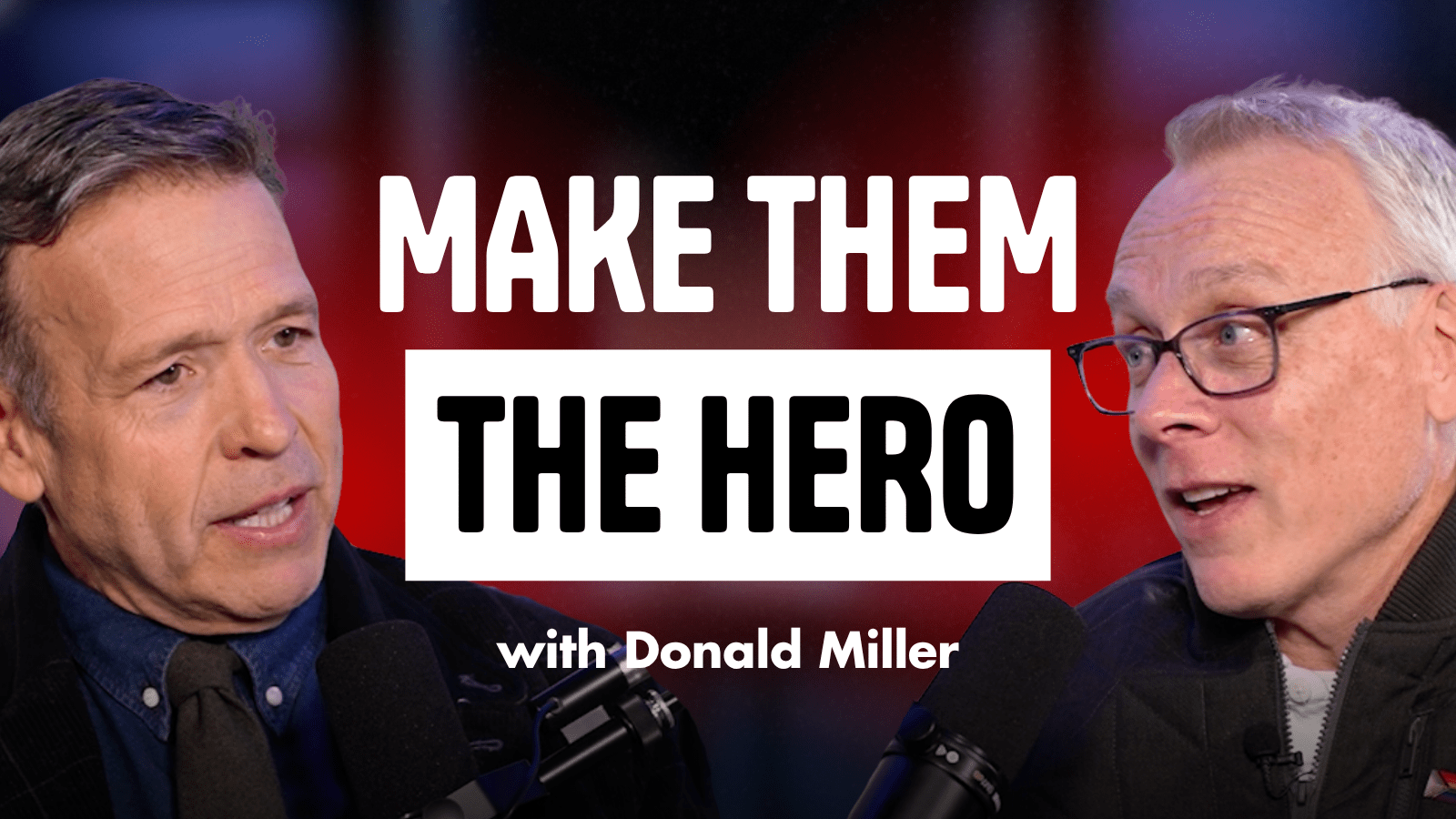
So, please enjoy this episode with one of the people I look up to the most in this industry, Donald Miller, author of StoryBrand.
————————
Jay Papasan:
I’m Jay Papasan, and this is The One Thing, your weekly guide to the simple steps that lead to extraordinary results.
————————
Jay Papasan:
Don, welcome to the show.
Don Miller:
Good to be here, Jay.
Jay Papasan:
Yeah, I’m excited. I’ve known you for a long time, and admired you from afar, and learned a lot from you. Today, so many of our listeners are business owners.
Don Miller:
Yeah.
Jay Papasan:
And more than ever, when we think about brand, we also have to think about our personal brand. And first off, like, when you talk brand, how do we address personal brand of the founder or the business owner with the brand? How do you think about that?
Don Miller:
You know, it’s interesting. I live in Nashville, and Dave Ramsey’s headquartered there, so occasionally I get to bump into him. And I asked him that question once, you know, “Do you regret tying Ramsey Solutions and all things Ramsey to your personality?” You know, he’s transitioning, getting older, those sorts of things. Although he’ll never quit. He loves his job. And he said, “No, not at all.” He said, “A brand without a personality is a brand without a soul, and having somebody on camera, on stage is a massive asset.” And of course, you’re asking a guy who’s been unbelievably successful, right?
Jay Papasan:
Yeah.
Don Miller:
So, the evidence is there. So, I think there’s a giant, giant upside to putting yourself out there as the face of the brand. You know, listen, if you’re gonna sell the company someday and it’s gotta outlive you, let’s just figure out how to do that having 10x succeeded in the first place because of that-
Jay Papasan:
Yeah, yeah. It’ll be a good problem to have when you get there.
Don Miller:
And then, I don’t know, there’s some studies that have come out recently that just say trust of brands and corporations is at an all-time low. And you think about misinformation and people being sold thing and transactional relationships with people. So, to be able to have a personality that you can put out there as the owner of the brand or the founder or the CEO or anything else in leadership, I think is a massive asset.
And if you have somebody who’s willing to do that at the top of your brand, I think you should put them out there, and they should have an interesting story, and they should be a leader in the market and be known for solving a specific problem. I think that’s just a terrific asset if you’re trying to grow a business.
Jay Papasan:
Okay.
Don Miller:
And I’ve done it myself, right? I mean, StoryBrand is not my name, but at the same time, I’m the face of the organization, and it’s been incredible to be able to enjoy that benefit.
Jay Papasan:
Yeah. For lunch I asked you, like, “Are you the CEO?” And you said, “Yes, and the CMO.”
Don Miller:
And the CMO, yeah.
Jay Papasan:
And I was like, “Of course. Of course you are” because you’re the brand character. And I think that’s why there’s a Geico. You know, that’s why there’s a Colonel Sanders. Every business needs an interesting character, and how that plays with the brand matters. What are some of, maybe, the don’ts of being … If you’re the founder, you built the company, so it’s gotta be a reflection of you in a lot of ways.
Don Miller:
Yeah. I think there are two characteristics that you wanna lead with. One, I don’t think … You know, as soon as I say that, as soon as we say somebody should be putting themselves out there on behalf of the brand, the inclination is to say, “Okay, well, I’ve got to get out there. If I’m the owner of my company, I need to get out there and tell my story.” And I think that’s an understandable intuition, but it’s not going to be helpful, and it’s not what you should do.
Jay Papasan:
Is that where they’re mistakenly becoming the hero of the story-
Don Miller:
That’s exactly it.
Jay Papasan:
… when they should be the guide, in your language?
Don Miller:
Yeah. Yeah. That’s exactly it. You know, in stories, there are multiple characters, and two of the main characters are the hero and the guide. The hero is Luke Skywalker, the guide is Gandal-… or the guide is Yoda. I’m mixing my stories there.
Jay Papasan:
Or Obi Wan, who’s-
Don Miller:
Or Obi Wan, yeah. Gandalf and Frodo, you know, those are heroes and guides. And you always wanna make the customer the hero of the story. So, really, the story that you are telling, if you are telling your story at all, would be the backstory of the guide. You want to be the guide in your customer’s story.
And the two most important things to talk about when you tell your story or the story of the brand, the two most important questions to answer are, why do you care about the customer and their problem? What happened that made you care so much about people who need a new roof or people who need a new fence? And I really mean that. I mean, there’s a company in my town, it’s called the Kowboy Fence Company. Kowboy is spelled with a K. And apparently it’s a bunch of cowboys who build fences. So, it’s a fun little brand.
Jay Papasan:
Yeah.
Don Miller:
You know, but if I were the founder of that, and I’ve never heard their story, they just have a billboard right above my office that I’m always criticizing ’cause it could be clearer than what it is. But you would want to say, “My dad got me started in the fence-building business, and I saw how much it elevated somebody’s yard and somebody’s house, and it just made me feel like I have a purpose going around and adding value to somebody’s house.” But you notice I’m not talking about me, I’m talking about the value that I’m adding to a house-
Jay Papasan:
Exactly.
Don Miller:
… instead of, “My dad started a company. And for years, I fought it. I didn’t want to be like him, and I wanted to do my own thing, and then I started to respect him.” Now, I’m telling my story. The only elements of the story that you want to tell is a story that benefits the customer. How did you learn to care?
And so, even today on stage, I told the story of not having a clear message and what that was costing me, and then creating a framework to clarify that message, then benefiting from it, now going to you and helping you do the same thing. So, the story that I’m telling is how I came to care about my customer’s problem. That’s aspect one of the story.
Jay Papasan:
Can I jump in?
Don Miller:
Please.
Jay Papasan:
Will you hold it? We’ll go back to two. One of the versions, sitting in this seat, talking to entrepreneurs like you, I hear again and again, the version of that story is a mix of the two in my mind. They had a problem, they solved it for themselves, and then discovered that the world had a problem. Is that an acceptable throughline? I see it a lot.
Don Miller:
Oh, it’s 100%. And if you didn’t have that problem yourself, I wanna know who you met that you cared so much about to help to solve the problem. And even if you inherited the company and it was already solving the problem, why did you come here? What was it about that problem that made you wanna solve it? If you go in, if I say, “Look, I have Acme,” whatever is the name of my company, and I joined this company ’cause I saw a great opportunity to have an early retirement and maybe an exit, you can see how like-
Jay Papasan:
I’ve always wanted a yacht.
Don Miller:
Well, that may be my story. That is not the story that I wanna lead with. And we know that companies that tend to take off, tend to have founders who are just on a mission to solve that problem for that customer. I mean, if you actually sit down with Dan Cathy here in Atlanta where we are or Truett Cathy before him, they’re gonna talk about the fact that they felt like people were mistreated when they walked into a quick-serve or fast food restaurant, that they weren’t treated with the sort of dignity you get at a fine dining restaurant, and they wanted to change that. They wanted people to walk into a Chick-fil-A and feel cared about, and respected, seen, and served. And their mission is not chicken.
And when you have a founder who has that backstory of, “That’s the mission I’m on. I’m on a mission to care for my customer,” I think those businesses tend to take off with greater percentages than those that the story’s all about them.
Here’s another thing that we sense when somebody makes the story about you. Hurting people because they’re hurting. They have a wound, or they have a toothache or whatever, they’re thinking about themselves. But strong people who are competent, capable, at home in their own skin, have this ability to not think about themselves. I’m thinking about you. And so, if your brand has this personality, this sort of vibe about it where they’re just always thinking about the customer, those brands become magnetic.
Jay Papasan:
Oh, so you’re saying that that is also just subliminally-
Don Miller:
Yes.
Jay Papasan:
You’re sending a signal of confidence. and strength.
Don Miller:
Yeah. I was with an audience just a couple days ago, and I asked the women in the audience, I said, “Hey, back when you were dating, did you ever have to suffer through a date where a man talked endlessly about himself?” You know, every girl in the audience raised their hand. And then, I said, “Are you married to him?” And every hand went back down . And so, I said, “See? It doesn’t work.” Like sitting and talking about yourself just doesn’t work.
However, people will hear me say that, and they’ll say, “Oh, we can’t talk about ourselves.” That’s not true.. What you can talk about is why you care. Like, why do you care so much about this problem? And by the way, if you don’t know that, if you don’t know why you care, if it is about the money and the yacht, sit down and actually ask yourself, “Well, why should I care?” And what happens when you actually say, “Why should I care?” and you start articulating that story is you actually do begin to care.
Jay Papasan:
Yes.
Don Miller:
And I have found in my line of work that everybody starts a company, you’re just worried about making payroll, you’re worried about paying the bills, you’re self-obsessed and narcissistic almost by necessity because we gotta keep this thing alive. Then, you start making some money, and then you realize, “Oh, wait a second. We have customers. And who are these people and why are they buying our product?” And then, you begin to fall in love with them. And that’s really when exponential growth takes off.
So, positioning yourself as the guide is very important. And the guide having a backstory is very important. So, empathy is huge. I empathize with my customer’s problem.
The second part of the story that you wanna tell is how you became competent because you can’t just be empathetic. You actually have to be authoritative and competent at solving that customer’s problem. And you have to be able to say, “Here’s what we did. Here’s the research that we did. Here are the scientists that we hired. Here’s why we partnered with so-and-so to represent their product. Here’s how I became competent at that.” because every story is about a hero who falls into a hole, and then a guide comes along at the top of the hole, shouts some empathy down, “I see you. I understand you’re in a hole,” then throws a rope into the hole and pulls them out. The rope is your product and your competency of pulling them out. But you both have to care about the person in the hole and be able to get them out. Otherwise, you’re kinda useless.
Jay Papasan:
Yeah. I have a very special rope just for this kind of hole.
Don Miller:
Yeah, that, exactly.
Jay Papasan:
And I keep it with me all the time.
Don Miller:
And it’s worked a thousand times, and it’s gonna work for you, friend. Let’s get you out of that hole. And that tends to be the part of the story that you want to put out there. And what you’ll notice about really, really competent CEOs, leaders, politicians is that you think they’re telling their story all the time. You think that you know them. But ask yourself, just put together your favorite politician in your mind, somebody who’s maybe been elected president or prime minister or won a Nobel Prize or something like that, you know, Dr. Martin Luther King, we’re here in Atlanta, something like that, and ask yourself how much of their story did they actually ever tell.
Now, the biographies have been written about them, but how much of their story did they tell? And the answer is none. It’s none. They’re always talking about you, and you feel like you know them. And it’s not the case at all. Great leaders-
Jay Papasan:
You feel seen by them.
Don Miller:
You feel seen, and you feel understood because what you do know about them and what you like is that they come off as strong and competent but also compassionate. And I think those are the characteristics that if you’re gonna get out there and tell your story, those are the characteristics you wanna talk about, why you care and why you are competent.
Jay Papasan:
The amount of time that a founder today would be promoting themselves as the interesting character for their brand, now it’s not like we have to shoot a commercial, or I’ve gotta go give a speech on television, those scenarios that we’re talking about. People are posting daily. And I know a lot of these figures, like they’re talking about the problem while they’re making their smoothie. So, is there a line where you reveal all of you? Like, I feel like there’s some of that that’s good. Like, I know the founder of Patagonia was a surfer, and that’s actually a part of their lore or was he a climber? He was a climber. But Take My People Surfing was his book. I’m getting him confused. But there’s parts of their personal story that also connect. So, is there a line where we’re trying to be a well-rounded human being while we’re telling the story that we shouldn’t cross, or we just always keep coming back to the hero, which is our customer?
Don Miller:
Listen, I think to the degree that you get into sort of telling your own story, I think is the degree that you’re kind of losing the plot. And it’s not always bad. I do think it is always bad if that’s how you are introducing yourself. But listen, if I build a brand as big as Patagonia, and I’ve made clothes, and I’ve had Patagonia clothes that are just as well made as Patagonia and people are finding it, at that point, we are deep, deep into a relationship with this brand, and I might actually be curious about your backstory.
The amateur leads with it, and that’s where I think you sort of make a mistake there. I think going back to the dating analogy, and I think all businesses are built on relationships, and even if your brand has a relationship, an ethos with your customers, it needs to start by listening, understanding.
And it’s amazing, those same shows of hands from those women who suffered those dates with guys who only talked about themselves, if they met a guy who had the strength and secureness for the first several dates to kind of only ask you questions and drill down and say, “Well, tell me about that,” and get to know you, she’s actually learning quite a bit from that man. She’s learning that he’s strong, that he’s competent, that he can hold a conversation, that he’s going to be interested in her. Why? There’s a lot at risk for this young woman. A lot at risk. And she needs to know somebody’s going to be focused on her. But at some point, that dynamic changes, and she becomes obsessively interested in his story. And now, and now all she wants to know is his story, and she wants to stop talking about herself because she’s found somebody.
And I think that’s kind of how it works with brands. There are brands that I’m an enormous fan of…. We’ve been talking, but this is a Double RL jacket. It’s just a men’s clothing brand. This is a brand that I’m sort of obsessed with. I love their stuff. And now, I’m more interested in them as a brand because they’ve served me so well and they’ve made such great clothes and those sorts of things. But I think people think that what you can do when you have brand evangelists is the same tactic when you’re introducing yourself, and they’re not.
Jay Papasan:
Okay. It makes sense. Like, I’m seeing the end product. I’m seeing someone who’s already gone through, built the trust and affinity around their core brand. And now, they’re a bit able to expand on it, and I’m mistaking that for the path versus they’re already at another place completely.
Don Miller:
That’s right.
Jay Papasan:
How they got there was very different.
Don Miller:
That’s right. There are three phases in building a brand relationship with a customer. The first phase is curiosity. You have to make people curious about you. And the only way to make anybody curious about you is to pique their curiosity. And the way you do that is you have sound bites that associate your customer’s survival with your product. You have to be able to say, “Look, we’re gonna help you save money. We’re gonna help you make money. We’re gonna help you look better. We’re gonna help you feel better. We’re gonna help you have better relationships. We’re gonna help you, you know, gain some sort of status.” There’s something that… And my intuition is smelling that you are a survival asset, that’s the only reason I would turn my head and look at your website or walk into your store.
And then, once we’re through curiosity, and that all happens with a sound bite sort of strategy,
Jay Papasan:
I’m gonna hit time out.
Don Miller:
Yes.
Jay Papasan:
Only because we’re right about the midpoint. We’re gonna take a quick break, and we’re gonna leave them in suspense. They wanna know what’s on the other side of-
Don Miller:
It’s called opening a story loop.
Jay Papasan:
There we go.
Don Miller:
We’ll close it on the other side of the-
Jay Papasan:
Yeah, you gotta catch this on the other side of the break, folks.
Don Miller:
Yeah.
————————-
Jay Papasan:
All right. We’re back. So, we left this with, we have this curiosity through sound bites. And I was processing all of that. You’re like, “I’m sitting here as a student, and I need to be also an advocate for the listeners.” I had to process everything you said in the beginning. We’ve got these two jobs as the interesting character, the personal brand connected to the brand. And my friend Justin Welsh once said, “You don’t need a thousand things to say, Jay. You need a thousand ways to say the same thing.”
Don Miller:
I would agree with that, yeah.
Jay Papasan:
So we have to just be disciplined about being the guide and talking to the hero and talking to the problem that we solve uniquely better than anyone else and just make our peace with that. Later, when we’re successful, the role may expand, but if we’re not doing it in that order, it’s a mistake.
Don Miller:
That’s exactly it.
Jay Papasan:
And so, now, we’re into the three phases. We’re looking at the bigger picture. Gone through curiosity. Where does that lead to?
Don Miller:
Curiosity leads to enlightenment. So, as soon as a customer… as soon as you get their attention and you help them understand, “Hey, I’ve got something here that I think could help you survive,” and there’s a million ways that you can help somebody survive, it’s very complicated, but it’s nuanced. It’s not complicated. The analogy that I always use or the example that I always use is, what’s the last car that you bought? Whatever it was, let me tell you what happened. You saw it on the street. You thought it was attractive. That’s a cool-looking car. That looks fun or fast, or whatever, or efficient, or Honda has a new Accord out or whatever. You wanted it.
Jay Papasan:
Being sold everywhere.
Don Miller:
Yeah, it’s being sold everywhere. And then, you wanted it. And then, you went to YouTube and you watched, depending on how expensive that car was, 100 or 1,000 hours worth of videos. And what you’re doing when you’re watching those videos is you’re building a case in your mind for a court case on why you should justify spending that money if it’s a nice car or something like that.
Jay Papasan:
Maybe it’s a guy thing or a me thing. I love that phase.
Don Miller:
Oh, me too.
Jay Papasan:
I’m just like-
Don Miller:
I can get stuck in that phase.
Jay Papasan:
Yeah. My wife’s like, “Why are you still researching the next computer?”
Don Miller:
My wife did the same thing to me.
Jay Papasan:
Why are you still researching that?
Don Miller:
Just go buy it. Yeah.
Jay Papasan:
And it’s like, it’s like there are very few… Like a lot of shopping, I hate, but there are some things that there is pleasure for me in this phase. I wanna learn more ’cause it’ll make me appreciate it even more when I get there.
Don Miller:
Yes. Now, the problem that a lot of brands… So, two mistakes we can already say that people watching this podcast are gonna make. They don’t have curiosity soundbites. So, they’re actually not piquing people’s curiosity by explaining in short soundbites how they can help them survive.
Jay Papasan:
Can you give me an example of that?
Don Miller:
Geico, our 15 minutes can save you 15% on car insurance.
Jay Papasan:
Okay. Clear promise, clear amount of time.
Don Miller:
Well, think about that. That’s exactly it. A very small investment from you can save you big is basically what that is. So, that’s one of those. Best cheeseburger in town would be an example of a curiosity soundbite. You know, there’s, there’s a million of them, but something that says you could help me survive, you can help me save money, make money, ease anxiety, get a better night’s sleep, whatever. So, people, what they’re doing is they’re using language that’s too vague. I once helped a company double their revenue with three words, kids love aquariums.
Jay Papasan:
I love this story. And you shared it with our audience, but can you share it really quickly with us here?
Don Miller:
Well, they saw a 99% increase in orders in a test market with those three words. Well, if you think about it, if I’m walking into a pet store and I’m a dad, and I am a dad, and we’re going in to buy a bunny, and I really don’t want a bunny because bunnies are gonna poop everywhere, or cats are gonna poop everywhere, whatever it is, and I see this “kids love aquariums,” you have just planted in my mind a way that I can get something for my child, which by the way is connected to survival – hers, mines, a family structure, learning about pets that’s connected a thousand ways. You’ve basically thought for me.
But let’s say that tagline wasn’t kids love aquariums. Let’s just say it was something like marine life is fascinating. So, “marine life is fascinating” may be true, but it’s not connected to my survival. Therefore, it’s a bad tagline.
So, they get the taglines and those curiosity soundbites, and there are five of them, by the way, that you need to create. They get those wrong. Now, if you get those wrong, nobody’s gonna pay attention to you. But let’s say you get them right. Now, you need YouTube videos, social media, case studies, white papers, LinkedIn articles. You need all sorts of stuff so that people can spend time with you being enlightened about how this works. And-
Jay Papasan:
What kind of proof do you find most effective? Like I know people say social proof. I want testimonials, I want reviews.
Don Miller:
Yeah, if you can get other people-
Jay Papasan:
Research.
Don Miller:
Other people talking about your product and reviewing your product, there’s nothing that beats it.
Jay Papasan:
Okay.
Don Miller:
Jay, I just bought the Milwaukee Packout toolbox. They make a toolbox that, literally, it’s a toolbox that has a dolly, and then you can actually stack other toolboxes onto it, and they lock into place like Legos. And they have drawers, and they have all sorts of stuff. I have spent probably nine hours on YouTube just watching about the different… And I bought a whole set of screwdrivers that I already had to match my Packout screwdrivers because there’s this cult following out there making YouTube videos about what they’re doing with these Packout… You know, I use it for my car detailing business, I use it for this, I use it for that.
The more collateral and material you can get your fans and your customers creating and putting out there, the more enlightenment collateral you’re gonna spend. But here’s the bottom line is, you know, in order… But I remember going to my now wife when I knew she was the woman I wanted to marry. And I got married late, I got married at 42. Just was a Bohemian writer until then without a lot of money and didn’t wanna get married, didn’t wanna settle down. Finally, Betsy, I was just like, “This is it. I’m never gonna do better than Betsy,” and we started dating. Well, when I knew I wanted to marry her, I sat her down about three or four months in and said, “Look, I think this is gonna work.” And she goes, “Don, you’re a quality time guy. I’m a quantity time girl. This is gonna take you a little bit longer than four months.”
Jay Papasan:
Not on your schedule.
Don Miller:
Well, what I discovered about my own business is when I looked at the data, up to 85% of orders were coming over a year after they’d actually met the brand. And so, if I didn’t have those YouTube videos and those emails going out and that social media presence, we wouldn’t have dated. So, the more hours that you can put out there that people can spend with your brand means the faster you’re able to date them, the longer you’re able to date them, and the more enlightenment they are able to do to become comfortable with you.
Jay Papasan:
I wanna just pick on that ’cause a lot of people struggle marketing in general. You’ve got all of the principles. You’re putting a message out, how frequently, consistently, all of the things that people talk about. And over time, people start to build an affinity for that message and that brand. But like with social media today, like you going and watching a hundred hours of this Milwaukee toolbox, you can speed up time
Don Miller:
It was 20, but I could easily watch 100.
Jay Papasan:
But, like, now you can have a year of dating-
Don Miller:
Yes, that’s exactly it.
Jay Papasan:
… happen in one weekend.
Don Miller:
That’s exactly it.
Jay Papasan:
And people can really just kind of very quickly go through that phase, even if it should be longer because-
Don Miller:
You can binge it. Yes, you can binge it.
Jay Papasan:
Yeah. And that is one of the reasons why video and some of these tools, like, people are hearing you, they’re trusting you over time. I’ve always heard that video, you talking on video, is gonna be the highest trust form that you can do.
Don Miller:
There’s no question.
Jay Papasan:
Okay.
Don Miller:
Yeah. And other people talking about your product without being sponsored, I think is even higher than that.
Jay Papasan:
And videos. It’s crazy.
Don Miller:
But you need… Yeah. You need to put stuff out there of you using your product. Just go out there and let people get to know you. Have your watchers, your viewers ever had the experience…
You know, there was an experience I had recently. I bought this pair of house slippers. I was finding myself running out to check the mail and get the garbage. I just needed something to slip on. And so, Instagram showed up whatever these were in my feed. I went, “That’s exactly what I need. There it is.” And I didn’t buy it. And then, it showed up again, and I didn’t buy it. And it showed up again, I didn’t buy it. And it showed up again, and I bought it. And then, I asked myself, “What’s the difference?” It was the same pair of slippers, the same picture, the same offer, and I bought the fourth time but not the first. And the only difference was familiarity. I just saw it four times. And so, all of a sudden, this is a brand I can trust? How is this a brand I can trust more the fourth time than the first time?
It’s not. By the way, they were great slippers. But it’s just familiarity. And I think that a lot of us are making the mistakes of not putting out kind of that content that gets to that familiarity. I always say this: you need to figure out, your website and your lead generator. Then, your follow-up emails and text messages in a sales campaign and a nurture campaign. You need both of those. So, you need all of that. Let it sit. Don’t touch it. And then, go back and create YouTube videos and social medias and keynote addresses and podcast interviews that point to the website.
Jay Papasan:
Got it.
Don Miller:
That’s it. So, once you create it, you don’t have any more marketing. There’s no more marketing to do on your checklist. Now, you have to go back and bring attention to your marketing, and that’s where you’re actually gonna spend the majority of your time.
Jay Papasan:
I’m gonna ask you one more question before we kind of wrap this up. A lot of people, they go on this marketing journey, and they’re putting in the effort. And because of the time lag, the familiarity that has to build up, like, Instagram’s really good at selling me clothes. I’m not sure how good it is at selling real estate or law services or any other business necessarily. So, in some categories it might happen faster. How do you coach people through, “I’m putting in all the effort, but there’s no evidence that it’s paying off”? Like, when is it faith that you need to have, and when is it you need to pivot ’cause I think people get antsy during that period?
Don Miller:
Yeah. I’m glad they get antsy.
Jay Papasan:
Okay.
Don Miller:
My personal view on that is the cash register will tell you if it’s working. And you think it happens fast for the most part. I’ve seen it. I’ve seen it. It’s not happening fast, we need to adjust. Something needs to happen. If you’re not getting people liking your videos, yes, it takes time to build, but you should know pretty quickly whether or not something’s working. And otherwise, just keep adjusting your strategy.
I say that for a couple reasons. One is to keep you paranoid and to make you continue to pursue something that works because if something isn’t working, and you’re sort of frustrated with it, is that a bad thing?
Jay Papasan:
No.
Don Miller:
No.
Jay Papasan:
No.
Don Miller:
No. So, I’d say keep adjusting.
Jay Papasan:
Obsession can lead to excellence.
Don Miller:
That’s exactly it. And even like Ray Dalio, one of his big principles of what’s important as a leader is a mild amount of worry. He said, “The only thing you should ever worry about is if you stop worrying.” Because if you’re worried, you’re worried, and you’re on edge, and you’re thinking. But in my opinion, if you’re creating marketing and messaging collateral, it should work. It should turn into orders.
Jay Papasan:
Okay. That’s good to hear, because I think a lot of us are thinking, “I need to wait longer. I don’t need to keep experimenting.”
Don Miller:
You need to keep at it.
Jay Papasan:
Okay.
Don Miller:
You need to keep at it, but you wanna keep iterating. Not necessarily doing the same thing.
Jay Papasan:
Trying new tactics to try to find what hits.
Don Miller:
Yeah, yeah. Keep iterating.
Jay Papasan:
All right. So, thank you so much for sharing your wisdom. I mean-
Don Miller:
My pleasure.
Jay Papasan:
… you’ve built a lifetime around marketing. And you were sharing over dinner, you’ve been teaching this for so long, and you’re just as excited today as you were.
Don Miller:
I’m very excited. Yeah, it’s very fun.
Jay Papasan:
And it shows. It shows, the passion for your topic. You love solving this problem for people.
Don Miller:
I love solving this problem.
Jay Papasan:
This whole you know how to get people out of. What’s one challenge that our listeners could put to use? Think of the business owners out there. I wanna take action on this podcast.
Don Miller:
I want them to own a problem. And I want you to figure out what problem you’re going to own. No matter what company you represent, no matter what product you sell, my assignment to you, if you will, is go out there and own a problem. What I mean by that is whenever this negative thing happens, people call you. So, what is the negative thing that you wanna own?
And a young college student who is a dog trainer said to me, “Don, I’m a dog trainer. Like, what problem can I own?” Well, I’ve had a couple dogs, and when somebody knocks at the door, the dog barks. It’s a very loud bark. It’s very unsettling. The person on the other side of the door doesn’t feel welcome. I said, “I want you to watch. I bet you your dog training appointments triple when you say, ‘You know how dogs bark when somebody knocks at the door? I’m the guy who stops that.'” I bet you they triple, even though that’s like 5% of what you do because you want to own a specific problem. And it has to be specific, it has to be painful, it has to be annoying, people have to be motivated to solve it.
Jay Papasan:
It doesn’t mean that’s the only problem you get to solve.
Don Miller:
No, it’s the entry-level problem.
Jay Papasan:
Right.
Don Miller:
So, once you come to my house, you say, “I can also stop your dog from tearing up the newspaper. I can stop the dog from running away from you. I can stop the dog from pulling at your leash. You know, I’m a dog trainer.” But if I just said “I’m a dog trainer,” it takes too much of a cognitive load to figure out-
Jay Papasan:
What does that do?
Don Miller:
… what problem you’re gonna solve.
Jay Papasan:
I love it.
Don Miller:
For instance, if you’re a marriage and family therapist or whatever and you said, “You know, the one problem I really solve is couples that are mad at each other but won’t resolve conflict quickly,” you know, whatever every-
Jay Papasan:
Everybody. Yeah.
Don Miller:
So, you kinda wanna figure out that universal entry point, that entry pain point, and then position yourself as the solution.
Jay Papasan:
If it’s not there, they’ll say, like, “Well, can you make my dog not pee in the house, too?”
Don Miller:
Yeah, yeah, that’s exactly it. Yeah.
Jay Papasan:
But they’ll take you to what they need really quickly if you’ve hit the universal problem.
Don Miller:
Yes, especially the dog barking at the door.
Jay Papasan:
Can you handle my in-laws?
Don Miller:
By the way, if you can solve that problem, give me a call. I’d like to solve that problem ’cause it’s a-
Jay Papasan:
We just adopted a new dog who’s part hound, and our first dog, Taco, didn’t bark.
Don Miller:
Did or did not?
Jay Papasan:
Did not.
Don Miller:
Oh, well, and now you got one of those.
Jay Papasan:
And so, it’s affecting my nervous system.
Don Miller:
So, yes. Call both of us.
Jay Papasan:
We need to talk to your friend.
Don Miller:
That’s exactly it. Here, let me say this lastly. The next thing that people will say is, “Well, everybody solves that problem. All dog trainers solve that problem.” I want you to understand something. If you say that you solve that problem, and they also solve that problem but don’t say it, you’re the only person who solves that problem.
Jay Papasan:
That’s right.
Don Miller:
In other words, pretty much it’s a blue ocean opportunity for you even though everybody solves that problem. Nobody’s reading your mind. Nobody knows that you solve the problem. You will literally be the only person in the world who solves a problem of dog barking at the door, and every other dog trainer does it, and nobody will know that. Everybody will think, “Well-“
Jay Papasan:
You’re a category of one if everybody-
Don Miller:
Jay, you’re a category of one
Jay Papasan:
Love it.
Don Miller:
So, that’s the power of words. And so, I would say the number one thing, just to repeat it, that you’ve gotta do is own a specific problem. You are the world’s leader in owning that problem. You know, this stage has been… There’s been a lot of people who help with marketing and messaging and things like that. That idea of clarifying a muddled message, I’m the guy.
Jay Papasan:
That’s you.
Don Miller:
You go anywhere in the world and I’m the guy. And it’s not because I’m the guy. It’s because I told you I’m the guy.
Jay Papasan:
Yes.
Don Miller:
That’s it.
Jay Papasan:
And you’re the only one who’s saying it.
Don Miller:
Hopefully, I’m boxing everybody out, right? But it’s a problem I love to solve, and I can own that category for the rest of my life and I’ll be the happiest man in the world.
Jay Papasan:
Well, I love hearing that. Thank you so much for sharing with us today.
Don Miller:
My pleasure.
—————
Disclaimer:
This podcast is for general informational purposes only. The views, thoughts, and opinions of the guests represent those of the guests and not ProduKtive or Keller Williams Realty LLC and their affiliates and should not be construed as financial, economic, legal, tax, or other advice. This podcast is provided without any warranty or guarantee of its accuracy, completeness, timeliness, or results from using the information.