Jay Papasan:
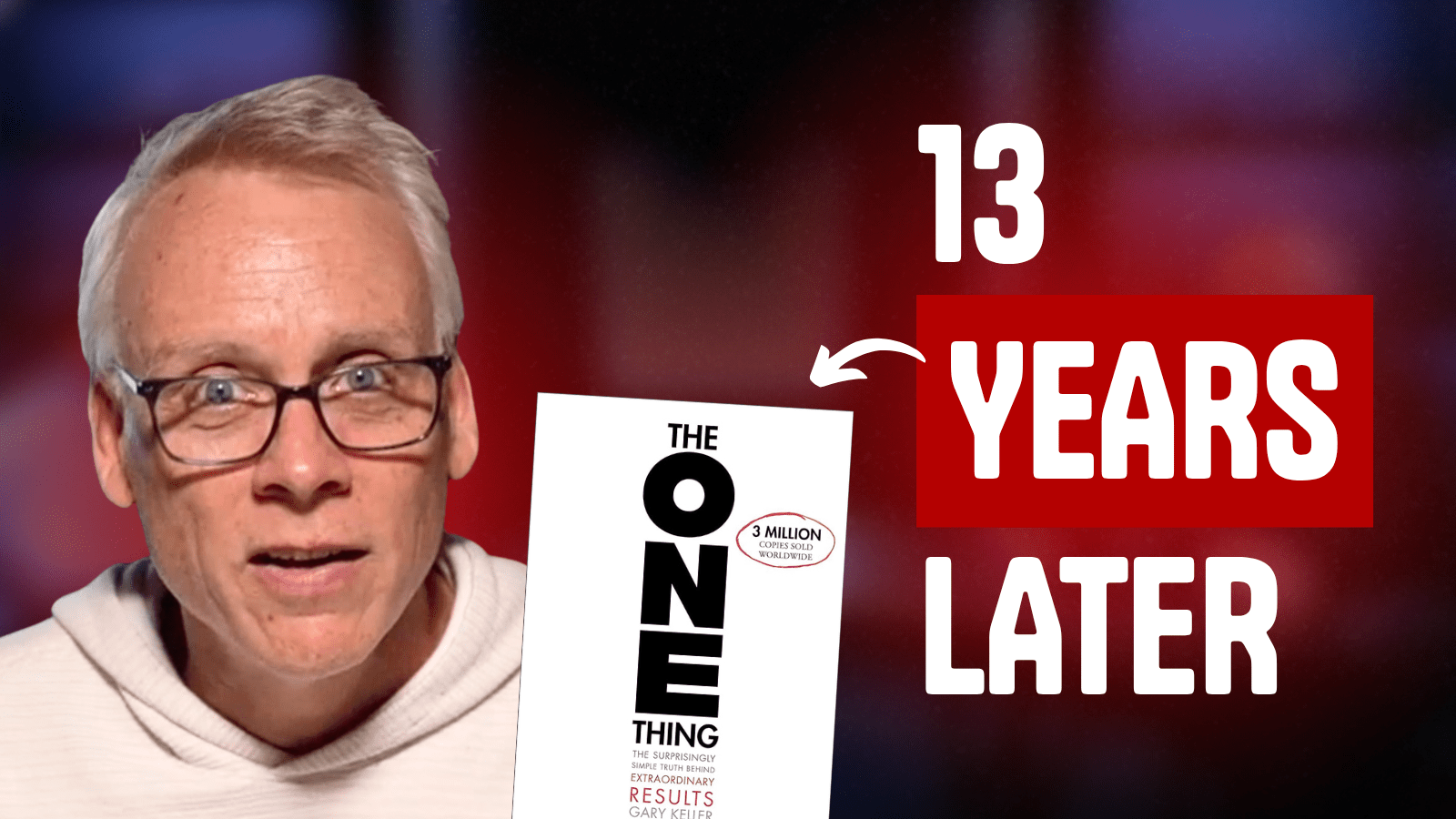
So, this week, we’re gonna do a little time travel. We’re gonna go back in time, 14 years to the year before we published The ONE Thing book. And there’s a book that you never really got a chance to read, and that was The ONE Thing when it was over 400 pages long. It was so big, y’all. But in those last few months, before we had to send it to the publisher, we ended up using the ideas in the book to make a lot of difficult decisions, and we cut a lot away to get it to where it is today, that book that has traveled around the globe in 40 plus languages and sold almost 4 million copies.
So, this week I’m gonna walk you through what were the big things that we took out of the book, why did we do that? And today, 13 years after the publication, with all the stuff that we’ve learned, what would be the things that I absolutely would add back in if I got the chance?
———————-
Jay Papasan:
I am Jay Papasan. And this is The ONE Thing, your weekly guide to the simple steps that lead to extraordinary results.
———————-
Jay Papasan:
So, let me fill in some of the blanks before I dive into the stuff that we cut and why. So, we worked with a guy named Ray Bard. He’s the Bard behind the Bard Press, which if a look on the spine of the book, that’s who our publisher was in the United States. Ray had a very simple principle. He was a one-thing kind of guy. He would only publish one book a year. I actually courted him for about two and a half years before we actually got to sit down, talk, and we got to pitch him the idea for The ONE Thing. So, he puts more energy than any publisher I’ve ever known in my 30 years in the industry into making every single book great.
So, Gary and I are working on the manuscript. We’re going back and forth meeting regularly with him, and we sent him kind of the manuscript in the summer of 2012. We have a hard deadline at the end of the summer that we have to have the book 99% right ’cause it’s going to copyediting, to proofreading, like we’re going into production now because the book had to come out in April 1st of 2013. And to do it the Ray Bard way, one-book-a-year way, that wasn’t a fast process. So, we sent him the manuscript, we were feeling really good about how well we’d built out all the ideas, we had this depth of history, and Ray called me up and he said, “Guys, if someone’s buying a book called The ONE Thing, they don’t expect to get a doorstop. You need to apply the principles of the book. Cut, cut, cut. And let’s get this down to the bare essentials of what people need.”
And it’s one of those, sometimes, you get some criticism and you react to it, not because they’re wrong, you react because they’re right. And I kind of think we both knew in our heart that we weren’t willing, as writers will say, to murder our darlings. The stuff, a lot of times, that you’re most attached to is really the stuff that’s just your darling, it doesn’t matter to the reader, you probably should cut it.
And so, we did the hard process of identifying everything that we could cut from this book. And by the time we were done, we had a 240-page book. And I can tell you, as someone who’s worked in bestselling publishing, I’ve done three books that did over a million copies in my career, short matters. We live in an industry, in a world where people are moving fast, they want to have something,,, if they’re gonna read nonfiction, they don’t want a lot of friction in this whole thing. They just want it to be easy to digest. So, a shorter, faster book always wins if you wanna reach a large audience.
So, we took it to heart. We kind of yelled and squabbled ’cause we were at the end of a four-and-a-half year writing journey, and we’re like, “Why are you always picking on my favorite parts?” Like we literally fought over parts of this, but we ended up doing the right thing.
And that’s also a lesson. I know somebody said, I can’t attribute it, they called it the 90% rule that it takes 90% of your energy to get 90% through, like a coding project, and it takes another 90% to get the last 10%. This was that last 10% going from good to great to make a really good book into a really great book, and it was as hard as the whole four years that came before it. I mean, Gary even got sick at the end of that summer. We were working so hard to try to make it all come back together and read smoothly.
So, let’s walk through the handful of things that we cut out of it and why. And there’s some good lessons. Like this stuff wasn’t bad material, it just wasn’t appropriate to what the final product needed to be. So, we kind of opened up the book with I think some of the sexy, fun stuff. You know, the six lies between you and productivity. And it’s all the stuff that we wanna believe to be true or the world tells us that it’s true that just isn’t so, and it’s actually getting in the way.
And so, if you’re not familiar with the book, we talk about everything matters equally as a lie, multitasking is a lie, a disciplined life is a lie, willpower is always on will call is a lie, a balanced life is a lie, and big as bad is a lie. And those all kind of flowed together. They had a nice rhythm, but there was a seventh lie and it was called the low hanging fruit is a lie.
And here’s the big idea. A lot of times in business, the low hanging fruit, that thing that is easily within reach, it’s actually doable, it’s on a short timeline, and a lot of times it’s actually profitable, it has this great appeal because it looks so productive, here’s this quick hit that’ll add money to our bottom line, and you just start checking all these boxes. The truth is, if you understand the concepts of this book, the whole idea of goal setting to the now, if we’re working backwards from this vision of our someday days, like business, self, whatever, there’s usually a pretty narrow path. If there’s the thing that we need to do today to get to the thing that we need to have done at the end of the week, at the end of the month, at the end of the quarter, the end of the year, that leads to our five year goals, that leads to our someday goals, but we’re working backwards. And when you work backwards, like what you have to do right now is usually pretty clear. It may not be sexy, it may not be a quick hit, it may be building a foundational building block for something much bigger, so you don’t even make a profit on it.
So, a lot of times, the low hanging fruit is actually a distraction. People will give you a promotion for it if they’re not paying attention because, “Wow, what did you just do? Wow, that is so cool. Look how many followers we just got,” but if you do that long enough, you’ll just run in circles. And I love that and we still use it. I mean, literally this week in The ONE Thing, I had some team members that came up with a great idea for a new product, and we all got really excited. That’s what we do, entrepreneurs, new ideas, fun, yay, squirrel, right? And I had to sit there as the CEO of this company and ask, “Is this a good idea or is this low hanging fruit? Is it the stuff that’s just tempting us to get off the path, the harder path, the long-term vision path to get to ultimately extraordinary success, not average success?”
And it’s not clear right now. That verdict is still out there, but we all agreed that if certain conditions weren’t met, we would all agree to set it aside. Great thinking. Love the creative ideas. I want all of our people trying to solve every problem in our business, add new streams of revenue, I wanna reward that activity, but we’re not just gonna say yes willy-nilly. We’re gonna be disciplined about it.
So, here’s the big idea. When you’re looking around you at what you could do, not what you should do, be aware. There’s lots of very appealing targets for you as a business owner to go chase, to take on that client. Wow. What if we did get into Walmart? What if we did get into Costco? I have no idea what that looks like in your business, but you have to ask the question, is this truly an alignment with where we’re ultimately going? If it’s not, folks, it’s a distraction. It’s a hard one. We couldn’t put it in the book ’cause you remember the lies are right up front. Goal setting to the now doesn’t get unpacked till around page 150, and we could not figure out how to have this big picture of working backwards from your goals without kind of being a spoiler for the rest of the book.
So, it just became something, that we teach that when we work with people and corporations in our training, our coaching and one-on-one, we try to make sure that they’re aware of it. The low hanging fruit is a lie almost all the time, folks. So, beware of the low hanging fruit.
So, one of the other big things that we cut, and I’m gonna finish on this one, but I’ll just rattle off ’cause I said there was a bunch of things, we had case studies around all seven areas that you could apply The ONE Thing, your health, your spiritual life, and they added like 40 pages. It wasn’t a small thing. These were like 10-page case studies. At the end of the day, like they just didn’t make the cut. We had a whole intro. You would not believe the research we did. Like we researched, like where does time come from? How do people view time in different cultures? I am like a font of trivia on water clocks and sundials and how people originally organize their lives around deadlines in time.
We went all the way to the beginning and hopefully, when you read the book,you could tell there was some depth to the research that we did, even if we kind of cut a lot of it away. So, like there was a big chapter in the front, there were the case studies. And now, you go all the way to the end of the book, we have the four thieves between you and productivity. And those are like pretty big ideas: the inability to say no, fear of chaos, poor health habits, and an environment that doesn’t support your goals. And those come up a lot on this podcast, especially our environment. A lot of people think they have no problem, what they really have is a poor environment for doing their work. Just figuring out and getting the right lens.
Well, we had a fifth thief, and it was maintenance. And it’s the idea… and it shows up in two forms. And I’ll do the first one ’cause I’m a writer. You look up and you see a lot of artists, they’re musicians, they are actors, they are writers and novelists, and they will spend years laboring and obscurity to perfect their craft. And they will write books that don’t sell. They will write music that doesn’t fill up an amphitheater. They will do all these things, but what they’re doing is growing, and they’re practicing, and they’re showing up, and they’re writing, and they’re doing the real work and becoming great at what they do.
What happens a lot of the time is when they become successful, the fruits of that success actually steal all of the time that they were giving to their craft. And that’s why we have this whole idea of a one-head wonder. A lot of people work forever to get to that thing. It’s not just luck. Then, they get so distracted by the success itself that they lose the discipline they had to keep doing the things that got them there.
A great anti-example of that is like Ryan Holiday. He’s incredibly successful as a business author, and the dude just keeps showing up and churning it out. He will say no to almost everybody trying to take him away from his writing desk. That’s a great example of someone who did not allow the maintenance of this empire of books that he’s created to steal away his one thing activity, which is to sit down and write on those little index cards. He’s got the craziest system. But that shows up all the time. We see it with musicians, with actors, with artists, with novelists, with nonfiction writers. They did all the right things to get their success, and the success becomes this big distraction and their career has kind of hit their pinnacle and it’s downhill from there.
The other side is that people get financially successful and they start acquiring junk. Oh, we should have a second house in Colorado. Oh, and what about a beach house down in Florida? And they look up, and they have the financial ability to acquire lots of things, and the stuff that they own ends up owning them. They don’t realize that now they’ve got two second homes and that is three roofs in addition… you know they have their own, and two more. All of those air conditioners, all the maintenance that can happen. If anybody out there is a landlord like I am, you know that every house has its surprises and they kind of happen on a regular basis. I love home ownership, but I know that there’s a job attached. And if they haven’t acquired the other muscles about hiring the people around them to take those things away, they’ll end up maintaining their empire instead of growing it. The size of it itself starts to weigh them down.
It’s like one of those giant dinosaurs that you read about that if they actually left the water, their bone structure wouldn’t support them. They just get so big, their infrastructure won’t hold them up again. So, maintenance is a thief of productivity, and we have to be careful about what we accumulate along the way in terms of our possessions, in terms of our ego, and also in our activities. We start to add all of the new things because we’ve earned the right to do them. Are we still doing the one thing that got us there?
All right. So, those are the big ideas that didn’t make the cut. All of that history, all of those case studies, this idea of the low hanging fruit, which really does show up a lot in entrepreneurship because we can squirrel and distract ourselves like nobody else. And if it makes money, it feels like we did the right thing, but it’s an illusion. And then, there’s this maintenance idea that as we become more successful, we’re accumulating a lot of stuff behind us that can distract us. So, those are the big ideas that didn’t make the cut.
And I’m proud they didn’t make the cut ’cause otherwise we wouldn’t have a nice digestible book at 240 pages. And people can breeze through this in one airplane ride. And I’m proud of that because the hardest part wasn’t writing the 400 pages, it was cutting the 40% to get to 240. And I bet Gary would agree with that statement.
Right now, let’s take a quick break. And on the other side, I’ll walk through a few of the ideas we’ve learned in the last 13 years that if we go back and update the book, they would be the first things I would want to add.
———————–
Jay Papasan:
So, first and foremost, when people ask me, “Jay, if you could add one thing to the book, what would it be?” the quick answer for me is always core values. If you’ve been to any of our trainings, if you’ve been a part of our First Domino group cohort, or maybe you’ve been in our one-on-one coaching, it’s one of the exercises we almost always do with people because purpose can be really hard for people to unpack. It’s often the number one aha they have from reading the book is that there is something that’s calling them to move forward in life, but they can’t name it, they can’t articulate it, and without that, they’re not clear completely of their direction in life.
And that calling is the thing that they want to hear and they want to, “Hey, I want to hear the call and I wanna go do the thing, but I’m unclear.” And you start talking to people, and I did it for years around purpose, and it just feels heavy. And sometimes, people feel highfalutin, like, I’m gonna write a purpose statement. I’m a rancher. What are you talking about, kid? Right? It just felt weird. But core values, 30 minutes, I can work with anybody, a room full of 400 people, and they will walk out with more clarity around where they’re going in 30 minutes than they had in the 30 years prior.
It’s a very simple exercise the way we do it. And frankly, we could have just dedicated a two-page spread to letting people do the exercise in the book. But I love it because it is kind of the gateway drug to purpose. When people start using their core values to make big decisions, you very quickly can look up, what are the decisions that I’m proud of? What are the ones that I have regrets around? How do these core values actually serve as my rudder in life and business? They very quickly start to articulate what their purpose statement might be.
So, it’s very powerful. It just wasn’t even a thought in my head. I know core values goes back decades, but it took me reading, I think Essentialism and Brene Brown, those combination of those two books is where I kind of came up with the idea and started building a core values deck right from scratch, which is one of the things that we offer in our training, like get the Core Values Deck, do it, or we just do the exercise, which is then if you go to our free resources, the very first download, it’s got the core values exercises. Absolutely free. And if I could add it back, that would be the first thing.
The second thing is something that’s even more recent. It’s the someday letter. Now, people have been writing letters to themselves in the future. I can date it back to a guy in the ’90s that I first heard about doing that. And it was more about getting in touch with who you were wanting to become. Today, this has become like a formal process where people can sit down and start looking out 10 years into the future, and it’s a part of the life by design. What is the life I want to be leading? How do I wanna show up in my business? What kind of business am I running? Am I retired? Who am I hanging out with? We help cue them with all the right questions, so they can start building out this vision of the future.
And we’ve designed it and I love it. I struggled with it for years. What is it I’m truly working backwards from way out in the future because my logical mind doesn’t work out there? Nobody can project 10 years in the future, much less three or four, but the exercise finally got me to do it and paint a picture, even if it is a little kind of a dream state, that it gave me an anchor in the future to start working backwards. And ever since I’ve done it, my life has been clear, my decisions have been clear. And I’ve even aligned all of my core values around that journey.
So, the core values and the Someday Letter are kind of a one-day punch for clarity about where we’re going and why. And when you understand where you’re ultimately going and why, it is very easy for you to first work backwards to what you need to do to today, and also, say no to all of those distractions, all of that low hanging fruit, it becomes that much easier because it’s tied to some very deep calling in you, the future that you truly want and the values that you wanna uphold in life. So, those are a big two that I would add back, given the chance today.
Number three. This was in existence, but we didn’t even think about talking about it. I remember the very first time I interviewed with Gary. He asked to see my calendar, and I’ve told this story. I had like a week-at-a-glance calendar. It was June of 2001 when we first did this interview. I was already working at his company and he looked at my calendar. He wanted to see how I plotted my time. And it was an interview, and I didn’t even know it, but I thought, “Man, this guy’s nosy. He’s looking at my calendar,” right? But he had a big month-at-a-glance on his table, and whenever you were gonna work with him, he had a pencil and he would erase something and then write it in.
And even though back in 2000, people were on electronic calendars and a lot of people were on Daytimers, it wasn’t that unusual, he stuck to it. And I can remember Geoff Woods joins our company and that would’ve been 2015. And now, everybody’s got iPads, everybody’s on Outlook or Google Calendars, and here’s Gary trying to schedule meetings with everybody with a paper planner. And it was irritating to Geoff and he’s like, “What is going on?” Every time he changes his calendar, someone has to look at it, they then have to communicate it, and then we all update our electronic calendars. It didn’t feel very productive.
And he actually asked Gary and he said, “Geoff,” this is my former co-founder, he’s like, “Geoff, if you want to achieve extraordinarily large things, you need to have a bigger view of time. And what you’re seeing on your screen on your computer, what you’re seeing on the screen of your phone is not big enough for truly having a big vision. You need a bigger view of time.” And I shared with Geoff, I fought it too. I fought it for years. I tried to create a special calendar on my iPad, so I could look at it, but it still obscured things because the nature of an electronic calendar is that every single thing goes on it, including meetings that you haven’t even accepted. They show up as little ghost image. It’s cluttered, it’s noisy. It is not about clarity. It’s about absolutely not missing anything. It has its purpose. It syncs up with the world. I love electronic calendars but it is horrible for planning.
And so, I finally bit the bullet. We ended up designing The ONE Thing planner, and it’s a month at a glance. And if you heard one of my very first episodes of me taking over the podcast with, now, Admiral Darrell Cardone, he ran an entire aircraft carrier on one of these planners. It works. But you look at your time.
So, every single month, when I’m looking at my month, I first look at my paper calendar, there’s not much on it. I’ve got key birthdays and anniversaries. I’ve got my writing days. What days am I supposed to be writing with my partners? What days am I writing by myself? I’ve got my big travel times. I’m going to this place to speak for this insurance company in Idaho or I’m going to this place. Those are all things that are kind of anchored on my calendar.
They’re the big 20% rocks – my time off, my core work, the big days where I’m personally teaching our curriculum, like for the First Domino, that’s all that goes on there. All of the other nonsense, the team meetings, the team huddles is gone. So, I can very clearly look up and I can say, “Wow. In the month of May, I’ve got a lot of travel. I don’t have many writing days.” And I now have the opportunity to start cutting and changing things, so that my core activity – writing – gets done well. Will I get to write when I’m on this trip? Will I not get to write? And I can plan out things bigger.
So, I know you’re laughing, you’re snickering. Okay. What is this guy on? A paper month-at-a-glance calendar? I promise you, folks, the proof is in the pudding. You will fight it until you embrace it. And now, I love starting my monthly planning looking at something in analog. There’s no noise, no distractions. I can just contemplate, what do I have to achieve this month? What are the core time blocks that’ll make that happen? There is no noise, and I can flip the page, and see another month.
Here’s a secret. If you’ve ever seen Gary open up his backpack at a training event and pull out his calendar, he doesn’t just carry one year of month at a glance. He has multiple years. If you are going to have a big vision for your life, you need to have a bigger view of the time. Pure and simple. You can fight it all you want, but no one has yet invented an electronic calendar with the simplicity and clarity that I’m describing. Give it a try, folks.
All right. We’ve got one more, and this was a surprise. I remember Geoff Woods, my co-founder who started this podcast years ago, we are sitting there, and we’re talking about the focusing question, what’s the one thing I can do such that by doing it, everything else will be easier or necessary? And I start to tell him, “Well, you know, in the chapter in the book how Gary came up with a question,” and I start to tell him the backstory, the origin story of how the focusing question showed up ’cause when we started writing this book. I don’t think we changed a single word of it. It was already fully formed. The focusing question when we started this journey and for four and a half years of writing it and researching it, it became the anchor at the center of the book that was just there.
And I remember, I told the story, and Geoff looked at me and goes, “Jay, that’s not in the book.” I was like, “What do you mean it’s not in the book?” He goes, “It’s not in the book.” And I went back and read the chapter and sure enough, it’s not in the book. And then, I went back and read the manuscript. We had talked about it, we knew it, but it never even was in the manuscript that we cut.
So, I’m gonna tell you the origin story. I’ve told it a couple of times over the years, but you may not have heard it. So, for years when we were building this company, Gary would dedicate a day a month to coach with the very top people in our industry. He would do it for free, but he would only coach the very, very best of the best. It was how he, as the CEO or chairman of the board, whichever role he was in at that moment in time, he never lost touch with what the top people needed or wanted in the field in our industry. He always knew, like, this is what the top people want, this is what they need, this is their miss, this is their misunderstandings. He was in touch with them ’cause he was coaching like 10 or 12 of them two days a month.
And so, you’d see him walking around the office with a headset on back when you didn’t have Zoom, you didn’t even have Skype yet. It all had to be done by telephone. And he shared with me, one of his big frustrations with being a coach was at the end of a coaching call, this is super typical, if you’ve never had an executive coach or a one-on-one coach, at the end of your 30 minutes or an hour together, you’ll have some clarity and the coach is usually gonna ask you, “Jay, based on this conversation, what are you committing to getting done between now and our next call?” And you, the coachee will list out, “Well, I’m gonna do this, this, and this.” Awesome. As a coach, you write that down because that’s your accountability. They know you’re gonna ask him about it and because you’re gonna ask him about it, the research says they’re about 76.7% more likely to do it. Just knowing you’re going to be asked by an accountability partner makes you more likely to do the work.
Well, Gary’s frustration was they’d show up a week or two weeks later, and they would’ve done some of it, but rarely the one thing. They wouldn’t do the number one. They’d say, “Hey, I did four through 13.” “But what about one through three?” “I did four through 13.” And there’s this whole kind of eat that frog, you know, the Brian Tracy kind of… it’s a quote that’s by Mark Twain that Brian Tracy turned into a whole book. A lot of times, the thing that we most need to do is a little bit like having to eat a frog. And his whole thing was go ahead and get it done first thing in the morning.
Well, a lot of people, if you’re running your own business, and there’s no one to hold you accountable, there’s no one who’s saying, “Hey, Jay, today, you need to eat that frog,” you’re not gonna do it. You’re gonna avoid it just like you always did. You’ll do the things that are urgent, but you may not do the things that are most important.
Well, people would come back having done some of them, and so Gary, in frustration would say, “Jay, based on this call today, what are the three things that you will absolutely commit to doing between now and next week?” And then, I would come back and I would’ve done two, maybe three, but never number one. And when he was finally completely frustrated, he just said, “Jay, based on this conversation today, what is the one thing you are committed to doing between now and our next call?” And that was like a breakthrough moment for him. What he found out is when you only have one commitment that you’ve made, there’s no place to hide. Everybody did it. It was either yes or no. Question, did you do the one thing? And imagine facing that question, I only asked you to do one thing. You only said you were gonna do one thing. Could you get one thing done this week?
Now, sometimes, life might show up. My kids were sick. I get it. But by and large, everybody always did it. And here’s the best part, they also did all of the other junk. So, by narrowing the conversation to the most important thing, that was where this question came from. It eventually evolved. What’s the one thing I can do, such that by doing it, everything else will be easier or unnecessary? It’s a very powerful question that’ll get you a very powerful answer. And guess what? Even when you’re all by yourself, if you only have one thing on your to-do list, there’s no place to hide, folks. There is instantaneous accountability. There is responsibility that you will feel for getting that done once you’ve made that commitment.
So, I kind of wish we told that story. We both knew it, but it never occurred to us to tell it because it shows the difference between people who make lots of commitments and people who really identify their one.
So, that’s the big picture. The things that we had to cut so that this book could make weight for its prize fight. And it did. And it’s gone on to travel around the world. And I’m really proud of those cuts, those hard, hard cuts at the close to the finish line. And today, there’s some things that we teach that I talk about on this podcast that we do in our one-on-one coaching that whenever we get around to updating this book, they will absolutely have to find a home.
I hope that you found something that you can take with you, which brings us to the challenge. I want to give you a challenge, and I’m gonna base it on that last 10%. What is the biggest project that you currently have in your life? I want you to think about that project and just ask this question, what is at least one thing I can subtract from that project to make it more manageable and, frankly, it’ll probably more be more elegant to? I want you to play the game of subtraction just like we did to make this book. What can you subtract from the biggest project you currently have to make it more manageable, to get it done faster, and to get you maybe outta planning mode and into doing mode.
I hope you enjoyed this episode. All the stuff that we had to cut, all the stuff we would add back to The ONE Thing and your one challenge is to play the subtraction game.
—————————
Disclaimer:
This podcast is for general informational purposes only. The views, thoughts, and opinions of the guests represent those of the guests and not ProduKtive or Keller Williams Realty, LLC, and their affiliates and should not be construed as financial, economic, legal, tax, or other advice. This podcast is provided without any warranty or guarantee of its accuracy, completeness, timeliness or results from using the information.