Jay Papasan:
The vision of a champion is bent over, drenched in sweat, at the point of exhaustion when nobody is watching. That’s a note that star soccer player Mia Hamm found taped to her car after she’d been running wind sprints in the park by herself in the off-season. Her coach, legendary coach Anson Dorrance at UNC, had spotted her in the off-season just torturing herself, doing the work that nobody sees behind the scenes to be the best that she could be. Heat of the summer, doing wind sprints, and come on, folks, I mean, other than burpees, is there anything worse than doing wind sprints? And she was doing it to herself. Why is that? Because she wanted to be the best that she could be.
And so, Anson spotted her. He wrote that note, put it under her windshield wiper. And when I was editor at Harper Collins and we were working on her book, she told us that story and how she carried that note with her in her wallet for years as a reminder and an inspiration that the true path to championship, how to be a champion, was putting in the work.
No matter how badly we wanna believe it, I think in our hearts, we understand there aren’t any shortcuts to big success. And what people don’t tell you about it is that big success, the path to get there, is actually incredibly boring. When you think about Mia Hamm out there in the off-season, instead of goofing off with her friends or going to the pool or going to the beach, doing the hard, boring work, there’s nothing exciting about it. That’s what makes the story significant. She was just doing it on her own because she was committed to the goal.
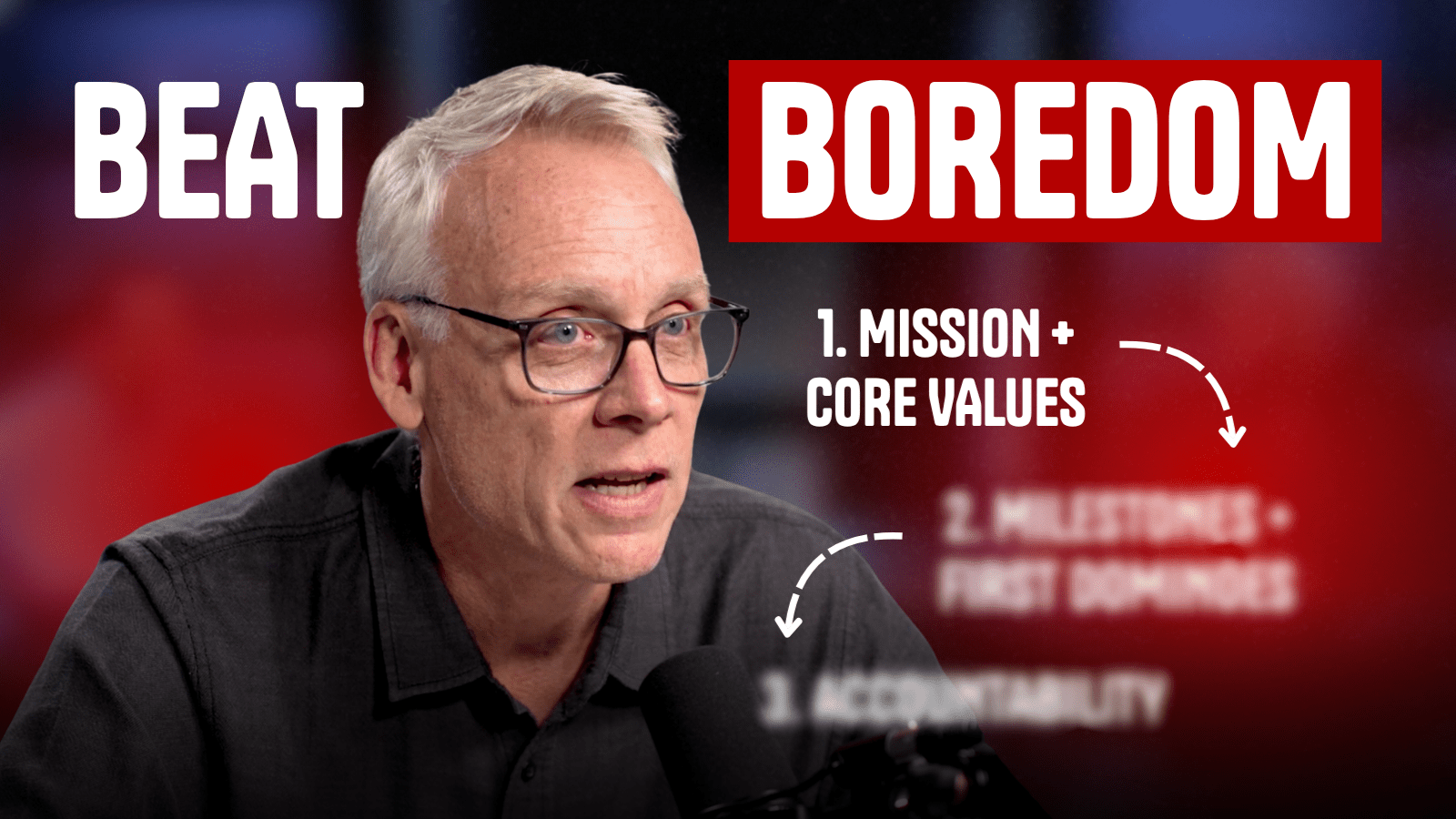
How do we find that? How do we tap in to breaking through the boring to do the work we know we need to do, so that we can have the success we hope to have? In this episode, I’m gonna share three strategies we’ve seen consistently work in our coaching and training, three ways to beat the boredom, find your consistency, and be on the path to extraordinary success.
————————
Jay Papasan:
I’m Jay Papasan. And this is The ONE Thing, your weekly guide to the simple steps that lead to extraordinary results.
————————
Jay Papasan:
So, this episode, I kind of crafted after one of our most popular courses at The ONE Thing. And here’s the thing, we’re not wired for boredom. And in fact, we can even connect the word wired to it. There’s a very, very famous study that happened in 2014. It’s at the University of Virginia, and it was psychologist Timothy Wilson that conducted it. And here’s how they set it up. They asked a group of men and women to sit in a room by themselves with nothing to do for 15 minutes. They had no phone, no book, no doodle pad to draw on, nothing to distract themselves. They just had to sit there for fifteen minutes.
And I know some of you just thinking about sitting somewhere for fifteen minutes is making your skin crawl. Well, guess what? It did to those individuals, too. The only thing they had the option of doing was to self-administer a shock. So, they were wired up, and if they just wanted to do something to pass the time, they could self-administer shocks. That was their only choice.
Well, here’s the thing. A lot of them said that they would pay money not to be shocked. Nevertheless, many of them chose to shock themselves just to get through the boredom. Sixty-seven percent of the men and a quarter of the women chose to shock themselves just to get through the boredom. And one dude even did it to himself 190 times.
We’re not built for boredom. We’re not wired for it at all. So, how are we supposed to show up and do the boring work that’s often the backbone of most of our success? I think a lot of people look at people like Mia Hamm or Gary Keller, whoever it is they look up to and say, “That person’s so successful. If I just had more motivation, if I just had more willpower.” Well, the trick with that, and we wrote about in the book, is those things are fleeting. They’re not the things that help us show up day after day after day. Show me one stretch of two or three weeks on your calendar where you showed up every single day stoked to do the boring work. It doesn’t happen very often.
But we have found in our research and our training and our coaching three pretty reliable ways that you can overcome boredom and actually find your consistency. Number one, it’s tap into mission and core values. I’ve talked about them a lot, but that’s the number one path. Number two, you can break it into milestones and first dominoes. And lastly, obviously for me, ’cause I’ve written about it so much, is we seek accountability.
So, I’m gonna walk you through each of those at a practical level, and maybe one of them will speak to you, and you can start doing that thing that you know you need to do, but you can’t seem to make yourself do it consistently.
So, we’re gonna kick it off with mission and core values. And in The ONE Thing book, we wrote about this as purpose, right? If you really understand what you’re here for, what your calling is, it makes it really easy to prioritize the things that matter. And if we’re doing our priorities, we’re being very productive. That’s the formula we wrote about in The ONE Thing. Mission and core values is just another label for that.
When I think about Mia Hamm and her teammates that won that World Cup in ’99, the thing that I think was driving a lot of them was both. Their mission, and it was very clear, is they wanted to change the way women’s sports and women’s soccer in particular were perceived by the public. They wanted to make their sport popular and legit. They also had a core value of competition. Every single one of them was highly competitive. So, I got to witness the mission at work. Michelle Akers was the captain of that team. She was amazing. She also dealt with chronic fatigue syndrome. These ladies would go on the field. I remember I was in Hershey, Pennsylvania. They played full 90 minutes. They went through overtime.
After the game, many of them had to go into the locker room to get IVs. They were absolutely dehydrated and exhausted. And then what did they do? They walked back on the pitch, and they signed autographs for hours, literally until their coaches and crew said, “You have to go back to the hotel.” Their mission was to inspire the thousands and thousands of young girls that were there and who would go on to create the movement that became women’s soccer in America. That’s what I believe was driving them to keep going, to show up again and again, even when they didn’t want to.
And the core values, competition was rampant. All of these female athletes was incredibly competitive, and it was designed into their practices. We wrote about this in the book, Go For The Goal. I remember reading that in the beginning, they were such good at being teammates, they didn’t compete as good as they could in practice. And I wanna say it was Tony DiCicco, or maybe it was Anson Dorrance, devised that every single practice, every single drill, they would be competitive. No longer would it just be practice. Everything they did would be a competition, and that brought out the best in those ladies.
So, every drill, whether it was sprinting or shots on goal, whatever it was, they were ranked from best to worst, and he posted them on the door of his office in the hallway where everyone can see. By posting the results, here’s the thing, not a single one of them ever wanted to show up at the bottom of the list. They were gonna go out and give it their all every single day. Every day by design became competitive on the practice field. Guess what showed up on the playing field? The best that they could offer every single time, and that’s how they became dominant. You can design competition, you can design around your core values, and they did that so that their mission and their competitive spirit showed up every single day, and they went on to be the champions of the world.
So, number one, I have to ask you, can you connect the boring work that you know you need to do to be successful to something bigger, can you connect it to a mission? Can you connect it to your core values? How can we game the system like the coach ranking the exercises around competition, so that our core values kind of rise to the surface and matter?
So, here’s some questions you can ask yourself. You probably know what it is you need to do and that you’re not doing. Who ultimately will be disappointed besides you if you don’t do it? Who are you failing besides just yourself? I’ve found, and in a lot of our work, is that when we make it about someone bigger than ourselves, maybe our family, our kids, the teammates that are looking up to us, we tend to rise to the occasion.
As a business owner, I can let myself off the hook every single day. I can just do it tomorrow. “Hey, I’ve got more time.” But if I know that someone else has trusted me to do the work, I’m a lot more likely to show up. Usually, when people ask those questions, right, “Who will actually pay the price of my failure besides me?” we often find that there is something bigger connected to the boring work, and we’re unwilling to fail at that work ’cause we don’t wanna disappoint those people.
So, the big question for you is: Is there something bigger at play with your most important work? Can you connect it to something bigger than just your experience day to day? When you can, it becomes a superpower. You become a person driven by purpose, and those people, well, they show up for the work.
A work example of the competition is a lot of sales teams will keep a public scoreboard. They will track not just the actual outcomes, like who had the most sales, but the best ones actually track the activities that lead to sales. Who had the most connections with potential customers? Who did the most whatever that thing is that’s the gateway to the actual outcome? When people track and gamify those things, the outcomes tend to shift because people do more of the activities, especially in a gamified competitive environment, than they would do on their own.
A huge truth, and I’ve seen this in a lot of the teams I’ve been a part of, people will compete harder to win a free iPad than they will to get a $7000 commission. It’s something about the spirit of competition. Can you tap into it? Can you tap into it in your work?
Number two is milestones and first dominoes, and this is two things. Almost everything worth doing is gonna take time, and more than that, it’s gonna take time on the task over time, right? We have to put in the work over long periods of time to get that extraordinary thing. For the women on the US Women’s National Team, they’re often usually two to four years away from their major competitions, whether it’d be an Olympic gold medal or a World Cup championship. Everything in between is practice and hard work as they earn the right to show up on the field for those competitions.
It’s the same in business. If you wanna be number one in market share in your area, that’s not gonna happen overnight. We, often, will overestimate what we’ll accomplish this year, but underestimate what is possible for us in a three or a five-year period, and we underestimate it because we just don’t often think about the payoff for doing the work for that long of a period of time. The build, the momentum adds up. That’s the dominoes in our book.
So, whatever your big goal is, it’s probably not gonna happen this quarter, it’s probably not gonna happen this year, it’s probably a little farther out in the future. How do we stay engaged with that? That’s what milestones is about. How do we break our big goals into milestones along the way? That’s ultimately what milestones are for. They give us something to track, to know that we’re making progress, that the little things that we’re doing on a daily basis are actually adding up to something worth celebrating. They also are worth celebrating. That monthly goal or quarterly goal gives us something to say, “Hey, I did it. I am making progress towards that big, big goal.”
We’ve found, and we wrote about in the book, that the best way to create those milestones is our process of goal setting to the now. All we’re doing is going out into the future to our big someday goal, and we’re breaking it into milestones. In the book, we talk about a five-year goal, and based on that, what will we have to accomplish in a year? And based on our annual goal, what do we have to accomplish this quarter or this month? And based on that, what do we have to do this week? And based on our weekly goal, what do we have to do today? We’re just working backwards, but instead of always asking, “In order to be a world champion, what do I have to do this week?” we’re working backwards systematically. We’re just breaking it into milestones because it gives us clarity around what we need to do.
So, before I kind of walk completely away from goal-setting to the now, like we’ve done whole episodes on how to make this practical in your life. I did an episode with our head trainer, Chris Dixon, on the 411. We’ll link to it in the show notes. And that’s just a simple way to break down your annual goals into monthly milestones and weekly activities so that you can actually do that boring work on a regular basis. So, if you really like that idea and want to go deeper, check out that episode on the 411 I did with Chris.
So, the other mistake that people make is they can break it into milestones, but they don’t actually know how to get started. And we built a whole course around this called The First Domino. And I’ll just illustrate it by a conversation that Jordan has shared publicly. That’s Coach Jordan. You’ve heard him here on this podcast. He had talked about his goal to be healthy was to meal prep every week. That’s what we call The First Domino. To define it, the first domino is the first significant action that unlocks your momentum towards the thing that you need to do.
And I’ll illustrate this by a conversation that I had with Jordan Freed. He was trying to understand the concept, and he said, “Well, one of my goals is to eat healthy.” And I said, “Great. What do you think the one thing is for you to eat healthy?” And he shared it was meal prepping. And I get it. I meal prep as well. And I said, “Great. That’s your one thing.” And he goes, “Well, what’s my first domino?” And I was like, “No, it’s not the first domino. The first domino precedes meal prep.” And he’s like, “What do you mean?”
“Well, in order to meal prep, what do you have to do?” He goes, “Shop.” “Great. You have to go to the grocery store, and you have to buy the things that will be the ingredients that go into meal prep. But what do you have to do before you shop?” Well, I have to have a shopping list. Great. So, if you are shopping at a grocery store in order to meal prep, is there anything else you need that actually precedes that? And he thought about it, and he came back and he goes, “I need to have a meal plan.” It’s like, yeah, you need to plan your meals. Is there anything before that? We couldn’t come with anything, so that became his starting place.
So, by focusing on planning his meals, he’s allowed to shop for the right things, he buys the right thing at the grocery store, and then he does his meal prep. That allows him to have those foods pre-prepared in little to-go boxes so that when he’s ready to eat, a healthy meal is waiting on him. He doesn’t have to use willpower. He doesn’t have to do anything on the spot. He just has to grab it, heat it up, and eat it. Boom. He’s been eating healthier for months and months by focusing not just on his one thing, which is meal prep, but the first domino to make it happen. When he does the meal planning, the meal prep happens. When the meal prep happens, guess what happens? He eats healthy. That’s how the first domino works.
So, you’ve worked through all your milestones. You know what you’re supposed to do this week. For a lot of you out there, you’re in sales. You know you’re supposed to be connecting with people. You’re supposed to be having conversations around what it is that you provide as a service, your product. How are you going to do that? That’s boring. What is your first domino?
One example that I just recently learned in a coaching call, a fellow wanted to make sure that he was having 50 conversations a week. We did some easy math. Look it up. Hey, I think that in order for you to have those 50 conversations, you’re gonna have to have a list going into the week of probably 250 names, maybe 200 because every time you reach out – in a TCPA compliant manner, I will add – then you have to kinda go through the list. Not everybody’s gonna be there. Not everyone’s gonna pick up. How are you actually gonna connect with those people?
Or you’ll have to design an event where you’ll naturally going to bump into that many people. There has got to be design before the activity. And when we focus on the list that we’re gonna work or the event we’re gonna go to, now the activity naturally shows up and happens.
So, for your activity, that boring thing that you know you’re supposed to do, can you figure out what the first domino is? Can you start building some milestones along the way so that you’re building a path where you start in the right place, you start to build momentum. And as you blow through those milestones and hopefully celebrate them, you get to feel the progress you’re making towards your big, extraordinary goal.
That’s the big idea. It’s a little bit to unpack behind milestones and first dominoes. Can we break down our big goal so that we know that we’re making progress? And can we identify the right starting point so that we can ignite our momentum and get going? That’s technique two. After mission and core values, working from this, we’ve seen thousands and thousands of people find that everyday success that had been eluding them through that path.
Now that we covered mission and core values and milestone and first dominoes, it brings us to the third proven technique for overcoming boredom and finding your consistency. And this is one that we’ve written about basically in all of our books in one form or another. It’s accountability. Accountability gets a bad rep. Most people think about accountability, and they imagine someone holding them accountable, right? And I wanna redefine it. When we talk about it in our training sessions, accountability is the vehicle we use to keep our promises. Often, it’s in the form of someone or a system that supports us to make sure that we’re doing the things that we need to do.
So when I ask you, when you are in charge, like you’re a grown-up adult, you’re listening to this, no one can force you to do the things ultimately that you don’t choose to do, at least not for very long. You’re gonna quit or do something else. How do you hold yourself accountable? Do you just do it on your own? Do you have a boss that tells you what to do? Do you like to do it with others? Do you like to have an actual coach that guides you through that? Everyone has a different formula.
And so, in one of our training sessions, I’ll attribute this to Coach Jordan. He kind of came up with what we call the four S’s of accountability. And the goal here is to acknowledge not everybody finds their accountability the same way that others do. What’s our unique formula for doing the things we need to do even when we don’t want to do them? If you can un- If you can unpack your personal formula for accountability, it’ll make it both easier to follow, but also you won’t be fighting that friction, right? ] You’ll have your own personal formula for accountability so that you can start doing those things.
So, let’s unpack those four S’s. Number one is support, number two is style, number three is source, and number four is structure. And we’ll link to this in the show notes if you just wanna see what this looks like or have the list. So number one, support. Who helps you stay consistent? And we’ve covered this before. Most people are always going to be more effective if they’re doing it with someone else.
So, think back. Think back to a time where you were remarkably consistent. Were you doing it alone? Were you doing it with others? Did you have a coach? Did you have someone that was helping you show up? I find personally that I work really well with others and a coach. I kind of combine them at times. My wife and I have consistently been working out at least three times a week for probably 14 years now, and we do that through a combination. We do it together. I don’t wanna let her down by bailing on a workout, and we know that there is going to be a trainer waiting on us, and I don’t wanna pay for a trainer and then not use that trainer. That combination has made me do something both uncomfortable, that I often don’t wanna do way too early in the morning for more than a decade.
What is your personal formula? Who helps you stay consistent? Write it down. Log it. What is your style? How do you respond to expectations? And for this, I’m gonna lean on Gretchen Rubin’s book, The Four Tendencies. If you haven’t read it, I interviewed her many, many years ago. You can probably find it on YouTube, and we’ll link to it in the show notes if we can find that old webinar I did with her on this topic. But in her book, she talked about different people respond to other people’s expectations different way. And she identified four different types. And I’ll just describe them, and maybe one of them jumps out at you.
One type is the upholder, and they are meeting their inner and outer expectations. They look up and they say, “Hey, I’ve got this thing. I know I need to do it,” and that’s kind of the person who just says, “I’m gonna make myself do it.” You’ve got the questioner. They’re gonna follow through if they understand the reasons for doing it. So, they just need to understand why. Why is this important to me? And if they’re really clear on the why, like, “Hey, if I don’t work out, you know, I’m gonna have to start going on cholesterol drugs. I need to do more cardio, and I don’t want those drugs, therefore, I’m gonna do the work.” They have to have a good rational reason, a why for doing the work. That’s the questioners.
The obligers, and if I had to say one screams me, it’s this one. They are gonna do their best when someone is counting on them. That’s me going to the gym with my wife. That’s me wanting to do things with other people. If I know someone is trusting me to do the work, folks, it’s really hard for me not to do it. I hate to disappoint other people, so I am definitely in this category.
And the last one is the rebel, and I’ve worked with more than a handful of them. They just have to know that any structure for doing it is something that they chose. The moment it’s chosen for them, they run away. So, I can work with a rebel. I’ve worked with plenty of them. They have to choose to work from a 411. I can’t tell them they have to. The moment I tell them they have to, they’re gonna mail it in, and they’re gonna disengage. But if they decide they want to, they’re gonna dive in headfirst.
So, there are those people, right, those upholders, they have some deep inner expectation, maybe it’s driven by mission or core values to do the work. Questioners, if you tell them why it’s important, they often will engage at a higher level. Obligers like me, they need to do it with someone else. Someone else needs to be trusting them to do it, or we have to identify who is counting on us to do it. And finally, the rebel, they have to choose their own path. Yes, they want to do it, but they have to design their own path. And when they get to design it, they get to take full ownership of the outcome, they will move forward. If you design it for them, they’re gonna resist. There’s no right or wrong answer. You just wanna know what is your style of responding to expectations.
So, support and style number three is source. Where does your accountability come from? Is it from public or private expectations? A lot of people need to have a cheering section. They want other people to see and observe their progress. Other people, they just need to know that they did it. Is it public or is it private for you? It’s a really good hack to know. I don’t need a lot of public acknowledgment for my work. That’s often on the tail end long after it’s done. I like to hear that it impacted people. I tend to be driven by private expectations. I know a lot of people I work with are public.
Know what your style is there. What is the source? Ultimately, I will tell you, when I’ve interviewed the people that were most successful, they have hacked away into figuring out how to drive themselves by their own inner expectations versus other people’s. Wherever you’re starting, start there, but know ultimately, if you can hack that path, it is a superpower.
And finally, what is the structure that helps you keep your promises? Do you like to have a day or a time of day? That’s what we call time blocking to do the work. Does that help you? I know some people that if you time block a workout, and it’s a specific workout, maybe it’s the rebel in them, it doesn’t work. I interviewed my friend Tyler here, and he talked about he knew that he needed to exercise every day. He just needed to have options. And if he had options without hard structure, he tended to be better at doing it consistently. Maybe he wouldn’t go to the gym in the morning, but he would go for a run outside. Maybe he wouldn’t go to the gym or for a run outside, but he would do a yoga class. If he had choice in it, that structure, that mattered to him.
So is there a structure that matters for you? The point of all of this is if we can just show up and do those little things day after day, whether it’d be through mission and core values, milestones and first dominoes, or we’ve hacked our personal accountability structure by knowing what kind of support we need, what our style is, what kind of source, where it comes from, the expectations, and what our structure is, if we can hack that out or any of the others, we get to show up more consistently.
And we’ve said it before, consistency in this context is intensity. Very few people are gonna show up day after day to do the work. They’ll do it in sprints. They’ll have a string of days. But the people who show up and do it day after day for long periods of time, they’re the ones who are number one in their market, that are on the top of the podium. They’re the ones who put in the work for long periods of time, time on the task over time, to get truly extraordinary results, and that’s what we want for you.
So, again, figure out what works for you. That is the challenge for this week. Do you need to tap into your mission and core values? Was that the part of this podcast that resonated for you? Was it more about the structure of milestones and first dominoes that’s missing right now, that you feel like, “If I could just break down my goal into milestones and figure out where to start, I just need to get started, folks”? And for a lot of us, that’s a fact. If we just get started, we’re gonna keep going.
Finally, and this can be an additive to both of those, do you need to bring some accountability to what you’re doing? Do you need to have someone, something, or some structure that provides a support for you to make sure that you’re showing up on the days that you need to show up? My challenge to you is take 15 minutes after this podcast and ask the question, “Which one do I need most?” And then lean into it. I hope that this helped you maybe beat the boredom. What I don’t want is for anybody to get their own personal shocker and start administering shocks to yourself. Nope, that’s not the path. What we want is to find our personal path to beating boredom so that we can be consistent and get the extraordinary results that we write about in The ONE Thing. That’s it for this week. Thanks for joining us.
————————
Disclaimer:
This podcast is for general informational purposes only. The views, thoughts and opinions of the guests represent those of the guests and not ProduKtive or Keller Williams Realty LLC and their affiliates, and should not be construed as financial, economic, legal, tax, or other advice. This podcast is provided without any warranty or guarantee of its accuracy, completeness, timeliness, or results from using the information