Jay Papasan:
There’s a reason we talk about resilience so much on this podcast. It’s one of the most important assets any business leader can have. But how do we actively develop a skill that may only feel important during the hardest times of our lives? In fact, can we actually build resilience before we actually need it?
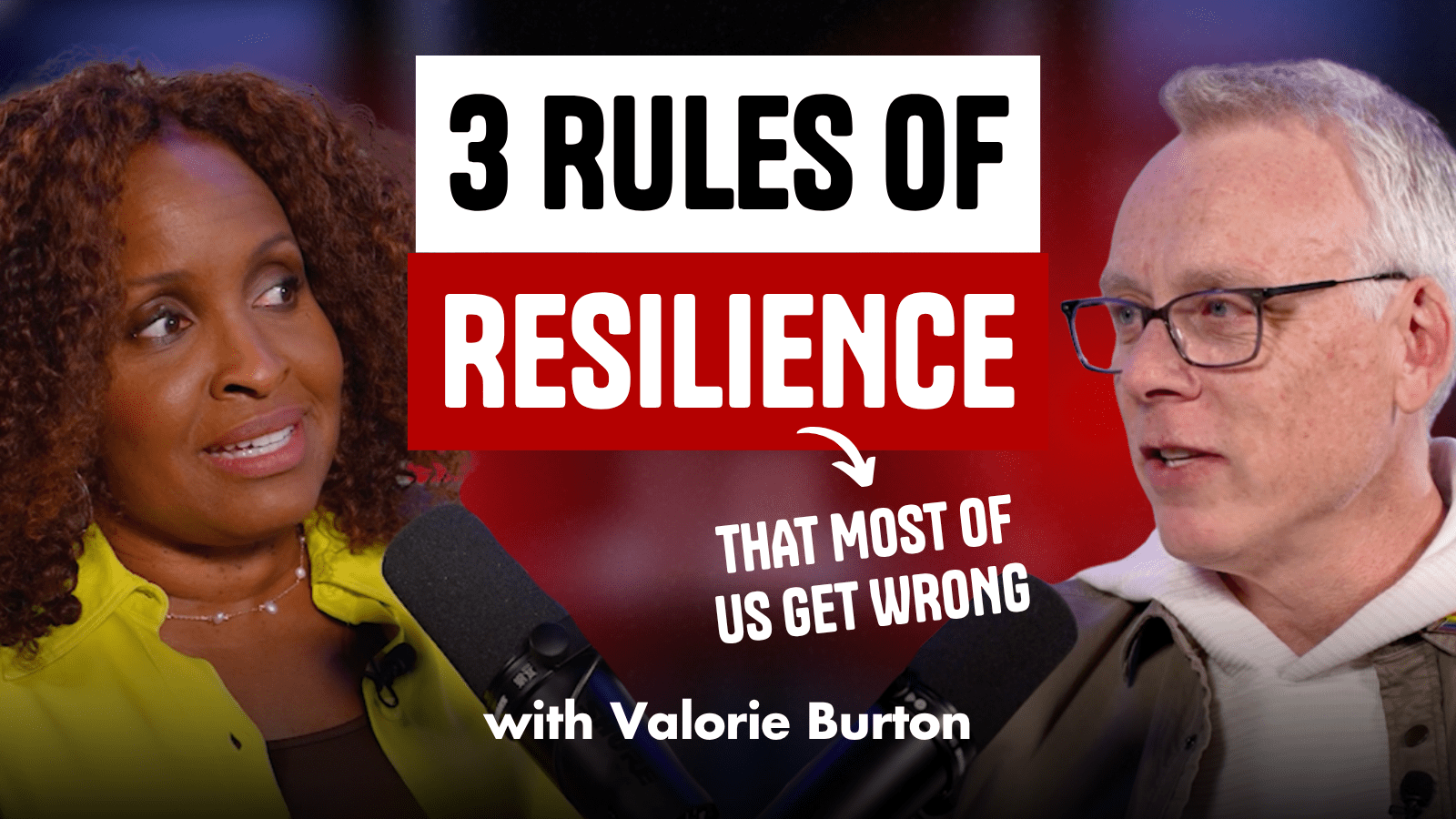
My guest today is Valorie Burton. She is a renowned strategist, she is a great speaker, and she’s also the CEO of the Coaching and Positive Psychology Institute. She’s authored over a dozen books, and she’s also been listed as one of the 50 most influential executive coaches in the world. Valorie’s identified patterns of resilience. It’s a repeatable system that she outlines in her new book, Rules of Resilience.
Today, we’re gonna unpack that, discussing some of her most interesting findings to understand how we can develop this important skill in our own lives. Specifically, what are the three core components of resilient life? It’s a practical framework for anybody navigating change in their business or at home. This is how you master the art of the bounce back.
————————–
Jay Papasan:
I’m Jay Papasan. And this is The ONE Thing, your weekly guide to the simple steps that lead to extraordinary results.
————————–
Jay Papasan:
Valorie, welcome to the show.
Valorie Burton:
It is so good to be here. Thank you.
Jay Papasan:
What does resilience mean to you?
Valorie Burton:
You know, a lot of times, we think of it as being able to bounce back from setbacks and to navigate challenges and change, and that is a good definition. But when I wrote Rules of Resilience, I wanted it to be very practical, not just, “Oh, I’m inspired, this person is resilient.” And what I realized in really digging into the research is that resilience is a personal system that we create, and you can be very intentional about building it up if you understand what the components are of that system. And so, that’s kinda the difference in how I approach resilience.
Jay Papasan:
Well, I wanna dive into that and go deeper, ’cause I love anything that gives our listeners agency.
Valorie Burton:
Yeah.
Jay Papasan:
Right? I think a lot of us will have an interior monologue. Like we’re going through a rough time, and we’ll start asking the question, “Well, am I tough? Am I resilient or not?” And we treat it like a trait, not something that can be developed. And again, we don’t teach our young people this, but maybe some of the parents listening can take notes.
Valorie Burton:
Yes, I have strong feelings. I think resilience should be a subject in school. We need it. And our kids need it more than ever as they’re dealing with more anxiety. There’s so much coming at them, so much pressure.
Jay Papasan:
Please, please, like seventh and eighth grade. That’s, like, everybody’s first year.
Valorie Burton:
Yes, yes.
Jay Papasan:
We just get it right there, right? For all of my fellow nerds out there, just here’s how you get through this period, Jay. All right, so resilience is a system. How did that breakthrough happen?
Valorie Burton:
Well, for me, it was digging into the research, but also really looking at the hundreds, sometimes probably more like thousands of people I’ve coached and worked with over the years. When you look at the research, it really breaks down into three things, that resilience requires adaptive skills. That’s what’s going on inside when you’re faced with a stressor. How do you react to it? And then, it’s those protective resources. That’s the external stuff that you call on that helps you be more resilient, things like money or past experience or connections that you have that could help you be more resilient.
The third piece is not one I had heard said in quite the same way, and it’s preventive choices. That is not necessarily for, right now, the challenge you’re dealing with. It’s about how your choices impact whether you’re gonna need to be resilient in the future or not. So, how do you reduce your risk for challenges occurring in the future? We can’t eliminate them, but if we’re really intentional about making preventive choices, we lower the likelihood that we’re gonna deal with adversity in the first place.
Jay Papasan:
So, it’s risk mitigation for our resiliency.
Valorie Burton:
Absolutely. It’s kinda like when you decide, “Hey, I’m gonna drink more water,” “I’m gonna take a 30-minute walk after dinner,” down the road, that probably means you’re going to be healthier, right? You’re not going to be dealing with the same types of issues. So, preventive choices are really important in every area of our lives.
Jay Papasan:
When we wrote The ONE Thing, it was almost a throwaway. I remember asking Gary, I was like, “This focusing question, you can apply it anywhere in your life.” You know, where should we? And we call it the Seven Circles. It’s the only page in my own book that I’ve memorized, page 114. But we started with The ONE Thing for your spiritual life, and then The ONE Thing for your health, which is where your mental and physical health. And if you’re going to do extraordinary things, you need to have something bigger that’s guiding you.
And you, also, from a health perspective, that’s where, I think, in our language, the resilience shows up. How do we prepare ourselves? You need energy to show up and do big things, and for a long time. I think people underestimate. They see their future, and I’m going to get a promotion, or I’m gonna start my business, and they see the highlight reel of what it’s supposed to look like, and not the bloopers and the misturns and all the things that we have to go through to get to the destination, so.
Valorie Burton:
That can really throw you off track.
Jay Papasan:
Yes.
Valorie Burton:
Yeah.
Jay Papasan:
So, going back to where we started, we’re going to set up the stage, so that we can prepare ourselves, that we’re better able to face those challenges in advance.
Valorie Burton:
Exactly.
Jay Papasan:
All right. So when you think about this system, someone’s listening to this, “All right, y’all stop talking. Tell me how to do it,” we’re The ONE Thing, like, where do we start? Like, if we were gonna start somewhere, the foundation, what would be the most important first step for us?
Valorie Burton:
Well, the foundational rule is expect the unexpected. And be ready to handle it. A lot of times, and we know this philosophically, but when we’re headed toward the vision or a goal, we tend to forget. We come up with our plan and we’re like, “Okay, here’s how it’s gonna go.” And we start down our path, and then we get knocked off course, knocked into a ditch. It’s like, what on earth happened? That’s the unexpected. And if we expect it, we can’t necessarily predict what the unexpected will be, but we know that there are gonna be unexpected things.
And so, when they come, if you’re able to say, “Oh, that’s the unexpected,” you’re able to say, “Okay, now, what do I need to do? Let me notice my adaptive skills. What am I saying to myself about the situation? Is it moving me forward or is it getting me stuck? What is my attitude? How does my faith play a role? How are my beliefs showing up, and is that moving me forward? Is that getting me stuck? Is that causing me additional problems?”
So, when we expect the unexpected, we’re not so shocked by it, and we don’t end up stumbling and being stopped for as long, because I think that’s a big piece of what happens. When the plan doesn’t go the way we had hoped, now, we’re not only disappointed, but we can be discouraged to the point where we over-focus, we’re ruminating about what went wrong, and we’re not strategizing “What now?” And sometimes, the “what now?” is I need to pause for a minute here. I need to breathe, I need to get my bearings, but I also am gonna find my vision again, so I can keep moving forward.
Jay Papasan:
That’s different than going into freeze or flight mode, ’cause you knew it was coming. I need to take a breath. Okay, the unexpected showed up. Now what? And I’ve found in some of our work with companies and individuals, we do coaching and training as well, like, you can just ask questions sometimes. They say, “Our quarterly goal is this.” So, great. What are the top three challenges that you might expect to face? And they already know them. But it’s like I said, the blooper reel is not even on their mind right now. And what’s one strategy that you could have for each? And just a little bit of a plan B, C, or a D, whatever you wanna go.
Valorie Burton:
That’s right.
Jay Papasan:
Now, they actually walk out with a little bit more confidence.
Valorie Burton:
Yeah, absolutely. That’s, that’s an adaptive skill, being able to plan, being able to look into the future and go, “Okay, if this happens, then what will I do?” And it shouldn’t just be an if. It’s like when, right? I don’t know exactly what’s gonna happen. I can just pretty much guarantee I’m not going to from A to Z in a straight line. And I think what it also does is it just shifts your mindset a bit.
If you’re running a business, it’s hard. People aren’t gonna do exactly what you want them to do. Some people are gonna leave. The team won’t always work together exactly as you want. And rather than focusing on, “Why does it have to be this way? Why are they this way?” this is what you signed up for.
Jay Papasan:
Yes. We have a lot of business owners listening in.
Valorie Burton:
Yes. This is what… You might not have said, “Oh, I wanna sign up to deal with a lot of people problems,” but if you signed up to be an entrepreneur to run a business, you did sign up for a lot of things that maybe you don’t enjoy, but it’s a part of it in order to also enjoy the good stuff. So, no need to be shocked by it. Be prepared for it.
Jay Papasan:
I found that some of the entrepreneurs, the self-starters, they were so good at something, it became totally the next logical step to start a business around it. And so, they’re in their genius zone, and the moment they step out of individual success into building a team, it’s like they haven’t built the skills or the backgrounds, the reps, and it can be incredibly frustrating on top of it being maybe unexpected for them that this is life as an entrepreneur.
Valorie Burton:
Yes. And I think it is that understanding. It is becoming aware that’s really important. One of the other rules of resilience is close your growth gap. And that was the case for me. I had very specific goals for my business and realized, okay, I hit this number that was years ago, like, oh my goodness, could I ever get there? I got there, and I realized I had a leadership growth gap. I didn’t even use the word leader when I described myself. My calling is inspiring people to live more fulfilling lives. I do it through writing and speaking. I’ve always been very confident of my writing ability. Communication just comes naturally. But that doesn’t build a business.
And so, I realized, okay, I’ve got to invest in my leadership development. I have to embrace that I am a leader right? There was something about that word. I like the word influence. The word leadership felt very corporate to me, and I was like, “Yeah, I’m a small business owner. It’s a successful business, but if I’m leading 10 to 20 people, is that really leadership?” And it was like, “Yes, it is.”
In addition, you have a lot of readers. People looking to you to get better understanding of how they can navigate challenges. And so, that was a turning point for me because I was really the lid on my business. Until I grew, the business couldn’t go any further.
Jay Papasan:
How did you get that aha? In my experience, a lot of times, my coach, he called me out and was like, “Jay, you can’t read the label from inside the box.” I think it’s hard, especially as busy as entrepreneurs can be. They’re always doing. They don’t get a lot of time to reflect. And I don’t know what percentage of the population is self-reflective, period. If someone is maybe struggling, like they know they’ve got gaps, what are some questions they could ask themselves, or how can we help them be comfortable, maybe, seeing those gaps?
Valorie Burton:
Yeah. So, how far you go is determined by how much you’re willing to grow. If you can keep that in your head and ask yourself, “How will I need to grow in order to get to where I’m trying to go?” How will you need to grow? That growth gap is so important because we tend to just focus on performance goals. It’s what I call them. They’re very measurable, how much revenue am I bringing in, how much profit, what house am I gonna get, what relationship am I gonna end up in, how much am I gonna weigh? Like, all those are very measurable.
Jay Papasan:
Those are all outcomes, too, of the work that came before.
Valorie Burton:
Exactly. But if you don’t identify the growth goal that needs to accompany that performance goal, you’re just going to be looking for, what are the steps I need to take? And that’s not enough because when it’s time to take the step and your fear of rejection gets in the way , you’re not gonna take the step. We don’t just need steps. I mean, that would make it easy. Everybody would be hitting these goals like clockwork. It’s the growth goal behind it.
So, you’ve gotta ask yourself, “Where is my growth gap?” And there are so many ways we can have growth gaps unfortunately, right? It could be in leadership. It could be in communication. It could be courage. It could be any number of things. Maybe you’re a procrastinator, right? Maybe it’s consistency, but when you identify what that growth gap is, now, you can intentionally begin learning, how do I close it? How do I grow in this area? And you don’t have to be perfect in that area in order to see measurable change.
Jay Papasan:
No, just intention.
Valorie Burton:
Just be more intentional. You begin to see what might have been a blind spot that’s keeping you from taking the steps you need to take. And when you really focus on it, it’s so very powerful to just identify it and go, “All right, this goal goes with this performance goal.” And the more you close that growth gap, the further you’re gonna go towards the bigger goal that you have in mind.
Jay Papasan:
I love that. And I think a lot of leaders intuitively know this. They just need space to step back and see it, and maybe permission that this is a season where I have to focus on my growth, so we can make the next leap forward.
Valorie Burton:
Absolutely.
Jay Papasan:
And I’ve observed with a lot of businesses, I mean, I joined one company that had 27 employees and then became the largest in the world.
Valorie Burton:
Wow.
Jay Papasan:
And it’s a growth journey. And the gaps don’t ever completely go away. It’s kind of like, people say, “Does it get easier when your kids get older?”
Valorie Burton:
No.
Jay Papasan:
No. It just changes. It changes. You worry in new and fantastically new ways as a parent. And I think as a leader, as a business owner, you’re gonna always be finding growth gaps. Has that been your experience, too?
Valorie Burton:
Yes. You close one growth gap and it’s like, oh, you couldn’t even see the other one before, right? Because you’re moving along your path and, now, you can see more. It just begins to kind of open up. And so I think if you embrace that journey, you don’t see it as, oh, these are all of my weaknesses. These are opportunities for me to grow. That’s a big part of what life is really all about. And I think, oftentimes, we focus so much on the what. What do I want, what do I have to do, as opposed to who.
Jay Papasan:
Who?
Valorie Burton:
Who do I need to become in order to have the things I want? And that is the question. And I have found that to be a really exciting question. It’s an intriguing question about your own growth.
Jay Papasan:
That’s beautiful. And I think it lines up with everything we teach. Like, who we become along the way is often more important than the destination we get to.
Valorie Burton:
And you’ll be so proud of who you become.
Jay Papasan:
Yeah.
Valorie Burton:
Right?
Jay Papasan:
The building, the relationships.
Valorie Burton:
Yeah.
Jay Papasan:
We need to take a quick break, and we’ll come back on the other side, folks. We’ll come right back, and then I’m gonna unpack more of your resiliency system.
——————————
Jay Papasan:
So just to recap for folks, it starts with expect the unexpected. Now, we have to also expect these growth gaps, anticipate them as well, so that we can be proactive on our journey. I’m building a line of dominoes for my listeners. We talk about exponential dominoes. They’ll knock each other. If that’s the first two steps, where do we go next?
Valorie Burton:
So, the way I wrote Rules of Resilience, my hope is people keep going back to it. Depending on the challenge you’re dealing with, “Oh, I’m gonna just pull that rule out.” They’re all really memorable: expect the unexpected, close your growth gap. But probably, depends on the day. Today, I’m gonna say one of my favorite rules is control the controllable, accept the rest.
Jay Papasan:
Okay.
Valorie Burton:
Control the controllable. This is really around this psychological idea of having an internal locus of control versus an external locus of control. We know the most resilient and most successful people have an internal locus of control. They look at what do I control and they don’t over-focus on the things they don’t control. Those who are less resilient tend to focus on the things they don’t control, which leaves them feeling powerless, hopeless, kind of a victim of whatever is happening. “I can’t control it. It’s just all the stuff.” It could be what people around them are doing. It could be what the country is doing. It can be what the weather is doing.
Jay Papasan:
With social media-
Valorie Burton:
Oh my goodness.
Jay Papasan:
I mean, we’re, like, hardwired for villages of 150. And now, we’re exposed to all of the-
Valorie Burton:
It can be overwhelming.
Jay Papasan:
… things outside of our realm of control around the world. All day, every day.
Valorie Burton:
Yeah, and it’s real And so, you have to be very intentional. Control the controllable is what do I have control of in this situation? You actually have control of your thoughts. You don’t always control the ones that show up but you get to choose which ones you keep dwelling on, right? You get to control your attitude. How do I wanna show up in this situation is a really powerful coaching question. You get to control, am I gonna practice at this? Am I gonna work at this? How much effort am I gonna put forward? How am I going to kind of manage my energy? All of those things are things that you actually control.
And so, by doing that, you control what you can control. You accept the rest. Accepting the rest doesn’t mean you like it. It doesn’t mean you approve of it. It means you look at it and you go, “It is what it is.” So, now what?
Jay Papasan:
One of our coaches, my friend, Jen Davis, she’s been on the show, she likes to say, “Positive action removes anxiety.” And when we focus on the things we can’t control, I think that’s where the anxiety switch just gets outta control. And sometimes, just starting. Just doing one thing that you can control and doing it, I think just moving into action means we’re making progress and good things can happen. And I’ve found it can be as little as, like, a five-minute spell, a 10-minute moment-
Valorie Burton:
Absolutely
Jay Papasan:
… early in the day where you just establish, “I’ve got control of something. I’ve not been knocked out of the boat in the rapids,” which it feels like some days and “I’m just hoping someone to throw me a life raft. I’ve got something I can do, and I’ve done it, and I’ve made some small amount of progress.”
I wanna highlight for our listeners, ’cause we love questions, like, you use a lot of questions. Obviously, you’re a coach. You’ve got a coaching practice. And I was flipping through your book before we started, and when you think about it being a reference, there’s lots of powerful questions in there. And so, if you don’t have a coach in your life, it could be a reference for people to go and just like, “What do I need today?” And flip through it. So, you said that you hope that people-
Valorie Burton:
That’s how I wrote it.
Jay Papasan:
Okay.
Valorie Burton:
Self-coaching is a resilience skill.
Jay Papasan:
Okay.
Valorie Burton:
Being able to pause, get quiet, ask yourself those powerful questions, and honestly answer them. You may be going through one of the most difficult seasons of your life. You’ve gotta say, “Okay, what’s within my control? What’s not within my control?”
Jay Papasan:
When I add up these things, we’re gonna know that unexpected things are gonna happen. We’re gonna know that, at times, we are the log jam. Our lack of growth is the reason we’re not moving forward. We’ve got things that are happening out of our control. I see a lot of people, no matter how successful they are, can spiral into self-doubt, and does that play a part here? I would imagine that would really undermine my resilience if I’ve got-
Valorie Burton:
Absolutely
Jay Papasan:
I’m focused on my imposter syndrome versus the other.
Valorie Burton:
You’re talking about rule number two.
Jay Papasan:
Okay. There we go.
Valorie Burton:
Choose thoughts that strengthen you.
Jay Papasan:
Okay, unpack that for me.
Valorie Burton:
Yeah. So, like I said, we don’t always control the thoughts that show up. I think of thoughts like you got a house, there’s a front door. You could leave the door wide open and whatever thought’s just gonna come in. They might flip on the TV, go in your fridge. They’re just out of control. First thing you gotta do is, at least, close the front door. Consider locking the door, right? And when the thought comes knocking, look out the peephole before you open the door, right? It’s like, what is that thought? Do I want to invite it in? Do I wanna spend time with this thought? You don’t control that it shows up. I mean, you could be flipping through television or you could be on social media and something pops up that just throws you for a loop, but you don’t have to stay there. So, choosing thoughts that strengthen you is about saying, okay, what am I saying to myself about this situation?
Jay Papasan:
What’s my response to the thought?
Valorie Burton:
Yeah. What am I saying to myself? And is that helpful right now? And so, sometimes, we’re saying things to ourselves, you know, “I can’t do this. What was I thinking? I’m being silly to even, like, have this goal.” Like, we don’t necessarily say those out loud. You’ve got to become really a student of your own thoughts. And the thoughts that are most persistent that are getting you stuck, write them down and decide in advance what you’re going to replace them with.
Jay Papasan:
Ooh. Again, get ahead of that stuff.
Valorie Burton:
Yes, ’cause they’re gonna keep popping up. And so, it might be a matter of, okay, I’m gonna keep this thought. Maybe it’s gonna be on my bathroom mirror. My favorite is put it in my reminders on my phone and schedule it to pop up every day until that actually becomes a more natural thought for me.
So, choosing thoughts that strengthen you isn’t a one-time thing. Changing thought patterns can happen, but it takes a lot of practice, but you have to decide to start being more aware of what you’re saying.
Jay Papasan:
A lot of people would assume we’re talking about affirmations. Is that kind of what you’re talking about? Does that have grounding in research?
Valorie Burton:
Yes. I mean, your brain believes what you say, whether it’s true or not. But if you’re saying things that are completely, like, not believable, and so you’re rejecting it, I would say, you might be saying to yourself, “I don’t think I can do this. I don’t think I can do this.” You might change that to, “I’m learning how to do this. I’m learning how to do this.” That’s very realistic, and it’s reframing it for the positive in the direction that you’re trying to go. So, it’s an art, but it’s really about practice.
And we know that the research bears it out. I speak with a lot of conviction because it’s worked for me too, when I was having self-doubt, when I was going through the most difficult seasons of my life. And so, I would suggest just trying it. What’s the most persistent doubt that you have? Admit it, look at it, and say, “Okay, what might be more helpful? When this thought comes up, what could I replace it with?”
Jay Papasan:
I love that. And just I mean, I’m just reflecting on some of the practices the coaches that I’ve worked with over the years have helped me when you’re thinking these things. And just I’ve used affirmations. I’ve literally got a Post-it Note, so every time I come into the office right now, I’m reminded of the positive thought just for whenever that negative one shows up.
Valorie Burton:
It’s about having a vision. And I think there’s some really great research around your best possible future self. Actually, writing about who you are becoming, writing it in the present tense as though it already , and then reading that over and over again. So, that’s one of the things I talk about, creating your own vision manifesto. Here’s who I am, even if it’s not who you are right now, here’s who you’re aiming to be, but write it as though it already is. It’s powerful. It’s acting as if. And then, when you shift your mind in that way, you begin showing up a bit differently.
Jay Papasan:
Yeah, it’s crazy how that happens.
Valorie Burton:
Yeah, it really is. And it works. Again, that’s that mental shift of speaking to yourself as though what you want to happen already is, and your brain goes, “Oh, well, if I already have what it takes, then how would I show up differently? How would I speak differently to people? How would I introduce myself? How would I reach out a bit differently?” All of those things begin to shift because you’re speaking in the present about the vision you have of who you’re becoming.
Jay Papasan:
I love that. And I’m going back to the beginning for parents, like how we talk to our children, we can role play this for them. “Hey, imagine how good you’ll be when you’ve been playing soccer for another year versus where we are today.” And so, that practice we get as parents, as leaders, we just need to turn the mirror on ourselves every now and then, ’cause like we said, ownership, entrepreneurship, it’s a long race, and we need resilience.
So, like, we’ve barely tapped. We’ve hit, what, four concepts in your book? I’m excited to dive in deeper. One of the things that we do on this show is at the end we often give our listeners a little challenge. Is there anything that we talked about today that in your practice and your work would be a great place for them to maybe set aside 30 minutes and do some activity to take the first step toward building their own resilience system?
Valorie Burton:
Yeah. So, I think it’s really important to just say, hey, the thing that’s going to close the gap between where I am right now and where I wanna be is resilience. This is about not being overly optimistic. Optimism is important for resilience, but it’s about acknowledging, hey, there are gonna be risks, there are gonna be challenges, there are gonna be unexpected things that happen, and me building up my resilience is the key to getting to that vision.
So, I would say, ’cause we’re all dealing with challenges, it could be in a relationship right now, maybe it’s your finances, maybe it’s in your business or your health, find the opportunity in the challenge.
Jay Papasan:
Okay.
Valorie Burton:
So, just pause and really ask yourself that question: What is the opportunity in the challenge I’m facing? And depending on the challenge, you might at first even reject the idea that there’s an opportunity in it.
Jay Papasan:
I know.
Valorie Burton:
Right?
Jay Papasan:
Right.
Valorie Burton:
But I promise you there is. Yeah, it might be an opportunity to become more patient.
Jay Papasan:
We often see that opportunity years later.
Valorie Burton:
Yes. Yes.
Jay Papasan:
So, we can also, if you’re doubting this, and I believe everything you said, what’s the opportunity for me in this challenge? Think to a challenge you had five years ago, and what you learned from it, and how it served you since. It’s there. We just have to look at it.
Valorie Burton:
Yeah. I mean, I think that so often, even if we look at changes in the economy, changes in just whatever, what is the opportunity in it? I guarantee you, if you make the decision to grow through the challenge and not just go through it, when you face the next challenge, you’ll be far more ready for it. In fact, it might not even feel like much of a challenge anymore because what you’re doing is you’re growing your resilience muscles.
And so, it’s just a different way to look at our stressors and our challenges. We’re not sugarcoating them. We’re just acknowledging life. Life can be hard. And you can do hard things.
Jay Papasan:
I love the language. You’re gonna grow through it. You’re not just gonna go through it.
Valorie Burton:
Yes.
Jay Papasan:
Right?
Valorie Burton:
Yeah.
Jay Papasan:
It’s about who we become. It’s not just about enduring.
Valorie Burton:
Yeah. Glean every bit of wisdom you can out of your challenge. And ultimately, at the end, I have this bonus rule. It’s about paying it forward, seeing a bigger picture, and you’ve mentioned kids multiple times, how might you pay it forward to the kids in your life? Maybe it’s your own kids. Maybe it’s nieces or nephews or friends’ kids. How do you take what you’ve gone through and somehow spread resilience in a bigger way in your circle of influence?
Jay Papasan:
I love it. Well, we’ll end on that thought. Thank you so much for joining us today and sharing your research and your great new book. I hope everybody listening will go check it out.
Valorie Burton:
Thanks so much, Jay.
———————————–
Disclaimer:
This podcast is for general informational purposes only. The views, thoughts, and opinions of the guest represent those of the guest and not ProduKtive or Keller Williams Realty LLC and their affiliates and should not be construed as financial, economic, legal, tax, or other advice. This podcast is provided without any warranty or guarantee of its accuracy, completeness, timeliness, or results from using the information.