Jay Papasan:
So many high achievers struggle with the same challenge. They know what to do, but they can’t seem to find a way to do it consistently. So, maybe this sounds familiar. You decide on a fresh start, you pick a new system, and you begin with big goals and high hopes. And you come out of the gates just great. And then, maybe six months down the road, somehow, you’re right back where you started.
The things that were working are no longer working, and you can’t figure out why it all fell apart. Nine times out of ten, it always comes back to the same thing that we see again and again here at The ONE Thing. People are trying to go it alone. And the way that we can get past this and find our consistency is, first, we need to ditch this lone wolf approach, this mentality that we can just do it by ourselves, and we need to harness the power of social accountability
—————————-
Jay Papasan:
I’m Jay Papasan. And this is The ONE Thing, your weekly guide to the simple steps that lead to extraordinary results
—————————-
Jay Papasan:
I figured out along the way that I’m at my very best when I’m around people. I can be very productive when I’m working at home, but I tend to not be very consistent. I am magnitudes better in an office setting, and I am a self-avowed introvert. I’m not super social. But yeah, I come to the office or the office environment. I do like to catch up with people at the coffee station. I want to hear about their weekend. I like to collaborate. Like, there are projects where we should be in the same room, looking at the same whiteboard, jamming together and riffing off of each other.
But I also spend a lot of time doing solo work. That’s the nature of what I do. I have to sit down. I have to focus. I have to dive in. And I find great comfort that on the other side of my door, there are people out there. And when I emerge, I have to kind of report back, like, what am I doing? What am I not doing? I feel this social pressure to do what I said I was going to do just by being in that environment.
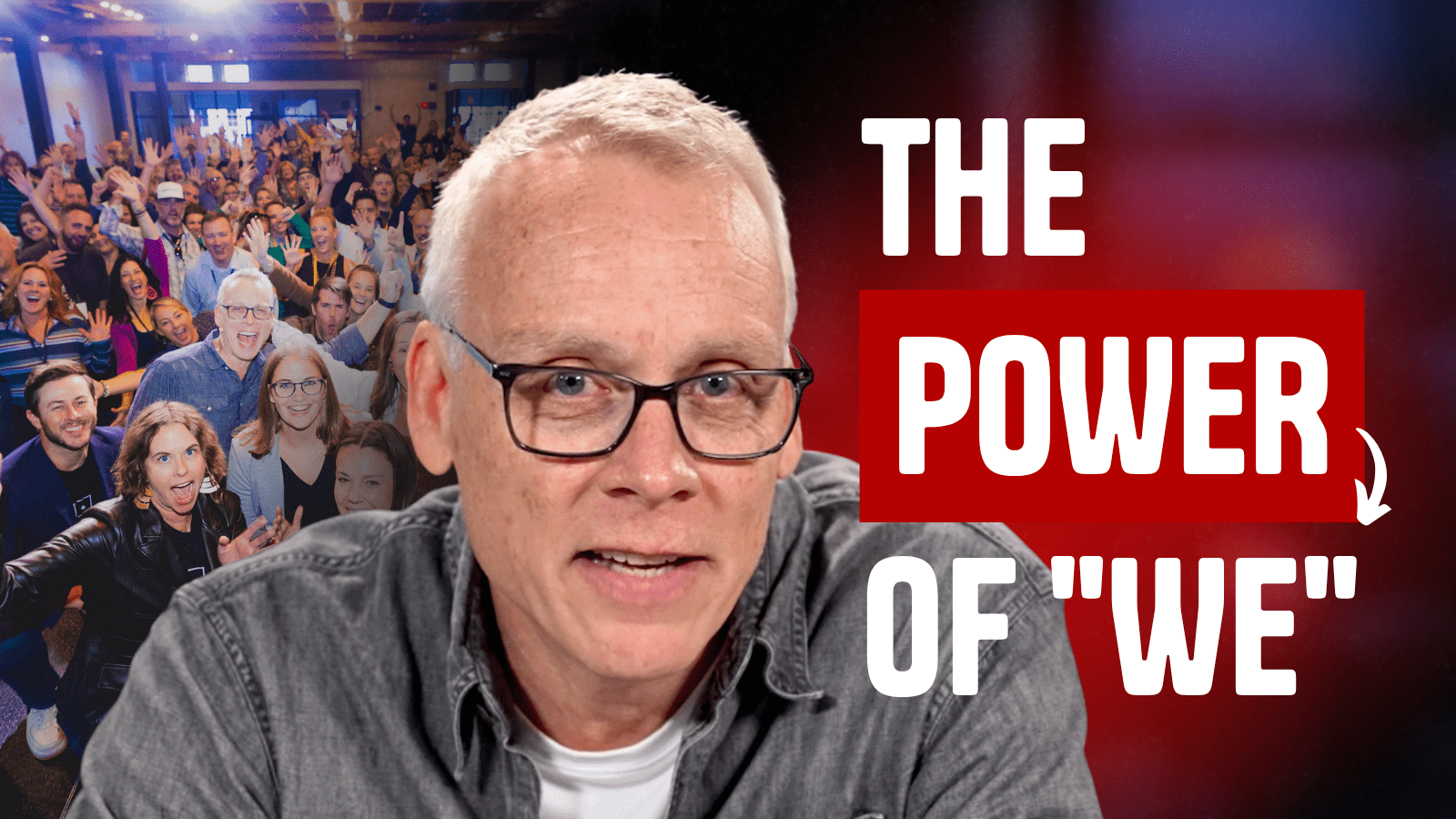
That’s me. And it’s the first step of what I, kind of, am calling social accountability. It’s how we get from the power of me, which is pretty good, to the power of we. If we can do it with others, if we can do it around others, if we can do it in public, all these different strategies that I’m gonna unwind here, we actually often perform better than we do it alone.
So, today, we’re gonna unpack some of these strategies to tap into the power of social accountability. First and foremost, we’re gonna talk about doing it in public. Then, we’re gonna talk about doing it with others. And lastly, we’re gonna talk about doing it around others, which is what I described as kind of my secret weapon for being productive
Now, social accountability. We’ve talked about this before. The word accountability has a lot of baggage for people. When we think about someone holding us accountable, we can think back to maybe that coach or that teacher, maybe even a parent figure that didn’t do it in a nice way. And so, the idea as an adult, as an entrepreneur, of someone holding us accountable is not something we look forward to. It’s not something we actually invite into our lives.
So, I always invite the entrepreneurs and business owners I work with to look at it this way: No one can hold you accountable. They can’t actually make you do things that you don’t choose to do. You can choose to be accountable to your goals. How committed are you? Are you committed enough to do things that may not be comfortable in order to get the things that you want? That’s the big question. And we’re gonna answer it with these three strategies.
So, strategy number one, I’m calling it do it in public, and this is what a lot of people call building in public. And if you’ve been on social media for a while, I mean, this goes all the way back to the days of blogging. People would document their journey from being in debt to being millionaires. They would document their journey of building their business.
And I remember first running across it with my friend Billy Murphy. Every year, he would do a long blog post on his newsletter or on his blog stating what his goals were very publicly. And at the end of the year, he would say how well he did. And he was ruthlessly honest. And I remember reading these long posts going, “Man, that’s a lot of pressure to put on yourself.”
And I think that’s the point. I think this is probably, in the realm of accountability, the one that creates the most accountability. You’re doing it in public. You’re tracking your progress or lack thereof, your failures and your wins in public. And at the end of the day, our reputation’s at stake. Like, we don’t want to fail publicly, which is a huge motivator for some people.
So, while this is not for everyone, we do see it a lot. And frankly, as one of my colleagues pointed out, if you’re building a business in public, it’s a great way to get publicity and media attention because as you grow, people, one, they see both the faults and the wins, and that makes you more real to them. They build more trust with the brand and with you as the founder. So, it’s a great strategy if you have the constitution to deal with the trolls and the people who will nitpick your progress and basically call out, like, any shortcuts that you take versus doing it the hard way, maybe the way they had to do it. Doesn’t matter. It’s just a good strategy. So, you can put the goals out there, and then you can live it in public and build it in public or make progress in public. All of those things are highly effective.
The things that we want to avoid are a couple of strategies here. First off, there are people who’ve been building it in public, and when they start to fail for too long, sometimes they cheat. And there’s numerous examples. I don’t want to call anybody out here, but we’ve seen people who’ve literally taken businesses all the way through multiple rounds of funding on a false premise that wasn’t true. They told a great story that simply wasn’t true, and a lot of them ended up convicted and in jail. So, we don’t want to go that far.
And I’ll tell you, some of the most inspirational stories I’ve read are people who failed and kept failing but kept going, because that’s often the message that people need to hear. You don’t have to be perfect to be what we call a journeyer. It just means you’re on the path. I’m trying to become a millionaire. And today, I fell down. Today, I spent money that I shouldn’t have. I put it on a credit card. Whatever you talk about, it does build trust, it shows vulnerability, and over time, people start to trust that you will eventually make it, and they will actually start rooting for you.
Just as a quick aside, if you’re wanting to build more trust with your audience, definitely check out the episode I did with Donald Miller. He’s got some bombs in that episode about how we build trust with our audience. We’ll put the link in the show notes for you if you want to go back and check that episode out.
We also know that a lot of us like to do it in public, to build in public, and we will announce our goals in social media. And there is some… I think his name is Gollwitzer, called them identity goals. And there is a challenge with that. If you’re going to Facebook to say that you’re gonna run three marathons this year or you’re finally gonna start your side hustle, you name the big goal that you’ve been waiting to announce. We love that moment because all of our friends, our family, our colleagues, they start pouring into the comments. You know, “LFG, let’s do this. You’ve got this.” You start getting all of the encouragement. But there’s a decent body of research that shows you can get so much encouragement that you lose the motivation to take action. You are doing this in public because that praise was a motivator for you. And sometimes, we over-index on the front end, and we lose our momentum coming right out of the gate.
The right way to do it – and we shared this in The ONE Thing, and it was Dr. Gail Matthews at the Dominican University – if you pick someone, an accountability partner, and this can be the way a lot of these entrepreneurs and wealth builders are doing it in public, they are using the public as a proxy for progress reports. Announcing the goal is one thing. Progress reports is where it’s at. What did I do this week, and how did it turn out, and where am I in relation to the goals?
And we also know from our research in the book that the most fulfilling steps on the journey to whatever it is you’re seeking are actually in crossing the milestones. You know, you’re trying to be a millionaire, but I went from negative to positive net worth. It used to be that if I sold everything I had and paid off all of my debts, I would have, still, debt left over, and today I am net zero. That’s a milestone, and it’s worth celebrating if you’ve lived a lot of time in the stress of debt. And that could be that way for businesses as well. Celebrate the milestones. Use the public as your accountability partner to report your progress.
Research shows that that works. In Dr. Gail Matthews’ research, people were sending email updates to an accountability partner, just email updates every two weeks. They were 76.7% more likely to achieve their goals. That’s how powerful doing it in public the right way can be.
So, let’s move on to number two, and that is doing it with others. And this is pretty much what it sounds like. You’re doing it with someone. You’re both doing the same activity. The classic example of this is, like, your gym buddy. I remember after we had kids, we all know what happens, all of your good habits start to fall apart. We had two kids 16 and a half months apart, and the second one was colicky. We had no family in town. So, we were pretty much chronically sleep deprived for at least a year and a half. There’s very low motivation to get to the gym and work on my dad bod when I’m that sleepy. I just want to take a nap every chance I got.
So, I had a friend, and I worked with– I think his name was Penley. We both were in the same boat. We both had small kids. We wanted to get in shape. We picked a gym, we picked a time, and we decided that we would meet each other there, I think it was three times a week at 6:00 a.m. We would knock out a quick workout, get back at home to help out the moms and get everybody ready for their day.
Well, it didn’t turn out so well. His mornings ended up being more chaotic than mine, and I would often show up at the gym and he wouldn’t. I’m not blaming him, but I still went to the gym because I didn’t want to disappoint him. And that’s the power of this. So, when you are going to do it with someone, a lot of times, our social accountability comes from the fact that we don’t want to let down the people who have said we want to do it with you.
And for me, that’s a powerful attractor. And there’s some research from the University of California at Berkeley, they cited that people who had gym buddies showed an increased show-up rate at the gym of about 35%. And anybody who’s been to the gym in February instead of January knows that show-up rates drop off really, really fast. So, having a strategy for consistency, that really helps. Thirty-five percent may not sound like a lot, but it’s meaningful if you’re trying to build consistency over time.
So, buddy up. That is number one strategy. A lot of times in our training, you’ll hear us kind of give the example, if you’ve got three people going to the gym, one of them is gonna do it alone. They’re gonna go on ChatGPT, get the perfect workout schedule, and they’re just gonna show up. And the second person is gonna get a gym buddy, and they’re gonna go, and they’re gonna work that same workout together. The third person is gonna get a trainer.
We usually ask people, if you’ve got a thousand dollars to bet on who’s gonna look better in six months, universally, everybody knows that working with a trainer is the best. But the problem is not everybody can afford a trainer. Not everybody can afford a coach. But the number one second choice is always doing it with someone else. So, everyone can afford to buddy up. It’s just about us being willing to commit to not letting our partner down. We’re gonna do it together. We’re not gonna let them down. That’s gonna increase our consistency. We’re gonna show up to do the work, whether it’s going to the gym or building that business or working on our side hustle.
I know people who literally come together in co-work spaces, so that they can work on their novel together. There’s a whole group here in Austin that does that. They just show up, and they do it together. I’m part of a mastermind, and we regularly will co-work together online. You can do this physically. You can do this virtually. You’re just saying, “Hey, let’s get together online or in person at this time, and we all agree that we’re gonna work on X,” while we’re there together. That social support is more meaningful than I think a lot of people give it.
So, here’s one place that gym buddying, the buddy up method, is not so good. When we’re doing things that we already know how to do that can be a little bit repetitive or simple, like we’re comfortable doing them, it works really, really well. When we’re doing a new task that is complex and requires a lot of focus, it can be bad. So, we have to be careful about how we choose to buddy up. Like, I think about the first time I go to the gym, I might pay to have one of the trainers show me how to use the gym materials. What I don’t want is having someone– Like I’m using a machine wrong and someone points it out, I might get embarrassed. So, I might make a small investment up front, so that was mysterious and complex to me is no longer, and now I can do it on my own or with my gym buddy. That’s maybe how we get over that hump.
So, just realize, if it requires a lot of focus or you’re afraid of looking bad, maybe don’t start with a gym buddy. Work that out, and then move to your buddy up strategy. Maybe one of my favorite quotes of all time, we had Cody Sanchez here on the podcast a while back, but she just said this as a throwaway post: “If you want to achieve your goals, start hanging out with the people for whom your big goals are just another Tuesday morning.” And she was talking about joining a gym where everybody she was hanging out with, they didn’t drink much alcohol, they ate healthy, and they all had like six-packs. You hang out with those people long enough, you’re probably gonna have six-packs because that’s your social circle.
We tell this to our kids. It matters who you hang out with. Take our own advice, folks. It matters who we hang out with too, especially when we’re doing the work that’s most important to us.
So, strategy number two is do it with others. When you pair up, when you buddy up, when you do it together in groups or just two people, it has a powerful impact on whether or not we’ll keep following through and stay the course.
All right. So, if I had to sum up what I’ve kind of learned around the buddy up system, either personally or through the research, you might think about three things. There is the social accountability. And for me, that was largely on trust. Someone else is believing that I’m gonna show up at the gym or show up at the co-work space or show up at the online spot to do the work with them. I don’t wanna let people down. And that’s a form of accountability in itself.
We think of it maybe on the number two level is that there is a positive peer pressure. When we’re hanging out with people that are performing at a higher level, we tend to play up. It’s just natural. You might think that you’re the worst pickleball player in your group because all of the people you play pickleball with on Saturday morning used to be tennis stars. Awesome. Well, go to another court and play with some novices, and you will look like a pro. You may feel bad in that group, but the peer pressure is probably helping you level up faster than you think.
And finally, and this is, like, again, an introvert, there are some things that are just better to do together. So, it can actually just be more fun, more pleasurable. If you fall down, there’s someone to lend a hand to help you pick you up. So, it can just be more fun and better to do it with other people. So, social accountability, positive peer pressure, and then it’s just sometimes better to do it together
——————–
Jay Papasan:
The third strategy is do it around others, and this is subtly different. This just means you’re doing it, like as I said, with witnesses. They’re not necessarily doing anything with you, but you’re around people that are seeing you working. So, it might be that you’re just going to your favorite co-work space. It might be like, for me, I’m going into the office, not because I need to work with others, but I need to work around them.
And there is real social pressure to having eyes on you doing the work. Like are you screwing around playing a video game on your computer, or are you actually writing the great American novel? Like there are people who might see your screen, and you’re in a public place, so there’s a little bit of pressure to kind of do the thing that you said you were going to do.
A lot of people, when we talk about doing it around others with witnesses, go straight to an old study. It’s called the Hawthorne effect. And if memory serves, I think it was maybe Western Electric, and they installed cameras in a factory. And the cameras weren’t actually hooked up, but they noticed that the individuals in the factory or whatever started to perform better because they thought someone was watching.
Unfortunately, no one has been able to replicate this. So, it’s one of those studies that got cited a lot but probably isn’t completely true. Like we all know, hey, if someone’s watching, we probably are performing better. But the whole camera thing, they’ve probably just faded into the background, right?
So, I would rather give you some more recent research, and it’s just kind of fun, and it’s called the Batman effect. So, there were some researchers in Milan, and they set up a study on the subway, the public subway, where they would step on and off cars and try to see if they could create social pressure for people to do good things by just having someone dressed up like Batman. So, there was a very pregnant woman, there was a guy dressed as Batman, and she would stand in a crowded subway, and they would test whether people would give up their seats for the pregnant lady with or without Batman.
And here’s the thing, just having someone that was a symbol of good in the environment, people were 67% likely to give up their seat if Batman was present, while only 37% if he wasn’t. So, just having someone in your presence that represents doing good has a powerful impact on us.
And you know what makes me think of? It makes me think about when I interviewed Sahil Bloom. And he was kind of giving his ultimate hack. If you want to perform better and be more consistent, imagine one of your heroes shadowing you for a week. If they followed you around and saw how you actually worked, like, if they were there, how would you behave differently? And sometimes, even imagining that person, that Batman character for you, whether it’s your hero and what it is you do, that person you look up to, I’ve heard people say if your kids watched you, how would they feel about you and your wife or your spouse? Whatever it is, someone that’s important to you that you wouldn’t want to disappoint, just having the idea of them around can have a powerful impact. And the Batman study shows it empirically that that presence really does matter.
So, there’s another angle on this, and it’s from the ADHD world. If you remember, I did a webinar with Tyler Elstrumm if you follow The ONE Thing. It was amazing. He’s an ADHD coach. He helps people kind of battle for consistency in their everyday lives, right? How do I focus when my brain doesn’t want to focus? How do I find a way to do the work when it’s not necessarily feeling as engaging as it should be?
And one of the strategies he shared is what’s called body doubling. And there is less research. There’s recent, but there’s a lesser body of research. So, what I’m sharing here is starting to be proven true, and there’s a lot of anecdotal evidence. So, you’ve got ADHD. Like, who doesn’t these days, right? The world is designed to have focus problems for us. Our phones are always going off. Our watch is vibrating. There’s always stuff in our environment that is trying to distract us from our most important work. The idea here is simply to invite someone to just hang out with you while you do the work.
And Tyler, I think, gave the example of, like, you’ve been putting off and putting off and putting off maybe doing your meal prep or cleaning out the garage. Just inviting someone to come hang out with you, they don’t have to do the work, just hang out with me while I do it, ends up being a very good strategy for getting you to actually start the work. Because they’re showing up, they’re going to witness it, this is coming back to me, they’re gonna witness you either doing it or not doing it. So, there’s a decent body of evidence that this actually helps us first to get started and keep going.
So, people refer to this as social facilitation, right? And it’s this idea of what’s the impact of having someone around us when we’re doing things. So, it increases our intention, it increases our effort, we feel less isolated, which can be very important as entrepreneurs and business owners, where we do feel alone a lot while we’re doing the work, and it can help us overcome our avoidance. So, it’s a real thing, and it’s an emerging body of research.
So, body doubling, just having someone there with you, hanging out with you while you do the work. That, for me, is the essence of why I like to work in public, in the sense of I’m gonna go into an office, I’m gonna hang out around people who know that I’m working. They’re not necessarily doing it with me. I find it incredibly motivating.
So, to sum it up really quickly, working around others is inviting people to hang out with you or be around you while you’re doing the work. You can either go to them, which is my case, or invite them to come to you. And this creates some real increases in both our effort and our intention and our consistency over time. But the most important thing is it’s a great way to just kinda get started. And for a lot of us, if we have that presence, whether it’d be Batman or just a buddy there with us, we’re more likely to start. And once we start things, don’t we usually keep going? That’s usually the case.
So, this is the third strategy of the three. It may be the least used, but it is also powerful. Bring someone into your environment that will be a good influence on you, so that you can do the work that you know you need to do but just can’t seem to do anyway.
All right. So, to recap, how do we escape the cycle of futility? How do we break out and find the power of we instead of always leaning into the power of me? You know, we’re trying to tap into social accountability here. The three strategies at a high level are, do it in public, right? It might be the highest form of accountability in that both your highs and your lows are gonna be known by whoever’s watching, and that’s a powerful motivator for us to keep going, to change the script from maybe a story that wasn’t going to end well to the one that will.
We can do it with others. You know, the power of teamwork, having someone there to do it with is a powerful motivator. It’s that gym buddy. It’s that person that you’re doing the work together, and it has all of the powerful effects to keep us going and showing up when we might not otherwise, right? We’d want to show up for them, sometimes, more than we want to show up for ourselves.
And lastly, can we do it around others? This is my personal hack. For me, I just need witnesses. And if I have witnesses, I’m gonna perform better because I wanna be congruent. I said I was gonna do the work. Now, there’s someone who’s gonna see that I did or didn’t do the work. And by golly, I’m gonna do it now.
So, do it in public, do it with others, do it around others. They’re all proven strategies to bring a little social accountability, a little positive peer pressure to your life.
All right, before we get to the challenge, real quick. You’re still here, that means you probably got some value. Two things you can do: subscribe to our channel and share this with a friend who might need this message, too.
Wrapping up this episode, we always end with a challenge. So, I’m gonna give you a real simple one. We’re gonna go really light. Pick out what your one thing is for this coming week. What’s that thing that you know you need to do, but you’re maybe not always doing it consistently? I want you to reach out to one person and just say, “Hey, this week, I’m going to do five recruiting calls to try to fill that position that I need to fill. This week I’m going to,” fill in the blank for you. “Can I ask you to check in with me on Saturday and ask me how I did?” That’s it, just a text message telling you the goal today. It’s Sunday, it’s Monday. “Will you please check in on me on Saturday and ask me how I did?”
We’re tapping into Dr. Gail Matthews’ research. Might be the most powerful that I’ve seen. Knowing someone that’s gonna check in on your progress to see that you did or didn’t do what you said you were going to do makes us 76.7% more likely to do it. That’s your challenge for the week. Tap into the power of a little bit of social accountability so that you don’t have to do it alone anymore. You can start tapping into the power of doing it with others.
——————-
Disclaimer:
This podcast is for general informational purposes only. The views, thoughts, and opinions of the guest represent those of the guest and not ProduKtive or Keller Williams Realty LLC and their affiliates and should not be construed as financial, economic, legal, tax, or other advice. This podcast is provided without any warranty or guarantee of its accuracy, completeness, timeliness, or results from using the information