Jay Papasan:
So this week is a very special episode. It might be one that you wanna tune into on YouTube. Why? Because I get to interview one of my favorite authors in the world, Angela Duckworth, on her brand new book, Situated.
You may know her from her mega bestselling book, Grit, where she shared her more than a decade of research into how people succeed through perseverance and passion where others don’t. Situated kind of flips the lens. It’s about where you’re working and who you’re working with. How do we increase the odds that we’ll be able to use that grit to good effect? And it’s by changing our situation.
And guess what? She only had a couple of hours in Austin, so we just did this whole thing from my car as we picked her up from the airport. We had a lot of fun. We covered a lot of ground, and you won’t find anyone smarter at the science of success than Angela Duckworth. Enjoy this episode.
————————————-
Jay Papasan:
I’m Jay Papasan. And this is The ONE Thing, your weekly guide to the simple steps that lead to extraordinary results.
————————————-
Jay Papasan:
Angela, welcome to The ONE Thing podcast, our first ever car interview.
Angela Duckworth:
Also, my first ever car interview, Jay.
Jay Papasan:
So history is being made right now. And just in case people are watching, no. We’re not gonna do karaoke, but we are gonna have fun.
Angela Duckworth:
Celine Dion a lot. So if you forced me, I can…
Jay Papasan:
Are you musical?
Angela Duckworth:
Not at all. Not at all.
Jay Papasan:
Okay.
Angela Duckworth:
Yeah. I think the point of karaoke is to be enthusiastic. If you’re actually too good, it intimidates everybody. It’s not even fun anymore.
Jay Papasan:
Your new book is Situated, and we’ve talked in the past about grit. I love the book because at the end of the day, it’s all about helping people find their agency, and there’s so many little paths we could go down. You cross into willpower, you talk about habits. I think we have to set it up with the three boxes, which I think is the foundation of the book, if I’m not right.
Angela Duckworth:
It is. It is correct.
Jay Papasan:
So would you just explain the three boxes so that people can understand it?
Angela Duckworth:
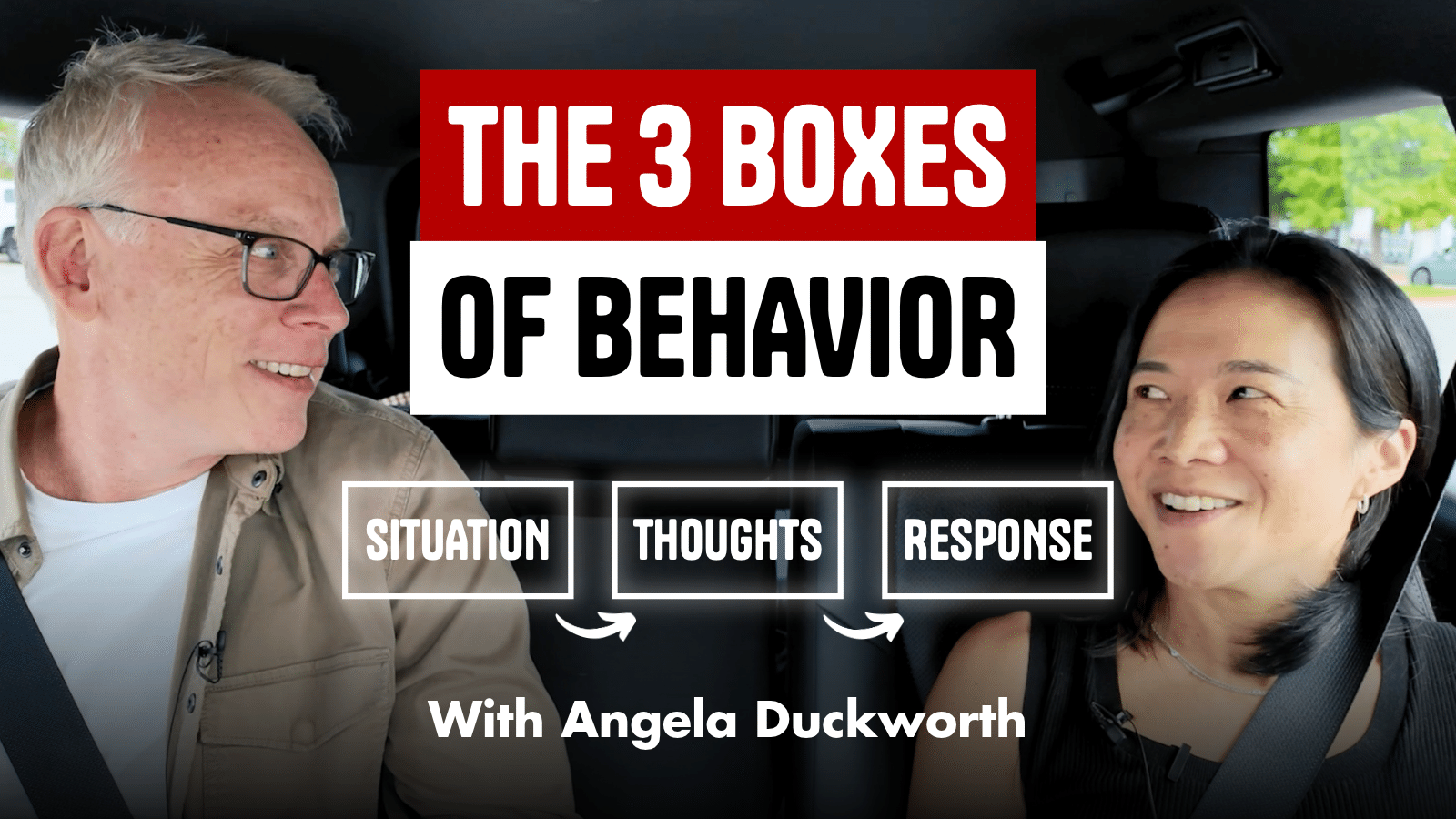
I know it sounds grand, Jay, but I think with three boxes and two arrows, you can explain all of human behavior. So box one is your situation, your objective situation. It’s where you are. It’s who you’re with. Box two are your thoughts. It’s not objective. It’s subjective.
Your thoughts are very often like, what’s going on here? So your thoughts are, what situation is this? But it’s a mental representation. It’s not objective reality. And the third box is your behavior, your response to your thoughts.
So your objective situation leads you to think certain things. Those thoughts lead you to behave in certain ways. In some ways, like, how else could it be? But the reason I think it’s so powerful is that when you try to understand yourself or someone else and you’re like, what the heck is going on, or I wish I would behave differently, or, you know, why do I procrastinate? Whatever it is, you can kind of reverse engineer the behavior to the thoughts that gave rise to that behavior and the situation that gave rise to the thoughts.
So it’s a very elegant model. It is not my model. It’s really the work of a Stanford psychologist named James Gross.
Jay Papasan:
Mhmm.
Angela Duckworth:
But I met him in 2011, and ever since then, it has been my model because I’ve adopted it and tried to understand anything that I’m studying. You know? Like, I wanna get off my cell phone, or, like, why do I keep eating this? Or, you know, how do I figure out what to do with my business, by reverse engineering the desired behavior or the undesired behavior just back to its origins.
Jay Papasan:
But with grit, I think that would have been between box two and three. I’ve got my thoughts. I wanna control my response. If it’s…
Angela Duckworth:
No. I think that grit was about a person who, in a given situation, would have optimistic, positive thoughts, and that would lead them to be passionate and persevering. Right? So try harder and to be resilient. And so what grit was about was, in the same situation, you know, different people respond differently, and that is still true.
I think you can certainly look at a place like West Point and say, look, it’s the same exact situation, like, literally. Right? But there, where grit predicts staying in the program, there are obviously things that a person brings to their situation. So this idea is not to say that those differences in your character or your personality don’t matter, but it is to say that in addition to whatever you’re bringing to the situation is the situation itself.
Jay Papasan:
Right. That’s where I’m getting at. You just moved it, I think, up a box. Right? That based on your situation, people with grit, passion, perseverance may think differently and respond differently.
Angela Duckworth:
Correct. They could have different box two thoughts that would lead them to different box three behaviors. But this framework says in addition to that… I feel like it’s the less obvious thing. I know it seems like, well, of course your situation shapes you.
But I think when we’re in the moment and we think of ourselves and how to motivate ourselves and how to motivate other people, we often, you know, consider the situation fixed or just ignore it. Anyway, the framework really emphasizes, I guess, the importance of the situation. And, of course, me being me, I guess, like, always trying to look for agency. So especially emphasizing what you can do to change your situation.
Jay Papasan:
That’s what I loved about it. And you have, like, a little riff in there about, like, willpower is not your character. But there are a lot of people that think about changing my situation as kind of, like, taking the easy way out. Cheating. Right? Like, if I’m gonna get or whatever, and they feel like actual shame or embarrassment about choosing the easier situation by changing their situation.
Angela Duckworth:
Let’s enumerate some of the ways in which people feel cowardly or lesser than when they change their situation. So GLP-1s, that’s one example. By the way, I think when GLP-1s were first introduced, there was a lot more shame about taking GLP-1s. I think now that it’s become more common, that’s changing.
But absolutely, a lot of people are like, wait, you should just go to the gym more. You know, you should make healthy eating choices. The idea that you would take medication to lose weight was, for a lot of people, something that if they were gonna do it, they were gonna do it in secret.
I think antidepressant medication. I think taking medication to sleep. So medications to change behaviors that one thinks, oh, but if I had more willpower. Right? If I had more motivation.
Jay Papasan:
I think that’s the thing is, like, if I need medication to be successful, if I need a coach or a tutor, even worse.
Angela Duckworth:
Yeah.
Jay Papasan:
That means I am less than.
Angela Duckworth:
Right.
Jay Papasan:
And they choose to try to do it the hard way. I’ve told so many people, when I ask them enough questions, like, I think you just need to change jobs.
Angela Duckworth:
Yeah.
Jay Papasan:
I think you’re in a really bad environment.
Angela Duckworth:
Given that advice?
Jay Papasan:
A lot of times.
Angela Duckworth:
Interesting.
Jay Papasan:
Yeah. People will tell me that they’re crying in the parking lot before they go into the office. And I’m like, if that’s not enough of a sign.
Angela Duckworth:
Yeah. What I find is, especially when people are gritty and they are trying and trying, and then they try harder and harder and things are not working out, I think they direct a lot of the blame and attention inward. Right? Like, okay, what’s wrong with me? And then, right, they, like, you know, dry off their tears, and they get out of their car, and they go in. They’re like, great. Suck it up, buttercup. Get back on the horse so you can, like…
Jay Papasan:
Right.
Angela Duckworth:
It’s about you. And, you know, I’ll never be one to say that hard work doesn’t matter. Hard work matters now and for the end of time. Like, hard work, I think, is the final common path to doing anything better.
And at the same time, I think, and this is not my quote, but I’m gonna repeat it, that sometimes fit looks a lot like grit. When you are in a job, when you are in a team, when you are in a relationship that really brings out your best, you can be a totally different person than when you are in a situation that doesn’t fit your interests, your values, you’re not supported, you’re not challenged enough.
So, yeah, I think it’s interesting to me that… You know, you’ve done a lot more of this, like, coaching, consulting than I have, that you would tell somebody that, like, yeah, sometimes the courageous thing is to change your situation.
Jay Papasan:
I call it strategic quitting. Like, giving up…
Angela Duckworth:
Yeah.
Jay Papasan:
…is bad. Like, that’s the “I gave up. I’ve learned nothing.”
Angela Duckworth:
Yeah.
Jay Papasan:
Right. I’m gonna strategically quit. Like, this relationship, this goal, this responsibility, whatever it is, this circumstance doesn’t serve me anymore. And I learned that from Seth Godin and The Dip, way back when, this idea.
Angela Duckworth:
The Dip is this very short book about how winners quit. It’s good advice. And, you know, the idea that changing your situation isn’t, you know, a cop-out necessarily, that it is a locus of agency. Right?
I think a lot of times, you know, coaches say, like, control the controllables, or, like, you know, you really can’t control the situation, but you can control how you respond to the situation. And I feel like that’s, like, dangerously incomplete advice. Like, wait, can’t you sometimes actually control the situation? And if you can, isn’t that exactly what you should do?
Jay Papasan:
Well, you quote Viktor Frankl. Right? Everybody…
Angela Duckworth:
Frankl.
Jay Papasan:
Oh, I know. It’s probably the nonfiction book I’ve read more than any other. I think I’ve read it maybe six times now.
Angela Duckworth:
Man’s Search for Meaning.
Jay Papasan:
Yeah. But the idea that even in the most difficult circumstances, we can control our thoughts. Like, that’s powerful. But then you quote him, that there’s a line that comes right after it that everybody forgets.
Angela Duckworth:
That nobody quotes. Right? Which is really that if you can change your situation for the better, of course, that’s what you should do. And Frankl says, like, otherwise, it’s masochistic. Right?
Jay Papasan:
So suffering is not required.
Angela Duckworth:
I think that the man who survived Auschwitz and Buchenwald to write his memoir, and then to spend the rest of his days trying to argue, like, what we, you know, should do as citizens to, like, preserve democracy and to live meaningful lives, this is not a man who is like, hey, you know what? The situation is what it is. The only thing you should, you know, concern yourself with is your box three response to the situation, or, you know, even your box two thoughts.
Jay Papasan:
If someone had handed him wire cutters and said the resistance is on the other side of the fence, he would have gotten out of there.
Angela Duckworth:
I think he would have wanted to save, like, himself and many others.
Jay Papasan:
Yes. Yeah. I just think that that’s the first thing, is that I usually…
When I ask, like, how do people grow? Like, how do we remove what’s gonna prevent them? Right? And yeah. I think a lot of people associate changing our situation with the easy way out or whatever. And I love that you address that head-on and take it off the plate.
Angela Duckworth:
I actually think it’s a very, very strong cultural norm to, you know, feel like… I mean, anytime there’s an athlete who complains about the conditions of, like, the golf course, etcetera, like, everyone is quick to say, like, you know what? You’re just blaming the situation.
Jay Papasan:
With NIL now, we have a lot of athletes that are jumping from school to school.
Angela Duckworth:
What’s NIL? Jay, you know all these things.
Jay Papasan:
I know this. Right?
Angela Duckworth:
So this is the NCAA?
Jay Papasan:
Yeah. Get paid.
Angela Duckworth:
Yeah.
Jay Papasan:
And so they are more free agents than they have ever been at college.
Angela Duckworth:
Yeah.
Jay Papasan:
And so you have these star athletes that the whole booster crowd, all the donors, like, are waiting to see on the field. And if they don’t get starting time early enough…
Angela Duckworth:
Yeah.
Jay Papasan:
They have the power now to change their situation, and they’re often villainized.
Angela Duckworth:
Right. Well, okay. And there’s some nuance here. Right? Because I don’t wanna say that, like, anytime anyone says, you know what? It’s the fault of the situation. It’s not me. Or… Like, I don’t wanna say that, like, oh, it’s always the right thing. Right?
Jay Papasan:
Oh, of course.
Angela Duckworth:
Right? I mean, nuance is hard in 2026. But if you’re doing everything you can and it’s still not working, it’s time to ask for help. The canary in the coal mine is like, hey. I’m exhausted. I’m really trying, and I’m not getting anywhere.
And then in a creative, open-ended way to say like, well, if it is my situation, which it must be because I’m already trying hard, so I’m already putting the effort. Like, in what ways is this situation not working? In what ways does it need to be changed?
Jay Papasan:
The sweet spot you shared around kinda place is like an environment that is… Correct me if I’m getting this wrong. It’s highly challenging and highly supportive.
Angela Duckworth:
I think those are the two dimensions on which you could, like, array… Like, any team, any family, any culture, you know, how challenging is it? Like, are the standards high or low? And then how supportive is it? And, you know, we wanna be in the top right quadrant.
But, yeah, I think that’s, you know, that’s not Angela Duckworth, by the way. That’s, like, over a half century of research on parenting, on organizational leadership, and so forth.
Jay Papasan:
I associate it, like, I think with Dr. Adam Grant. No. Or maybe it’s Simon Sinek, like, the most powerful phrase you can tell is I have high expectations of you, and I believe that you can fulfill them.
Angela Duckworth:
I think you’re thinking of a particular paper.
Jay Papasan:
Well, again, I think he quoted someone.
Angela Duckworth:
I don’t think any particular person can say like, oh, I patented, like, you know, high standards, high support. But I think you’re thinking of the work of David Yeager, who lives in Austin and is a professor at UT. And he is a developmental psychologist. He was a protégé of Carol Dweck.
The paper I think you’re thinking of is this experiment where kids in middle school write essays, and some kids are randomly assigned to get a Post-it note in the control condition that just says, like, you know, I’m giving you this feedback because, you know, it’s important to have feedback, something like that. And in the treatment condition, they get a Post-it note along the lines of, I’m giving you this feedback because I have high expectations, and I know you can achieve them.
And I think that is the combination of, you know, high standards, high support. Easier said than done. But that is, I think, exactly the recipe for a healthy, you know, growth-oriented, noncomplacent, but also non-burnout culture.
Jay Papasan:
I think every leader listening to this has had a moment where they’ve struggled to find the balance. Right? All the good-intentioned ones. They wanna create high expectations and high standards, and they also don’t wanna burn people out in the process.
Angela Duckworth:
And I think it’s, like, less about, you know, I’m too supportive or I’m not… More that you have to be both. And I do think sometimes it’s hard, like, in a single conversation, like, how do I communicate that, you know, this isn’t good enough. But also I have your back. In fact, like, you know, anything you need to be successful, like, that’s my job as your mentor.
But I don’t think it’s like a trade-off. I don’t think it’s like, oh, six of one, four of the other, you know, five and five, three and seven. I think it’s more that you wanna be as high standards as possible and as high support as possible.
Jay Papasan:
That’s great. So it’s not a combination. So when you talk about situational agency, I’m not imagining we’re gonna go through all of the book. I’m just sitting…
Angela Duckworth:
Yeah. That’s fine.
Jay Papasan:
Yeah. Pages of notes. But you talk about the things that we can control, and it’s our space, our peers, our mentors, and our culture. And maybe we can hit a couple of those. Like, so when people think about what can I control in this situation so I can change my circumstances, how do you define space?
Angela Duckworth:
I define space as, like, physically, you know, your immediate surroundings. I mean, you know, mostly talking about what’s within three feet of you, because that is what you can reach and what you can see. And as we all intuit, you know, out of sight, out of mind, but within sight, top of mind. Right? And within reach, most likely to be picked up, and like, oh, I have to get up out of my chair. Okay. Now I’m possibly not gonna, like, interact with this inanimate object.
And so when I talk about space, I really am talking about your physical surroundings. You know? Like, do you have a water bottle near you or not? How far is it from you? Where’s your phone? What’s on your desk? You know, for me, I work in an office, in my work office, and I have a home office. Right?
But what I see in that office, like what is within three feet of me, like, you know, on my walls I have now actually pasted Post-it notes for the sort of, like, box two thoughts I want to have. Like Nelson Mandela, I never lose. I win or I learn. I have that at eye level because I really want to think that thought, especially when things are not going right.
One thing that I think is profoundly important to understand about human behavior is that we are so reactive. Like, we’re not that different from dogs. Right? It’s like, you know, whatever you dangle in front of us, we pay attention to, you know, then that will occupy our thoughts. That will change our behavior. Whatever you, like, hide from us, meaning whatever we hide from ourselves, like, oh, yeah. I mean to read that book. But, like, if it’s somewhere that you’re not gonna see, I don’t think you’re gonna read that book.
I really emphasize this because in some ways people are like, yeah. Yeah. Your personal space. Like, you could change that. But I think it can be enormously important.
Jay Papasan:
I’ve used the… Like, if you wanna go jogging in the morning and you don’t wanna use your willpower, like, never knew that it had any backing, but, like, put your running shoes right by your bed, and, like, you use that example. Right? And I was like, oh, so there might be something to that. Bigger impact than you think? You’re like, who cares? Sometimes when I run…
Angela Duckworth:
There’s no friction.
Jay Papasan:
You’re removing friction.
Angela Duckworth:
Right. And, you know, one of the things that I have researched, you’ll be happy to know, I think, because I know you like research, and there is evidence to back up this intuition. So I just published a study with a team of scientists led by someone named Asaf Mazar.
And even the friction of, like, one, two, or three seconds on a website, you know, that’s enough for people to just, like, wander off and never come back, even when it’s something really consequential. Like, you are literally learning to code. It’s your livelihood, but there’s a load time that, you know, again, a matter of seconds. So these…
Jay Papasan:
The difference between four and one, I know. I’ve got a good friend that’s a designer, and that is huge. Right? People are on… They’re gone.
Angela Duckworth:
Hence, one-click shopping. So if that makes sense to people, you know, with or without the scientific evidence, then just friction down all the behaviors that you want to do more. Change box one.
Jay Papasan:
The ones you wanna stop.
Angela Duckworth:
Exactly. Right? Don’t just wait for box three willpower. Right? And even, like, box two, it’s like, well, I’ll think about it differently. I’m gonna reframe exercise as, like, not only good for me, but good for my kids. You could do that, but you could also change box one.
Jay Papasan:
Yeah. The anecdote that came to mind: when I was in graduate school at NYU, I used to smoke back then.
Angela Duckworth:
You did?
Jay Papasan:
I did. I lived in Paris.
Angela Duckworth:
My god.
Jay Papasan:
Rolled cigarettes.
Angela Duckworth:
Lived a long life.
Jay Papasan:
I have. That’s a good way of saying I’m wizened. I’m not old. But my professor was a guy named E.L. Doctorow.
Angela Duckworth:
Famous author. Of course.
Jay Papasan:
You know him?
Angela Duckworth:
Oh, great. Yes.
Jay Papasan:
And so, like, we go to this bar after our writing workshop, and, you know, he orders his cold vodka because he’s got that good Eastern European thing going on. And he notices that I’m rolling a cigarette, and it’s in a bar. You could still do it back then. Rolled cigarette. Very, very glad. I’m rushing.
Have you ever thought about quitting? And I was like, yeah. I’ve tried a few times, and I figure it’ll stick eventually. He goes, do you wanna know how I quit? And I was like, please tell me. He goes, get yourself a watch with a second hand, and every time you want a cigarette, just wait sixty seconds. At the end of sixty seconds, if you want it, you can have it. That’s the rule. I was like, okay. He goes, what I found is that after sixty seconds, I never wanted a cigarette.
Angela Duckworth:
Wow. It’s so interesting. That tiny amount of friction. Right?
Jay Papasan:
Yeah. Yeah. And those kind of things, I just wrote that down in the margins, and of course, it did come up. The Doctorow effect. But, like, you’ve got a great study. That was one of the things where you were… Before I even knew the book was coming out, I saw you on some speech talking about the proximity of a student’s phone and their GPA.
Angela Duckworth:
Yeah. Yeah. Well, I’ve been…
Lately quite occupied by phones and teenagers, as I think some, you know, well, many people are. And one of the findings that I find to be most, like, just intuitive and striking is that when you ask kids where they keep their phones, you know, there’s just a whole variety of distances. Like, some keep them, like, oh, right next to me with the sound on and the screen up, like, even when I’m studying. And some kids, you know, are more deliberate and put it farther away, even in a different room.
Jay Papasan:
Or their parents do for them.
Angela Duckworth:
That’s absolutely right. And, essentially, when you ask that question of, like, when you’re studying, where do you put the phone, then distance really predicts grade point average. So the farther the phone, the higher the GPA. And it illustrates to me a profound psychological principle, which is that physical distance creates psychological distance. Therefore, create more psychological distance from temptation simply by creating more physical distance from temptation.
I mean, it’s so universal too. Right? So, you know, phones, food, you know, Americans understand this. Also, in our international data, like other, you know, people understand it, but we rarely do it. You’re like, what do you think you should do? Like, oh, you should change your situations. Like, what do you do? I use willpower.
So I think there is something very deep about, you know, the neglect of the situation. I think it’s probably lots of things, but, you know, we talked about one of them. I think, you know, we’re sort of like, oh, you know, tomorrow, I’ll work out. Tomorrow, I’ll have the motivation to work out. I’m the sort of person, or would like to be the sort of person, who can motivate themselves and doesn’t need to depend on their workout clothes being out and, you know, Post-it notes reminding them of their goals.
Jay Papasan:
I’m with you. I feel like that’s the opportunity of this book, is to create more awareness that we all have a different lever we can pull.
Angela Duckworth:
Right.
Jay Papasan:
And give ourselves permission to pull it.
Angela Duckworth:
Exactly. I mean, I had to invent the phrase situational agency because it didn’t exist.
Jay Papasan:
But I— which is good writing, by the way. I mean, come on. Now you’ve got your trademark phrase.
Angela Duckworth:
Well, I have to say the writing of this book was, like, very difficult for me, Jay. Maybe if you had been in my situation, I could’ve, like, called you, and you’d certainly have given me better advice than I was self-administering.
But I did feel like we need language to describe the agency that we have in looking around, both at the inanimate objects, like your physical space, and also the people, absolutely the people, and asking—and it takes a while to answer the question—like, how could things be better? And knowing the different categories to look at and just building that little muscle of, well, the space that I can control, my workspace, my environment, like, do I need to change something there?
Jay Papasan:
I think you provided what I thought was a helpful checklist. And I’m gonna go from there to peers.
————————————-
Jay Papasan:
Peers. You talk to any parent, what’s one of the most important things that you could curate for your kids? The kids that your kids are hanging out with.
Angela Duckworth:
Yes. Exactly.
Jay Papasan:
And yet we never take that advice for ourselves.
Angela Duckworth:
Right. There’s obviously, you know, something about loyalty and friendship. And I’m less concerned, at least in this book, where… This book is about achieving your goals, right? And again, I think a complement, not a contradiction, to whatever, you know, people understand of my work on grit. But your peers are enormously important.
And here’s something that I will tell you. Like, anytime I am walking down the streets of Philadelphia and I see a group of runners go by, a group of runners, I think to myself, they’re gonna be okay. Because when you are in a flock, when you have found a tribe, which if I could, you know, revise the table of contents, I think I would call this chapter not “Pick your peers,” which has alliteration, but “Find your tribe.”
When you are trying to achieve your goals, not on your own, like I wanna run a marathon, I wanna get in shape, but as part of a group of people who are also trying to achieve a goal like yours, I think it can be just like a qualitatively different experience. And when I see those runners, I mean, I can’t say exactly what’s gonna happen to them, but like I feel like they are doing exactly the right thing.
Jay Papasan:
I mean, that’s one of the things that if you’re looking for community, go join a group doing something you’re already interested in. Do a book club. Go…
Angela Duckworth:
I mean, Jay, you mentioned to me that you have a group of other writers who are, you know, all trying to do what you’re trying to, have impact, share ideas through words, and you… What, you meet every year, you said?
Jay Papasan:
I have three different groups of creators…
Angela Duckworth:
What?
Jay Papasan:
…that I meet with one to two times a year. Because even though I live in Austin, Texas, like, we’re not getting to culture… like, I do live in a town that favors those kinds of people. I still typically have to get on a plane to find my actual peers.
Angela Duckworth:
Your actual peers. Are these three groups of, like, they’re all writers, or are they three writing groups?
Jay Papasan:
They’re people who rely on content to grow their business or for their impact.
Angela Duckworth:
Yeah.
Jay Papasan:
And most of them are writers…
Angela Duckworth:
Yeah.
Jay Papasan:
…or authors…
Angela Duckworth:
Yeah.
Jay Papasan:
…which means there’s even more overlap for me.
Angela Duckworth:
Yeah.
Jay Papasan:
But I know you talked about the strength of weak ties, which is one of my favorite studies, but like one person introduced me to one group, and then one person on the fringe of that group introduced me to another. And there’s not as much overlap as you’d think between the three groups, but they’ve all introduced me to people that I wouldn’t have known otherwise, that understand what I do even if they do something differently. And I find learning from people who were kind of… Like a sprinter could probably learn something from a marathon runner that they wouldn’t find out from their group of sprinters they hang out with all the time.
Angela Duckworth:
Yeah.
Jay Papasan:
So they’re…
Angela Duckworth:
There’s a little cross-fertilization.
Jay Papasan:
Yeah. We’re kind of in the same zone, but we’re approaching things very differently. And I’d be like, “Well, why do you tie your shoes that way?”
Angela Duckworth:
Yeah.
Jay Papasan:
And they’ll be like, “Well, because of this. Don’t you know this?” And I find that intermingling from different disciplines… Like, I learned from the YouTubers. I learned from the podcasters, even though we’re on a podcast now. My identity is as an author.
Angela Duckworth:
Right. Well, I think the idea that this is elemental is maybe intuitive to you or to me. And by the way, I’m not saying that I’m like embedded in peer groups that are like…
Jay Papasan:
It’s not elemental. When my kids were growing up, like, I focused on being a good husband, being a good father, and winning at work.
Angela Duckworth:
Yeah.
Jay Papasan:
The thing I gave up was all of my friendships.
Angela Duckworth:
All your friendships.
Jay Papasan:
And it’s only in the last few years that my coach told me, “You need to reengineer your village,” and I got very purposeful about it. So I don’t wanna pretend that I didn’t walk down the wrong path.
Angela Duckworth:
It’s not the default, but it is essential. I mean, I was interviewed by a journalist who claimed to me that he had none of this, by the way. He had no peers that he consulted, like, nobody to commiserate with, nobody to, like, trade ideas or notes. And I really pressed him. I mean, I was the one being interviewed, but I was like, “Really?”
The idea that you could be just as good on your own trying to pursue your individual goals as you could trying to pursue your individual goals in some kind of community, right? In some kind of like, “Hey, let me tell you about the week I’ve had,” or, “You know, I’ve got this problem. I wonder if you have any experience.” Like, it flies in the face of the evidence from anthropology that we are a profoundly social species, like, to a degree where I feel inarticulate in my ability to, like, emphasize.
Jay Papasan:
But, you know, there’s this evolution that we have genetically, but there’s also cultural evolution, which is like, if it was Jared Diamond, or I’m trying to think of who the author is, so I apologize wherever you are. But just remember the whole thing, like, Neanderthals and humans coexisted. Neanderthals were stronger. They were actually more intelligent, but we work together and they did not.
Angela Duckworth:
We are the social species. I mean, it is true that we have bigger brains slightly than, you know, our nearest primate cousins. I mean, our brains are, you know, corrected for body weight, like, we do have bigger brains, but not like brains that are 10,000 times bigger, right? Like, whatever, 20% or so. And it cannot explain, like, skyscrapers and, you know, electric vehicles, and it doesn’t explain, like, you know… Human technologies are all social in their creation…
Jay Papasan:
Mhmm.
Angela Duckworth:
…and in their application. So if you’re gonna be a novelist or an entrepreneur or like a great, like, you know, Girl Scout or like, you know, the idea that you could like figure it all out on your own, I think it’s naive.
I think one thing that’s, you know, maybe a current trend, which I don’t know that it is a good trend, is that people are getting their social learning from, like, YouTube and TikTok and whatever.
Jay Papasan:
Yeah.
Angela Duckworth:
I think… And, you know, I probably should study this, that the kind of learning that we get when we’re in relationship with people where there’s like a reciproc… Like, I know you. Like, actually, Jay, you know, I’m not… You know, I don’t spend a lot of time with you in person, but I feel like because we’ve known each other for so long…
Jay Papasan:
Yeah.
Angela Duckworth:
…like, there is a relationship there.
Jay Papasan:
Annual letter.
Angela Duckworth:
I get yours. Annual letter. Exactly.
Jay Papasan:
Yeah.
Angela Duckworth:
The occasional emails, text messages. It’s different. And, you know, like, just saying, you know, personally, I think in the next decade of my life, I would like to lean more into those peer relationships. Like, you know, yes, I have a tribe. I’m an academic psychologist who writes, but being even more deliberate as…
Jay Papasan:
Your friend Katie Milkman, who you introduced me to, I believe.
Angela Duckworth:
I maybe have.
Jay Papasan:
Yeah. You referred to her as your BFF in the book.
Angela Duckworth:
My academic BFF?
Jay Papasan:
Yeah. So cool.
Angela Duckworth:
Yeah. And I need to spend more time with Katie, for example.
Jay Papasan:
The tension for a lot of people, especially when they have children, is when do I get to have permission to go do this for me versus the duties and responsibilities, whether it be the marriage, the kids, or your people if you’re a leader, and not let people down. But like if you don’t do that for you, it’s almost like a recipe… We talk about put the, you know, the oxygen mask on yourself first. Like, it’s a selfish self-care necessity if you wanna help others over time, is to also…
Angela Duckworth:
It’s so hard to do in the moment. I completely agree with you, right?
Jay Papasan:
Yeah.
Angela Duckworth:
Like, also when you’re distressed, like, the idea that you’re investing in the long term, it’s…
Jay Papasan:
It feels so slow.
Angela Duckworth:
It feels so slow, and it feels like not what you should do at the time. But, you know, my husband Jason, who I write about in the book a lot, and…
Jay Papasan:
You were very personal in this book.
Angela Duckworth:
Yeah. This is a lot more personal.
Jay Papasan:
Yeah. That’s where I wanna end, if we can talk about your mom.
Angela Duckworth:
Absolutely. But my husband Jason, you know, being a real estate developer during the financial crisis, like, he too had this sort of like, “Oh my god. Like, I’m so stressed. I couldn’t possibly do things that are,” for example, like, taking an afternoon off to, like, you know, talk to people about, like, their… Like, it’s just everything was…
Jay Papasan:
He was working a hundred hours a week, you described.
Angela Duckworth:
And none of those hours were like, “Oh, maybe I should, like, reach out to other real estate developers and see what problems they’re having,” or, like, you know, take time to, like, actually, you know, develop mentor relationships. All those things did not seem like a luxury that he could indulge in at the time. But they, you know, absolutely, like, you know, they’re investments, right?
So I really empathize with, like, anybody who’s like, “Yeah, that sounds great, but I don’t have the luxury of making those investments right now.” And yet that’s really the only way, I think, that you can actually, like, move forward sustainably, right? Like, it’s… You know, I disagree with the journalist who said that I’ve done… Well, he may be right that he’s done everything that he’s done alone, but I guess I’m imagining what he could have done, and maybe I don’t…
Jay Papasan:
I’d fight with that guy that thinks that, but I would agree with you. Oh, so you never had a teacher pour into you? You never had…
Angela Duckworth:
Right.
Jay Papasan:
…someone say, “You know, you’ve got talent, you should pursue this”?
Angela Duckworth:
Yes.
Jay Papasan:
So we can remove all of that from your history and you’d still be where you are today?
Angela Duckworth:
Right.
Jay Papasan:
I just don’t think some people haven’t learned to see that. Your whole message about Mister Rogers, like, and mentors, I think that good peers can do this too. What did you say? They love us into being?
Angela Duckworth:
That was Mister Rogers. He said…
Jay Papasan:
Yeah.
Angela Duckworth:
It was…
Definitely Mister Rogers. I can’t take words out of Mister Rogers’ mouth, but he did say that our mentors love us into being. And, you know, I feel like in so many ways, I have been really blessed to have mentors for whom I’ve wondered again and again, like, what do you get out of this relationship?
And now that I’m old enough to do some mentoring, which isn’t always easy, by the way, I really do see it as, like, you know, the closest thing to parenting there is. Right? So it is this, like, beautiful asymmetric relationship where the answer to the question, like, what are you getting out of this? Is only the pleasure of loving another person into being.
Jay Papasan:
It’s a beautiful thing. And you share a lot of different people who are… You call them mentor magnets.
Angela Duckworth:
You can see that I’m quite fond of alliteration. But, yeah, there are people who… Questions. Ask them. Ways to notice them. People who are giving you maybe extra time. Yeah. They’re out there.
…is a mentor magnet, but I really think anybody could be. Right? If you just take a moment and ask yourself, like, well, what would attract a mentor into my life? Like, what sort of relationship would a possible mentor find to be gratifying? And you’ll soon answer your own questions, like, maybe I should be prepared. Maybe I should be curious. Maybe I should be grateful. You know, maybe I should be the sort of person who pays it forward. I think it’s check those boxes.
Jay Papasan:
Be curious. Be coachable. Right? The thing that shuts me down fastest if someone asks me to mentor them is when they start arguing with me. And so I’m just like, no. Go try it. If it doesn’t work for you…
Angela Duckworth:
Has that happened to you when you’ve been, like, trying to mentor someone that, like, you give them a suggestion and then they just, without even letting you finish, like, tell you what…
Jay Papasan:
And that’s usually not a sign that it’s gonna continue, but I sometimes will wait. Because sometimes people are just really nervous.
Angela Duckworth:
Yeah.
Jay Papasan:
You know, nervous energy, like, I don’t want… This is, like, a hero of mine. I’m not saying that people think that about me, but they put you on a pedestal because you wrote Grit or whatever. And then they’re nervous, like job interview nervous.
Angela Duckworth:
Yeah.
Jay Papasan:
And so they’ll say things that they might go, why did I say that? Why was I arguing? So it’s not a one-strike-you’re-out. But if someone shows a pattern of debating, it does take the joy out of it.
I know that I’m gonna give bad advice along the way. So if they come back and said, you told me to read that book and I hated it, I’d be like, oh, I’m so sorry. What did you not like about it? Well, great. I’ve got another one. But the fact that they follow the advice and then report back is a big part of the loop that keeps it going.
Angela Duckworth:
So when Mister Rogers talked about mentoring when he received the Emmy for lifetime achievement, because in the precious moments that he had, he decided to thank his mentors and to ask everyone else to thank their mentors. He said how pleased they must be after there was this, you know, unprecedented ten seconds of silence as he asked the entire auditorium, and I guess the whole viewing audience, to just think for ten seconds about the people who had mentored them, who had loved them into being. And at the end of those ten seconds, he looks up from his wristwatch and he says, how pleased they must be to know the difference you feel they’ve made.
Jay Papasan:
Mhmm.
Angela Duckworth:
And when you talk about a mentor magnet as somebody who doesn’t almost have to agree with the feedback, but really absorbs it, right, and tries to learn from it as opposed to being like Teflon, I think it connects with what Mister Rogers is saying, is like, you know, somebody is pleased to know that they’re making a difference. And if they don’t feel like they’re making a difference, they’re not going to be pleased.
So send them a thank-you note. Send them a text if you’re not gonna write it out by hand, and just say, hey. You asked me to read this book. You know, I read this book. And I mean, that suggests that the feedback, the information, the advice, the knowledge, the care…
Jay Papasan:
The investment of time.
Angela Duckworth:
…is soaking in.
Jay Papasan:
Yeah. It’s huge. What I’d love to do is kinda wrap it up. You dedicate the book to your mom. You tell some of her story, and you actually close the book, your epilogue is also about your mom. And I thought long about this, like, so did she take ninety years to find her situational agency? Is that the moral of the story, and it’s never too late?
Angela Duckworth:
So my mom was born in China in the 1930s, and to a very traditional family, her career, according to her mom, my own grandmother, was to become a wife. And when she married my dad, that meant putting aside her lifelong dream of becoming an artist. So it’s true that my mom, I think, lacked the situational agency, the idea that it was within her rights to change her situation, because she didn’t have any role models. You would imagine, the 1930s. She had no role models, certainly not in her own family.
And it was only after my dad died, or maybe you could argue in the years when he was very sick and in, you know, an assisted living situation, where my mom now suddenly had some time in the day where she wasn’t, you know, keeping him company, doing what he wanted her to do, that she was able to pursue her art again.
And my mom texts me every day. We talk nearly every day. And there is a little art studio, a room of her own, as is often said, that artists need to think and to write. There’s also a ceramic studio apparently, and that was a new addition to this retirement community. And so my mom is, like, literally every day making these, like, ceramic replicas of these slippers that, you know, women in China used to have to wear with the foot binding. So, like, four or five inches long.
And so, you know, my mom is there. She’s 91 and a half, like, going on 92. And it is a message of it’s never too late. And I don’t want to sound so glib, but when I think about the years, the decades that my mom did what my father asked her to do. Ran a business to support the family. Ran a needlepoint business that she had no desire to run. I mean, it really was a situation where you have this very gritty person, you know, who immigrates here, who sacrificed so much, like nobody would work harder than my mom, but was not in a situation that enabled her to realize her ambitions.
And to me, it is a parable for all of us, which is to say that grit is not enough. You know? Grit is not enough. And I didn’t really understand that about my mom until, I’m sorry to say, like, you know, fairly recently. I never thought of my mom as gritty because she wasn’t a successful artist, because I didn’t see her painting. What I failed to account for was the situation.
When I really understood and, like, took a step back, widened the aperture, and saw not only my mom but my dad and her cultural circumstances, I understood how important it was to take into account the situation. And then, yes, when you can, and it’s never too late, but it’s also never too early, when you can, to change the situation.
Jay Papasan:
I love that. Alright, folks. First off, you need to go buy the book and read the book. It is fabulous.
Angela Duckworth:
Jay, you’re too generous. Thank you.
Jay Papasan:
It’s really important.
Angela Duckworth:
I’m really… I’m just, like, very honored that you read it. I mean, you know, we’re like in a mutual admiration society, and you took notes.
Jay Papasan:
I always take my underlines, and then in the back, I will write down the pages so that if I pick this up a year from now, I can go and say, well, that’s the… That’s what that was.
Angela Duckworth:
That’s what the blank pages at the back are for.
Jay Papasan:
That’s what they are for me. This is my CliffsNotes for the second read.
Angela Duckworth:
Well, I’ll sign the front page. But, anyway, it’s very gratifying because I told you, like, I, you know, wanted to have this conversation. And you asked me, like, what would make it successful? And I was like, I don’t know. I like you. I respect you. And I feel like, you know, you do a great job of trying to share ideas with people who are trying to achieve their own goals. I want people to have the agency to do what they need to do to be happy and successful in their lives. And sometimes it’s right in front of them. Right? They just need to be reminded.
Jay Papasan:
What’s one thing our listeners could do between now and next week, maybe to take action on something we talked about?
Angela Duckworth:
Here’s something that I would recommend to anyone. I would take a favorite quote or saying, something that you would like to have top of mind, you know, the boxed truth thought that you want to bring to your life. I use this Nelson Mandela quote. I have others too, by the way, so it’s… He’s not the only Post-it note.
Jay Papasan:
In my… to my wife that says I love you.
Angela Duckworth:
Okay. There you go. Nice affirmation. Yes. Like, whatever you don’t want to forget. Right? I have one that says hunt the good, and I actually have one which is very The ONE Thing, like, less better. I’ve got one that’s nothing changes until what’s unspoken is spoken.
Jay Papasan:
And are these on Post-it notes?
Angela Duckworth:
Some of them I’ve written out in Sharpie and just stuck up. So I will just say, put it at eye level somewhere that you’ll see at least once a day, a thought, a quote, a verse.
Jay Papasan:
A question.
Angela Duckworth:
Yeah.
Jay Papasan:
What’s my ONE Thing?
Angela Duckworth:
Yeah. That would be a really good one. And, you know, make sure you use, like, tape that is not gonna ruin the surface, but also isn’t gonna, like, fall off in, like, two seconds. And just see whether that changes anything.
Jay Papasan:
I love that. Thank you again for agreeing to this crazy interview.
Angela Duckworth:
Yeah. Thanks, Jay. We’ll see how this experiment goes.
Jay Papasan:
It was great. Awesome.
Announcer:
Warning. You must comply with the TCPA and any other federal, state, or local laws, including for B2B calls and texts. Never call or text a number on any Do Not Call list, and do not use an autodialer or artificial voice or prerecorded messages without proper consent. Contact your attorney to ensure your compliance.
————————————-
Disclaimer:
This podcast is for general informational purposes only. The views, thoughts, and opinions of the guest represent those of the guest and not ProduKtive or Keller Williams Realty LLC and their affiliates and should not be construed as financial, economic, legal, tax, or other advice. This podcast is provided without any warranty or guarantee of its accuracy, completeness, timeliness, or results from using the information