Jay Papasan:
How does it make you feel when you really don’t know what to do? When you’re looking at all your choices and none of them feel very good? When someone asks you a question and you just don’t know the answer? That’s all in the realm of uncertainty. And I don’t know about you, it gives me the heebie-jeebies. I don’t like not knowing. I want to know the answer.
And the truth is, as leaders and entrepreneurs, a lot of the time, we’re not going to have complete knowledge. We’re going to have to make progress through uncertainty. And if that describes you, this episode is for you.
I’m talking with my friend Simone Stolzoff about his new book, How Not to Know. He’s an amazing journalist and writer. And he went on a deep dive on the three traps around being certain and some great techniques, practical stuff for us, as leaders, on how we can get more tolerant of being uncertain and lean into the benefits of it. I hope you’ll enjoy it
———————————–
Jay Papasan:
I’m Jay Papasan. And this is The ONE Thing, your weekly guide to the simple steps that lead to extraordinary results.
——————————————–
Jay Papasan:
Simone, welcome to The ONE Thing podcast.
Simone Stolzoff:
Thank you so much for having me.
Jay Papasan:
Your book, which I loved, you identify the three unhealthy ways, you called them traps, that people have to know and why it’s maybe important to avoid them. Maybe we can open it up about the unhealthy ways we deal with uncertainty. And then, we’ll dive into some other.
Simone Stolzoff:
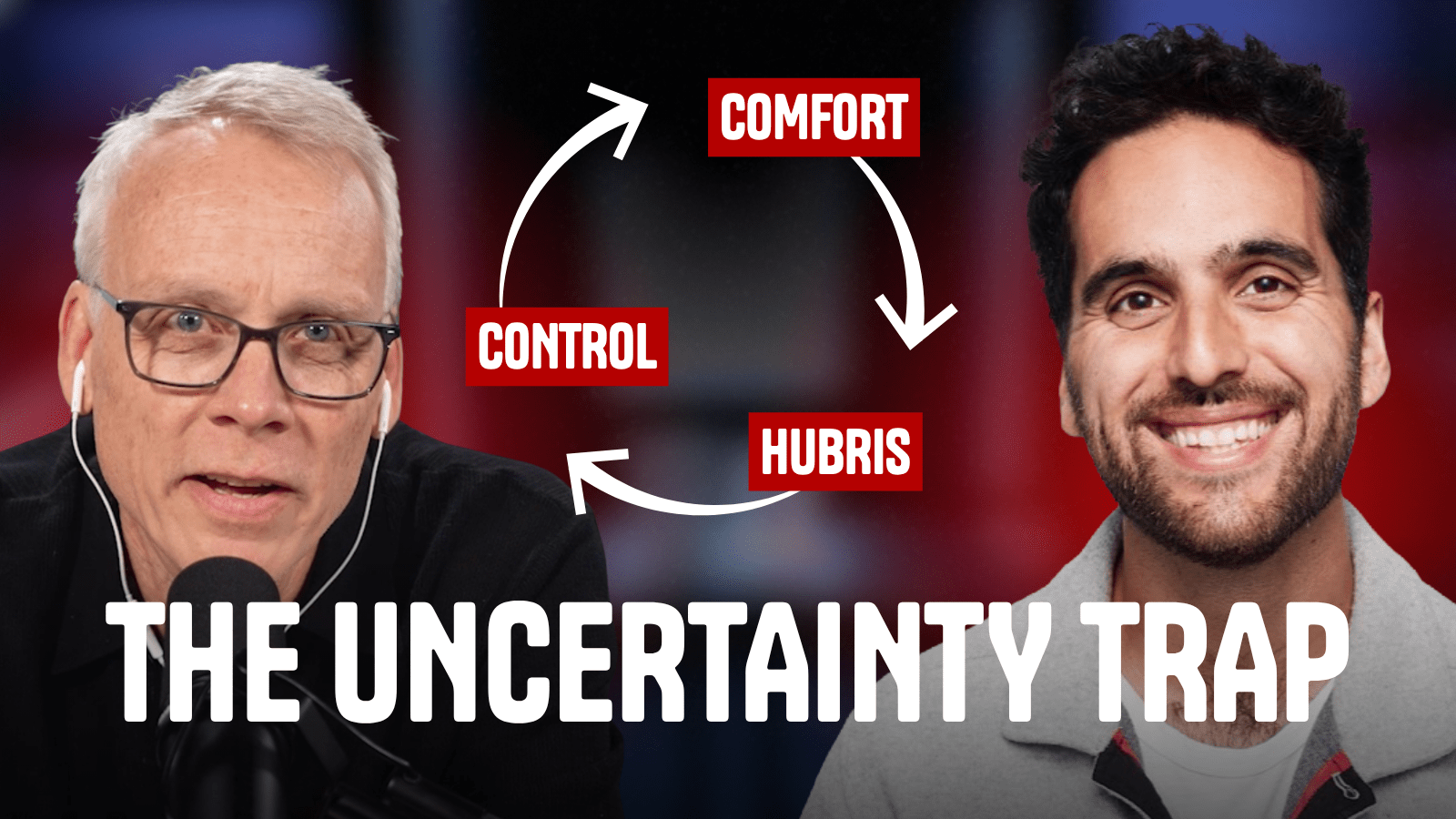
Yeah, for sure. So, in short, the book is about how we can get better at dealing with what we don’t know. It’s called How to Not Know. And the way that I break it down is in these three sections. Every nonfiction book needs its framework, and this is my framework. And it’s around these three traps, these cognitive psychological traps that we can fall into that get us looking for certainty where there is often no certainty to be found.
And so, the first trap is comfort, our desire to stay with what we know. We all probably have a friend who’s in a job or in a relationship that they know isn’t quite right, but they would rather stay with the devil they know than have to explore the uncertainty and the potential discomfort of stepping outside of their comfort zone. This is often called our status quo bias as well. We want to stay with the status quo as opposed to looking at the growth or the learning that might come from stepping outside of our comfort zone.
The second bias is hubris. So, this is particularly common in the business world, our excessive pride that makes us think that we know best. And often we assume that the most credible CEOs or leaders are the ones that speak with the most conviction, that can tell you exactly when the market is going to crash or who’s gonna win the election or what the sales forecast will be in Q4 of this year. But in actuality, the research shows that the most credible leaders are those who can admit what they don’t know or admit what they were wrong about in the past. And so, the sort of call to arms here is to trade some of our hubris for humility.
Jay Papasan:
I’ll just add on the hubris, like we documented like the jokes around economists and weather prediction. We’re really bad at calling shots in the future. Nobody is actually… They can just speak with confidence but it’s not necessarily competence that they’re actually leading us towards.
Simone Stolzoff:
Very well said. Yeah. The canonical study was from this guy named Phil Tetlock, who is a professor at Wharton, and he collated data from about two decades worth of predictions from some of the smartest people in the world. So, economists, politicians, journalists. And his finding did not mince words. He says, “The average expert is roughly as accurate as a dart-throwing chimpanzee.” And so, as much as we think we can know, we can predict the future, when you actually compare these predictions to what actually transpired, experts are often wrong.
And then, the last trap is, I think, the most common, which is our desire for control. And so, we want to know exactly what the future holds. We want to be able to plan for all potential circumstances. And this gets us holding on to a very fixed view of what is in store as opposed to opening ourselves up to the reality of what happens.
And so, on the flip side of each trap, I have a virtue. So, on the other side of comfort is growth. On the other side of hubris is humility. And the other side of control is acceptance of what actually is reality as opposed to what we wish it to be.
Jay Papasan:
You do a great job of telling stories throughout it. I couldn’t help myself, as an author, was any one of those three the germ that got you going into this? Where was your personal stake? Because writing a book and like you were traveling around interviewing people in depth, where did this germ of an idea come from?
Simone Stolzoff:
So the cliché among authors is that you write the book that you need to read, and that was very much true for me. So, sometimes, I’ve done lots of these interviews in promoting the launch of this book, and I had a first book called The Good Enough Job that was about work and identity and how work has come to be so central to particularly Americans’ identities. And I went on tour for the book. And I’d always get some version of the same question: How should I think about my career when AI is on the horizon? And the honest answer is that I don’t know.
I am a journalist. And one of the things I love about my job is I don’t have to have all the answers myself. I can point the camera to an expert over here or someone who has been studying this topic for 30 years over here and try and triangulate the truth by looking at all of these different people. But underneath that, a mission that I’m not exactly sure what the future of work holds is the understanding that maybe the more important skill is that meta skill of being okay with not knowing.
And I actually think that is very true. As you and I both know, we’ve been entrepreneurs for a long time. One of the skills that you develop as an entrepreneur is being able to develop a certain level of comfort with the ambiguity, with the uncertainty, with not knowing exactly how you’re gonna make money next year, or not knowing when the next client is going to come in. And I think that skill that entrepreneurs have had to develop by nature of not having a boss telling them what to focus on is a skill that I think the whole labor force will have to develop in the next five, ten, twenty years as a lot of the infrastructure that once held our jobs starts to break down in favor of these more horizontal flat organizations.
Jay Papasan:
I love that. And that was actually my first planned question. There’s such value, and you listed at the flip side, you’ve got growth, humility, and acceptance on the other side of the traps, right? There’s real value in tolerating uncertainty and learning to be more comfortable with it. Based on all that you learned in your research, if someone said, “I want to develop my tolerance for uncertainty,” where would you point them to start?
Simone Stolzoff:
There’s a few different starting points. Maybe the easiest one is to just think about your past and think about moments of uncertainty that you’ve already made it through. Through that evidence, you can build confidence in your ability to handle uncertainty moving forward.
The second place to start is in the present, which is much like any sort of phobia or aversion we have, one of the best ways that we can develop tolerance is through exposure. Similar to if you had a fear of spiders, maybe looking at a picture of a spider and then being in the same room as a spider will help you eventually be able to tolerate spiders in your life.
The same is true with uncertainty. By microdosing uncertainty, by exposing yourselves to small uncertain moments, whether that’s striking up a conversation with a stranger that you don’t know how it’s gonna go, or taking a new route to work, or maybe trying a new restaurant or ordering something that you don’t normally order at your favorite restaurant, these little ways of exposing yourself to uncertainty help rewire your brain, so that when those bigger uncertainties fall, you’re more likely to be able to adapt and roll with them.
And the third is an attempt to look at the future, which is to say that we suffer from what social psychologists often call the end of history illusion, where if you look backwards in your life, you can think about all these moments where you’ve changed, where your preferences have evolved, where you’ve been able to grow. But we often assume that who we are today is fixed in time, that exactly what your tastes are at age 35 or 65 or what have you will be the tastes for your re- the rest of your life, and that’s a fallacy.
So, something that gives me a lot of confidence when facing uncertainty is the knowledge that maybe what I’ll want from my career or from my relationship or from my life in five, seven, 10 years from now will likely not be able to be predicted by the current version of myself today. You have to be able to trust in your future self.
Jay Papasan:
I love that. That’s one of the four points you end on is give yourself some credit. Your future self, because they’ve been on this path, and it might not be such a surprise to them five years from now, they’ll be preparing for it, and just trust them to be able to handle it when it comes. We don’t have to have all of the answers.
Simone Stolzoff:
That idea comes from a friend of mine, and I just wanna give her credit ’cause her name is Emily Anhalt. She’s also an author and a clinical psychologist. And I really like the backstory of where that phrase, trust in your future self to handle your future problems, comes from ’cause when she was in her early 20s, her mom was given this potentially terminal diagnosis, and so Emily spent week after week in the hospital by her side and was really struggling to cope. She was riding this roller coaster of anticipatory fear and grief.
And one day, a family friend of hers named Bill, who’s an oncology doctor who has a lot of experience dealing with people at the end of their life, came to visit and said, “Emily, how are you doing?” And she said, “Honestly, I’m terrified. I don’t know what I’ll do if my mom passes away.” And Bill said something very wise. He said, “Emily, the version of you who will deal with that tragic event if or when it ever takes place will be born into existence in that moment.” And that version of you will have more information, more context, and be better equipped to deal with it than you are today. You have to trust in your future self to handle your future problems.
And so, maybe if you just take away one thing from this podcast, it’s that. Because our natural tendency when faced with uncertainty is to catastrophize, to think about all the things that will go wrong. But one of the best things that we can do is reground ourself in our sphere of influence today. What is it that we can control, and how can we cultivate a sense of self-trust that we can handle problems when they do, if they do arise?
Jay Papasan:
I love that. And I caught your framework, past, present, future. Obviously, it’s a good device. And the past is priming us for the future. If we go back and remind ourselves of other times where maybe we lost our job or we broke up with that person we loved and everything felt like it was up in the air, we’re still here. We figured it out. It might not have been comfortable, but there’s usually, you said the word evidence. We have evidence in our past that should give us confidence for our future. And so, the combination of those two is a nice one-two punch to me.
I wanna dive in a little deeper on the present. You devote a whole chapter. Is the guy’s name Max? Could you just tell us a little bit about Max and his randomizing his life? ‘Cause that made me very uncomfortable even to read about it, but at the same time, I became aware of some other things that I’ll share after you tell the story.
Simone Stolzoff:
Yeah. It’s a fascinating case study. This guy Max was a software engineer at Google. And after a few years working, started to feel what is perhaps a familiar feeling, which is that each day felt like it was a rinse and repeat, like he was acting out a script that was already acted before.
And so, software engineer that he was, he decided to apply software to try and debug the issue. And so, he created a series of apps. The first one was a random ride generator, where he would call an Uber to his house to send him at a destination that was only known to the driver. And it brought him to a cemetery on the other side of town and a gay bar in the gayborhood in San Francisco, and to the planetarium that he had never been to before. So, that was level one.
Level two, this was in the mid-2010s. And so, at the time, Facebook had a lot of public events that you could see if you just logged into the site. He created this random event generator where on a given Saturday, he would spin the proverbial wheel, and his app would tell him, “Okay, go to this intro to nursing meetup,” or, “Go to this chess master class,” or, “Go to this networking event for young Russian professionals.” Max is not Russian or a nurse and/or a chess master by any means. But it was his way of sort of getting outside of his bubble, getting outside of his comfort zone.
At its most extreme, Max quit his job at Google and created an app to tell him where to live. And so, for over two years, every month, he would press a button on his computer, and it would say, “Move to Slovenia,” “Move to Ho Chi Minh City, Vietnam,” “Move to Dubai.” And he did it. And he honored thy computer. And it’s fascinating because it plays on some of these fantasies that we might have to just roll the dice and see what life gives us.
But I do think the takeaway of the chapter and the reporting and spending time with Max was not exactly what I expected. I thought it was just going to be a story about someone who is an uncertainty master. But it turns out if you just spend multiple years randomizing all of your decisions and not necessarily taking responsibility for them, there’s another cost.
Jay Papasan:
I love that. And where I ended up with it when we were last traveling in Portugal and actually in Japan, we noticed it on both of our last two big trips, everybody was going to the same places to see the same things they’d already seen online. And what my awareness became when I was reading this chapter, I was thinking through those moments where the algorithm is already driving so much of what we experience online, and now it’s driving what we experience offline.
And I go not just to being curious and exposing myself to new things. I was like, I also want to ask the question, are we losing our agency and choice because we’re always asking whether it’d be Google or Yelp or ChatGPT or Claude, what’s the best whatever? Because those machines are really good at telling us the top of the bell curve. This is a really good answer for most people, but we’re losing a lot of the edge experiences.
And so, I had to stop reading your book after this chapter, and I just sat there and thought for a while and just asked the question, how do I bring a little bit more randomness to my experience offline and online? The depth of my curiosity drives me into some weird corners of the Internet to get answers. You say, “What is the word origin of this?” And then, you start playing the game. And I used to love that with physical dictionaries ’cause I would look up a word, and then learn six new words on the page that I’d never seen ’cause, now, you just go right to the source.
And so, I love the idea of if we are really uncomfortable with uncertainty, not to the max level – and his name is literally Max, so I guess I didn’t mean that double entendre – but how can we inject a little bit more uncertainty into our lives and a little bit more randomness so that we get more comfortable with stepping into rooms that we never thought we’d go into?
‘Cause I don’t remember if your examples are literal ’cause it’s been a month, but let’s just go to the gathering of Russian-speaking whatever. And I’m standing outside, and I don’t speak Russian, but I’ve made this commitment. That’s a moment that you remember stepping through the door and just seeing how you’re greeted. Are you gonna be seen as an outsider or a welcome newcomer? And what I gathered from Max was, for the most part, people didn’t look at him like an outsider. They generally greeted him like a newcomer. “Welcome. What brings you here?” And were just curious, and I think we should maybe try our hand at more of that.
Jay Papasan:
Totally. Yeah, I often think about happiness as the difference between our expectations and our reality. And one thing that is true about our optimization culture or our culture of looking up the menu before you go to each restaurant or just going to the top-rated UNESCO Heritage Site on TripAdvisor is you step into all of these experiences with expectations of what you’re going to get. As any traveler knows, often the best experiences are the hole-in-the-wall falafel stand that you go to because the restaurant that you wanted to go didn’t have a reservation that night, or you miss your bus and end up having a great conversation with someone at the bus stop.
And so, part of the cost of this culture where everything is documented, where we try and optimize every step of the way, is that you come in with so much of the assumptions that actually cloud your experience of the thing itself. And so, one of the beauties of traveling is being able to see the world anew. As in my home city of San Francisco, I’ll see a man reading a newspaper on the corner and just walk right past him. But if I’m in Lisbon or Tokyo or Dar es Salaam and I see a man reading a newspaper on the corner, I’m like, “That’s the most beautiful thing in the world.” And part of it is just the fact that we have new eyes, that we are uncertain about what we might find, and therefore we are exposing ourselves to new possibilities.
Jay Papasan:
I love that. That’s a whole angle I hadn’t considered the expectations, right? If we are always going to the most recommended restaurant and ordering the most recommended dish, we walk in with sky-high expectations, so it’s really hard to be delighted. All it can do at that point is meet our expectations.
One of the most delightful things we did in Portugal is everybody was going to the same places, and everybody was seeing the places just like they saw it on their phone, through their phone. They were going there to Instagram the thing they saw on Instagram And we finally got a little fed up, and we just said, “Where can we go that’s not gonna be crowded?” And our guide said, “There’s this abbey, and it’s a little off the beaten path, so most people don’t like to go there. Would you like to try it out?”
And we ended up spending almost a half day in this place with only two other tourists and learning about some crazy wild stuff. A guy who lived in a cave for almost 70 years or something because he was in penance, and he would not sleep indoors. He would sleep in this little… we went to the little cave where he slept. It was fascinating.
So, I love the idea, just to go back to where we started, if we have the three techniques to build our tolerance for uncertainty, remind ourselves that we’ve been uncertain before, and we came out just fine, try to introduce a little bit into our lives is what we just talked about, and then trust our future selves. And if I captured that right, did I get those three right?
Simone Stolzoff:
You did indeed. Yeah. Just one point off the travel thing. So, for a while, I was an international correspondent. So, I’m a journalist. I spent a number of years traveling full-time. And I realized that when you ask, say, the front desk guy at the hotel or at the hostel, “Where should I go to dinner?” They often recommend the place that is the least risky option, the place that the other tourists like or the place that is likely to not give you a stomach bug. But if you ask a different question, which is, “Where do you go to dinner when you’re off?” or “What is a place,” like you asked, “that people don’t normally go to that you think is really good?” you get exposed to this whole different menu of possibilities. And so, what I like about your story in Portugal is that you asked the right question, and it led to a much more interesting answer.
Jay Papasan:
Oh, I love you’re highlighting that because that’s the one thing in a nutshell is asking better questions. We get better answers when we think of better questions. Let’s pause on that note. I wanna take a quick break. And then, on the other side, I have some notes around crisis and I wanna dive into one of the chapters where you talk about defining crisis and a woman who’s a specialist, ’cause a lot of our entrepreneurs are dealing with a crisis every three hours. So, let’s take a quick break, and we’ll talk about crisis on the other side.
——————————
Jay Papasan:
Welcome back, everybody. So, one of my favorite parts of the book is you devoted a chapter, I believe her name was Meredith Wilson, and you opened up the chapter by redefining what a lot of people think a crisis is. And I kinda wanna pull that thread a little bit. Can you take us to that moment real quick?
Simone Stolzoff:
Yeah. So, Meredith is, today, a crisis management consultant. So, she comes into companies at their lowest points when they’re dealing with something that was unprecedented and helps them get through it. She came to this through a crisis in her personal life where she was running a hedge fund, and she realized that her firm’s biggest investment turned out to be a gigantic Ponzi scheme, and she lost all of her clients’ money and had to shut down this firm that she ran with her husband. And so, had this incredible personal moment of crisis.
But through it, through talking to the PR consultants and the lawyers and the accounting people and the folks with the MBAs trying to handle her own business, she realized that there wasn’t anyone looking at the crisis holistically and helping manage the emotional side of what it’s like to be a leader trying to navigate an organization through a crisis. And so, she decided to be the change that she wished to see. She opened up a crisis management firm.
And every single time she gets brought into a company, often at their lowest point, she asks the same series of four questions. Maybe, Jay, you can read the questions out and we can go through them.
Jay Papasan:
Yeah, and only because I teased it, the thing, I guess I’m a word guy. Crisis, I think it was Greek origin, it came from a medical moment, a turning point in a disease. Like will the patient live or die? And I was like, I love it when you get to the heart of it because a true crisis means there’s a lot at stake. Like for her, her company was teetering on the edge of going away, and it ended up going away, but how do we manage that crisis in a way that maybe the patient, Meredith, does survive?
So, the four questions that she asked that I underlined, ’cause I just think they’re good for us to just maybe have on a cheat sheet, is let’s define the crisis. So, what exactly is happening? And what are the trade-offs between the two choices? For her, do I do this or do that? And can we just do a decision tree around the pros and cons? What are my priorities? And I love this because absent that question, you look up and you look at the trade-offs, and the pros and cons may be based on someone else’s priority. So, it’s a little check against maybe I’m not valuing my financial stability, so much as my client’s in this case. And the last one, which I thought was very unusual and also very valuable, is what is the next right action? So, can you unpack some of the thinking that went into that for us?
Simone Stolzoff:
Yeah. We can go one by one. I love the defining the crisis because even though it might be self-evident, you go around a room full of executives and you ask what’s the crisis, you might get six different responses from six different people.
And so, the canonical example that I use in the book is United Airlines in, I think, 2017 or something like that, had this big crisis where they had overbooked a flight and rather than accommodating the guest that had been booked for the same seat, they called security and dragged one of their passengers off of the plane. And there were these videos on social media of this guy who had been dragged by security, hit his head, he was bleeding, getting dragged off of the plane. And the next day, they issued a statement about, “Oh, there was a problem with our booking software, and we’re so sorry that we had to re-accommodate this passenger.”
And so, they treated it as if it was a logistical crisis, as if they had made a mistake in the booking, as opposed to the reality of being a brand that stands for the friendly skies forcibly dragging one of its paying customers off of its plane. So, it’s really important to define the crisis and exactly what it is that you are solving. It took a few days for the CEO to issue a mea culpa, and I think they lost over a billion dollars in brand equity during the crisis itself.
The next question is what are the trade-offs? And so, often, when you’re in a moment of crisis, you have the false assumption that there’s this sort of silver bullet that will make everything go away or that you’ll go back to normal. But in reality, the crisis is often choosing between two or more bad options, where maybe it’s better in some reasons, less good in other reasons.
So, a great example is from the pandemic from Brian Chesky. I dedicate a little bit of the chapter to this global travel company CEO when global travel shuts down, how do you think about what to do next? And so, there are things that he could have done that benefited his investors, things he could have done that benefited his hosts, things that he could have done to benefit the travelers and the platform, and no choice made everyone happy. But understanding those trade-offs made it easier for him to choose.
The third question is about what are your priorities? And I really like this because it works on both a personal and an organizational level. So, often, when we’re making a decision, it’s hard to know what the outcome of our decision will be. And so, my favorite question to ask people is, “Who do you want to be through this transition?” Because it gets us to tie our decisions to our values and our identity. So, even if you don’t get the outcome that you desire, hopefully, you can still stand by your decision because it’s in alignment with who you want to be.
Jay Papasan:
How do you want to show up in this crisis, right? And so, I think that’s such a powerful question to remind us of our identity, because we don’t want to get lost in a business outcome when our identity might be at stake, ’cause that’s a recipe for just really bad regrets in the future. You did the “right play.” This was the benchmark decision that everybody would say was best practice. But if it doesn’t actually agree with who you are and the business you’re trying to lead, it was completely inauthentic. And even if it works, you won’t feel good about it. So, it’s just a trap.
So, I love it. I didn’t even remember to write that one down, but thank you for bringing that back, is who do you want to be through this or in this? Because that determines, often is the vote that should determine which path you choose.
Simone Stolzoff:
And I think the last question is very important too, which is what is the next right action? This is an idea that’s very common in Buddhist practice of thinking about one step at a time, what is the next right action?
And the example that Meredith gave me has really stuck in my mind, which is she was working with this giant manufacturing company who had a crisis in one of its factories. Equipment malfunctioned, a bunch of their employees got injured. And so, she flew to the company headquarters. She was in this big board meeting. Everyone was running around like a chicken with their head cut off. And what she did is she took a giant piece of butcher paper and rolled it out on the table of the boardroom and said, “Okay, tell me everything that needs to be done.”
They need to issue a public statement to the press. They need to check in with the families of the injured. They need to communicate with their staff. They need to think about their plan for fixing the malfunctioning equipment. And one by one, she filled this entire sheet of butcher paper with different potential action items. And then, she asked, “Okay, what is the next right action? What is the first thing that we have to do?”
And it goes back to this idea of The ONE Thing. Like you can have this vision of all of these different things that you might want to accomplish in your life, but unless you have that sense of prioritization, unless you know what it is both that you’re going towards and the one first step that will help you get there, then you can get caught in this swirl.
And so, for this particular case, the most important thing was the health and the safety of her employees. And so, they talked to the employees and their families and made sure everyone was safe and healthy before they thought about investors or PR statements or how this might spin in the public.
Jay Papasan:
I think that’s so important because I think it goes back to the question you reminded me of is in the decision to where do I start, that was informed, I would guess, by who they wanted to be in the crisis. So, who are we as a company? We’re the company that takes care of our people. And so, they leaned, first, into comforting the families and the people that were most likely affected.
And I can just think of case after case. You read about these people that are in plane crashes, and when the company comes to help, they almost always come with a contract that’s like a hold harmless. We’re gonna do this for you, but you also are saying that you’ll… Their first step looks like they’re doing what this company did, but it’s really we’re gonna protect the company long term, but we’re gonna do this performative act.
So, I remember that story and the butcher paper illustrates if you really think through all of the paths that you might have to go down in a crisis, the list is always gonna be incredibly long. And usually, by the third step, most of the things that you thought would be next have all been reordered anyway, so don’t waste so much time trying to come up with this Gantt chart and the perfect project management plan.
This is where… I think Pat Flynn is the guy who taught me, do a lot less of just in case planning and do more just in time. What’s the next right step? And when we take that step, we can ask what’s the next right step and you can continue moving forward pretty darn well, especially in a crisis where things are gonna be fluid and moving.
Simone Stolzoff:
I’ll give a personal example. I think this is very true in crises. I think it’s also just true in business and entrepreneurship. So, right now, my book came out just a few months ago, I am in this sort of liminal space where when I’m writing a book, I know exactly what I should be focused on. I know what is my one thing. I know what I have to do tomorrow. And that was true until my tour finished, basically until Sunday. And now, it’s Monday, and I have to figure out what I should do now.
And this idea of focusing on the next right action has really stuck with me. And so, part of my own anxiety is that I’m a new father. I’m self-employed. My wife is a teacher. And I’m financially anxious about my ability to provide for my family and to give my son opportunities, et cetera. And if I let my mind spiral, there are a million things that I could be doing right now. But when I really boiled it down, as I was sitting down journaling yesterday, I realized the most important thing for me to do is to get clear on how much money I actually need to make. And in order to do that, I have to get clear on how much money I’m actually spending. I had to run the numbers.
And so, what I did yesterday, literally, right before getting on this call, was go through my bank statements, put it into Claude, and help create a budget for myself. And it took this sort of amorphous anxiety that I had about, “Oh, I don’t know if I’ll be able to provide for my son. I don’t know if I’ll be able to pay for his college money,” – he’s one and a half years old – into this more concrete understanding of, “Oh, okay, this is how much money we spend each year. This is how much I want to save. This is how much I will probably need to put to the side for taxes. And so, this is my number for how much I want to make.”
And so, rather than it being this sort of amorphous fear in the ether, it became this very concrete goal where I got to see, “Okay, that’s how much money I want to make. How can I back my way into making sure that is my target this year?”
Jay Papasan:
So, if I’m on the outside, you needed to define what the crisis actually was. So, you felt this crisis, you talked about it when we were first get– like the liminal state, like you’re between two states, and now you have this anxiety around finance. So, you defined the crisis in real terms, and in doing that as the step it narrows the options of what you have to deal with and be worried about. I love that.
And as a fellow writer, we’ve all been there. And as we’re recording this, I’ve got three days left in my day job. And so, I’m about to step off of a precipice myself, and I’m just trying to embrace the idea of leaning into the curiosity and having faith in my future self based on past evidence that I think my wife and I will figure it out, and I need to just enjoy the journey. My kids are grown. You’ll get there too, Simone. We have one more college payment to make for our oldest son. So, we are marking the days when that last college payment goes out, and I’ll be like, “Ah, yes.” That’s a big milestone to look forward to.
I wanna fast-forward to the end of the book, right? ‘Cause we’re getting close on time, and you have some things that you sum it all up. ‘Cause the book is a good reading book ’cause there’s stories, and then we have to stop and think about what to draw from them. And then, by the end of the book, you do some of that work for us. And one of them, you say, is let go of the ghost ships. And that’s one of the phrases that stuck with me. Can you unpack that for us?
Simone Stolzoff:
Yeah. So, I love this image too. It comes from the writer Elizabeth Gilbert, and she has this advice column where people write in and she gives advice. And one of her most famous columns was around this question of whether or not I should have kids. And so, what she says is, when you’re making a decision like this, it’s as if you’re standing on a dock and you’re deciding which ship you want to board. And you make a decision. Maybe you decide that you don’t wanna have kids.
And in that moment, a fleet of other ships also leave the dock at the same time. One ship might represent you having this large family. One ship might represent you taking your kid out of school to travel around the world. One ship might represent a miscarriage or a desire to have kids that doesn’t actually work out. And each decision of our life is choosing to board one ship and seeing these other ships fade off into the distance.
And so, the idea of the ghost ship is when you’re on the ship of your life, these other lives you could have lived will be there, and you have to be able to wave at them as they fade into the fog. It’s the acknowledgment that you can’t board all of the ships.
Another way to do it is this great passage that I love from The Bell Jar by Sylvia Plath. And there’s a scene where the protagonist, Esther, is sitting under this giant fig tree, and each branch of the fig tree represents a different life that she could live. There’s one fig where she marries this man, and another fig where she marries this other man. One fig where she becomes a poet. Another, she becomes a professor. And she’s looking at each of these figs, and they’re all so attractive, but she doesn’t know which one to grab. And as she’s doing this little thought experiment, the figs begin to ripen and then over-ripen and then fall off the tree, and they’re no longer available for her to grab.
And so, this story is both empowering and a bit of a call to arms, which is to say that you have to be able to step onto a ship. You have to be able to pick a fig, not in the absence of doubt or uncertainty, but in spite of your uncertainty, and then be able to wave at those other ships as they fade into the distance.
Jay Papasan:
Yeah. We don’t get to truly have a sliding doors moment where we get to see how it would’ve really turned out. I had a friend, we were debating two paths, and she just said to me, “Jay, they both come with their own particular set of problems. Which set of problems do you prefer? Stop trying to optimize everything and just realize it’s like we imagine the one that we didn’t take to not have any blooper reels at all.”
So, I love that for people who really struggle and they wanna optimize these big decisions. To have kids or not to have kids, that’s a consequential decision. But once we make it, we need to make the choice right. We can reconsider it later, but constantly asking and second-guessing from the benefit of hindsight doesn’t serve us.
So, I just remember that being a particularly inspirational passage. And for a lot of the people I work with, they can be a little bit all or nothing, they really want to make this great decision, and then they wanna go all in on it. I felt like it was like just let the ships go. Wave at them. That’s a choice that was in the past. You’ll have new choices in the future, and just make peace with where you are and enjoy the ship you’re on.
Simone Stolzoff:
Yeah. The most important thing is that you make a choice.
Jay Papasan:
Yes, or none of the ships are available.
Simone Stolzoff:
Exactly. It’s through the action, it’s through that choice that clarity begins to emerge. I used to work at this design firm called Idea, and we used to have this metaphor, which was that being a leader is like sitting on a lake that’s shrouded in heavy fog. You might not be able to see very far in front of you or know exactly where you’ll end up, but your job is to keep rowing. And through that rowing, you know that you’ll eventually reach land. Remember, you’re on a lake. And the fog will begin to clear.
Jay Papasan:
Row through the fog. That’s probably a great place to end. A lot of our listeners love it when, based on the conversation, we can give them a small challenge. Does anything come to mind for you, Simone, that we could maybe give them a little nugget of how not to know?
Simone Stolzoff:
Yeah. So, maybe let’s go back to an idea that we covered in this conversation, which is next time you are deciding between two options, I want you to ask yourself, what does each option say about the person that you are or would become? And the idea here is to tie your choices to that sense of identity, to your values. And again, even if you don’t get the outcome that you desire, by asking that question, you’ll make sure that you’re making a choice that’s in alignment with your aspirational self.
Jay Papasan:
I love that. Thanks very much for pouring into Simone. I really enjoyed your book, and I encourage everybody listening to this to go out and get it. It’s really one that’ll make you think about your choices and hopefully make you a little bit more comfortable with uncertainty too.
Simone Stolzoff:
Thanks so much for having me, Jay. You can learn more at howtonotknow.com. Cheers.
——————————-
Disclaimer:
This podcast is for general informational purposes only. The views, thoughts, and opinions of the guest represent those of the guest and not ProduKtive or Keller Williams Realty LLC and their affiliates and should not be construed as financial, economic, legal, tax, or other advice. This podcast is provided without any warranty or guarantee of its accuracy, completeness, timeliness, or results from using the information.