Jay Papasan:
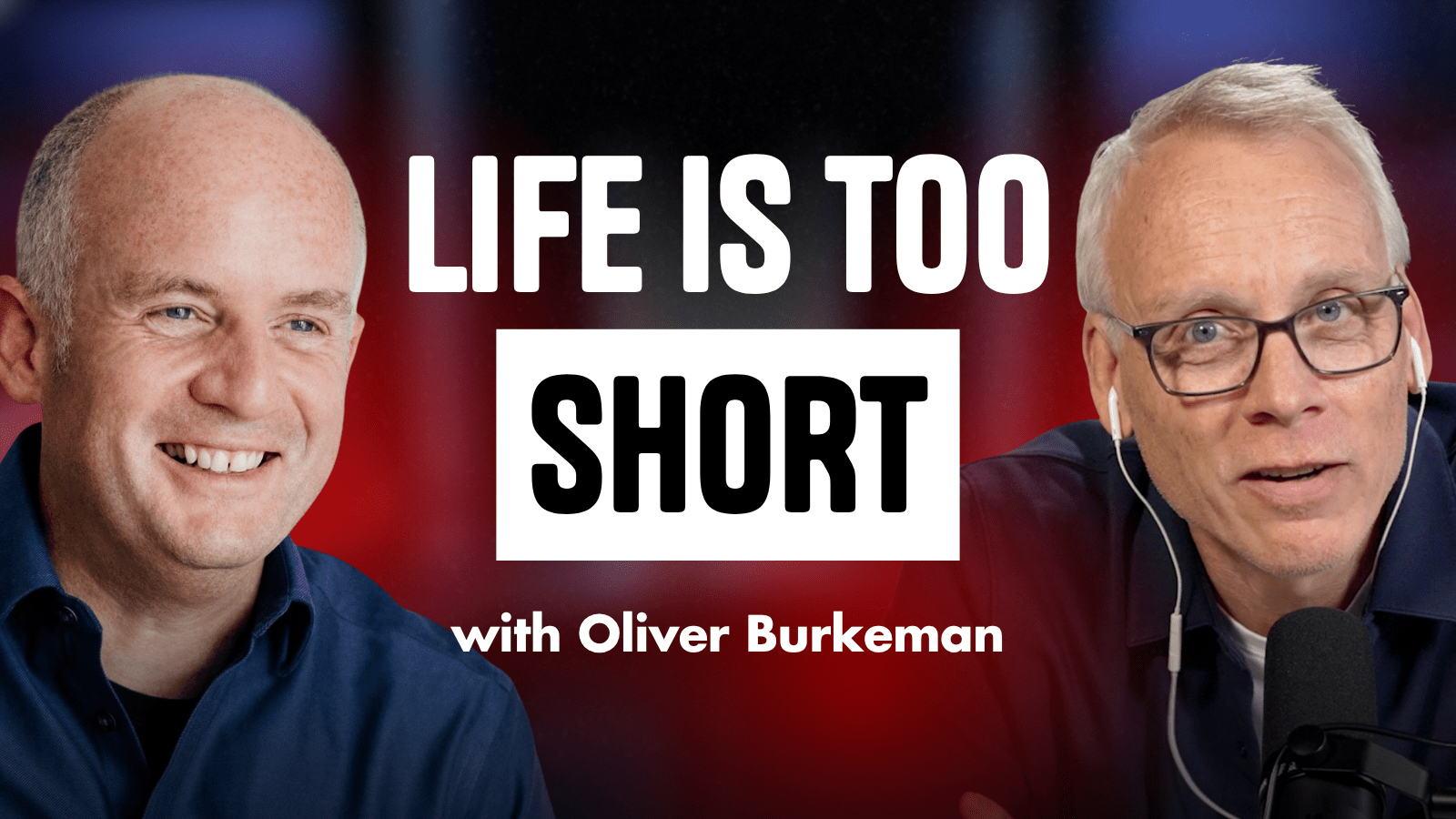
This week, I’m chatting with author Oliver Burkeman. He wrote a great book called Four Thousand Weeks. In the book, we’re specifically talking about is called Meditations for Mortals. It’s one of my favorite reads of the last two years.
And we’re gonna unpack some ideas on how we can balance our ambition without compromising our need to grow and do good work with, also, finding some acceptance for the fact that we have finite time and life is gonna be a little imperfect. It’s not a perfect answer for everyone, but we do point us down a path of maybe having a little less anxiety and a little bit more enjoyment in our pursuit of our best selves. I hope you enjoy this episode.
————————–
Jay Papasan:
I’m Jay Papasan. And this is The ONE Thing, your weekly guide to the simple steps that lead to extraordinary results.
———————————-
Jay Papasan:
Oliver, welcome to The ONE Thing podcast. I’m so happy to have you.
Oliver Burkeman:
I’m happy to be here. Thanks for inviting me.
Jay Papasan:
I know a lot of people who in their career might write one book, and you’ve managed to write four that I know of. You’ve been a columnist for some big papers. You write a newsletter. A lot of people would say, “Wow, that’s a very productive life.” Yet, a lot of what you write about is about trying to find a balance between kind of extreme productivity and ambition and more of an accepting to that we’ve got this imperfect life. Where are you on that journey, and how are you doing it today?
Oliver Burkeman:
Imperfectly, I think would have to be the number one answer to that. I mean, obviously, and I think this is probably true for most people writing nonfiction, especially the kind of prescriptive nonfiction, as they call it, I write about it because I struggle with it, right? And it’s been my one of the sort of dramas of my life, I suppose, to try to figure out is there a way that I can rescue some idea of ambition because I’m somebody who wants to create cool things and hopefully have them reach a lot of people, hopefully have commercial success, all those other good things, but in such a way that it isn’t ultimately driven by anxiety, which I think it was for me for a big chunk of my earlier adulthood.
Do we have to choose between being just constantly unfulfilled and anxious and producing things as a result of that versus this image of the perfectly zen person just floating through life perfectly happily, but not doing anything cool. So, trying to reconcile that is a big part of the ideas that I’ve been pursuing. And not only do I think it’s possible. I think it is ultimately a more productive way to live with an acceptance and an awareness of the limitations that we have built into us as humans. But anyway, we can talk more about that. Yeah, that is the thing, the question.
Jay Papasan:
It’s also refreshing. I think the reason your books are resonating for a while now, everybody’s been striving to be their most efficient selves. A lot of productivity gurus out there talking about living the perfect morning. “I’m gonna cold plunge, I’m gonna read three books, I’m gonna journal, I’m gonna meditate all before the rest of the world’s up.” This kind of extreme where we’re competing with ourselves all the time, so everything gets measured, everything becomes its own form of competition.
And I shared with you before we started recording, I’ve been getting rid of some of my measurements. I stopped wearing an Apple Watch except when I need the timers on it.
Oliver Burkeman:
It’s funny because in a certain way I was never an optimizer in the sort of wearable computers mold. I certainly was an optimizer in the squeezing every moment of productive value out of my time mold. So, I guess, it all amounts to the same idea.
And what strikes you eventually when you pursue that avenue is, firstly, the question is what is this all for, right? What is the state to which you’re heading? What is it in service of? And I don’t think that collecting personal metrics can never be valuable in that way. Maybe you really do need to get your blood pressure to a particular healthy level, say. So, then, you need to measure it and you need to follow what’s happening to it.
Too easily, the idea sort of takes root, even if only unconsciously, that where we’re headed is to a kind of unlimited, omnipotent, perfect state where we could handle every single demand that was thrown at us, where we could pursue all the goals we feel passionate about while fulfilling all the things we feel as responsibilities on our shoulders, do it all in a state of sort of perfect constant happiness and high energy.
And right at the back of that, usually implicit, although there are one or two influences on the scene who make it explicit, to live forever, right? That’s what it is. It’s either to live forever or to be able to do an infinite amount in the time we do have, which is a kind of alternative version of living forever. And because those things are not actually open to us as finite humans, that’s gonna be a permanently restless, unfulfilled, anxiety-inducing quest where the meaning of life, the really real bit of life is always sometime in the future and never here and now.
Jay Papasan:
Very eloquent. And your optimization may not have been the same as mine or some of the people that I’m tracking, but I just think the tools evolve. Like now, I’m seeing a trend where people are going, “Well, with AI, I can do even more.” And so, every tool becomes a way instead of to reduce the amount of time we’re doing the work and free up more of our life to think and have space, it’s just to squeeze more in. So, like for me, the battle is how do we know when enough is enough?
Oliver Burkeman:
It is the question, isn’t it? And I think the AI point is really fascinating for all sorts of reasons but one of the phenomena that I’ve seen is people feeling bad about whether they’re using enough of the capacities of the AI that they have access to.
And in so, one or two cases, feeling bad about spending time with their family because aren’t there another 10 things they should be or 100,000 things they should have their AI agents be doing while they enjoy a family meal or something, right? So, this constant feeling of “There’s more I need to be doing to get to the state of enoughness,” and the more tools I have, the more and the sort of remit of my powers expands, the worse it gets because there’s more potential things that we could be doing.
I think at the end of the day, this idea of enough, it is something that is connected with self-worth, isn’t it? It’s a sort of an emotional and psychological thing that we have to not shy away from. I think that for most of us, certainly the people who fall into this bucket that psychologists call insecure overachievers, people who like getting loads done in the world but fundamentally doing that out of the motive to fill in a void or feel okay about themselves at last or something like that. Sorry.
Jay Papasan:
Speaking for a friend, I think a lot of our listeners just felt seen. Okay. I think they just felt seen.
Oliver Burkeman:
Yeah, yeah, yeah. And I’ve been in public events and stuff like that, and I really see the recognition with that phrase. Me too, obviously, right? It’s “Oh, yeah.” On some level, this is a feeling that you don’t quite have the right to be here, to stand on your two feet on the earth unless you are continuing to meet or exceed certain standards.
And so, you get that terrible thing – familiar I’m sure to you and to plenty of people listening or watching this – that when you succeed at something, after the sort of 10 minutes of celebration having succeeded at it, it just becomes the new minimum baseline that you have to reach the next time around.
Jay Papasan:
I’ll take it a step further. When I cross the finish line, my first instinct is a sense of relief, not jubilation. It’s like, “Ah, I didn’t mess it up. Oh, wait, I won.” And I’m like, “How twisted is that I’ve got these crazy expectations, but also this sense of, am I good enough? Can I do it?” And I’m sure some of that gives us some of the drive, so we don’t want it to completely go away, but it’s not necessarily the healthiest drive.
Oliver Burkeman:
Yeah. No, exactly. Well said. And I just think there is… again, I’m imperfect at this. I don’t claim to have nailed it, but there is a way of being in the world where you do feel that you’re okay as you are, that you’ve made a contribution or even if you haven’t, you get the right to be here and live your life and enjoy yourself.
And from that place of okayness, of course, you wanna do loads of things and excel at them because that’s just a more interesting way of living in the world. You do it as an expression of feeling like you’re enough rather than as a desperate attempt to get to the place where you feel like enough. I mean, yeah.
Jay Papasan:
Well said. Well said.
Oliver Burkeman:
I totally still fall into this trap, right? It’s like books especially, partly, ’cause they have this sort of big cultural status, and there’s a lot riding on them, and they take longer, and at the beginning anyway, there’s less deadline pressure. It’s very easy for me. You know, I’ll write a book proposal, and I’ll sell the proposal to a publisher, and they’re paying money because they are pretty confident that what I already do when I sit down and write a book is a saleable thing. But in my mind, it very swiftly becomes like, “Oh, now, my editor, who’s really on some weird level my internalized father or mother or something,” right?
It’s setting this test. It’s like, can you do something better than you’ve ever done before? In which case… And of course, this is not how it works. These people are running a business. And so, there’s this constant need to remind oneself that you’re doing the things you do, and you’ve got to the place you’ve got in your career because you do them well. Because what comes naturally to you is something that people value. It’s not the case. You don’t need to think of the next moment of life always as some sort of unprecedented test that finally, at last, you’re gonna fail and everything’s gonna crumble around you.
Jay Papasan:
I see a lot of people that are, I think in your various writing, you’ve called this the efficiency trap. Like, there’s different words I can put to it, but this sense of you’re striving for this thing, and I will finally be enough when, right? I will be happy when… We make a lot of what should be unconditional conditional on our performance.
And so, in our conversations with our coaching clients, a lot of times we hear the word should or I need to. “Oh, I really need to do that,” or, “I should do that.” That’s what you were talking about with AI. People now have this amazing tool, and it’s just adding to the guilt of what’s not being done because, now, there’s this potential for even more being done. And at some point, I think we have to make peace with the fact, and you very eloquently… I really encourage people to read “Meditations for Mortals.” And time is finite. The options for what we could do is infinite. And the moment we realize that we’re not gonna do it all, we can’t have it all, we can’t know it all, we get to make better choices with our time.
Oliver Burkeman:
The subject of artificial intelligence is so many subjects. As someone who primarily makes his money writing, I’m part of a whole debate about the use of generative AI in writing. I keep an eye on the arguments that the whole Doomer arguments about whether this is going to destroy the whole of human civilization. And then, there’s the kind of job replacement. There’s so many different things going on.
And I think it would be fair to say that I’m, broadly speaking, a curmudgeonly-old-man-yells-at -cloud person when it comes to most of this. I do not use LLMs in any part of my writing process unless you count search engines that are partly AI powered. Obviously, to some extent, you can’t avoid it but-
Jay Papasan:
It’s baked into a lot of what we do, whether we choose it or not.
Oliver Burkeman:
The thing that I guess was lighting me up then is that it seems to me to be a… And other people have. I’m not unique in noticing this, but it’s such a good illustration of this idea of the efficiency trap. Parkinson’s law, the Jevons paradox has been making a big new appearance on the scene. As a general rule, if you make any system more efficient, including your own personal productivity system of yourself, in your work, all else being equal, more and more inputs will flood into the system.
It’s like the classic thing about how when they widen freeways to ease congestion, and then the road becomes more attractive to more drivers. So, the congestion-
Jay Papasan:
It gets more congested.
Oliver Burkeman:
It tends back towards what it was to begin with. And we all know this from email, right? You decide to get on top of your email ’cause you’re so underwater, so you start answering at a much faster tempo, and then you get loads more replies. And before you know it, email’s taking over your life even more than it was before instead of less.
And yeah, putting aside all sorts of debates we could be having about how effective or useful AI is in this or that domain, even just assuming that it’s gonna be aiding your output, there’s just no reason to believe that this same problem isn’t going to recur in an extreme way. If you use it to offload all sorts of things that you don’t need a human to do so that you can focus on the unique, distinct things that a human can do, then all else being equal, you’re going to find yourself under more pressure than ever to do more and more of those of those human things.
And yeah, if you use it to just take care of admin in that way, the amount of bandwidth that you free up is going to be the amount of bandwidth that gets newly filled because we live in a world of infinite inputs and a sort of competitive economic environment where anyone who can do more and more of those value-creating tasks will feel the pressure to do more and more of them just to stay afloat.
Jay Papasan:
It’s a different kind of rat race.
Oliver Burkeman:
Right. It’s never gonna lead to peace and serenity.
Jay Papasan:
No, no. And if that’s even the destination that people want… we’ll have to go to a quick break. And then, on the other side, I want to pick this up. But there’s a quote by Ian Simkins that we’ve used and shared on this podcast before: “If busyness is your drug, rest will feel like stress.” So, I think, a lot of people, their default is always additive. They want to do more. And so, they’re adopting all of these techniques, this system, this hack, whatever it is, technology, to just do more.
And if you actually allow them to pause, right? Go watch some people in a DMV waiting room, being still is almost impossible. You don’t ever see someone just sitting there experiencing life. They have to be flipping through something, scrolling on their phone. There’s this sense of doing that has to happen.
So, let’s take a quick break, and then we’ll dive into some of those, ’cause I want to get… I think we’ve defined the challenge that we’re all facing right now, and that a lot of us that are reading your books feel maybe we can start on the flip side offering a few solutions for people to maybe take a step back, give themselves permission to pause. So, let’s take a quick break, and we’ll pick it up on the other side.
———————
Jay Papasan:
As we opened up, we talked about your journey. I shared that your journey reflects some of my journey, that people who fall for this efficiency trap, where we’re optimizing our lives in lots of different ways, we can get into kind of a hamster wheel that has no finish line. So, a lot of what I found in your book, you give us permission, a lot of permissions in Meditations for Mortals, to maybe take a different approach one thing at a time.
So, if you had a loved one who was caught in the busyness trap, where would you point them first? What would be one of the first things we can do to maybe start easing the pressure on ourselves to constantly be chasing, chasing, chasing?
Oliver Burkeman:
I think the very first thing I’d want to say, and I promise to speak in practical takeaway terms as well, but I think the very first thing I’d want to say is there’s a particular kind of feeling that comes with slowing down, that comes with facing the limitations of how much you can be doing, that comes with working sequentially instead of keeping your mind on a million things at once, there’s a certain kind of uncomfortable, not really very painful, but there’s an uncomfortable feeling.
There’s a wonderful study that I’m sure some people in the audience will be familiar with where people were asked to sit in a room on their own for an extended period of time with nothing to do except a machine they could use to administer a mild electric shock to themselves, and finding out what proportion of people… to be fair, a much greater proportion of men than women, so go figure, but were so unwilling to just sit quietly for the duration that they would rather spend time giving themselves electric shocks.
There’s a feeling that comes with doing one thing and allowing the others to wait that comes with sitting on a park bench and watching the world go by, and actually resisting the urge to jump up that comes with doing things around the house and not listening to something at the same time. Sorry to make a slightly anti-podcast point here, but yeah. It’s so interesting-
Jay Papasan:
Someone right now is walking their dog going, “Don’t make me feel guilty.”
Oliver Burkeman:
But it’s so interestingly hard to do that. And that is also, you made the point before the break that if you’re wired for busyness, rest is gonna feel painful, difficult, like a kind of punishment, and it applies to that as well. There is this kind of scratchy, unpleasant feeling, which is to do with coming back to being finite and limited, and not distracting yourself into the idea that, actually, you can be all places at once and do all sorts of things at once.
And basically, anything that cultivates that feeling is the place to start. So, yes, that can absolutely mean setting a timer and doing simple, kind of, do-nothing meditation, as they call it for five minutes. What happens if you just stop and do nothing? And if you catch yourself doing something, just stop doing that thing and keep coming back to that.
But equally, ways of organizing your tasks. It was in Four Thousand Weeks, I give this very simple example of the open and closed to-do lists where you keep two lists. One has absolutely everything and anything that is on your plate. And then, another list with maybe five slots only, and you move items through from the long list to the short list, so you’re creating this bottleneck, and you can only focus on a few, and you have to get one done before you free up a slot to put a new thing on. That’s another example of this kind of feeling the friction of being finite.
And there are a hundred others that we could talk about, but they all work because they have this sense of coming back to reality even though it’s a little bit constraining to do so.
Jay Papasan:
I like how you added… I think a lot of people, doing nothing is in… If you’ve not practiced sitting in meditation or gotten any experience doing it, people are gonna get fidgets just like I did when I was a kid at church, right? I was gonna squirm in the pew, and I would constantly be getting in trouble. That’s just maybe in our nature to be doing something.
But monotasking is very uncomfortable for a lot of people. So, the idea of just being focused. So, maybe I’ll throw it out there, think of a time, if you’re listening to this, like what are some of the activities that you do that you actually get lost in? Is it reading a book? I know, for me, if I’m going for a walk in nature, when I’m fly fishing, those are things that for whatever reason, I just can get absorbed in and the stray thoughts go away. I think most people have at least one activity, hopefully not a video game, but maybe that’s it, where they are just wholly present and focused at least doing one thing. And I think, just getting a little practice in that zone, we can start to acclimate the other direction ’cause we spend all of our time in these frenzied states trying to check off as many things on our list versus doing the right things.
So, I’ll add that to the beginning. And then, I like your system. You have your long list. It can be as long as it wants but at any given time, you have to choose. We call that going from a to-do list to a success list. We just want people to prioritize it. And if you’ve read David Epstein’s new book, I like how he encourages people to make all of your commitments visible, right? Put them all on Post-it notes. And now, you look up and you’re like, “Wait, I’ve got 50 Post-it notes. Why did I say yes to all of these things?”
So, I think a lot of that, we’re FOMO or whatever, we’re committing and committing, but our commitments aren’t visible, which is why when we go to live our time, it all feels so scrunched and overlapping because we’ve actually unconsciously done all of these commitments.
Oliver Burkeman:
Yeah, and it all taps into the same basic thought, which is, what you’re actually cultivating or this is how I would put it anyway, what you’re actually cultivating is not so much motivation or discipline or something. It’s the tolerance of the anxiety of letting all the other things go undone for now. It’s the point at which you say these are the things that I’m gonna have to wait outside in the corridor before I let them into my, sort of, work space, it’s not ’cause I’ve figured out that they’re all unimportant. It’s not ’cause they wouldn’t be incredibly valuable things to do. It’s just because I’m finite and I’ve got to pick.
There’s a lovely quotation from Elizabeth Gilbert. I’m paraphrasing, but she makes the point that we hear all this stuff about the importance of saying no. We think that it means saying no to all things you don’t want to do, so that you can focus on the thing, or don’t really want to do so you can focus on the things you absolutely want to do. But in fact, it involves saying no to all sorts of things that you do absolutely want to do. And as you’ll know, the more successful you get in life, the worse this problem gets because the range of options, the more appealing is the range of options that are coming your way. So, it doesn’t get easier. It just gets harder.
Jay Papasan:
I think Derek Sivers, I heard him articulate that point on the Tim Ferriss podcast years ago, and he just said the more successful he got, every time he opened his inbox, there’s just opportunities being thrown at him every day. And he came to the conclusion if it wasn’t a hell yes, it was a hell no. He had to raise the bar for saying yes to something that just clicked every single box for him, and he had to come up with a process for letting things into his life because success will beget a lot more opportunities.
And there’s a lot of people listening, they’re just really good at work. They’re a productive person. Well, guess what? If your manager notices how productive you are, what’s gonna happen?
Oliver Burkeman:
Yeah, exactly.
Jay Papasan:
They’re gonna load you up, and you’re just gonna get more. And so, you have to come up with some boundaries at some point, healthy boundaries for where we’re going to invest our time and our focus and resources.
Oliver Burkeman:
And just quickly, what all these methods that we were discussing have in common as well? The way I see it is that they start with the boundary. They say, “How many hours do I have,” or, “How many items am I going to allow?” And then, you bring in the content. They don’t start by making a list of all the things that I need to do because that’s always going to be longer than is actually possible to accomplish. They start with the container, whether that’s temporal or something else, and then see what can fit in the container.
Jay Papasan:
You mentioned Parkinson’s law. Parkinson’s law is not actually a law, but I’ve written about it a lot. Where does that show up in your thoughts and your work?
Oliver Burkeman:
So, this is the so-called law that the work expands to fill the time available for its completion. And this is just another way of expressing this basic problem that efficiency pursued as the goal, optimization pursued as the goal will just leave you busier, more anxious, more stressed.
It’s not that you can’t try to optimize or be more efficient in respect to one or two carefully chosen other goals. But as a goal in itself, you’re endlessly approaching this thing that will just keep vanishing over the horizon, which is the state of being able to handle everything.
I think you make a really good point that the world is not set up to help us understand our own limitations and to set the boundaries because the basic promise of, you know, on some level all technology, but certainly digital technology, certainly internet technology, and absolutely certainly AI technology, is to hold out this promise that maybe now, with one last push, finally now, you’ve got this application or device or whatever it might be that, that is gonna get you over that hump.
And of course, what it always does is while it extends your reach over the world, it also effectively brings you more of the world to have to deal with. That’s the basic problem. You’re trying to get on top of things. You use technology to try to get on top of things, but technology also increases the size of the pile of things that you feel compelled to get on top of, so you never win.
Jay Papasan:
Our argument here at The ONE Thing is, also, as you increase the number of things that you’re trying to get done, you’re diluting your quality control, right? The more things that you’re trying to achieve in any given day, week, or month, the lower the overall quality’s going to be.
When I’m working with some of our people, I’ve said, “Let’s try to make Parkinson’s law be in our favor.” If it’s really important to you, like for me it’s writing, I assume writing is probably one of your number ones given what we both do, I try to give that an unreasonable amount of time. And for the things that I know are necessary but not gonna be ultimately part of my life goals, I’m not gonna be thinking about my inbox at the end of my life. I hope not. So, look, I’m gonna use very small compartments of time, and then I have to go in, and it’s like, “How much email can I do in the next 20 minutes?” And then, I get out because you don’t want to give yourself an open time block to do email, ’cause that’s a time machine that’ll take you to tomorrow if you’re not careful.
So, like, we try to use the containers. We do use that as a theme. Use big containers for the things that really, really matter because there’s magic in getting stuck for a long time, and then having to sit back and think, maybe take a walk around the room, and then that’s a lot of times where your biggest breakthroughs happen, right? Because you gave it maybe an unreasonable amount of time. That’s not being super efficient, but I do think we get to be more effective if we invest our time differently based on what it is we want to accomplish.
Oliver Burkeman:
So, let me ask you a question ’cause I’m fascinated. When you talk about these different sizes of blocks, to what extent is this something that you’re scheduling days or even longer in advance? And to what extent are you choosing them in the moment? See, I think there’s an interesting tension, and this is a sort of utterly friendly argument I’ve had with Cal Newport-
Jay Papasan:
Let’s have it. Let’s have it.
Oliver Burkeman:
… over the recent times, which is like I think it’s… I mean, I’m still experimenting, but I think it’s really important to have some space in your productivity system for the question, what do I feel like doing right now? Not necessarily to let it run the day always but there’s a problem with certain kinds of time-boxing approach – I want to argue. Certainly, it’s been my problem with trying to implement them – that nothing good comes of saying, “Oh, it’s 2:00 PM. I said I’d do this for the next 90 minutes. I absolutely do not feel in the right place to do this, so I’m just gonna have to force myself somehow to do it.” That is a bad recipe for the relationship between the parts of my psyche, right? I don’t wanna always be saying, “Oh, look, I’ve got this wonderful energy that would have me do X,” but no, I gotta squelch that energy and make sure I do Y because that’s what I planned earlier.
Jay Papasan:
I love that. And in our book, the kind of the ultimate minimalist is you would figure out what your number one thing was. There would be three things that you would try to always timeblock. First is your time off, actually. And then, when am I going to do my most important activity? Like for me, writing, I’ve got not a super strict but a loosely strict kind of I want it to feel like a ritual. It’s 8:00 AM. On this day, I know I have a good two to three-hour block where I can just be purely in my creative brain before the world comes to me. So, I try to have at least four to five of those on a week when I’m in writing mode. And if I can line them up, I can really get a lot going.
And the third big time block professionally would be planning time. So, I look up, usually, at a monthly level and sometimes at a weekly level, looking at my big things, those five things that you would say that I’m trying to fit and asking, when does it make sense for me to do them during this block of time? The month allows us like, “Well, I’m taking a vacation. So, it’s the summer. I’m not gonna get as many writing days ’cause we’re with family.”
So, that’s where I try to live. If you’re working at a corporation where your calendar is already pre-populated with lots of staff meetings and things, it can be more difficult to take control of your time. But the mistake I try to get people to avoid is blocking all of their time because they’re trying to live the perfect day on repeat, the perfect productivity day, where they’ll do this, and then they’ll transition, and they’ve given themselves 30 minutes for lunch.
And there’s a blooper reel that is going to happen every single day that will throw you off, not even getting to the fact that some days you’re gonna be like, “I don’t feel like doing that. I need to have space in my calendar to punt it to the next day or the next day if the inspiration to do it or the willingness just isn’t there,” right? I didn’t sleep well. We have a baby. You have to build more margin into your life when you have more variables.
Oliver Burkeman:
Yeah. Yeah. That’s nice. Yeah. That speaks to my sort of middle way, moderate soul, right? Yeah, yeah. A few important blocks and good, go easy with the others.
Jay Papasan:
Yeah. I was happy to argue a little bit. I would’ve been really curious to find out. I actually love finding out when I’m wrong, ’cause then I’m really learning something new.
Oliver Burkeman:
I have been through phases of experimenting with trying something much more intuitive. There’s a book I go singing the praises of in Meditations for Mortals and elsewhere called Time Surfing. It’s been re-released with the title I’ve Got Time by a Dutchman called Paul Lumens, who really, even he, I think, having talked to him since, wouldn’t say never time block. But it’s a very much more with the exception of calendared meetings or whatever, just decide intuitively moment to moment what to do.
And I really see, there’s something really true and good about that. It may not be the only thing that I want to be running my life by-
Jay Papasan:
There’s a lot of people squirming at the very thought of that, you realize. There are a lot of people like, “What? I’m supposed to feel my way forward with my heart, not my head?” What? It’s sacrilege.
Oliver Burkeman:
No, it’s difficult. And trust me, you are talking to an overthinking neurotic guy, but I’m on a journey, and it is a journey towards being more intuitive about these things. And I think it’s really worth the experiment. Like even if you decide to do it for three or four days just to see what happens, you may surprise yourself to the degree to which you don’t just spend your time, like, doing useless stuff and vegging out and eating potato chips, right? It’s like, actually, some of the sort of more daunting or even tedious tasks that you’ve been avoiding, it arises naturally that “Oh yeah, now is the time to do that thing.”
Jay Papasan:
All right. I will promise to you publicly that I will give that an effort, and I will give it a try. I’ve got some time off coming, and I can just feel my way forward a little bit. I think in Brad Stulberg’s book, The Way of Excellence, he’s been on our show, he has a whole section on a guy who makes his whole life random. And I just remember thinking, “That sounds completely crazy to use a randomizer for everything that you do.” And he was forcing himself out of his comfortable zone.
So, I connect those two thoughts. If I am used to thinking and leading with my head, can I feel my way forward? It might lead me to places I don’t often go, and I might discover new things that I truly love and want to do the same way that randomness could also help us in our lives.
Oliver Burkeman:
Just quickly, the real brain-bending thought is that even when you follow a more organized and scheduled day than this intuitive one you are still following your intuition from moment to moment, right? ‘Cause you’re intuitively deciding to stick with the program. So, it’s kind of a little scary how completely spontaneous life actually always is, even when we build these structures that seek to imply otherwise. Anyway, sorry, I’m just getting-
Jay Papasan:
Well, more often than not, it’s not the world that’s not sabotaging our plans, we’re self-sabotaging. And you’re just acknowledging the truth that a lot of times, we didn’t do the work we were supposed to do when we were supposed to do it because we just didn’t feel like it. But we come up with a lot of other reasons for how that could be.
I wanna give one more nod to, I didn’t catch the gentleman’s name on the feeling your way forward, but we’ve worked with a lot of folks that would self-classify as ADHD, and they know that they’re supposed to do something healthful every day. And one of the coaches that I got to interview, he said, “What I found very helpful is that I give myself freedom to choose between multiple things because maybe I wake up today and the idea of going to the gym, I can’t get my feet to start moving in that direction, but I could go out and walk the dog.” And so, giving himself permission to do a different activity or do it at a different time allowed him to more consistently do the things that he needed to do versus this one path forward.
And I think just as a big takeaway from your book, you’re just saying there is no one single way, right? We all will find our own path through this and find the balance that works for us.
Oliver Burkeman:
Yeah, and I love that idea of having a sort of a menu of things to pick from that would still fulfill the criterion because, yeah, again, it’s an expression of both our finite time. It’d be nice to do all of those things, but you’re not going to if you’re going to do other things in your life. And also, our finite control over our own moods, right? I mean, we come into each new moment with all sorts of emotional stuff going on that we don’t… It just arises, right? We don’t get to control it. So, I think that’s a great idea.
And there are other ways in which you can have that same kind of, yeah, I’m gonna pick from one of these three or four in that period of time.
Jay Papasan:
We’re just parenting ourselves like the toddlers we are, right?
Oliver Burkeman:
Yes, exactly.
Jay Papasan:
So, you have a choice. You can have the dinosaur nuggets or you can have this. They’re both choices I find acceptable but I’m gonna let you choose.
Oliver Burkeman:
It is exactly the toddler choice.
Jay Papasan:
So, we’re giving ourselves a little agency.
Oliver Burkeman:
Yeah. Would you like to wear the blue jacket or the red jacket when we go outside now? Because you’re wearing a jacket.
Jay Papasan:
But you’re wearing a jacket. Well, this has been delightful. I think I could ramble and ask curious questions all day long, but we do have to wrap these things up. If you could offer our listeners maybe one small step they could take, maybe, to find a more mortal approach to their productivity, what would maybe we could take from this episode and give them as a challenge?
Oliver Burkeman:
I was asked a similar question at an in-person event the other day, and I said something that I’m gonna say now ’cause I kinda liked it the way it came out. And this is to subvert the question, right? Because I think that when people have that desire for something to do, often it’s the yearning for one daily habit or something that could really put stuff in place to make this all go differently. And there’s a sort of a desire in that for control that is not unrelated to this optimizing and efficiency, right? This sense of “Okay, I’m gonna do this one thing as part of my morning routine,” or whatever it might be.
So, what I wanna say is the one thing, while we’re talking about one things, is to pick something to pick an activity that you know you want your finite time on the planet to have more of. Maybe it’s one of the things you envisage doing 20 years from now when you’ve finally got on top of everything, or finally retired, or finally achieved financial security or whatever. Or maybe it’s a work project that you’re excited to get into, but only after you’ve got all this other stuff out of the way or whatever. Some aspect of your social life, anything. And actually do 10 minutes of something that speaks directly to that in the next 24 hours.
Jay Papasan:
That’s cool.
Oliver Burkeman:
Right. By the way, I fall into this trap all the time, but it’s not deciding to meditate ’cause you’ve heard that meditation is great, so you’re gonna go and buy a book, and you maybe take a course. It’s like, no. It’s like, look up the 200-word instruction and just actually do it today, probably badly or go for a run if that’s the kind of thing that you’re working on. Or if it’s reach out to a friend.
So, if you feel like your social life should be better than it is, it’s very tempting to try to implement a plan or tell yourself that every day you’re going to reach out to a person or something like that. None of this stuff over longer time horizons. What’s the thing you’re gonna do today and actually do? And I think just that gesture of actually doing, that’s just absolutely golden. It’ll get you all the way.
Jay Papasan:
Let me see if I can put that on a bumper sticker for folks. That thing that you’ve been putting off, that thing that you haven’t given yourself permission to do, that thing you’ve felt like you haven’t earned the right to do, just go take 10 minutes and start actually doing it. Try to do that in the next 24 hours, and see what that experience feels like. Even doing it badly might be really exciting.
Oliver Burkeman:
Right. And with no sense that you’re now gonna be doing it for 10 minutes every day for the rest of your life or anything like that. Just the doing.
Jay Papasan:
It’s not another rigid rule.
Oliver Burkeman:
Exactly.
Jay Papasan:
That would be very off-brand for you.
Oliver Burkeman:
Exactly.
Jay Papasan:
Oliver, thanks so much for pouring into us. I hope someday when you’re either Stateside or I’m over in the UK, I can buy you a cup of coffee. I’ve really enjoyed talking to you.
Oliver Burkeman:
I would love that. Thank you. I’ve enjoyed the conversation.
—————————
Disclaimer:
This podcast is for general informational purposes only. The views, thoughts, and opinions of the guest represent those of the guest and not ProduKtive or Keller Williams Realty LLC and their affiliates and should not be construed as financial, economic, legal, tax, or other advice. This podcast is provided without any warranty or guarantee of its accuracy, completeness, timeliness, or results from using the information.