Jay Papasan:
In this episode, I’m gonna try to make the case for you, the busy leader, the busy entrepreneur, the busy founder, to set aside your phone, maybe close the spreadsheet, put down that business book that everybody told you that you really had to read, and maybe pick up a piece of fiction.
And I’m gonna break it into three parts. We’re gonna talk about why I don’t think business people read much fiction anymore, why people don’t do it in general, why you should, how it’s actually a secret edge to being a business person. And finally, if you stick around to the end, I’m gonna share 10 of my favorite books, fiction books, that I recommend to entrepreneurs that, sometimes, get them hooked on reading a little bit of fiction too.
Even though I’m a nonfiction author, I’ve written all nonfiction books, I shouldn’t be making this case, I’m hopefully gonna make the case for you to read a little bit more fiction, or if you don’t read any, read some.
——————–
Jay Papasan:
I’m Jay Papasan. And this is The ONE Thing, your weekly guide to the simple steps that lead to extraordinary results.
——————–
Jay Papasan:
Let’s start with the case for not reading fiction. And what you hear again and again is that serious people read serious books. And I get it. We need to read nonfiction. I think that’s how we learn, that’s how we grow, it’s how we learn about the world. Business books, biographies, you name it, there’s a great endless source of knowledge in every library near us.
But at the same time, there’s this other thing called fiction. So, I hear again and again, like they’re business people, they wouldn’t be caught dead reading a fiction book. I’ve even heard some people tell me they read fiction like they’re embarrassed to admit it. And I have no idea where this came about, but I think it’s kind of baloney. I can’t profess to tell you exactly when the stigma around non-serious books started to show up with business people. Maybe it was in the ’80s with all the Gordon Gekko “I’m gonna be Wall Street. I’m gonna be serious.”
But I’ve also seen a lot of people, you’ll walk into their room and their house, and the few books they have will be business books. And I’ll pick ’em up and look at ’em, and I can tell you they haven’t been read. I think there’s actually as much performative reading of some of these business books because they’re not always easy to read.
That’s one of the reason that Malcolm Gladwell was so popular is he taught through stories. Like, all of his books open up with a just banger story that gives you the big idea, and that’s what people talked about. Why? Because story sticks. But somewhere along the way, maybe it was about hustle culture, I don’t know, people thought that if I’m gonna be a serious business person, I need to read serious books.
‘Cause I’m in business books. I’ve been in business books since the mid-’90s. I’ve been a part of three million-copy bestsellers, and here’s the secret: Some of the best-selling business books are actually business books wrapped in fiction. They call them business fables. It’s a whole category. And guess what? They’re some of the most popular business books that have ever been written. But you can call it a business book. It’s just really fiction.
So The Goal Giver, The Phoenix Project, The Energy Bus, The Traveler’s Gift, these are all million-copy bestsellers. These publishers look up and they realize business people want to read things and learn, but they want it to be fun too. They want it to be something that’s a little bit less intense, that doesn’t have footnotes, that doesn’t feel so highbrow, that doesn’t take so much dadgum focus and energy.
But if you really wanna roll it back, stories is the original learning technology. You can go all the way back to the oral tradition. How did people learn? They told stories. They told stories. A lot of our religious stories are just that. They’re meant to be learning lessons, but they’re wrapped in a story. You go back to Aesop’s Fables, The Brothers Grimm. How were they teaching us these important lessons? They were wrapping them up in a story, a fable, or a parable.
That’s one of the reasons this is our original teaching technology. Tell me a story. Let me infer the lesson. It also gives us distance. It’s not someone telling you what to think. You get to inhabit someone else’s thinking, so we get a little safe distance. And a lot of the original ones, the fables, Aesop and Brothers Grimm, you have animals actually playing the parts. So, we get even more safe distance. It’s not really to us, about us. We don’t have to feel like we’ve been labeled when someone tells us a story of the dog who lost his bone because he was staring at his reflection. Well, there’s a moral to that, and we learn it safely through story.
So, going all the way back to the beginning of civilization, this is how we’ve learned, . And why did we decide in the last, I don’t know, fifty, one hundred years, that serious people don’t read stories? I think that’s BS. I think that serious people will embrace the lessons wherever they come from, and they’ll also understand that there are a lot more benefits to reading fiction than just learning.
I think that reading is absolutely good for everyone. I think that what we read does matter. So, let’s take a few minutes and talk about the benefits, not just of reading but, as specifically, how do we actually benefit when we read fiction and how does that serve us as business people?
There’s a bunch of studies, and we can link to them in the show notes, but there was a Yale study, over 3600 people happened over 12 years. It’s a huge study, and they were looking at mortality rates. And one of the things they were correlating was against reading. And they saw a 20% reduction in mortality rates when people read. And that was both fiction and nonfiction, just to be completely transparent, but reading in itself is a healthy endeavor.
But there was a 14-year longitudinal study in the International Psychogeriatrics. We’re digging not even that deep, but it’s almost 2000 adults, and they were all older, 64 plus. Weekly readers showed a lower risk of cognitive decline. In an age where everybody knows somebody with an older parent with dementia, like, how do we keep our brains healthy? Well, guess what? Reading is a big part of that. It is like brain exercise that doesn’t feel like you’re working your brain. It has all of these benefits.
And I could just go study after study, and you’ve probably seen them, you probably scrolled past them when you were on your phone instead of reading, they talk about how it lowers your stress, it gives you better sleep, and here’s the big one: it vastly increases your vocabulary. And if you wanna look at the thing that correlates highest to IQ, look at someone’s vocabulary. The people with the highest IQs tend to be the people who have the largest number of words that they can pull from. They communicate better. It’s just one of those things that correlates very highly. It’s not causative. But let me tell you, you will be smarter and more informed.
So, fiction for me has always been where my mind goes to unwind. I can do it with TV shows too. I can do it with movies. My business brain doesn’t really engage when I’m reading fiction or watching a show, but fiction is different than watching a show.
Here’s a huge one. In an age where we cannot focus at all, one of the coolest things about reading books and actually staying engaged with them, we extend our focus time. There has been a study after study where they are looking at how long people can focus, and you can go back just a decade, and people couldn’t focus without looking at a phone or something for less than three minutes. That’s now close to a minute, folks. It’s just getting shorter and shorter as our digital attention just gets turned into a goldfish, right? We have no ability to do it. Well, books extends it actively while giving us a better vocabulary.
And you look up, and there’s this really cool thing. Reading stories activates neural representations of visual and motor experiences. I had to read the title. It’s a 2009 study. It’s been replicated widely. When you’re reading about a character that’s running through the forest and dodging tree limbs, the parts in your brain that activate are exactly the parts of your brain that would be active if you were running through the forest. So, it’s cool. If you watch it on a TV show, it happens too. But what’s great about your child or you as you’re reading about it, your brain has to become the camera person. Your brain has to become the cinematographer. You’re actually engaging your imagination so that you can see the story too.
This is all really helpful for our brain health. It’s really helpful for our focus. Hey, what are we about here at The ONE Thing? Focus, folks. If you struggle to focus, learning to read and get lost in books is one of the ways that you can expand your attention span. Boom, right there would be reason number one.
You go farther than that, though. Fiction specifically ties to empathy. Does empathy matter? I think it does. There’s some pretty famous people that think empathy is for the weak, and I have no time for them. I think empathy is incredibly important for business. If you can put yourself in another person’s shoes, you can understand your customer experience. If you can empathize with them, you know what their objections might be. You can then know how to better position the value you offer as a business person ’cause you could see it from their point of view.
So, purely just from a business standpoint, if I can raise my empathy there’s lots of studies that say you can through reading fiction specifically. So, there was a great one in the Journal of Research in Personality 2006. Fiction highly correlates with empathy and social ability. Hey, both of those are important in business, don’t you think? Kieran Castano, 2013 in Science, also wrote “Literary fiction improved theory of mind performance or an individual’s objective capacity to infer the mental states and feelings of others.” Basically empathy, folks.
If you can walk a mile in someone else’s shoes, you are a better business person ’cause you know how to better serve them, you know how to better offer your products. And what do you actually do when you’re reading fiction? You are literally embodying the mind and the actions of another person, and your brain has to do all the work. It’s like little muscle memory for you. How do other people think? Read fiction, and you get to inhabit their thinking.
Non-fiction, like I said before, often tells us what to think. You don’t get this weird practice of seeing other viewpoints, crazy viewpoints, other genders, like in some science fiction, maybe another race. It changes our perspective on the world. That’s why it increases our empathy and our social abilities.
Now, I love this so much, but I’ll just go down to a pure basic. Why do I read fiction? I love it. When we talk about counterbalancing in The ONE Thing, if you’re gonna work really hard, you’re also gonna need to rest and relax. I kinda kicked this off with saying my business brain, which doesn’t turn off easily, it turns off when I’m reading a great work of fiction. I’m just there, I’m present, I’m in the story. Maybe I’m not sleeping as well because I wanna finish that chapter, and I’m staying up a little bit too late, but that’s a far better reason than binging some show on Netflix when I just go to bed not having really experienced anything super worthwhile, and I’m also sleep deprived.
So, counterbalancing, relieves stress. It actually is a place to relax if you make it there. And I’ll tell you, I think a lot of people when they say, “I don’t read fiction,” it may have nothing to do with the stigmas that we talked about. Maybe they’re just hung up on their high school experience when they had an English teacher that made them read, and I’ll put this in quote, “the classics.” And the classics are classics for a reason. They’re cultural touchstones. When they were written, they changed the world they were in, but they’re also hard.
I remember having to memorize The Canterbury Tales, the preface to it, “Whan that Aprille with his shoures soote, the droghte of March hath perced to the roote.” Like, how is that still in my brain? And why does it even matter? I don’t know, but some teacher thought it was a good exercise for us. If that was your experience, then maybe that’s the baggage you’re carrying around, and you just need to pick better fiction books that you actually can enjoy, and you could just relax on a Sunday afternoon with a good book, with no television, and maybe you could start role modeling it for your kids, too.
All right. For this last section, I’m gonna kinda lead you to where to start, but I’m gonna give you some rules before we do it, because if you’re diving into reading any kind, I’d like to have some boundaries for you, so that you just don’t go in there and think I’m not very good at this,” or, “I don’t enjoy it.”
So, first off, bridge to fiction based on what you already consume. So, nonfiction readers might like historical fiction, right? So, you could read historical fiction. They tend to be highly researched, so you’re reading about a certain period of time. And I love reading historical fiction when I’m traveling, right? When I went to Scotland, one of my friends gave me Outlander, and I thought, “Oh, isn’t that that kind of romance whatever?” And it’s actually a very seriously researched book. But I remember being on there with the tour guide driving us around, and I’d be like, “Oh, is that about the Jacobites?” He’s like, “Yeah, you’re really well informed.” How was I informed? I was reading a book of fiction that was well-researched historical fiction. By the way, that book is actually super entertaining. It’s not even on my list, but historical fiction, if you really are committed to nonfiction, might be a place to start.
So, maybe you love science, so maybe it’s science fiction. Like, how do you pick something that you’re already interested in but wrap it in pure fiction instead of nonfiction or whatever else it is you consume? So, that’s rule number one.
Number two, entertainment first. So, you’re gonna read stuff, and it’s purely okay for you to just enjoy the read. You don’t have to feel like you’re working. It is purely a leisure activity. It is something that you get to enjoy. Why I even have to say that, but I can tell you, I serve entrepreneurs in my coaching, we do it in our training, that feel they have to work and earn their rest. Guys, you’re working hard. You need to rest. That is how we grow. Your brain needs to relax and assimilate. So, this is number two rule, entertainment first. You’re just gonna have fun.
Number three, and this is a big one, and this is why I think a lot of people say, “I’m not a very good reader.” They haven’t given themselves permission to quit. The do not finish rule, like I developed this when I was an editor at Harper Collins. I worked with David Hershey. He was the vice president and executive editor. And every week I would get five to 10 full manuscripts, one-sided, double-spaced, from very, very powerful agents. And we were expected to read all of these books and make a judgment on them.
So, I had to figure out very quickly, how could I possibly have a life while doing a full-time job and reading five to 10 manuscripts a week? I came up with the five in 50 rule. And the five in 50 rule simply said, if this book isn’t good enough to make me interested in the first five pages, then I’m not reading any farther. And if I got through the first five, I would give it 50 to hook me, right? ‘Cause some books, it takes a little bit of time. They’re building the world. They’re trying to explain something complicated. So, if I got hooked a little bit in the first five, I would give it 50. If I still wasn’t into it after 50, it was a rejection letter every single time.
That was how I survived that period of time. I’m just gonna make it simple for you, you don’t have to read past fifty pages if you’re not enjoying the book. In today’s world, if you’re trying to become a fiction reader, we can find you something that will hook you in 50 pages. If this is not the book, set it aside and say, “I picked the wrong one.” It’s not the reading’s fault. It’s not that you’re a bad reader. It’s that you picked the wrong book. Especially in an age of short attention spans, they have to grab you, right? They have to grab you.
So, the do not finish rule, you don’t have to finish. Give it 50 pages. If you’re not into it, move on. You don’t have to confess it. You don’t have to talk to anybody. You just gotta pick up another book and try again.
And finally, just do it in small blocks. Most people who say, “Jay, how do you read almost fifty books every year?” I read it in small time blocks. I read 10-15minutes in the morning. I read another 30 or 40 minutes at night. I’m not sitting there for six hours straight reading a book. I have done that. I’ve lost whole rainy day Saturdays doing that, and those are some of my favorite days, getting lost in a book.
But that’s maybe not where you start. You can just start with saying, “I’m gonna read 10 or 15 pages.” And guess what? If the book’s good, you may look up and it’s 30 pages or it’s 40 pages, and you’re looking for a place to stop so you can go to work and do your life. But that’s the joy here.
So, just start small. You wanna make sure that you’re starting with what you already love, topics that you’re already interested in. It’s entertainment first. You don’t have to finish it, and just read in small blocks. So, those are my rules for you if you’re gonna play this game.
So, I’ll walk you through some of the fiction that I’ve recommended, and I just picked three categories of fiction. I picked sci-fi, historical fiction, and then just good general fiction. So, let me give you five fiction books that have been pretty much surefire winners.
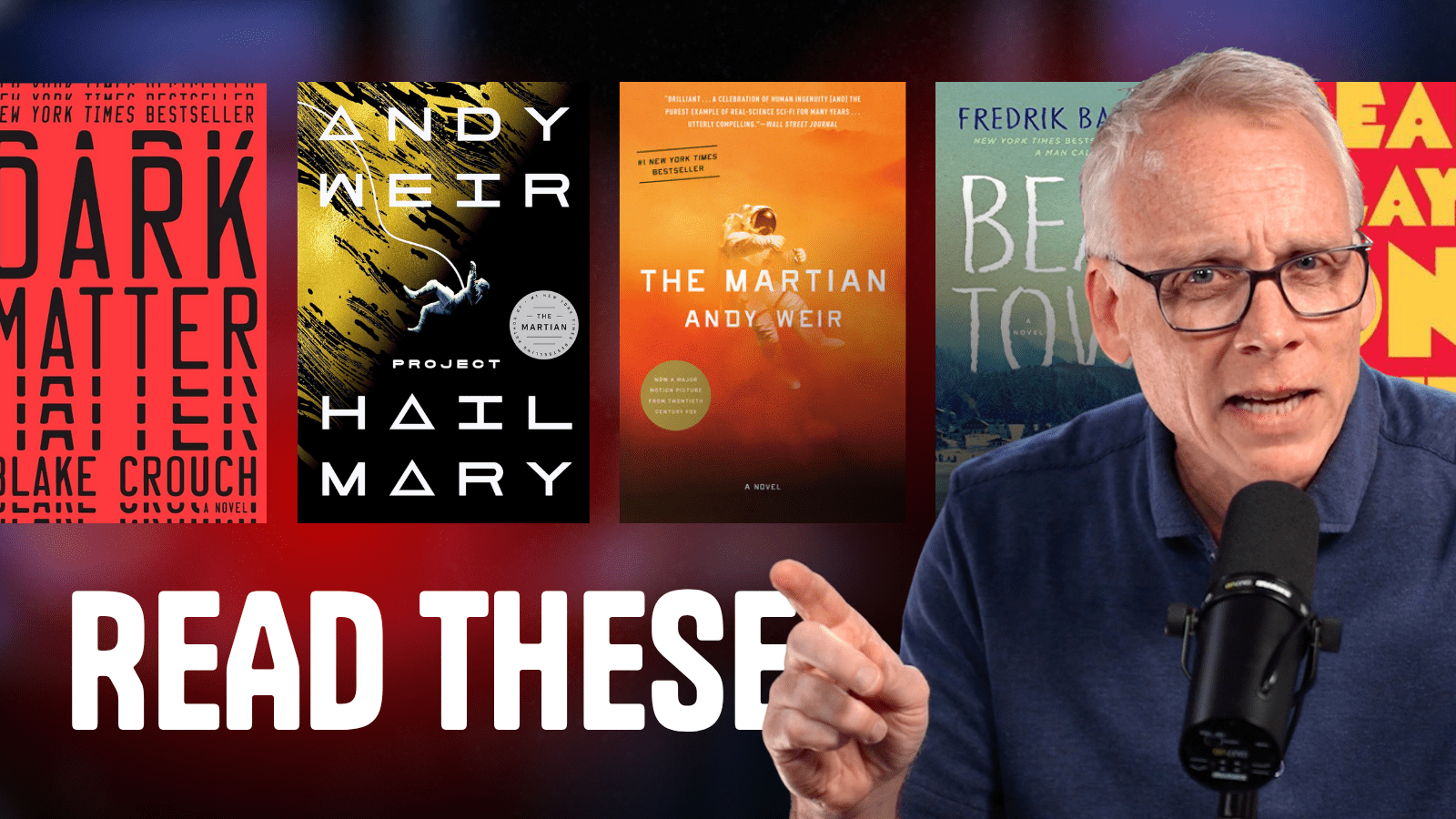
Number one, Dark Matter by Blake Crouch. It is one of his fastest reading books. It is a mind bender of a book. It’s got a little bit of time travel, all kinds of crazy stuff, and they even made it into a huge Apple TV show. That’s how good it was. Like, someone said, “Hey, I think we should bet four or five million dollars on turning this into a show.” That was because it was so widely read and so widely loved. I’ve given that book to dozens and dozens of entrepreneurs, and they’re like, “Wow, that’s the first fiction book I’ve read since high school.”
Two easy winners. You’ve probably seen the movie, The Martian or Project Hail Mary. Guess what? Both books are absolutely addictive. They’re based on hard science, and they are funny as heck. You can read those books a lot of times in a single weekend. And if you like science at all, both of them will absolutely entertain you from start to finish. Thank you, Andy Weir, for writing two amazing books, The Martian, Project Hail Mary.
Ernest Cline, who I had heard actually lived here in Austin and drove around in a DeLorean with a fake alien dummy in the passenger seat. Great science fiction. He wrote a book called Ready Player One. And it’s theoretically about a future where everyone spends a lot of their time in a simulated universe, right? Virtual reality. I remember recommending that to my partner, Gary Keller. He showed up after the weekend. I said, “Did you like it? What did you think?” He goes, “Jay, that’s the best business book I’ve read in ten years.” And I’m like, “What?” He goes, “It’s all about the technology. Like now I can see where all of this could be leading.”
Yeah, someday our classrooms could be a hundred percent virtual, right? You’ve got the best teacher in the world in front of you, no matter where you are. Maybe you’re wanting to tour the Grand Canyon, so we put on our headsets and our glasses, and we get to go there in virtual reality. And what he saw was all of this crappy technology that we see today, he saw where it could go, and he saw it through a very entertaining story that was also made into a blockbuster by Steven Spielberg.
So, the last one for sci-fi, Wool by Hugh Howey. This was a book he wrote online. It was a serial he published on Kindle, one chapter at a time. It blew up so big, publishers were offering him hundreds of thousands of dollars to claim the rights to this book. And I remember hearing him at South by Southwest talking about Wool, right? That’s being sold in these little chapters on Kindle, and some publisher had said, “We’ll offer you three hundred and fifty thousand.” And he’s like, “Dude, I made more than that last quarter from Kindle. Why would I sell the rights?” And he was like a pioneer because this book was so popular, and he sold just the hardcover and print rights and kept the electronic.
I remember thinking, “You’re my hero.” Wool? You’re like, “What is wool? W-O-O-L.” That’s what they based the hit TV show Silo on, which is now in its third season, and I think it’s got a hundred percent on Rotten Tomatoes. Go read it. It’s awesome, and it’s a great story with great characters. So, those are my five sci-fi books.
Historical fiction. This is for people who like, “I read biographies and I read serious books.” Well, great book by Steven Pressfield, who’s one of my favorite nonfiction auth-authors, he wrote a book called The Gates of Fire. And if you’ve heard of the Battle of Thermopylae, that’s where the 300 Spartans went down and had that epic battle that they made into the great movie. Well, guess what? He wrote a highly researched story of how that battle actually took place. It is absolutely compelling. You learn all about ancient Greece and Rome and the Babylonian Empire, but it all happens like secondarily, right? You just learn it through story. So, The Gates of Fire is one of my most recommended Steven Pressfield.
Kate Quinn, she is a monster in the historical fiction. She’s written so many books that you’ve heard of. My starting drug for her is called The Alice Network. Takes place in World War II. It is about a series of spies behind enemy lines. You learn all about what it was like to live in France back then when you were occupied by the Nazis, and it is absolutely a compelling story from start to finish. Loved it. Loved it and learned a lot.
Good fiction that’s easy to read would be my third category. I’m gonna give you three, and these are just some of my favorites. And again, if you don’t like them, read 30-40 pages. If you don’t like them, move on. Number one, Hemingway. Sorry, folks, I’m a writer. But For Whom the Bell Tolls, one of the most amazing stories out there. I love it. Great, great story, great characters, compelling from start to end. This guy was known as one of the greatest fiction writers of all time, and guess what? You think reading is hard? He wrote at a fourth-grade level. There’s not a single vocabulary word in this book that you won’t already know what it means. It is absolutely easy to read and fantastic. And then, you can tell people you actually read a classic.
Down River by John Hart. He’s a little-known literary author that kind of writes in this space between thrillers and murder mysteries and literary fiction. So, to me, this is what people who like really bad fiction, like the kind of serial stuff that people churn out in a month, I usually recommend this book ’cause it’s fundamentally a murder mystery set in the South, and it is absolutely beautifully written, but the story itself is actually compelling. It’s got the mystery element to it, what’s going to happen next? But it’s written fabulously well. That’s what I give to people to teach them, you don’t just have to read these, kind of, potboiler mysteries and thrillers. There’s actually really good ones in this space, too, that will make you appreciate language more than you’d possibly imagine.
And finally, lastly, a book that surprised the heck out of me. About four years ago, my assistant, Carly, gave me a book called Beartown by Fredrik Backman. And I looked at it, and it’s about a small hockey team in a nothing town in, I think, Norway. And I’m like, “Why did she think I would wanna read this book? I don’t follow hockey. I’m not into hockey.” Fredrik Backman, in this book paints a picture of small town life, kids growing up, parents dealing with issues. Every sentence is so real it gives me chills just talking about it.
He can make a whole character come alive in one sentence, and you’re like, “Oh, I knew that kid in high school,” or, “I knew that teacher,” or, “I had a coach like that.” He perfectly nails the human experience. He’s really one of the greatest writers of our time, and I just love everything he’s written now. But that would be my gateway drug into that.
So, there’s 10 books. Somewhere on that list, we’ll have them in the show notes for you, somewhere on that list is a winner for you if you think, “I just don’t read fiction,” one of those will be the one, I believe, that will hook you, and you’ll say, “Well, you know what? This isn’t so bad. Maybe I should read a little bit more fiction. I can get off my phone. I can stop streaming the shows at night, maybe be a better parent to my kids. Instead of just reading children’s book to them, they can walk into the living room and seeing me reading a novel for myself,” and maybe hook them and yourself at the same time.
So, I hope you’ve enjoyed it, but I’m gonna give you your challenge for the week. I want you, especially if you’re a rarely or never fiction reader, to take the challenge. Pick one of these books, or maybe someone who’s given you a book and sworn “This was written for you, man. You should read this,” pick it up. You only have to read 50 pages. Give it a try.
We have so many compelling reasons to have more story in our lives. I think it makes us better people. It makes us better humans. And if we can all get a little bit more empathy and can understand what it’s like to live in other people’s shoes, I think the world becomes a better place, too. I hope that you’ll take the challenge as a business person and start reading fiction after this episode.
So, folks, if you do take the challenge, here’s my request back to you. Let me know in the comments. I go in when we post these on social media, when we post it to YouTube. We check out the comments. Let us know which book you chose or if you have a better recommendation than the ones I’ve given. If you’re a fiction reader that hooks business people on fiction, share your recommendation in the comments. Maybe I’ll pick up my next read, too. Thanks.
———————————
Disclaimer:
This podcast is for general informational purposes only. The views, thoughts, and opinions of the guest represent those of the guest and not ProduKtive or Keller Williams Realty LLC and their affiliates and should not be construed as financial, economic, legal, tax, or other advice. This podcast is provided without any warranty or guarantee of its accuracy, completeness, timeliness, or results from using the information