Jay Papasan:
Hey, gang. This week, we’re talking to my friend Cyril, the author of Less Achieves More. And I’ve always been taught by my mentor, Gary Keller, be careful who we’re adopting models from. If you’re going to adopt models or approaches to your work or your life from someone, make sure they’re doing it at a high level.
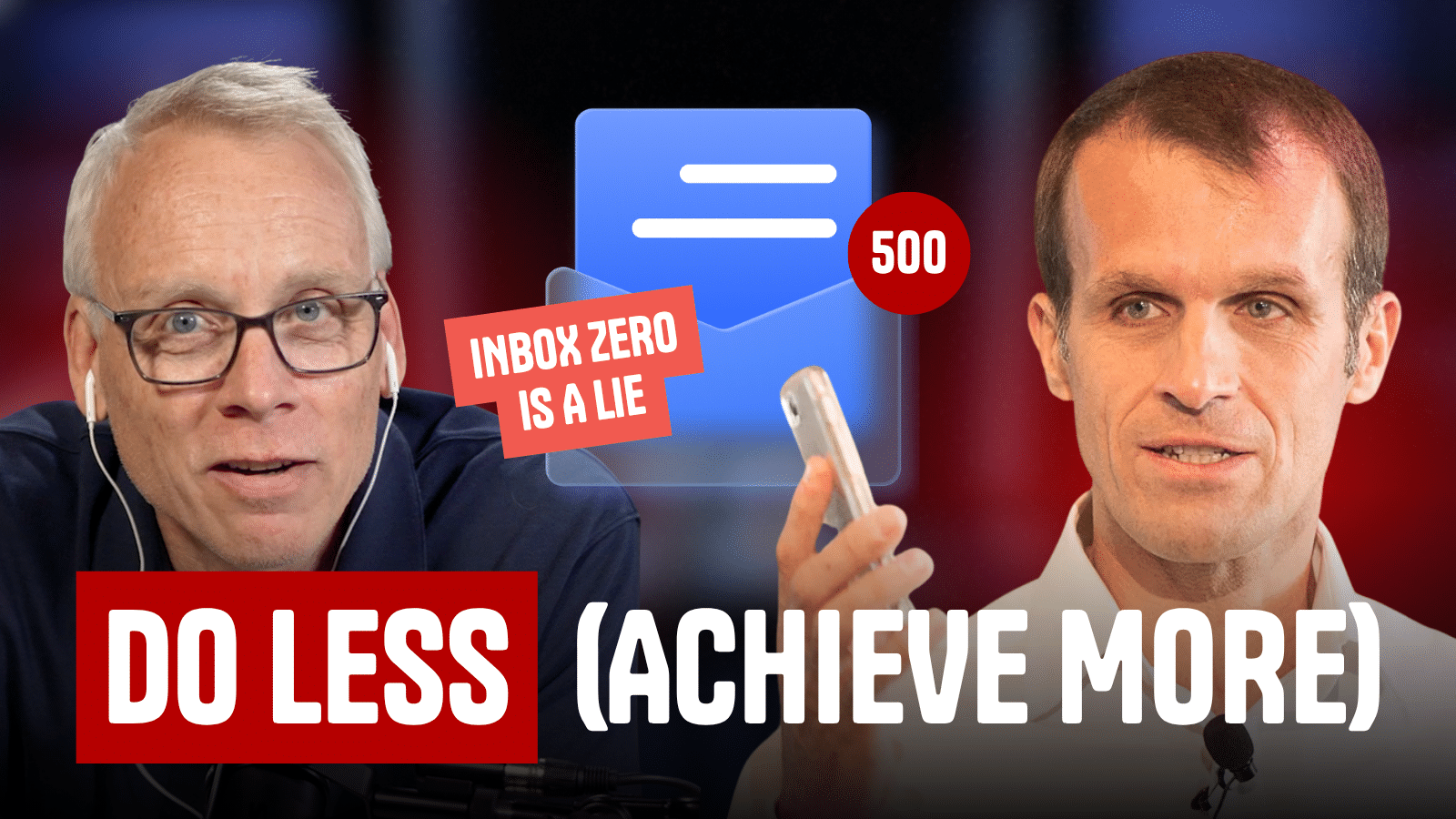
Cyril has been teaching people how to focus better and achieve more who are some of the busiest people on Earth. These are top executives in some of the biggest companies in the world, and they get five hundred emails a day. So, we’ll walk through his approach to helping people understand how the answer isn’t to do more and to work longer. It’s actually just subtract. Actually, by doing less, we’re going to be more effective, healthier, happier in all the things.
And then, we go deep in one area of how to do it. If you dread getting into your email, your DMs, and your social media, if communication is stealing your life, we will walk through some of the systems he helps these top leaders around the world to get an absolute handle on their communications, both internally and externally. There’s lots of practical takeaways in this episode. I hope you enjoy it.
——————————–
Jay Papasan:
I’m Jay Papasan. And this is The ONE Thing, your weekly guide to the simple steps that lead to extraordinary results.
——————————-
Jay Papasan:
Cyril, we’ve been friends for a while. I’m a fan of your book. I got to read it in draft form and in its newly published form. And we were just laughing before we started that our books, as we record this interview, are side by side, face out in Hudson’s bookstores in airports all across America. So, one, congratulations on writing a great book, and I’m excited to dive into an area our listeners love to hear about. Your book has got so many parallels to The ONE Thing, but I think you’ve taken it a whole different level because of the people you serve. Can you tell us a little bit about the companies and the people that you’ve helped become more productive?
Cyril Peupion:
First of all, a huge thank you for your help. You’ve been in the background helping me, criticizing, changing, and so on. So, massively helpful and so nice to see our two books sitting next to each other.
Jay Papasan:
Yes.
Cyril Peupion:
So, for 20 years, the world’s biggest company have hired me to teach their busiest executive how to get more done. It’s companies like the Boston Consulting Groups, where I work with the leaders literally across the world. Microsoft, American Express, even BHP, which is one of the biggest mining company in the world, ING. So, big company like that. And I’ve had the pleasure of training thousands of their leaders, and we’re talking in-depth training literally around the world. I’ve counted actually about 19 countries. I like to have a little pin where I’ve been. But so fascinating. And to see that all those leaders, whether you are a leader in the US or a leader of a large company in Australia or in France or in India, have exactly the same kind of problem in that area.
Jay Papasan:
And just for context, I was talking to a mutual friend. I get a lot of emails, right? I’ve owned several businesses, but I haven’t actually counted. But I probably get, I don’t know, if I look at all of my channels, 100 to 150 people trying to connect with me on a daily basis. The people you serve, and I’m trying to remember at the beginning of the book, you talk about between the Slack message, like they could be getting 500 inbound a day.
Cyril Peupion:
Indeed. And it has increased. It’s funny because we’re living in a world where the speed of everything is increasing. I mean, remember the time, Jay, you and I have a bit of gray hair, so we still remember the time where we would receive letters.
Jay Papasan:
Yes.
Cyril Peupion:
And then it moved to fax. And then, we started having emails. And then, at the beginning, email was fun. Still, I remember when email started appearing, everyone was excited. “Oh, we received an email,” three, four, five email a day. It’s been a very long time since I’ve ever heard anyone linking the word email and fun together.
Jay Papasan:
No. They don’t go together.
Cyril Peupion:
No. No, they absolutely don’t go together. People hate them. And then, on top of that, at least email we had a devil we knew. And now I see company and leaders getting email, Slack, Team, Trello, Asana. Yeah, you name it. WhatsApp, you name it, you have it. And they are completely swamped. And there’s this logic of I need to try to keep up on top of a lost battle, to be honest with you, because how can you manage 500, even more, messages, not even email anymore, message per day?
Jay Papasan:
I’ll add on to that. Actually, when I was preparing for this, I counted almost every week. I’m not as good on LinkedIn. I have at least eight inboxes, eight places… Oh gosh, I just realized I have three on Slack alone, so it’s more like 11. There are 11 different places that people have an open channel, and that’s before they would call me or text me.
So, it’s not just how many we’re getting. Also, it’s not like the old days, they all came to your mailbox, right? Your actual physical mailbox, right? You might have to go to the post office to get a big package. But now, it’s not just how many we’re getting and how fast they come, but it’s how many places we have to look just to stay on top.
Cyril Peupion:
100%. It’s like living in a house where you have to go in 11 different places to collect your mail. And even in one place like Slack. Now, Slack or Teams, people are using different channels. So, it’s one place where actually you have five, six, 10 different mailbox. The volume is completely crazy. And I see more and more people giving up. I mean, I keep a little tally of the worst inbox that I’ve seen. I think my gold medal had… sorry, I’ll start with the bronze. My bronze medal had about 50,000 read and unread emails left in inbox. My silver had about 80,000. And my gold medal had about 110,000 in them.
Jay Papasan:
I just glanced at my phone. I usually keep it out of sight, but you just made me challenge. I have 5,100 unread emails right now. And I was gonna say guess. I was like, I don’t wanna guess,” ’cause I know that in the last month, it’s been as high as 22,000. I’m not gonna try to be inbox zero. I’ve written about that. I think that’s a waste of time, for me at least. But it’s a Sisyphean battle, right? If you were to conquer your inbox, the moment you close it down, pat yourself on the back and go to bed, tomorrow, it starts all over again.
Cyril Peupion:
100%. And it’s a lost battle. I’m from Paris originally, and big city like Paris for years have tried to win the battle of the increase because you move from 5 million to 10 million to 50 millions. I mean, when I go to Asia and some of the city in Asia, a city with 10, 15, 20 millions is just very common. But the size of the city, it try to expand and expand, but it can’t keep up.
And so, for years, city like Paris have tried to win the battle. And I think they’ve understood that the only way to win the battle is almost to go the other way, which is the less achieve more, which is to say, I cannot keep up and check 500. Like, I’m gonna spend my whole day just responding to email, which for those top leaders that I work with is not where they bring the best value. And so, you almost have to have the reverse and accepting that I’m going to lose the battle, so I might not even fight the battle against that.
Jay Papasan:
So, the people you’re serving, they don’t have a choice. They might have an executive assistant if they’re lucky enough to be at a certain level in the organization. But you serve people that serve below that as well, like the whole leadership team. They don’t have an EA sitting outside their door to be a gatekeeper. We’ve acknowledged and set the size of the problem. It’s enormous. It’s not going away anytime soon. How do you get them to conquer the communication problem? How do you coach them to either be comfortable with the less-is-more approach or just being more focused in their approach? Where do you start with that?
Cyril Peupion:
I don’t address that first. I address that in the end. Let me explain the logic here. I think before you go into the tactics, you need to… And exactly what you have in The ONE Thing. They need to understand the mentality behind that.
Jay Papasan:
Okay.
Cyril Peupion:
And the mentality is we all, or a lot of us, have a bias for more.
Jay Papasan:
You write about… I’m trying to think. I’ve written it down. It’s Leidy Klotz’s research, the additive bias. So, yeah, educate us.
Cyril Peupion:
Leidy Klotz is a professor in a university in the US. So, imagine someone come to you and say, “Jay, I’ve designed a day for me to visit Sydney, and I’ve designed a day from 8:00 in the morning to 10:00 in the evening where I’m gonna try, Jay, to show you as much as I can of this wonderful city,” which is Sydney, for example. Okay. And the question I’m gonna ask you, Jay, is can you improve it?
This is what Leidy Klotz and his team did in Washington. They designed a day to visit Washington, DC. And on purpose, they did quite a busy day where you had to go to one thing and then visit another one and so on. So, it was a day where they tried to maximize the use of your time so you could make… You only had, Jay, one day in Washington, how can you make the most of it?
And the exercise is, give that day to as many people as possible with one question: Can you improve it? Okay. Guess what happened. 75% of people added more things to an already jam-packed day. And the research Leidy Klotz and his team did, they redid this experience in different format, and what they show is most of us have a bias for more. We think more is better. It’s engraved in us. It’s biological. I mean, when we’re living in the savanna and we were looking for food, we never knew when the next food would come, and so we gatherers. Look at our wardrobe, look at our inbox, look at all the things we store. It’s cultural. The bigger the empire has always won.
It’s even economical, Jay. Most company talk about growth. And so, we have engraved in us this logic that the more we do, the better it is. And actually, when you bring that to your workload, it’s the opposite that is true. The people that I…
So, I’ll take a very simple example. If you decide that you have 15 priorities, and you might say it’s a lot, I see that all the time. I remember last year working with an organization in Australia where they had about 250 people in the organization. I asked them to see their strategic plan for the year, and they had 45 page of initiative for 250 people. 45 page. Everyone had about 20 initiative that they were in charge of, if not more.
Jay Papasan:
When we talk about getting people on the same page, you would have to have microscopic typeface to make that happen. It’s impossible. You can’t get everybody on the same page for that many tasks.
Cyril Peupion:
So, imagine you’ve got 15 priority, 15 thing you need to lead. The amount of time you’re spending on each of them every week is so small because if I take five days of your week, I’m gonna tell you what’s gonna happen. One day is gone by checking email and messages, and I’m very nice in this if I accumulate. One day is taken by all the internal meeting and so on. One day is taken by all the crises. The amount of time you can really spend on your priority is much less than you think. Much less.
And so, if you only spend that time on 15 priorities, every week, you’re making so little incremental on the each of them that nothing happened. And so, it’s having the courage to say, “Performance is not about quantity. Performance is about quality.”
Jay Papasan:
Yes. Yes.
Cyril Peupion:
It’s about having the courage. Really fascinating story when Steve Jobs became the CEO of Apple. I find it fascinating where Steve Jobs created the first Macintosh with Steve Wozniak in the garage of their parents, grew Apple to be this big business, got kicked out of Apple, spent 10 years away from Apple. After 10 years, Apple is really struggling. They’re losing money every year. They are really… their revenue is down. They bring Steve Jobs first as a consultant and then a CEO.
If you read the biography, Steve Jobs come back at the head, and he suddenly say, “I’m a bit confused. We’ve got all this research, we’ve got all this project, we’ve got all this product. Can you try to explain me which product for which client?” And they have a chart, Jay, with the name of all the products with some arrow and the potential client behind that. And Steve Jobs is like, “A company where-“
Jay Papasan:
And they had 350 products when he came back?
Cyril Peupion:
100%.
Jay Papasan:
Yeah, a huge number.
Cyril Peupion:
350%. Huge number.
Jay Papasan:
I was old enough to be around then. They had printers. They had stuff that Apple had no business doing. They were just slapping their name on it.
Cyril Peupion:
What Steve Jobs does is he put everything in the mining room, they make some tough decision, and they cut from 350 to 10. And everyone is shouting, “He’s mad. He’s killing the business.” He’s not killing the business. He’s refocusing the business.
Jay Papasan:
Yes.
Cyril Peupion:
In a few years, the iMac, the iPod, the iPhone, the iPad, and he brings Apple to being the big success that it is today. What was the mantra? And so, to answer your question, Jay, this is what I’m trying to make people understand. What was the mantra of Steve Jobs? Forward. Focus mean saying no.
Jay Papasan:
“Every yes has to be defended by a thousand noes” is a quote I attribute to him.
Cyril Peupion:
I love it. When they were talking, the executive team were talking to the shareholders, and they were explaining their logic. And there’s a phrase that I really like from Steve Jobs and from Apple. They said, “Saying no to bad ideas is fairly easy. Saying no to good ideas is very hard. This is what you have to do every day to be successful.”
And so, to answer your question, this is the root behind everything, whether we’re talking about the priorities you take, the number of meeting you accept, or your communication, you need to understand that before you can really go in depths of managing all your communication. Does that make sense, Jay?
Jay Papasan:
Oh, totally. And I’ll jump, ’cause there’s some parts of your book that I underlined that if I could go back in time, have that research available, I would’ve totally added to ours. You have this additive bias. When we want to make anything better, our company bigger, we’re gonna just do more. We’re gonna have more products, we’re gonna do more things.
Instead of hearing that advice from Steve Jobs or from Less is More, they throw more hours at the problem. And one of the things that just stood out to me is you talked about there is a work hours tipping point that I know so many high achievers listening to this, when you share those numbers, if you can I’m putting you on the spot, I didn’t tell you, there’s a place where you go where more hours is hurting you, it’s not helping you. And I almost guarantee you so many of the people listening to this are running their own businesses. They’re blowing through that mark.
So, yes, I’m trying to do more, but before I’m gonna listen to you, Cyril, before I’m gonna do less is more, I’m just gonna do more work. I’m gonna work harder and longer. What is the work hour tipping point?
Cyril Peupion:
It’s between 40 and 50. Let’s say around the 50 hours is where, yes, if you work two hours a week versus working 20 hours a week, you will achieve more by 20 hours a week. There’s no question about that. But the tipping point is around the 45-50 hours, where the curve in term of number of hours versus performance/productivity start doing this.
Jay Papasan:
For those who are just listening, like it starts going down, right?
Cyril Peupion:
It start going down.
Jay Papasan:
Yes.
Cyril Peupion:
You start going down. And I remember working with this leader of a large global company, [Anna]. You know when you have one-on-one when you’re coaching?
Jay Papasan:
Yes.
Cyril Peupion:
They start open up about why they want to do the coaching, and Anna said in our first session something I will never forget. She said, “Cyril, I need you to coach me to work smarter, but to be honest with you and transparent between you and I, in six months, I will resign from my job.” And I was like, “Tell me.” And she said, “I love what I’m doing. I love my team. I love the people I’m working with. I love my clients. I love what I’m doing, but the price I’m paying is too high. I’ve got two young kids. I’m not seeing them. My husband is starting whinging about my crazy hours and traveling, and I’ve got some aging parents that needs me. I’ve tried to make it work and it doesn’t. And then, on top of that, I don’t exercise anymore and my health, sorry for my French, sucks.” And so, she said, “I’m gonna wait till bonus, and the only reason I want to work with you is so that in the next job I don’t avoid the same mistake.”
Jay Papasan:
I’ve heard versions of that. Anna’s story is all too common, especially among entrepreneurs. They’re trying so hard. They’re pushing so hard. They’re so afraid of disappointing themselves or their customers and their business. They’re disappointing their families. They’re disappointing the people that matter most in their lives. And I mean, you just see it all the time. There’s a parent, they’re at the soccer game, but they’re not really at the soccer game. They’re still at work. They’re on their Slack channel on their phone.
Cyril Peupion:
100%. Fast-forward six months. And so, I coached Anna. We worked together in depths about her ways of working. I respected her decision. So, fast-forward six months, I have this meeting with Anna, and she says, “Cyril, I have to tell you something. I have decided to stay in this business.” And then, she explained. She said, “This year will be my best year performance-wise. In six months, I’m already in my target for a year. I’ve smashed everything.” But she say, “I don’t work weekend anymore. I hardly work in the evening. I spend much more time with my parents, with my husband, my and our kids. And I love painting and piano, and I’ve started doing that again.”
Jay Papasan:
Wow.
Cyril Peupion:
And for me, Jay, this is the success.
Jay Papasan:
Yes.
Cyril Peupion:
A lot of people, exactly what you’re saying, a lot of those people, whether you’re an entrepreneur, whether you’re a big business leader, the people that I work with, they think it’s an either/or. I can either be a high performer or a great dad, great parents, a great husband, but it’s really hard to be both.
And what I’m trying to show them, not show them, what I work with them, is to show them that it’s not an either/or, it’s an and. You can get more done or achieve what you want to achieve and make it home on time for your family dinner and be the parents or the partner that you want to be. And I have seen that countless of time.
Jay Papasan:
I believe it. And I refuse to believe that there isn’t an approach out there, and that’s what you’re teaching them. Yes, you can do both, but you have to do a new approach. You have to approach the work differently to get the and instead of the or. But I refuse to believe there’s a world where we can’t be really successful at the office and at home. I believe that that exists, but it means that we can’t approach thing the way average people do. We have to choose a different path.
Cyril Peupion:
I love the quote, I think it’s Einstein, doing the same thing in the same way and expecting a different result. And this has been one of my surprise. This actually what you’re talking about is one of the seed that pushed me to launch Work Smarter: Live Better.
One of my first big job, I was the leader of a global company in France. And Jay, when you found the job that you love, the perfect job, and after three years in that job, I resigned. When I was in my mid-30, I became one of the leader for British Airways in France, and it was a dream job for me because I had done an engineering degree in aeronautical and mechanical, and then I had done an MBA. And so it was the meeting of both. I loved the job, I loved the people, and the perk. Oh my God. I was flying around the world nearly for free, business class, upgraded first class. It was a dream. I loved what I was doing, and I loved the environment. But then, it hit me. I had 14 direct report and I had so much to do. I discovered, Jay, that the joy of working with a large organization with number of email, and I was part of a leadership team in France, I was spending my life in meeting.
And my answer was exactly what you’re describing: working harder and harder. And I was living in Paris with my girlfriend, who since then has become my wife, TK. She had moved from England to live with me, and I was coming home late, I was stressed, I was taking work home. That’s not the life we wanted.
And the reason I’m saying that is because it really planted a seed in me, Jay. I had done one of the best education you can do in France. It’s called the Grandes écoles, and then the best MBA you can do in France. And in all my education, no one had ever taught me how to work.
Jay Papasan:
No. No. The approach to work is not something they teach you. It’s like you can learn how to open a bank account, but nobody teaches you about money either. The important stuff isn’t being taught there. It’s sad to say that.
Cyril Peupion:
It’s sad. Yesterday, I was doing a speech in front of… I had about 400 leaders of a large organization. So, I was doing an online speech to them and asked this question and said, “Did you learn how to work when you were in university and school and so on?” And everyone, I had the chat going, and it’s like “No, no, no no, never,” and so on, “No, no, no.” Most people, and that’s been my surprise, I was not alone.
And so, you’re right. I think it was Peter Drucker who said it beautifully. He said over all this career, working with executive on the logic of effectiveness, he had never found a naturally born effective executive. All the executive had to learn it and to practice it until it became a habit.
Jay Papasan:
And I’ll just throw it out there. You’re referencing one of my favorite books, The Effective Executive by Peter Drucker. And if you are a leader and that’s not on your shelf, it’s one to add to your reading list for sure. It’s a great… That man was a genius at helping people. He defined effectiveness is doing the right thing. It’s so much more powerful than being really efficient at the wrong thing.
Cyril Peupion:
I agree. I love his definition. Efficiency is doing things right. Effectiveness is doing the right things. It’s so simple and so clear, and he was spot on. And so, that’s why when we were talking in the beginning with email-
Jay Papasan:
Hold on. I’m gonna bring you back to emails. I’m gonna interrupt you ’cause I want you to… I’m gonna hit one point that you didn’t on the work effectiveness tipping point. So, you’re most effective in this 40 to 50-hour range. It starts to drop off after that. After 65 hours, it really does a nosedive.
And so, I just want people to hear that because I know so many people that are running their own business, maybe they’re in real estate sales, maybe they’re a leader, maybe they got a full-time job and they’re trying to start the next thing, and they’re trying to throw more hours of their life at the challenges instead of doing what we’re talking about, which is doing the right things, being effective, saying no to everything else. If they can learn that discipline, they can avoid all of the human life costs of working that hard that made you leave your dream job, that made Anna want to leave her dream job, right?
That goes away when we’re doing the right things and we learn how to identify them and ignore the rest. You don’t have to go way over that tipping point because now you’re a zombie at work. I am sorry. There is nobody that’s effective between their 65th and their 75th hour. But I’ve talked to people and worked with people in private equity.
I had a guy tell me the culture was so strong that you would work late. He would go into a bathroom stall, get a roll of toilet paper, and take tiny naps every two hours just so he could function.
Cyril Peupion:
It is crazy. And not only we’ve discussed about it doesn’t increase, it actually start decreasing your performance, but then we spoke about the impact it has on your personal life and your health, your family. It’s just mind-boggling on this one. I completely agree with you.
———————————-
Jay Papasan:
All right, so the core problem is we’re gonna try to throw more at every problem. We’re gonna try to have more products, more stops on the tour, more services. That’s how we grow. That’s how we get better. And when that stops working, wow, imagine that, 350 products, and Apple was mired in a death spiral. We throw more hours at it, and that doesn’t work either. All we’re doing now is burning us and everyone around us out.
I started with communication because that’s usually the thing that’s most visible to people. They’re not aware of all the jobs they’re doing that they’re not supposed to be doing, but they’re very aware of how much time they’re spending in their inboxes. So, to bring us all the way back, I just interrupted you, you’re about to go there. If you’re a leader, you’re told and taught communication’s important. If someone says, “But someone didn’t tell me,” or, “I didn’t know what to do,” these are all… 90% of the challenges in the office are around communication, so it is important. How do we balance this and do less is more with communications?
Cyril Peupion:
So, there is an individual level, there is a team level, and there is a company level.
Jay Papasan:
Okay, individual, team, and company levels. Let’s break it down.
Cyril Peupion:
At an individual level, the most simplest approach that I suggest, and I’ve written in detail in the book about it is when you check your emails, now that you have this mentality of less achieves more, now that you have this mentality that it’s not about quantity, it’s about quality, you look at your email, and for each email, you ask a really simple question: How long? That’s simple as this. Remembering, now, I explained to you why you have in the back of your mind that I’m trying to really do less. So how long?
And in my view, there are three answer to that question. There are some email that you can do or you should do really quickly. You could spend a lot of time, but you say, “Hey, a quick answer now is much better than a long answer never.” And so, “Jay needs some help on this one. I’m really busy today. I’m gonna give my first answer. It’s gonna take me two minutes. Done.” Okay? And so, my approach to all those email, whether the cut up is three, four, five minute, you decide, but it’s all those email you can do pretty quickly. Just the first time you look at it, you do that now, and then you just delete the email. If you want to file, I’m a big deleter. I delete 90% of the email I receive, but anyway, those done, out of your inbox.
The few email that you think are worth your time, and I explain on the few. Before I go in that, I do an exercise with the executive that I work with, and I say, “Look at your inbox and take the last 10 email you have received. And out of those 10 email, tell me honestly how many will truly have an impact long term on your performance? It’s a simple question. How many, if we were to talk in a year time, how many will really matter in a year time? And the answer I get, Jay, is one, zero, or zero point something. And I say, “That’s my point. 90% of what you’re receiving will have no impact long term on a performance, so you should spend no time on them.” Okay?
So, the one or the 0.1, the few… So, I’m ruthless with many email. Either delete, but there’s a huge difference between I’m not going to do it, that’s a decision, or I’m gonna leave in my inbox hoping I’ll find the time to do it, which never happen.
The few one that you really wanna spend time on, you don’t do them now, but you decide now when you’re gonna do it. So, in a very practical way, Jay, when I do my email, I actually open two window. There is my inbox window, and there’s my calendar window. And I look at, and I answer quick, delete, answer quick. Ah, this one I need to spend half an hour. And I actually drag and drop it into my calendar, and I block a time. It’s such an important concept. Book specific meeting with yourself. I block a time with myself to do it.
Now, again, imagine me telling that to this-
Jay Papasan:
Okay. Hold on. Time out. You just said something really significant. I’m gonna highlight it. I’ve heard you say this differently, and maybe this is from the book. When we talk about time blocking, time should be devoted to task. It’s not a big idea. People go, “I’m lead generating right now.” It’s like, no. That time block should be, “I’m gonna call these five specific customers and find out where they are in the buying cycle.” Because when it’s specific, we show up, we know what to do, and we can actually attack the actual activity versus wondering what we should do.
So, like, time is for task is what I remember learning from you, but it’s very specific. And you’re saying this block, 15 minutes or whatever, is for this specific email. That is incredibly precise.
Cyril Peupion:
If you look at my calendar, you would see over the next few weeks a lot of time protected for thinking time and so on. A lot of time. If you look at this week, you will see exactly what I need to do there.
Let me explain the logic behind that, and I call that you need to connect your task with your time. You need to connect task with your time. Let me explain that. I see some executive who try to be good at this, and they will go in their calendar and block me time or thinking time or work time. Let me tell you what happen. It’s Wednesday morning, 10 o’clock, and you see me time in your calendar. And you look at that and you’re like, “Ah, what am I gonna do?” And you, the back of mind, know that you got 300 email that is not resolved, and you have five urgency that has come to your desk. Game over. It’s finished.
I call that my logic is don’t try to be the general and the soldier at the same time. The general is the one who decide what you’re gonna do, when you’re gonna do it, do the planning. So, for me, the general, in my book I talk about think quarterly, plan weekly, act daily, the general is the one that every quarter decide the priorities, the big rocks. The general is the one, once a week, organize the calendar, book specific meeting with hisself. So, that at 10:00, you’re just a soldier. You look. I look at my calendar, and I see at 10:00, prepare the session for X, Y, Z, or write down the contract for, or blah, blah, blah. And I say, “Sir, yes, sir.” And I just execute. That’s all what I’m do.
If at 10:00 you try to be a general and a soldier, which is what you’re trying to do, you’ve got the dual soul, the the general who’s looking at everything you need to do and say, “I have half an hour there, and I need to say, I’m gonna do this, am I gonna do this? Am I gonna do this?” Game over. The urgency will take over.
It’s a very important concept here. I’m glad you’re pointing that out. Book very specific meeting with yourself.
Jay Papasan:
In communication. You’re gonna delete some of the emails. You’re gonna have your, I can knock this out super fast. I can just rapid fire, and then you’re gonna time block specific emails. Is that the three categories?
Cyril Peupion:
Three categories. I’m gonna make it very simple. Less than five minutes, whether it’s three, four, five minutes, whatever that is. Let’s say less than five minute, do it now, getting it out of the way there. More than 15 minute, schedule it now as a really specific meeting with yourself. When I use Outlook, I love this function. You can drag and drop. So, I take an email, I drop it into my calendar, and I know exactly what I need to do.
Jay Papasan:
Love that.
Cyril Peupion:
And then, you have the in-betweener, the 10-minute email. And they’re the worst. I hate those because if I start doing them now, in half an hour I’ve done three. But if I start blocking them in my calendar, that’s gonna have a lot of little things. So, what I do with those specifically is I really challenge them. I said, “Cyril, is that a 10-minute that I should only spend five, and I accept to do a really bad job on it because it’s not worth more money than my time? Or is that a 10-minute that, honestly, I’m gonna end up spending 15, 20?” But if it resists that, then I do my first pass and I leave those. So, I do all the five and all the plus 15. And then, in the second pass then I do those.
And the image I’m trying to give is wearing different hats. In my first hat, or my first pass, I’m wearing a processing hat. Speed is what I’m after. I’m trying to get rid in my inbox of as many email that I can. In my second part, then I put a little more focus hat, and then I’ll do the first one, 10-minute, the second one. And sometime, I need to have another slot at the end of the day just to do those. That’s how I help people who are receiving three, four, five hundred emails managing that.
Now, I’m not on top of that, I ha- when I work with leaders, we talk about how their EA can help, how AI can help, and sort and prioritize and so on. And I’m not gonna go in depth. I just wanted to start with the individual level there.
Jay Papasan:
I think most people are here for the individual. If they want more, it’s in the book, folks. Go read the book.
So, let’s talk about, this ends up being about the big philosophy. Thank you for bringing us up a level to this idea of we’ve got to focus, and that’s, less achieve more. We have to believe that principle in order to act it out in real life. For these communication traps, like that people are falling into, when do you invite them to actually do this activity of their emails? So, if I’m gonna triage my email, when do I do it? Because I see people doing it every time they have five minutes. Is that the right approach?
Cyril Peupion:
Many years ago, I was working with one of the biggest strategy consulting firm in the world. And one of their top partners shared in front of the group how he was working with a really large organization where the CEO had this reputation for being super effective. Those kind of CEO that everyone admire because, normally, they really lead, drive the business, but still manage to get home on time to be with their family at night.
And so, they were having dinner, and he asked the question, say, “How do you do it? How do you manage a multi-million, billion organization with thousands of people so effectively and still manage to be the father and the husband that you wanna be? How do you do it?” And the CEO answered and say, “Look, there’s quite a few rule, but one of the most important rule for me is my first three hours.” And I was like, “What do you mean by your first three hours?” And he said, “I have set this rule that the first three hours of my day has to be spent on a long-term priorities, not on the day-to-day noise and so on urgency has to be spent, to the point that if my team has put a meeting at 8:00 o’clock on something which is urgent but not long-term priority, I will start my working day at 5:00 to make sure that when my brain is fresh, it is on the most important things.”
Jay Papasan:
It’s rare that the most important things are the urgent things. It’s very rare.
Cyril Peupion:
Very rare. Very rare. So, my point is this: How do I… So let’s come back to communication. I love the discussion because then we’re talking about really simple thing communication, but elevating constantly to much more important thing.
Jay Papasan:
This applies to a lot of other things, not just your inbox, but we’re putting it in that context. Yes.
Cyril Peupion:
So, my suggestion here is this. First, you batch it, and batching it is you choose, on average, I would say two slot per day that you call triage time. And my suggestion is mid to end morning and mid to end afternoon. So, let’s say 1:00 in the morning, but not at the start. Remembering, I want you to protect, big idea here, block the first hour and a half per day.
So, remember the question I asked earlier. Out of 10 emails in your inbox, how many will have an impact long term? Very little. If that’s the case, why? Here’s one. Why do you want to spend the best time of the day, the morning, when your brain is fresh, on that? No, not at all. So, block your first, I’m not gonna be as extreme as the CEO, I suggest hour and a half. So, if you start working from 8:00, from 8:00 to 9:30, it’s a no email zone.
So, let’s say you check your email first at 10 o’clock, and another slot at 3:00, as for example. And you go in your calendar, and you call that triage time, and you go, and you have the courage to create a recurring meeting with yourself every day at 10:00, every day at 3:00, called triage for half an hour. “But Cyril, what if I have a very important meeting at that time?” That’s okay. You can move it, but you don’t want to delete it. Because batching will dramatically accelerate your speed in dealing with things.
I call that butterflying, Jay. You’re butterflying all day through all the different things. No, you batch them.
Jay Papasan:
It becomes almost a game, right? The first level is almost like a game. How much can I do in a really limited amount of time?
Cyril Peupion:
You’re spot on. Speed is what you’re after. And what you’re trying to start seeing is I’m starting asking you wearing two different hats. When you do your triage, I want you to wear your processing hat. The word behind that is speed. First email decision, second email decision, third email decision. You are a postman in front of a huge pile of posts, and you’re just triaging.
When you block the first hour and a half of the day, or when you are 2:00, and you block one hour to work on something important, you’re wearing a different hat. It’s your focus hat, and the word is depths. You are spending one hour to go in depths into one topic. Don’t wear the hat at the same time. And that’s what people do. When they process their email, first email, second email. Ah, third email. I need to think about it for 10 minutes. You’re trying to wear the two hat, and they clash.
So, my last little advice on this one is for those people who work in international business, and I have a lot of my clients that say, “But Cyril, when I wake up in the morning and I come, I have to check just in case.” I say, “Great. Do a lightning triage first thing in the morning.” Five minutes.
Jay Papasan:
I’m so happy that you’re saying this, ’cause that’s my path.
Cyril Peupion:
Good. Five minutes, Jay. And in five minutes, your only job is to see if there’s a bomb here. If there’s something so big need to be addressed. And if it is-
Jay Papasan:
The hat I’m wearing then is I’m bomb squad.
Cyril Peupion:
Exactly. You’re bomb squad hat. You’re looking at it, and then you say, “Okay, this one I need to reorganize my day. This one I’m gonna forward to my team.” That’s all what you’re doing. Five minute. And then, you close, and then you go to your an hour and a half of deep focus.
Jay Papasan:
I’ll share. I love this ’cause a lot of times people who’ve been living in this space and trying really hard to achieve in this space of being their most productive space, they end up very similar paths. So, I tried the batching. Batching works. If I set a timer and say, “I’ve got 45 minutes to triage my email. I’m gonna do a working lunch with me, not with someone else. I’m just gonna eat my soup or whatever, and I’m gonna try to knock out as-
Cyril Peupion:
And then, boom, boom, boom, boom boom.
Jay Papasan:
Yeah, exactly. The fact that I’ve got a clock, I’ve literally… People who are here, I’ve got a little timer that I can turn, and I can just set the timer, and it’ll go beep whenever I’m done, and I can look at it and go, “Crap, I’ve only got 10 minutes. I gotta work faster,” right? It becomes a game for me. I typically do that between 11:00 and 1:00. So, depending on how my day shakes out, I’ve got a midday.
I do one at the end of the day. I try to make the very end of my day light, so that if there’s something, a bomb, I don’t want a bomb in the back of my mind when I’m trying to go home and be present with my family. So, I’m gonna clear out anything that’s really important at the end of the day. What I found is that I would go into my day when I had five different departments, 44 direct reports. I had all of these people that needed my time. Sometimes, if they couldn’t get an answer from me on Slack, if they couldn’t get an answer from me on Asana, if they couldn’t get an answer from me in email, they weren’t productive. So, they were waiting on me in order for them to take initiative.
And so, early in the morning, I allow myself, almost always before 8:00 AM, before my official start of the day. After a workout, I’ve already done my reading. I’ve maybe journaled and looked at my calendar. I’ll look and I’ll say, “I got 20 minutes before I have to hop in the shower.” I’ll do my triage, and I’ve got two jobs: look for bombs, ’cause something very rarely, if we’re honest, does something-
Cyril Peupion:
Very rarely, if we’re honest.
Jay Papasan:
Rarely.
Cyril Peupion:
Very rarely. I’ll go the same.
Jay Papasan:
But my thought is in the morning, I am gonna put my intentions out in the world. So, I can go in, and I can send my instructions to my team. So, a lot of times, this will happen over the weekend, and I’ll time it. You can do this with text messages, emails, Slacks. For 8:00 AM the next day because I’ve got a lot of working parents. I don’t want them thinking that if an email shows up from me at 9:00 PM, that they have to answer it, so I just time it to show up in the morning. So, a lot of that is, “Hey, this afternoon, I’m doing this. Can you make sure that report is ready?” I’m putting my intentions out.
The other two triage are for me to manage everything else. So, I do three. I’m very happy you gave me that out, so I’m not gonna contradict you, but that freed up my mind, so I could go into my focus time knowing everybody’s fine. And if it’s a real emergency, they’re gonna call me or knock on the door.
Cyril Peupion:
100%. And it’s funny because I have a routine in the morning that I call start like a chef. You know, when you are in working kitchen, they have what they call the mes, and the mes is the mise en place is the French word to make mise en place and to make sure that you start your day with the right wind song.
So, every morning I have something in my life called start like a chef, and I have three thing that I do: what’s in, what’s on, what’s big. The three thing: what’s in, what’s on, what’s big. What’s in is checking the urgency, the bomb squad in there. What’s on is looking at my calendar, and if there’s, hey, when is my day, so on, making sure I have a quick look at my day, make sure it’s organized the way I want. And what’s big, I always ask myself my question, this question to say, “If I only do one thing today, which one will matter?”
Jay Papasan:
You can say it. Yes. Yes. What’s the one thing today?
Cyril Peupion:
What’s the one thing? I’m wondering where I got that from.
Jay Papasan:
I can do such that by doing it everything will be easier and necessary. So, I love it. So, we’re gonna have to end this. We’re right at the edge of time. I feel like we’ve done a great arc. We’ve covered the additive bias, how throwing more hours at it does not help. We’ve got to take on the right mentality, and we’ve narrowed it down to this field of communications, which is eating everybody’s lunch right now. And we’ve given people some good rubrics. So, I believe there’s at least five or six tactical things that someone could take away from this podcast and go apply to their lives.
Can I invite you to give our listeners a challenge? If you’ve got a working mom out there, an entrepreneur, a self-employed person, they don’t know where to start after this podcast, where would you challenge them to start this week?
Cyril Peupion:
I have two ideas in mind on this one. The first one is apply… I call them the gold nuggets. Hopefully, you’ve worked out from this podcast with a few gold nuggets. And a gold nuggets could be go to your calendar, block two triage per day as a regular meeting with yourself called triage forever. Boom, boom. And during that triage, be the Jay with your clock, be the postman in front of a big pile of post, and your speed is what you’re after. Less than five minutes, five to 15, more than 15 minutes. Simple, simple, simple.
Then, I’m gonna elevate the debate. As of today, connect your task with your time. We’re all expert in to-do list. We all have spent years writing to-do list on our notebook and so on. Everyone’s got to-do list. As of today, I want you to connect your task with your time, which mean I want you to take your to-do list, look at exactly what you’ve written and go in your calendar and block a specific meeting with yourself. Not me time, not work time, but prepare the document for X, Y, Z, or review this, and exactly what you need to do. That’s my second thing.
Jay Papasan:
So, I could almost flip that. I could say, “Connect your tasks to your time, and the first task I want you to connect with your time is triaging your email.” And you’re gonna do that, right? So, we made it two things, one thing with the first step.
Cyril, obviously, anybody listening to this knows we kept it really narrow, and we could’ve kept going. So, I’m just gonna encourage them on your behalf, if you really enjoyed The ONE Thing, and you’re listening to this probably ’cause you do, Cyril’s book, Less Achieves More, is a wonderful, wonderful addition to this kind of oeuvre on productivity that aligns everything, and you’re gonna be like, “Wow, that is exactly why I’m on this journey.” And you’re gonna say it at a level that I think is tactically genius.
And I said this at the beginning. You’re serving some of the busiest people on Earth, and you’re developing models that actually work for those people. And if it works for them, the odds are very high, listeners, that it’s gonna work for you. So, try not to fight that, right? We’re not all unique snowflakes in this way. These are models that have been tested in the furnace of some of the hottest, biggest, fastest growing businesses on Earth, and they’ve survived the test.
So, you bringing us proven wisdom, thank you for that, Cyril. I hope everybody will take action and bring intention, connect their tasks to time after listening to this.
Cyril Peupion:
Yeah, and I’ll add one thing to that, Jay, is I have spent the last two years writing this book because I wanted to make it… So, one keyword for my business called Work Smarter, Live Better, is practical. When I work with executive, I want to be… And you’ll be very surprised. It’s not about big idea. It’s sit down and do this, like the five-minute thing and so on, really simple thing, like the lightning triage that we spoke about. It’s simple things. And I have-
Jay Papasan:
They wanna take action.
Cyril Peupion:
You want them to take action, and I’ve spent the last two years to say, “How can I bring those 20 years of expertise of the world’s biggest company hiring me, working with super smart cat into something really simple, really practical?” And you and I that simple takes a lot of time to go to one idea, so much harder. Sorry for my long letter, I didn’t have the time for a short one. It’s exactly that. So, it took me two years to say, “I’m gonna share some really practical things that will have an impact not only on your performance, but for me, on your life, on your relationship with important one, on getting home on time for the people that you love.” That has been… It’s not the either/or, it’s the and. That has been my motivation.
Jay Papasan:
The stakes are bigger than just being a productive person. This is about being a whole, healthy person, too.
Cyril Peupion:
Do you know the best email, Jay, I have ever received? I got that a few years ago from a lady that I had never met, Cecile, from Copenhagen, and she said, “Cyril, we have never met, but you’ve trained my husband, and you’ve changed my life.”
Jay Papasan:
Yay. Well done, sir. Well done. Love that.
Cyril Peupion:
For me, that’s the best compliment you could ever get.
Jay Papasan:
All right. We’ll end on that high note. Thank you again, Cyril. Thank you everyone for listening. We’ll hope to see you all again next week.
Cyril Peupion:
Thanks very much for inviting me.
————————————
Disclaimer:
This podcast is for general informational purposes only. The views, thoughts, and opinions of the guest represent those of the guest and not ProducKtive or Keller Williams Realty LLC and their affiliates and should not be construed as financial, economic, legal, tax, or other advice. This podcast is provided without any warranty or guarantee of its accuracy, completeness, timeliness, or results from using the information.