Jay Papasan:
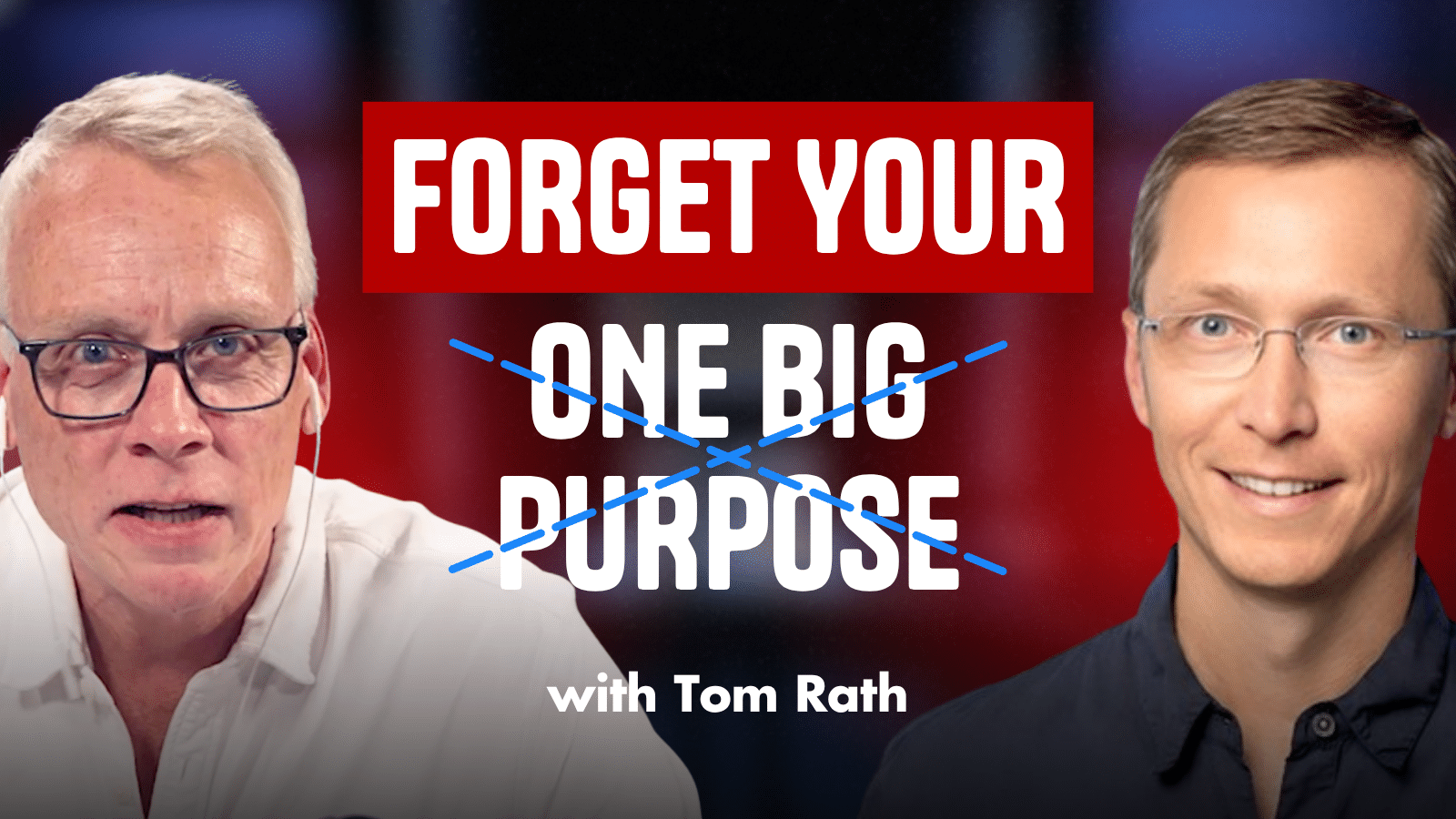
Hey, gang. This week I’m interviewing my friend Tom Rath. If you recognize that name, maybe you’ve read a book called How Full Is My Bucket or Strengthfinders. He is one of the great thinkers and great authors of our time, and his most recent book is called What’s the Point?
And what I love about this book, it’s like a good parent tricking their kids into eating broccoli by putting melted cheese on it, he is making the idea, the heavy idea, of “What’s my purpose?” He makes it practical, manageable, and easy. And he talks about the benefits it can have to every single day at work.
And by the end of the book, we’ll also talk about how you can bring that wisdom not just to your own work, but how we can help the young people in our lives, our children, make better career choices and design the jobs we have to bring more fulfillment.
It’s a super practical episode about a very important topic, purpose, but we’re just going to whisper that, and we’re just going to ask the question, what’s the point? Enjoy this episode with my friend, Tom Rath.
———————————
Jay Papasan:
I’m Jay Papasan. And this is The ONE Thing, your weekly guide to the simple steps that lead to extraordinary results
———————————–
Jay Papasan:
Tom, welcome to The ONE Thing podcast.
Tom Rath:
It’s good to talk to you, Jay.
Jay Papasan:
I know. It was really great catching up when we did our pre-call as well. I really enjoyed your book, What’s the Point? And you’re tackling a topic that so many of our listeners have struggled with. My coach, our head coach at The ONE Thing, Jordan Fried, he asserted, he was the first person to say, “This is not a productivity book. This is a purpose book.” And when we figure out bringing meaning to our work, our purpose, it can feel really heavy when you say, “What’s your purpose? What’s your purpose, Tom?” But it’s so liberating when we figure it out. So why don’t we start off with how do you define that and why you think it’s important?
Tom Rath:
It’s a good place to start, Jay, because I’d always had this… I guess I’d idealized the word purpose and thought, I’m finally going to write a book about purpose, and sat down, put together all this research, digging through everything I could find, like my normal process. And then, about five months before we were going to launch a book that was tentatively titled Purpose Unlocked, I got so deep in the research, I realized that when most of us hear the word purpose, we kinda clench up a little bit, tighten up, and we think of this as something that needs to descend from the heavens on a sunny day every ten years. And the word purpose itself kinda stresses us out.
So, I realized and I called my publisher and said, “We gotta rethink this. If we put purpose as the main title of the book, I’m worried that we’re not gonna get people into it because they’ll be too intimidated to read a book called Purpose instead of something fun like ONE Thing or What’s the Point or what… right? So, how do we ease people into it?” Because the good news is the research, I think, proves out that purpose doesn’t need to be something that’s that intimidating or that heavy, and purpose can be something that’s a lot lighter and it’s fun and it’s more like a daily compass for how we prioritize our day in its very best form.
And the more I learned about it, honestly, just from a personal level, it took a lot of the pressure off on me thinking that purpose was something I had to try and find every few years, and it involved some big quest. And once you demystify it, I think it makes it a lot more practical to plug it into your daily life.
Jay Papasan:
I love that. 100% agree with everything you said. That was my discovery on the road teaching The ONE Thing is that people’s response to the idea of discovering their purpose, they felt like they had to have a road-to-Damascus moment, like it was something that was gonna be given to them versus something they could actively discover, and it felt heavy. That would be the word I use. It felt like a heavy journey that would take lots of wisdom and time to figure out.
Since then, we’ve found some practical ways to get people closer to it faster, and I love… I want people’s purpose, whatever they call it, core values, however we wanna define that, to be a compass. The whole point of it is it should help us make better decisions with where we spend our time.
Tom Rath:
Yeah. And that’s what I realized as I got into it. Midway through, I was trying to figure out how do we help people apply this concept of purpose in what they do on a daily basis when they wake up in the morning and how they think about their daily routine? And what I found is that if I just ask myself not what’s the point of a big project I’m working on, but what’s the point of what I’m about to do for the next thirty minutes? If I’m going to sit down first thing in the morning and respond to 10 emails from people who I may not even know or have any connection with, not only does it not serve a great purpose when I scrutinize my own routine, but it’s also 30 minutes less that I have to spend in a meaningful conversation with one of my kids at the end of the day as well.
And so, as I started to ask, “What’s the point of this meeting? What’s the point of this hour reading a book someone asked me to blurb?” it changed the way I prioritized my daily routine in a pretty good way.
Jay Papasan:
I love that. You’re using it to such a practical end. What’s the point of this? Is this impactful at all, or am I doing busywork, right? It’s impactful, or it feels important just ’cause it’s the last thing that showed up in my inbox from an important person. There’s lots of ways we can answer that question, but when we bring our own answer to it, I think it becomes a great compass. So, one of the things that I paused over and reread is that you shared some research that shows that people who figure this out, they don’t only enjoy their work more, they earn more, all of those things. Can you share that with us?
Tom Rath:
Yeah. It’s been interesting. One of the challenges I’ve seen in the modern workplace over the last 10-20 years of working with companies and leaders and workers on this is the fact that most of us are doing pretty meaningful work and some meaningful work almost every single day. And I don’t know, unless you’re manufacturing cigarettes or something it’s, it’s hard to think of professions where you’re not serving another person, internal customer, external customer at a Starbucks, whatever it might be. But most of us do a pretty lousy job of reflecting and connecting back and saying, “Here’s what I did three or four times in a day that made a difference for another human being.” And when you fail to do that, you are less motivated at the end of the day, and you’re less likely to do more of that work the next day, and so on.
And so, being able to connect a customer who walks into a retail store or a coffee shop, and they’re really frustrated, and if you bring them from a negative five to neutral even, that’s a big win in a day that made a difference for another person. And if you can acknowledge that, or your manager can acknowledge that, or you can be the manager who acknowledges that and helps people to see what they’re doing that makes a difference, I think most of the purpose that’s created in life is really created in our lab of these daily choices and these little interactions with people. And so, we all need to do a better job of doing that for ourselves and then helping others to do that as well.
And when you talk about the research around it, I would’ve thought from my own personal experiences in our healthcare system that if you’re a nurse, or you’re a teacher, or you’re a radiologist, you just know that you do important, meaningful work all the time. But even in those professions, if you take one group of radiologists and have them keep plowing through their day reading MRI scans and CTs and writing reports, and you take another experimental group and all you do is append a photo of the patient to the radiographic record, they write 30% longer reports with 42% better diagnostic accuracy because someone’s just bringing the humanity of another person in with a picture and a face, right? And we just so often fail to do stuff like that.
So, when I talk about making purpose practical, I think that’s a big piece of it, is how do you build that reflection into your day as well?
Jay Papasan:
You put it into a very simple question, and we love questions ’cause our book is all about asking the right questions. If you don’t know the answer to that question, then with each task or with each big project, just ask the question: Who am I helping? And I’ve just studied that for so long. And if you don’t know how to help yourself, helping others is a great start, that there is something intrinsic that when we feel like we’re doing a service for others, we feel better about the work and about ourselves as well.
My father’s motto, it was like when he passed away, someone gave us a pillow with it embroidered on it, and he just said, “Happiness is being useful to God, useful to family, and being useful to other human beings.” And he must have said that enough times to make us roll our eyes as teenagers, right? But it was still a great lesson to learn at a fairly young age that if you want to be more fulfilled, you wanna be more happy, then focus your work on how it helps other people, and that’s where so much of the reward comes from.
So, like as a simple practical tool, I don’t know what impact my work does. Who do you help? That could be a sign. And I love the researcher on the picture. Like seeing the person or an avatar for who it is you’re serving reminds you, and we strive harder, just unconsciously, to serve them when they’re present, even virtually in the space.
Tom Rath:
Yeah. And you know what? I love the way you talk about that in your book and in our conversations where I’ve even taken that learning and turned it into kind of a tactic for coping with my own chronic introversion and lack of wanting to go to cocktail parties. So, now, instead of kinda asking people the old generic question about what do you do where you get some idealized answer or whatever, I’ve started asking people, “Talk to me about, what do you do on a typical day?” And just kinda what is it you’re doing that’s serving and helping other people?” And you get such better and richer answers.
And I’m trying to do that as a parent of 15 and 17-year-old kids, too. It’s not, “What do you wanna be when you grow up?” Or, “What do you wanna do?” It’s, “Who could you see yourself helping? What professions do you think our community will need more of in the future, and how do you see yourself connecting with those contributions and those missions?”
And I think when people ask me about the throughline and what I’ve spent most of my career working on, I think my biggest learning across all the books and research that I’ve done is just that life is so much better and richer and more meaningful the earlier on in your career you can get as other-oriented as possible instead of getting into that kind of self-orientation. And I mean I’m sure you see this too, but I’ve seen a lot of that being involved with all the strengths work and the self-development where sometimes it gets into, “I wanna know all about myself,” and then go tell the world it needs to revolve around me, right? But the faster I can get people to turn that mindset and say, “Okay, I know who I am. What does that mean for who I can help and how I can do it more efficiently?”
Jay Papasan:
Love it. You coined a phrase I’d never heard, contribution confidence, and it felt to me like, how confident am I that the work I’m doing is making a contribution? And we can almost use that as a measure for the work we choose to do when we get to choose to do it. Am I remembering that correctly?
Tom Rath:
Yes, you’re remembering that correctly. And I think it gives you the confidence too. It’s an entendre there where the more you can see that you’re making a contribution and be able to describe that, and like you said, prioritize and orient your day. None of us get to orient our whole day doing the things we like or the things we think would be most meaningful.
And it was a big learning for me 25 years ago. We were working on employee surveys and basic questions about employee engagement and strengths when I was at Gallup, and the question we ask everyone about strengths was not, “I get to use my strengths all day.” It was, “I have the opportunity to use my strengths each day.” So, it might just be one fleeting moment on some days. In a good day, it might be an hour. Two hours if you’re having a great day, right? But if you can just carve out a little bit of your day to see where you’re making a difference and do things that are meaningful and make that contribution, that does matter, and it can outweigh a lot of the time that you have to be doing things that aren’t as pleasant or filling out expense reports or whatever it might be.
Jay Papasan:
The opposite end of that spectrum is what we do. When we sit down to write a book, I know Gary and I, we have a process. And the first thing we do is, how will this book that we’re writing, how will it impact how they view the world and how they act in it in a positive way?
And so, we try to set the frame from the very beginning, and you know this process. It can take years. It took us four years plus to write The ONE Thing, the research, the writing, the drafting, all of the things that happened. That was the longest book project I’ve been on. And you just have to keep coming back to that, “Hey, if I can do this work, this is the impact we’re hoping to have with it.”
So, sometimes, it can be real and experienced. And sometimes, the project you’re working on, you can see how, if you fulfill it, it will do that thing. So, I can see it both ways. Yes, I want my kids every day to have that moment where they know that their work is connected to helping others, that’s a great day. And if they’re in a field like mine, can they go ahead and make the conscious decision about how their work is going to be a contribution and measure themselves by that? That was a line I actually wrote down: “Define your success by your contribution, not comparison.” And I was like, “Okay, that’s an underliner. I’m gonna have to quote you somewhere in my life in the future,” because it’s such a true statement.
Most of us are walking around defining our success by comparing it to other people versus the simple thing of what kind of contribution have I made, and am I proud of that? ‘Cause that’s a very simple statement that exists for you and you alone, and it doesn’t have to be defined against anybody else.
Tom Rath:
Yeah. The more I’ve talked about this with friends and people and learned from leaders I’ve followed in this, I’m starting to think that purpose is a lot more like gardening, where you’re always planting seeds, and I’m planting seeds hoping that they continue to grow even when I’m not there tending to them or watering them or working on it, right?
And so, that might be a book I work on that someone picks up and reads a decade from now. It might be a wonderful conversation I have with my son. And two generations from now, when I’m no longer around, he does something different in an interaction with one of his kids that happened to be rooted in what he learned from me, and he doesn’t even realize it at the moment, right?
So, when you think about how do you really build a life that makes a difference, not only in the here and now, but when you’re not working on those things, I think that takes a little bit of the pressure off when we think about our day-to-day lives, and hopefully it makes things a little more meaningful in the end too.
Jay Papasan:
I’ve worked 25 plus years in the real estate industry, and my wife is a professional real estate agent, and in all the chaos, that’s a very crazy entrepreneurial career. We can forget that… and there’s a lot of them that are listening to this podcast right now, that we are helping people get one of the fundamental needs they have, which is shelter. And you can get caught up in all the complexities, but if you remember, like, our job is to help people have a shelter, a place that they can call home, you can remember how important the work is.
And you talk to agents who serve first-time homebuyers who are experiencing it for the first time, this moment where they’ve gone from renter to homeowner, and their levels of job satisfaction are absolutely through the roof in those moments ’cause they’ve seen the direct impact they’re having on other humans around them.
I’m just now extemporizing a little bit, but one of the things you shared in the book was that there’s this idea of a one-purpose myth that everybody has a calling, it’s singular, and that’s one of the reasons it makes it heavy. So, before we leave the topic entirely, can you unpack that a little bit? ‘Cause that really stood out to me, and it also rang true.
Tom Rath:
Yeah. I mean, there are a few things that I think contribute to this. I think there are people asking you and telling you when you’re young and entering the work world, whether that’s out of high school or out of college, that you need to find this purpose, and it’s something that society kind of drills into you. I’ve also seen and been a part of a few hundred management retreats and leadership sessions where CEOs and executives love to talk a good game about this big purpose thing and have their mission statements. And so, they’ve elevated into some grandiose thing that makes it feel even less attainable in a lot of ways, right?
Jay Papasan:
Yeah. And most of those mission statements, when you understand the people who wrote them, feel a little phony sometimes, right? They’re a little performative, if we’re being honest. It’s a box that everybody was taught to check at some MBA school. And they were taught to check it for good reasons, but people are going about it the wrong way.
Tom Rath:
Right. So, all that, I think, makes a lot of us feel when we finally find this purpose, it needs to be a 30,000-foot purpose and something that kind of sits above and over everything else, and we finally figure it out, and it’s this big moment. And unfortunately, I think by the time most of us get to my age, at least, we realize that’s not how the flow of a spiky and variable career works over time.
And so, I was relieved to read some of this research where the scientists were talking about it’s not the big P purpose, they called it, that matters, it’s the small P purpose. And this small P purpose is really what takes place during the day, and we accumulate it, and we build it into our lives by asking, “What’s the point of this?” and, “Why am I doing this?” and “Who does it make a difference for?” and “Who am I helping?” A lot of the questions that we’ve been talking about here.
And so, the minute I figured that out, it diffused a lot of… I didn’t even realize that I had what some of these researchers had called purpose anxiety, but I clearly did, and I think a lot of people do. And so, the more you can diffuse and dial that down, it’s been really helpful.
————————————
Jay Papasan:
When I finished your book, I’ve got a 22 and a 20-year-old, I was like, “I wonder if you were writing this for your kids.” Was there a moment where you realized, “Man, I wish I’d read this book earlier in my life”? Was there a moment where this book became crystal clear because you realized maybe you hadn’t been asking the question, “What’s the point?” often enough?
Tom Rath:
Yes. I mean, a couple things kinda came together there. One is that because of a kind of life-threatening genetic condition I’ve had battling cancer all my life, I realized that really early on, I was diagnosed at 15, that I had to pack kind of a whole life into a life expectancy that at the time was about 40 years. So, I spent all this time trying to pack a whole career, a lot of accomplishments, a whole family, all this stuff into the first 40 years just in case I didn’t get any overtime, right?
But then, I got to age 40, and I’m 50 now, but I got to age 40 and realized that about 90% of what I’d been doing up to that point was trying to live up to other people’s expectations and following in my family’s footsteps just because that’s what everyone does, and it’s kinda gravity, and I hadn’t really taken the time to look at all the careers and jobs and things that are out there. And so, the more I got into that, I was increasingly convinced that most people get to the end of their career and the end of their lives without ever even having seen, let alone tried, what they could’ve been best at in life.
So, I was, (A), determined to prevent that. And then, as I realized that, this was two, three years ago, I had my daughter walk into my office when she was 14, and I said to her, “When you think about jobs and your career and stuff and what you’ve seen, what do you think you might wanna do or you might wanna be when you grow up?” Classic question that I hadn’t asked her. And she said, “I think I’m a pretty good writer.” She is. And she said, “Or maybe I could be a teacher.” My wife’s a reading specialist. So she was two for two with nothing else in terms of the only thing she could see was following in the footsteps.
And so, I started hitting myself in the head right then and said, “You know what? I gotta fix that so she knows how to see 20, 30, 40, 50 careers, (A); and (B), I gotta tell my kids explicitly, ‘If you end up doing what we did, great, but that has to be after you’ve looked at everything else-‘”
Jay Papasan:
Yeah.
Tom Rath:
“… and exhausted all options.” So, yes, I was writing this for my kids eventually. They’ don’t care right now ’cause they’re just thinking about school and college and stuff. They’re not there yet. But when the time comes, I want them to be able to think outside of the conventional wisdom a little bit.
Jay Papasan:
I’ll point out, – when I picked up the book, it was like 350 pages. I was like, “Okay, this is gonna be a lot.” Then, I start flipping through it. I was like, “Oh, wait. There’s a 140 at the back that…” Some of it is you quoting all of the… – sourcing all of the research that you put into this. You’re a scientist. You actually did hard research and wrote about it. And then, there’s like probably a hundred pages where you go through and profile all of these different career paths. And I was like, “Oh, what is this for?”
And I realized it when I got to the part in the book where you talk about what you just demonstrated, that when kids make a career choice, the likelihood, whether their parents were dishwashers or dentists, that they’ll choose a similar career path is incredibly high, right? It’s ’cause it’s what they’ve been exposed to. And how do we expose the young people in our lives to more choices, so that they can not just through serendipity, but maybe through a system or process, discover where their strengths really come to bear and triangulate with their joy and contribution?
And that’s giving them space to experiment. And I’ll be honest with you, when my oldest son said, “Maybe I’m gonna be a writer,” I didn’t think any of that. I just thought I was so flattered. I was like, “Oh, my son might wanna do what I wanna do.” And this book was a good wake-up call. I used to joke, I don’t wanna act too enthusiastic ’cause I don’t wanna scare him away from it, but I would be so proud of him if he did, and that might be because I can contribute a lot to his career if he chooses a similar career path. There is an advantage to that. Hopefully, he can not have to learn the hard mistakes the hard way. I can show him a path.
So, there’s some wisdom to that, too. But what you’re saying is even more important. Our job is to make a contribution to our kids, and we want them to have the choices, so they can make a good choice, not just take the best choice that happens to be in front of them.
Tom Rath:
Yeah. And I think we all have the best of intentions, most of us as parents, and that’s kinda the path of least resistance where in some occupations, it’s… and it’s really gendered, too, by the way, where if your mom’s a military officer, you’re 131 times as likely as a young woman to be a military officer, and if your father’s a welder, you’re 170 times more likely to be a welder, right? So, it’s remarkable, and it’s how we evolved from an industrial economy, right? And there are real practical purposes for it. I grew up in Nebraska where if you’re a young man, the expectation is you maintain the family farm, right?
Jay Papasan:
In the English language, if your last name was Tanner, it’s because a long time ago your family were tanners, right? A lot of the last names actually came from the profession, and that family was known as whatever that profession was. And it’s just crazy when you put it in those context.
Tom Rath:
But if you really say, “What’s best for this young person who’s growing up and developing and thinking about what they could be,” most parents I’ve been talking to want their kids to be what they could be best at and where they might have the biggest contribution and impact in the world and so forth.
And so, if that’s the case, I did all the math on this. It took quite a while, but I looked at all of the Bureau of Labor Statistics job codes in the United States and said, “Out of the top 200 jobs, how many would a person need to understand or see even a three-minute preview of in order to have awareness of 50% of the jobs?” So, if you think about a camera lens, to go from 2% aperture to 50% aperture. And the answer is you would need to know 50 jobs in order to have a feel for 50% of what’s out there.
So, that’s what I’ve set my sights on with those profiles in the book and building a website with videos around that and stuff too. And I did both, again, just for kind of my kids and their generation to say, how can they at least know enough to be dangerous about… My son watched it and was absolutely fascinated by the routine of a day, what an electrician does over the course of a day, which I never would have known much about or had exposure to. My daughter saw some things from a biology and a physical standpoint, physician stuff that she got really interested in. It’s been neat for me to see things they grab onto that they never would have had exposure to because it’s not in our family circle, essentially.
Jay Papasan:
Yeah, I thought I wanted to be an attorney, and my mom says, “Well, we know one. Why don’t you go spend the day in his office?” And a wonderful human being. I loved getting to know him but I saw, within three hours, I was like, “Oh my goodness, this is not for me.” What I saw in the movies with attorneys and defense attorneys, like what I had in my mind versus the reality of what most people do was not something that I wanted to do.
So, I’ll just make this call out for you. It’s not that season, but if you’re listening to this and you have a high school senior, that’s actually when I might just say, “Hey, before you go to college, before…” ‘Cause people are gonna ask you what’s your major within five or six months of going, and a lot of times, once we invest the time and energy towards pursuing a major, it almost becomes like sunk cost. We start going down that path and it becomes harder and harder to say, “This is not for me.”
So, why don’t we just take 15 minutes and walk through some of these different professions in this book. Is it about 50? Is that what you provided?
Tom Rath:
Yes.
Jay Papasan:
Yeah. So, it’s a little two-page spreads. It takes three minutes. Again, some of them are gonna be like clear nos. But I ended up just… I think I earmarked seven of them. It’s like, “Oh, I’m gonna go back and read those because I’m curious about maybe the road not taken for me,” and ask, where is the intersection of the things that I truly love? I did teacher, I did writer or author, whichever one you had in there. There are pieces of my job that I recognized, and then there were things that were close to those things that I know as a 57-year-old man that I also enjoy, and I was like, “I wonder what professions could have stemmed from those things that I now know that I love to do.”
But giving them to a young person early, maybe they’ll make a better… they’ll explore the right things at college before they even start doing their internships and then do the job selection. So, I just thought that was a great resource, and I don’t know that… most people don’t read many books and a lot of them don’t finish them, so at least maybe that we’ve called out that it’s a hidden resource in your book that they may wanna check out.
Can I change the topic and go to this idea you had around job crafting? And one of the questions I wrote down early while I was reading it, what if someone’s listening to this and they’re truly unhappy with what they do? They don’t feel like they’ve made the right choice. They come home work exhausted. They don’t feel like they’re making a contribution with a capital P or a small P, and they’re just feeling that angst.
Tom Rath:
Yeah. And I think it’s also, as we’re talking and thinking about it, it’s important to step back and say the whole concept of a job and a career it’s somewhat similar as we talked about with purpose, where it’s kinda heavy and it’s seen as a monolithic thing where I’m convinced that especially with what we’re seeing with disruptions in technology and everything now, that we’re going to need to think of our job or career or what we do that helps people as something that’s a lot more nimble and variable. And we might have three or four of them at one time, and we might move around every few years, and it’s subject to change, where when you and I entered the workforce, there might’ve been this desire that you want to spend 20 or 30 years doing one thing, right?
So, I think, one, to understand that is changing, it might change even more rapidly, and the faster you embrace that, it could be a good thing. Instead of saying, “I’m gonna dedicate four, six, eight years to education around something,” only to then realize that it’s not the right thing.
So, that being said, if you’re in a job that is far from ideal, let’s say that you’re at a negative seven on a negative ten to a plus ten scale, right? And if you’re at a negative seven right now, and you have tried absolutely everything possible with your boss and your relationships and the way you do your work and all these things, and that job is still making you miserable, you’re not sleeping, you dread coming home from work It’s important to note that if you’re in a job that’s that bad, that condition is worse than unemployment on 15 out of 16 well-being and physical health metrics.
Jay Papasan:
Okay.
Tom Rath:
So, sometimes, I’m saying, let’s say it’s 5 or 10% of the time, the right answer is to cut bait even if it’s a painful choice, right? But in 80 or 90% of those cases, you can get the negative seven up to a negative two or maybe even a positive two if you do some diagnostics on the job.
One big piece of it that researchers at Michigan and Yale found is that if you, one, change the way you do things. So, what your employer really wants is for you to achieve, let’s say, three or four given outcomes, which those are the dependent variables. But how you get from A to B is gonna be a lot different than how five other people do it. And most good employers or managers would be glad to say, “I’m gonna do it my way if I can get more done in less time, and it achieves those outcomes,” if that’s number of homes you’ve sold or number of people you’ve interacted with or whatever it might be, right? So, how you do it is one.
Second big thing, and we can all relate to this is who you spend time with during the day, the people side of it, the relationships, because we know there are people who, when we talk to them for 15 minutes, we get all wound up with ideas, and we have fun, and we go out and get a lot more done. There are other people who we kind of dread calling back. We don’t want to answer their emails. And then, when we spend an hour with them, we’re just dejected about the whole trajectory of the world, right?
Jay Papasan:
Yeah.
Tom Rath:
So, I mean, sometimes you just got to call that out and say, “How do you structure your day to spend less time on the people who are draining you?” Okay. So, that’s another piece of it.
And then, as I think we’ve already covered and talked about, if you can build those reflection points into your day where you’re connecting what you do with the people it serves, even if you’re not in your ideal job, that may be the most important way to get yourself to a salvageable zero to plus two. So, if you can craft your job into something that’s neutral to tolerable, and then always be looking around at other things you might want to learn about, go deeper on your spare time, because I think over time, we should all aim to be in the plus five to plus 10.
But that’s not something that most of us get when we graduate from college. You don’t just stumble into that. We usually make a little progress, go back another five steps, come back. An arc of a career should be something that’s spiky and moves around a lot, and the quicker we learn to embrace that, the better off we are as we get into the latter stages, I think.
Jay Papasan:
I’ll just sum up what I just heard. So, we can focus on three things. The work itself. The activities that I do and perform my job. Can I design my days to maybe get the outcomes my manager wants by doing more of the activities that typically give me energy than take them? Can I design my days, so that I’m spending more time with the people that are in my environment, whether it’d be customers or coworkers, that tend to give me energy versus subtract it? And then, finally, where we started, can I assign some meaning or contribution to my work? Because that’ll make even the tougher jobs feel better. This is a hard part of my job, but I know it makes a huge contribution that typically, I think I heard that from Simon Sinek, hard work without meaning is just stress, and hard work plus meaning is typically fulfilling. It was a hard day, but it was a good day kind of conversation.
So, I like that three-part framework because it gives them multiple angles. Maybe I know I’ve had jobs where the work itself did not excite me, but the people did. And you can, sometimes, find great satisfaction in just being around the right people that change your attitude about the whole place, and then you may get the right to earn the right to do different work that you do find more satisfying with those people.
So, I like the three-part framework because it gives people a place to make the job they have maybe a little bit better, or if there are a lot of people are out there looking for their next thing, at least they know the three areas they can focus on to make a better choice.
So, we’re almost out of time here, Tom. And I took, I think, 12 pages of notes when I read your book. It’s really good. I really enjoyed it, and I definitely am gonna make both of my sons go through those job profiles because they’re at that point where I think it could really serve them, so that they can at least experience in a small way what their choices could be, so they’re not making life choices by default. I’d like them to do that by design. And that’s all of our goals as parents, I would hope.
What’s one small challenge we could give our listeners today that they could implement this week?
Tom Rath:
That’s what I spend way too much time trying to boil things down like that. And it’s taken me years to do that with some of the books. And the first book I ever worked on was called How Full Is Your Bucket? And the reason that worked and still… I mean, I’ll be out on a walk with my wife later on today, and I’ll be complaining about something going wrong at the house, and she’ll say, “Didn’t you write How Full Is Your Bucket?” And go look. So, it’s in the lexicon of my family for 25 years, and i-it’s just a little heuristic and a shortcut.
And I’ve been doing that for the last year or two with just saying, “What’s the point of this meeting? What’s the point of watching one more episode of Netflix instead of getting a little bit more sleep? What’s the point of going out and exercising before I was gonna have this conversation with you?” Because I thought I’d be a little bit sharper, right? So, if you can just say “What’s the point of what you’re doing?” every 30 minutes, every hour throughout the day, I think you can harness that into a question that leads to better choices and more productive days.
Jay Papasan:
I love that. The power of a great question. We devoted the whole back of our book to our question, and you were brave enough to put it right on the front cover. What’s the point? So, if people need a reminder, they could just set this up in their visual landscape and remind themselves, “What’s the point? What’s the point?” Or put a Post-it note up. I love that as a challenge.
Tom, thank you for writing this book, and thank you for sharing your talents with the world. I can assure you through… I mean, I cannot tell you how much benefit I got from How Full Is Your Bucket and StrengthsFinders. Our teams have used those for years. So, thank you for your contributions to helping others, and thank you for this book, and thank you for being on our podcast.
Tom Rath:
Thanks for your time and thoughtful questions. I appreciate it, Jay.
Jay Papasan:
Thank you.
—————————
Disclaimer:
This podcast is for general informational purposes only. The views, thoughts, and opinions of the guest represent those of the guest and not ProduKtive or Keller Williams Realty LLC and their affiliates and should not be construed as financial, economic, legal, tax, or other advice. This podcast is provided without any warranty or guarantee of its accuracy, completeness, timeliness, or results from using the information.