Jay Papasan:
Hey, there. One Thing family. This week, I’m talking to my friend, Nir Eyal, who just came out with an amazing book called Beyond Belief. And this matters to you because whether you’re a business owner, you’re a leader, or you’re just trying to be your best, by the end of this interview, you’re gonna understand how little of your reality is actually fact.
So much of what we see, what we believe, and what we do is based on our beliefs. And before we even get to the mid-break on this, Nir is gonna unpack a way for you to identify your current beliefs, whether they’re limiting or liberating, and identify them. These are unconscious things that we’re carrying around. They impact our relationships, they impact our work, and most importantly, which we get to at the end, whether or not you’re gonna go the distance, so you can get the extraordinary results that you’ve been working so hard for.
I know you’re gonna love this episode. It’s absolutely what you need to hear. Pay attention. There is so much to unpack.
———–
Jay Papasan:
I’m Jay Papasan. And this is The ONE Thing, your weekly guide to the simple steps that lead to extraordinary results.
———–
Jay Papasan:
Nir, welcome to the show. I’m so happy to have you here.
Nir Eyal:
Thanks Jay. It’s great to be here with you.
Jay Papasan:
I really enjoyed reading your book. And I kept thinking this has so many connections to the people we serve. When people are living The ONE Thing and there’s so much of extraordinary success that happens over a long period of time. So, one of the things I wanted to dive right into, you have an amazing opening story, and we talk a lot about when should we just give up and when do we, like, strategically quit?
Giving up is when we kind of give up or quit before we needed to, and therefore we deny ourselves success. And strategic quitting is like this relationship, this service, whatever it is doesn’t serve me any longer.
You dove into that pretty hard. Talk to us a little bit about how we, maybe we give up too soon.
Nir Eyal:
Yeah. So, that’s really the big question of the book is, why do some people succeed and others fail? Why do we succeed at some things and fail at others? And my gut reaction, I think most people is, is, well, it’s about not knowing what to do if I had the right information, or maybe it’s about resources, or maybe it’s about skill.
And I don’t think it’s any of those things because we are drowning in information. We have more information available than ever before. And if you don’t know the answer to something, Google it. Ask ChatGPT, you’ll get the answer. It’s not skill because skill can be acquired. And it’s not resources because we all know people who have every opportunity in the world and don’t accomplish very much, and other people who start from very little and go on to do great things.
I think what underlies success is really persistence. It’s that you can know what to do, but if you don’t sustain that behavior, if you don’t persist, you’re not gonna achieve the goal. And it-
Jay Papasan:
Especially in big success in entrepreneurship, like we see people and we think they’re an overnight success, but anytime you talk to them and interview them and get under the hood, which I’m sure, as an author, you get to do too-
Nir Eyal:
Oh yeah.
Jay Papasan:
… you realize there’s like a decade of work they were doing before they had an overnight success.
Nir Eyal:
That’s right. I like to say that successful people are losers. And that they lose more often. If you talk to successful people, they’ll tell you, “Oh, yeah. I tried
this, it didn’t work. And then, I tried this, it didn’t work.” Whereas unsuccessful people, they try it once and it didn’t work, and then I’m never gonna try it again.
And so, if we know that, if persistence is really the key, how do we sustain our motivation over the long term? And so, I wanted to look at kinda the steeper question. Okay, well what is motivation and how do we keep it going? And I think that the way I saw motivation was completely incorrect, the way most of us are seeing motivation.
Jay Papasan:
What did you think about motivation?
Nir Eyal:
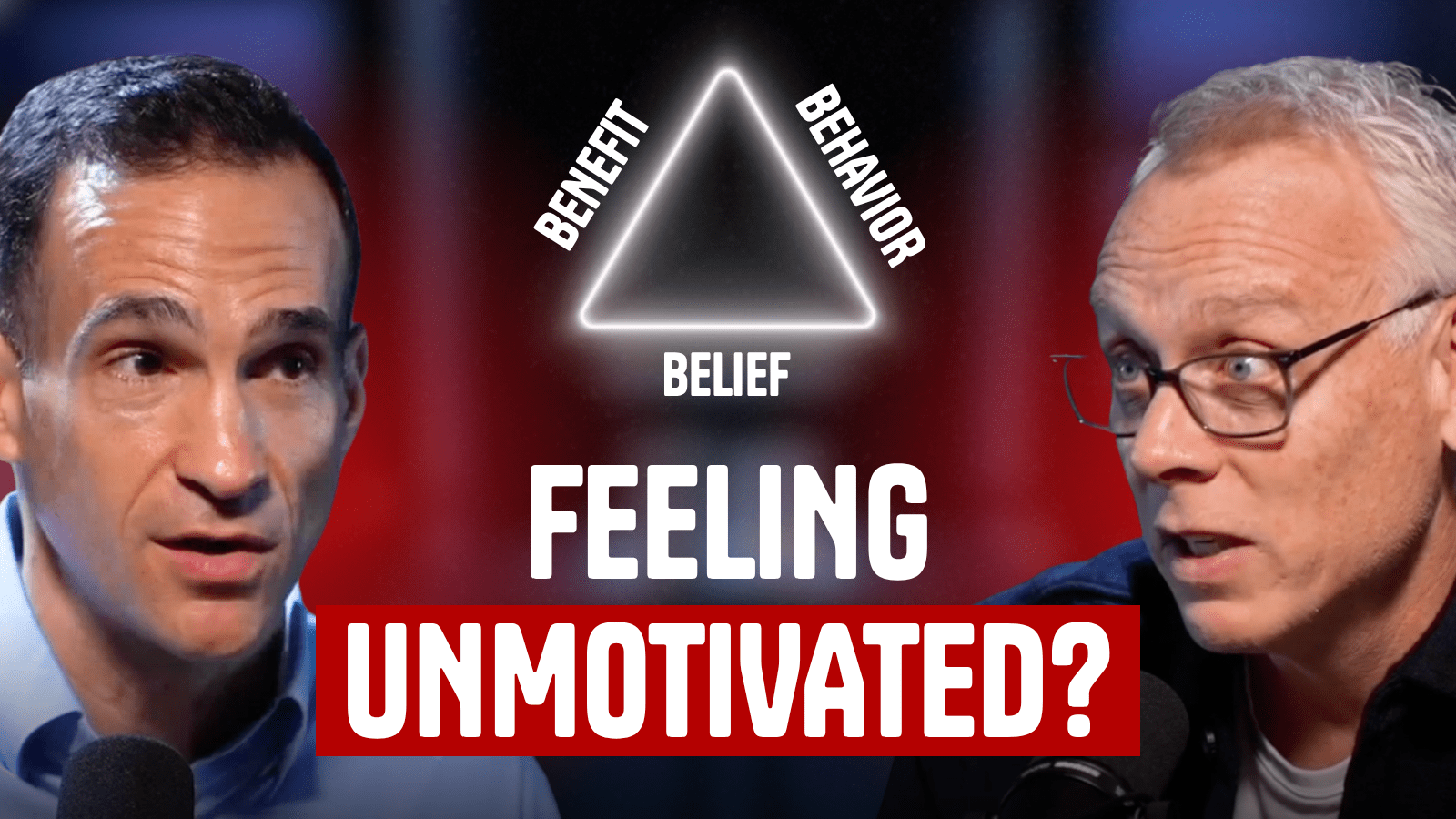
Kind of classic economic theory of if I want this benefit, I’ll do this behavior. It’s a straight line.
Jay Papasan:
Like ambition, desire, that sort of thing.
Nir Eyal:
Whatever it is that I want, I’ll do the behavior to go get it. So, all I need is the benefit and the behavior. That’s not enough because if it were enough, we would all have six pack abs and be multi-millionaires.
Jay Papasan:
Right.
Nir Eyal:
Right. Because even when we know what to do, who doesn’t basically know how to get in shape, it’s not that complicated, right? We know how to do these things.
Jay Papasan:
It’s even easier today. I can go to ChatGPT or Claude, whatever my model is, talk about my body type, just even a tiny amount and say, “Will you custom design whatever it is?” Like we have custom information available to us.
Nir Eyal:
That’s right. So, why don’t we just do it? Well, because I think there’s something missing. That motivation is not a straight line. Sustained motivation is a triangle that I can know what to do — the behavior — I can know even why I’m doing it — the benefit — but if I don’t have beliefs underlying those two things, I won’t
sustain my motivation.
So, for example, if I’m working with someone who if… Let’s say I’m working for a boss, and I don’t believe that my boss has my best interests at heart, I don’t believe they’re gonna gimme that promotion, I don’t believe they’re gonna gimme that raise, how motivated will I be to keep working at my best if I don’t believe I’m gonna get the benefit?
Jay Papasan:
Right. You have some doubt. Like I might do all the work and they’ll say, “Try, try again,” whatever that is,
Nir Eyal:
Right. So, that’s on the benefit side. On the behavior side, and this is actually much more common. If I don’t believe in my own ability to sustain that behavior, I’m also gonna quit. And we call these limiting beliefs.
Jay Papasan:
Right.
Nir Eyal:
So, in order to sustain our motivation over the long term so that we can meet our goals, we have to have all three. We have to have the behavior, the benefit, but most importantly, the beliefs that hold this motivation triangle together.
So, that’s where Beyond Belief came from is, well, if beliefs are so important, how do we develop the right ones and get rid of the ones that hurt us?
Jay Papasan:
Which is something kind of provocative that you talk about in the book. I think a lot of people think of beliefs as maybe facts, but it’s really, you should be using them and thinking of them as tools.
Nir Eyal:
That’s exactly right. So, a belief is not a fact. A belief is something else completely. A fact is an objective truth. It is something that is true, whether or not you believe it.
Jay Papasan:
Right.
Nir Eyal:
The world is more like a sphere than it is flat. Sorry, flat earthers. The earth doesn’t care what you think. That’s a fact.
Jay Papasan:
Right.
Nir Eyal:
On the other end of the spectrum is faith. Faith is a conviction that does not require evidence. God rewards the righteous, that’s a matter of faith. No evidence is required. But between fact and faith is a belief.
Jay Papasan:
Got it.
Nir Eyal:
And what makes belief so special by definition, they are convictions that are open to revision based on new evidence. And so, what makes them so powerful is that unlike facts or faith, we can decide what our beliefs are. We can discard the old beliefs and pick up these new beliefs that serve us much better. The problem is that our default state is constantly to go back to comfort, is to constantly go back to our old beliefs, whatever has served us in the past. That’s how we’re wired. Whether or not those beliefs serve us.
Jay Papasan:
Do we tend to also find evidence to support those beliefs once we believe them?
Nir Eyal:
That’s exactly right. It’s called a confirmation bias.
Jay Papasan:
Right.
Nir Eyal:
So, based on what we’ve seen before in the past, and, you know, the most… if you wanted to summarize my work over the past six years, it’s this. That beliefs are tools, not truths. Beliefs are tools, not truth. And so, what we do, you know, it’s kinda like a carpenter that says, “Oh, you know what? In the past, this hammer was really great. It was a great tool. So, I’m gonna use this hammer for every job. It’s the one and only true hammer.” That’s ridiculous, right? That carpenter wouldn’t stay in business very long.
Whereas what we should do is to say, “Hey, sometimes, the right tool is a saw or a wrench or a screwdriver.” It’s not always the same tool for every job.
Jay Papasan:
What’s the phrase? Like if every problem looks like a nail, like you become the hammer. There’s like that-
Nir Eyal:
That’s right.
Jay Papasan:
There’s like a truism in business.
Nir Eyal:
That’s so true.
Jay Papasan:
People take their strength, what got them there, and they think that it’ll take ’em to the next level. And that’s actually a common belief we see in a lot of people. It’s like, what got you here will get me there. And it’s not always true.
Nir Eyal:
That’s exactly right.
Jay Papasan:
We have to evolve as businesspeople.
Nir Eyal:
That’s right. And so, those beliefs are there for a reason. They’re there because they did serve you in the past. But if we become calcified in those beliefs, we never grow, we always stay static. So, for a company implementation, not only does that affect personal motivation. What is company culture but codified beliefs?
If you think about Amazon, for example. Amazon, one of their core beliefs, one of their core tenets is that “It’s always day one.” And I’ve interviewed and known many people who work at Amazon, they actually repeat that.
Jay Papasan:
So, it’s not just like a slogan on the wall there.
Nir Eyal:
No, they will say, “Hey, remember, it’s always day one. So, we’re gonna make this decision based on that belief.” Now, why is it a belief? ‘Cause it certainly isn’t a fact.
Jay Papasan:
Right.
Nir Eyal:
It’s demonstrably false. It is not day one. But beliefs are tools, not truths. It doesn’t matter that Amazon has been there for years and years. It’s definitely not a startup.
Jay Papasan:
I think someone called me from the press when I was in publishing, like, in 1998 to ask if Amazon was gonna make an impact. It’s been around for a little while. It is not day one.
Nir Eyal:
Exactly. But they keep this thing that is clearly not true. They keep it as a core belief. Why? Because it’s a tool. It serves them. It guides their behavior to do things that they otherwise would not do.
Jay Papasan:
Because if you believe it’s always day one, what would you do differently?
Nir Eyal:
That’s right. That’s right. You would act differently. You would act scrappy. You would act more decisively. You would take risks that maybe you wouldn’t. If you were a big, calcified company, you would act like a startup.
Jay Papasan:
Yeah, it’d be startup mentality. I love that. So, let’s talk a little bit about, so if belief lies between fact and faith, faith. requires no evidence. Fact is just indisputable. Belief can lay anywhere on that spectrum, right? Because we choose it as a tool. It could be very anchored close to faith, or it could be anchored close to fiction. So, we get to choose where that is.
Nir Eyal:
And most of our decisions in life are not based on facts.
Jay Papasan:
No.
Nir Eyal:
When you think about it, I mean, we just don’t get that many things that we can more are decisions to that are grounded in facts that most of our decisions, especially as businesspeople, they’re guesses about the future.
Jay Papasan:
Yeah.
Nir Eyal:
They’re not laws of physics.
Jay Papasan:
No.
Nir Eyal:
Should I take on this product line? Should I hire this employee? Should I go into business with this partner? These aren’t facts. They’re not based on laws of physics. They’re based on beliefs. The problem is, if so many of our decisions are based on these beliefs, we need to make sure that we’re identifying the ones that serve us. These are what I call liberating beliefs. And that we discard the ones that are hurting us, what we call the limiting beliefs.
Jay Papasan:
I love that you have a line in there. It’s probably a header. I think that our labels are our limits. And so, like, do you want to give yourself a high ceiling or a low ceiling? Then, pay attention to. the labels that you consciously or unconsciously putting on your life.
Nir Eyal:
We see this all the time. I’m not good at sales. I’m not a salesperson. I can’t do that kind of thing.
Jay Papasan:
I’ve been in that camp.
Nir Eyal:
Yeah. I have too. Absolutely.
Jay Papasan:
Yes.
Nir Eyal:
Or it’s too late. That’s probably the number one limiting belief I hear. There’s not enough time. That’s not a law of nature, right? That’s not-
Jay Papasan:
It’s not in my control.
Nir Eyal:
It’s not in my control, exactly. There’s nothing I can do or this is hard. I’m no good at this. I don’t know what I’m doing. You know, we hear this whisper of limiting beliefs constantly that are trying to protect us. They’re trying to keep us safe, but in fact they limit us because your labels, in fact, become your limits.
Jay Papasan:
Well, I mean, going purely practical here. I want to know, how do I, as a business owner, as an entrepreneur, maybe I’m just trying to lead myself better, how do I become consciously aware of the labels I’m carrying around with me, these beliefs and start sorting out the ones that are good and bad? Is there some wisdom that you can give us around becoming a little bit more aware? ‘Cause I feel like a lot of this is habitual. It’s just stuff that we’re carrying around. And like you said earlier, it might’ve serviced in the past, but because we’re not aware of it, we haven’t named it maybe, it could be steering us off a cliff and we’re not aware of it.
Nir Eyal:
That’s exactly right. So, let me tell you a story that’s a little bit difficult for me to share, but I have to do it because it’s in the book and I think it’s an important demonstration of how to change these limiting beliefs. So, this is what happened with my mother one year, and I’m gonna tell you about my mother, but you can replace any relationship in your life, whether it’s with an employee, whether it’s with a boss, whether it’s with a partner, whether it’s with a customer, you can do the same thing.
Jay Papasan:
I think with mother, we’ve just gone right to complicated right from the bat. Right. Everyone has a-
Nir Eyal:
Messy history.
Jay Papasan:
Yeah. We all have the longest possible history with our mothers.
Nir Eyal:
Exactly, exactly. So, we all have mothers. And so, this is what happened. So, a few years ago, it was her 74th birthday, and I decided to do something nice for her. And I wanted to send her some flowers. The problem was that I was in Singapore, and she was in central Florida where I grew up.
But I called a bunch of florists. I looked for the ones that had the best reviews, and I put in an order, and I even called, I stayed up till one in the morning Singapore time, so I could make sure the flowers arrived on time. And I went to bed that night, and I patted myself on the shoulder, and I thought, “Nir, you’re a good son. You did a nice thing for your mom. She’s gonna love it. She’s gonna call you tomorrow morning and tell you how great this thing that you did for her was.” That’s not what happened, Jay.
Jay Papasan:
Of course not or you wouldn’t be telling it.
Nir Eyal:
Here’s what happened. I called my mom, and I said, “Hey, mom. Happy birthday. Did you get the flowers I sent?” And she says, “Yes, I did. But just so you know, those flowers that you sent, they were half dead. And I wouldn’t call that florist again,” to which I said something I’m a little embarrassed about. I said, “Well, that’s the last time I buy you flowers.”
Jay Papasan:
Oh no.
Nir Eyal:
And that went over about as well as you’d expect. Not so good. After the call, my wife who heard the whole conversation, she turns to me and she says, “Would you like to do a turn around on this?”
Jay Papasan:
Right.
Nir Eyal:
To which I said, “No, I do not wanna do your touchy feely hocus pocus mumbo jumbo.”
Jay Papasan:
Dr. Becky might add, like-
Nir Eyal:
I’m not in the mood for that.
Jay Papasan:
repair, repair, repair,
Nir Eyal:
No, yeah, not in the mood. I want to avoid, avoid, avoid. And how do you do that? You vent. This is what we’re told to do. We’re told that if you can’t keep feelings inside, you have to speak your truth. You have to tell people how you feel. You have to get off your chest, right? It turns out, that’s a terrible idea.
What the psychological literature says is that when we vent, what we’re doing is we’re reinforcing this effigy of people that we do not see people as they are. We see our beliefs about people more accurately. We see them as we are.
Jay Papasan:
Hmm.
Nir Eyal:
Lemme explain. So, I didn’t sit down and I didn’t vent, but rather I sat down and I did what’s called a turnaround. And this answers your question that you can… this is how you figure out what those limiting beliefs are that you carry, so that You can do something about it.
And just a quick digression. One of the things that’s so interesting about limiting beliefs is that we all have them, but we can’t see them. They’re, by definition, hidden to us. It’s almost like your face. You can see my face right now. But if I said, “Hey, look at your own face,” you can’t look at your own face. You can look at your hands. You can look at your feet. You can’t look at your face.
Jay Papasan:
It’s a blind spot.
Nir Eyal:
Yeah, but we can see other people’s faces, just like we can see other people’s limiting beliefs. If I told you, think about a good friend of yours or a family member, I bet you, in 30 seconds, you can think of all their limiting beliefs.
Jay Papasan:
Yeah.
Nir Eyal:
But when it comes to our own limiting beliefs, we can’t see them because we think they’re facts. We think that this is a condition, this is something that… this is just the way things are. This is reality.
Jay Papasan:
That’s back to, “I’m not good at sales,” right?
Nir Eyal:
Exactly.
Jay Papasan:
All of those things that we believe… because they’re beliefs, they feel like facts.
Nir Eyal:
That’s exactly right, but that’s not true. So, we have to have a process to make us aware of these limiting beliefs. Just like we have to look at the mirror, we have to reflect in order to see our own face.
Jay Papasan:
Right.
Nir Eyal:
So, here’s what you do. This comes from a technique called inquiry-based stress reduction. And this is a very validated technique. It’s a very valid-
Jay Papasan:
Inquiry-based stress reduction.
Nir Eyal:
That’s right. And it comes actually-
Jay Papasan:
I’m surprised it’s not an acronym.
Nir Eyal:
You can make one.
Jay Papasan:
Okay.
Nir Eyal:
But it comes from the work of Byron Katie. And she developed this decades ago. And in fact, it has its roots all the way back to Aristotle. So, this is an ancient practice.
What it does is it asks you to consider other potential beliefs, not to change your mind. Why? The brain hates changing its mind. This is something we all need to realize that when you try and change your beliefs, when you try and look at things from a different perspective, your brain says, “Whoa, whoa, whoa. Don’t do that. That’s dangerous. I’m not comfortable with this. I hate that.” So, knowing that that’s going to be uncomfortable, what you’re gonna do is not to force yourself to change your mind but just to collect a portfolio of perspectives. Just like your collecting Pokemon cards or baseball cards or stocks, you want a portfolio of different perspectives.
So, here’s how this works. You ask yourself four questions. So, here’s what I did. The first thing I did was write down my belief. My mother is too judgmental and hard to please.
Jay Papasan:
Okay.
Nir Eyal:
That was my belief. After this interaction, that’s what I believed. Fact. Then, I asked myself-
Jay Papasan:
That was probably a belief you carried into the conversation.
Nir Eyal:
Yes.
Jay Papasan:
Okay.
Nir Eyal:
Yes, definitely.
Jay Papasan:
Okay.
Nir Eyal:
But now it was time to, to process that. Of course, you know, where do our beliefs come from? They always come from some kind of prior understanding. They’re called priors for that exact reason. So, the first question is, is this true? Sounds like a dumb question. And in fact, when I read that question, I said, “Yeah, that is a dumb question,” ’cause obviously, Jay, come on.
Jay Papasan:
It’s a fact.
Nir Eyal:
Yeah, my mother was clearly being judgmental and hard to please. You agree with me, right? Okay, next question. Let’s skip that one. Second question. It sounds similar, but it’s not. Is it absolutely true?
Jay Papasan:
Oh, so is it true? Is it absolutely true?
Nir Eyal:
That’s right. Is it absolutely true? So, absolutely. that means in all cases, no exceptions, a hundred percent of the time, is there no other potential interpretation? I had to admit, okay, I don’t know what the other interpretation might be, but maybe there’s a circumstance that I’m not thinking of that could provide an alternative explanation for why my mother is not judgmental and hard to please. I dunno what it is. Let’s go with it.
The third question, who am I when I hold onto that belief? When I believe my mother is too judgmental and hard to please-
Jay Papasan:
You’re a victim.
Nir Eyal:
I am not myself. I act like this 13-year-old version of me. And you can substitute your employee, your boss, your colleague, anybody in your life that’s causing you suffering in some way, you can substitute that just like I’m doing for my mom. So, when I hold onto that belief, I’m not really happy. I’m not being myself. I’m causing myself suffering.
The fourth question, who would I be without this belief that if I had a magic wand and poof, I could make that belief disappear? How would I feel? Who wouldI be? I’d feel lighter. I’d be more patient, I’d be more kind, I’d be more myself,
Jay Papasan:
Be more curious.
Nir Eyal:
Yeah, all those things. So, it would be much better. So, in four questions in 30seconds, I realized, one, that thing that I thought was a fact that my mother was too judgmental and hard to please, maybe is not a fact.
Jay Papasan:
Right.
Nir Eyal:
That carrying that belief doesn’t really serve me, makes me feel pretty crummy, and that if I didn’t have that belief, I might be well better off. So, now, I do the turnaround. Now, I’m ready for the turnaround.
Jay Papasan:
One of the questions we ask in our coaching, Coach Jordan will say, when someone’s in this place, he’ll say, “Nir, what would the hero version of yourself do in this situation?”
Nir Eyal:
Oh, I love that. What would the…Yeah, that’s wonderful.
Jay Papasan:
Because it immediately puts you into like your best incarnation.
Nir Eyal:
Yeah.
Jay Papasan:
Right? It’s not just who am I without it? It’s like, who could I be if I was free from it? It just takes it maybe a little bit higher.
Nir Eyal:
Yeah. I love it. Now, I’m guessing, well, you tell me in your experience that when most people hear that, the initial reaction is kinda like, “I dunno, I don’t want to because I can’t, because there’s some kinda limitation here that prevents me from doing that.”
Jay Papasan:
Actually, I’ve seen enough of it that a lot of people, if they’re doing that, maybe, I’m looking for my own evidence of my belief,
Nir Eyal:
Well, they’re also-
Jay Papasan:
I see a lot of people look up and they wonder like, what is the hero version of myself? Because I think a lot of people aren’t in tune with their potential.
Nir Eyal:
Yes, yes. So, what you’re doing… and I think when I certainly did this, it felt very uncomfortable because it was asking me to consider something that may not cast me in the best light, that I wasn’t being the superhero of my story yet.
Jay Papasan:
Yeah.
Nir Eyal:
So, here’s what you do. You take that belief. You turn it around. Whatever that belief is, that I’m no good at public speaking, I’m not a salesperson, there’s too much to do, there’s no time, whatever that limiting belief might be, and you ask yourself, could the exact opposite be true? The exact opposite, could that be true?
So, let’s take in my case, my belief that my mother was too judgmental and hard to please; the opposite, my mother is not too judgmental and hard to please. Could that be true? Is there any possible way that could be true?
Jay Papasan:
You’ve already done the absolutely true. You had to give some space there.
Nir Eyal:
That’s right. So, maybe she was trying to prevent me from getting scammed from this florist. She did just say a statement of fact, right, that the flowers were half dead.
Jay Papasan:
Yeah.
Nir Eyal:
That doesn’t say anything about me. It was about the flowers. So, maybe she was trying to be helpful, not hurtful. Okay, now, I have two beliefs. Let’s do a third. The opposite of my mother’s too judgmental and hard to please, the opposite might be I am too judgmental and hard to please. What could that sound like? Well, I had rehearsed in my mind that if I’m gonna do this nice thing for her, she was going to give me this effusive praise that when it didn’t come, I lost it.
Jay Papasan:
Yeah.
Nir Eyal:
So who is being judgmental?
Jay Papasan:
If you’ve ever seen someone tell someone else, you’re projecting, that never lands well.
Nir Eyal:
No.
Jay Papasan:
It’s kind of good that that’s like five questions into this. You’ve already warmed up a little bit.
Nir Eyal:
That’s right.
Jay Papasan:
Right?
Nir Eyal:
Yeah. It’s like telling someone to calm down. That has never worked in the history of mankind. Just calm down. Yeah.
Jay Papasan:
Oh, getting your blood pressure. This is literally happening. It’s like, if you’ll just calm down. It’s like, you don’t understand.
Nir Eyal:
Exactly. Because why? Well, because we see reality not as it is. We see reality as we believe it to be.
Jay Papasan:
Got it.
Nir Eyal:
So, here’s this fourth question. Sorry, the fourth turnaround, the fourth potential belief. I am too judgmental and hard to please towards myself. And this one actually was the hardest to accept, but the most true ultimately that when I had put in all this effort into something and it didn’t work out the way I wanted, that was a statement on me, that I felt like I was incompetent somehow.
And this is called a misattribution of emotion. When you feel one way inside and you’re looking for who caused it, you, don’t want it to be you, you’re gonna find the first person in front of you and blame it on them. And that’s exactly what I did to my mom.
Jay Papasan:
Which is often someone really close to us ’cause they’re the ones most often around us.
Nir Eyal:
Accessible. Exactly. And that we have a whole history about, “Oh, she always does this. There she goes again. That’s so like her. This is a pattern,” right? And so, again, we do not see people accurately. We see our beliefs about people.
And so, which one of those four statements, now that I have four beliefs, which one is true, Jay? Which one is false? All of them? None of them?
Jay Papasan:
They could be situationally true, right?
Nir Eyal:
Exactly. Who cares? It doesn’t matter. What I know is that that one belief that my mother’s being too judgmental and hard to please, in order for me to stop suffering, she had to change.
Jay Papasan:
Which is not necessarily in your control.
Nir Eyal:
Yeah. Well, I dunno if you know my mom. It’s not gonna happen. I can tell you.
Jay Papasan:
Not gonna happen, fact. Yeah, got it.
Nir Eyal:
Not gonna happen or, at least, I shouldn’t hold my breath ’cause I’m gonna suffocate if I wait.
Jay Papasan:
Okay.
Nir Eyal:
So, the other three beliefs ease my suffering, and they gave me more motivation to work on that relationship. And that is the definition of a liberating belief. A liberating belief, we started the conversation with what sustains motivation, so we can meet our long-term goals. Well, if I believe my mother’s just too judgmental and hard to please, I’m not a good at sales. I’m not built for entrepreneurship, I don’t have any time, whatever the case might be, what happens to my motivation? Instantly drained.
Jay Papasan:
And that’s the foundation of your pyramid.
Nir Eyal:
That’s exactly right. So, that’s the secret that if you can find those liberating beliefs that increase your motivation and decrease your suffering, voila, you can sustain that motivation over the long term and you become exponentially more likely to meet your goals.
Jay Papasan:
All right. I love that story and thank you for being transparent ’cause it isn’t one that necessarily reflects well on you. And I find those to be very effective when we’re teaching. Thank you for tying that up and giving us that great tool.
Let’s take a quick break. And on the other side, I’d like to kind of revisit where we started this idea of when we give up versus when we quit, where this one is we’re giving up too soon, and the other is when we are choosing to and it’s actually serving us. Does that sound like a good idea?
Nir Eyal:
Perfect.
Jay Papasan:
All right, let’s pick that up after the break.
————
Jay Papasan:
All right. So, kind of like back to the beginning of this interview, I see a lot of people, I believe what you said, that most extraordinary success is a marathon. We want it to be a sprint, but people underestimate just showing up every day. And it’s like James Clear, 1% better every day is 37 times better over the course of the year. That persistence adds up far more than we believe. We want it. We wanna believe that it’s a short sprint. How do we manage the tools of belief, so that we can know when to keep going and also know when to quit.
Nir Eyal:
Yeah. So, maybe the most common pushback I hear is. are you telling people to lie to themselves? Should we delude ourselves and just pick whatever beliefs serve us and feel good?
Jay Papasan:
Today’s day one. I mean, there’s a little bit of that in there.
Nir Eyal:
There is. There is. And so what I would argue is that you’re already lying yourself.
Jay Papasan:
Okay.
Nir Eyal:
You’re already gaslighting yourself. Most of us just pick those limiting beliefs to tell us that we’re one way or the other.
Jay Papasan:
As opposed to gaslighting ourselves, let’s do it in a way that makes us grow and better people.
Nir Eyal:
Pick the right one.
Jay Papasan:
Okay.
Nir Eyal:
Because again, it’s-
Jay Papasan:
If you called this positive gaslighting, it was not gonna work. So, I’m glad you chose Beyond Belief.
Nir Eyal:
And most importantly, the definition of a belief is a conviction that is open to revision based on evidence. So, if there’s zero evidence, you can’t just make up facts, but you can use beliefs to serve you as tools, right? Beliefs are tools, not truths.
Jay Papasan:
But you’ve verified this, if we adopt a belief, we do start to see more evidence that our belief is closer to fact than faith.
Nir Eyal:
That’s exactly right. I mean, there’s-
Jay Papasan:
Even if we’re really anchored to faith, but we start looking for that evidence, we just naturally see it more.
Nir Eyal:
Okay. I have to tell you this one study, but I really wanna get back to this point of when do we actually quit?
Jay Papasan:
Yes, of course.
Nir Eyal:
This is a question that comes up all the time. Are you saying never quit? No, no, no. I’m not saying that at all, but let’s get back to that. But to this point of we see things as we believe them to be, lemme give you a great example of this. And I think entrepreneurs will really resonate with this.
They did a study where they asked people to do a very simple task on this psychological assessment. They just said, look at this newspaper, flip through it and quickly count the number of images. Then, when you’re done, tell us how many images you saw. Like, how many pictures in the newspaper. Now, there were two groups if people-
Jay Papasan:
So, theoretically, everybody could do this and be a hundred percent correct.
Nir Eyal:
Everybody can do it.
Jay Papasan:
Right.
Nir Eyal:
These two groups, one group were people who believed they were lucky people. Had no evidence that they were lucky, at least not for the scientists’ perspective. They just called themselves lucky people. The other group were people who called themselves unlucky people. They believed they were unlucky.
Now, the people who believed they were unlucky took two and a half minutes on the task. The people who believe they were lucky, it took 11 seconds. Why the difference? Why the difference? Because on page two of this newspaper, one of those images contained big, large text, very clear that said there are 43 images in this newspaper, collect your reward.
Jay Papasan:
Oh, wow.
Nir Eyal:
The people who believed they were lucky, whether it was true or not, saw something in reality that the unlucky people did not see. The unlucky people said 1, 2, 3, 4. They just counted through them, and they didn’t see an opportunity to save them a ton of time and get out of there in 11 seconds like the lucky people did. They literally didn’t see it. Their eyeballs didn’t register in their brain what had happened.
Why does this occur? Because the brain can’t handle all this information. The brain is taking in right now 11 million bits of information. 11 million bits of information per second, that’s like reading War and Peace every second twice.
Jay Papasan:
That’s insane.
Nir Eyal:
Tremendous amount of information, but your conscious mind can only process 50 bits of information. So, War and Peace every second, twice versus one sentence per second. So, the brain-
Jay Papasan:
All right. Just hold it for a second. Like someone’s driving their car right now and they’re trying to process the scale difference, like War and Peace, if you can’t picture it, it’s about a five-inch-thick book.
Nir Eyal:
Right.
Jay Papasan:
Right. And it’s multiple volumes, is it not?
Nir Eyal:
It’s huge. It’s huge.
Jay Papasan:
It’s huge.
Nir Eyal:
11 million bits.
Jay Papasan:
So, our brain is already filtering to an extraordinary degree.
Nir Eyal:
That’s right. Every second. So, the light-
Jay Papasan:
This is the Hoover Dam, and it’s got a pinhole in it.
Nir Eyal:
And you are looking at reality through this tiny pinhole of attention. And you think it’s real.
Jay Papasan:
Wow.
Nir Eyal:
It’s not.
Jay Papasan:
So, we’re looking through this pinhole. Our brain, with or without our permission, probably based on our beliefs, is doing this tremendous amount of filtering. And like, this is huge to me ’cause so much of what we do in our work, like my mantra is, “When in doubt, zoom out.” So many times, people will say, “Ah, the stock market’s down this much overnight.” Well, what is it for the year? What is it for the last five years? What is my horizon for my investing? Like perspective matters tremendously, which is one of the reasons, like I believe firmly in having a coach or a mentor or someone who can give you outside… you know, we can’t see your own face.
Nir Eyal:
That’s right. That’s right.
Jay Papasan:
So, like our brain is denying us perspective in so much of the time.
Nir Eyal:
That’s right. So, we don’t see reality clearly. We don’t even feel our own bodies, our own emotions clearly. I mean, I document these case studies of people undergoing surgery without anesthesia.
Jay Papasan:
That part was just crazy to me.
Nir Eyal:
And listen, you know, I don’t like the woo-woo stuff. The book is full of 30 pages of citations to peer reviewed studies. I wanna see the science. I have seen these surgeries, okay. I’ve seen the videos. This is real. This can happen. Why? How is that possible? It’s because some… and the-
Jay Papasan:
This is so kung fu. Like I grew up watching kung fu, right? It’s like mind over matter stuff, but it’s real.
Nir Eyal:
It is absolutely real. And in fact, tens of thousands of people every year undergo surgery without anesthesia because they’re trained on how to refocus that pinhole of attention. Now, why do I tell this story? I’m not advocating for people to do it. I’m not gonna do it.
Jay Papasan:
I’m not doing that.
Nir Eyal:
Nope, that’s fine. It demonstrates the power of the mind through our beliefs to shape our perception of reality. If you can undergo surgery where a scalpel is cutting into flesh, okay, for 55 minutes is what I document in the book of this guy, Daniel Gissler, who I saw the video of his hypno-sedation, if we can do that with our brains. what else can we, do? Can we unlock the power to stay motivated, to stay persistent and not quit in the face of a bit of disruption and discomfort? Absolutely. we can, if we know how.
Jay Papasan:
Okay. So, we’ve got this massive filter going on. How does that impact whether we’re going to give up too soon or keep going?
Nir Eyal:
Okay, great. So, this is a question I hear a lot from entrepreneurs of how do I make sure I’m not just deluding myself into thinking that I should persist, or, uh, how do I make sure that I persist even though I feel like quitting? I think there’s three criteria.
Jay Papasan:
Oh, I love this already.
Nir Eyal:
Three criteria for when it’s okay to quit. Number one is have you met the mile marker? Not the deadline, the mile marker. Meaning when you adopt that new belief, that new mindset of I believe that this might be true. I’m gonna try that turnaround that I was talking about earlier about any one of your limiting beliefs. You wanna adopt it for a certain number of days.
Okay. Say, I’m gonna try for a week, a month, a year, whatever it is. Even if it’s a new business trial and experiment you’re doing, you’re gonna give it time. You’re gonna meet that mile marker. And don’t quit until you’ve met that time period that you set in advance. Why? Because if you say, “I’m just gonna try it for a while,” as soon as it gets difficult-
Jay Papasan:
Define a while.
Nir Eyal:.
Yeah, exactly. Well, this hurts. I don’t like it anymore. I’m out.
Jay Papasan:
Okay. I’m just gonna riff on that. Angela Duckworth, my favorite chapter in her book, Grit is Parenting for Grit. And we adopted this in our family every semester, our kids had to adopt hard thing. You got to choose but you don’t get to quit. And the mile marker was one semester of school.
Nir Eyal:.
Amazing.
So, like those were all defined because the same thing, like you say you don’t like soccer, but like this is your first year playing soccer and everybody sucks when they start playing soccer. Imagine how good you’ll be after three semesters. But like we have to give it enough time to give ourselves a chance to get through that awkward… call it your awkward teenage years of whatever it is you’re doing.
Nir Eyal:
That’s exactly right.
Jay Papasan:
All right. Step one.
Nir Eyal:
I wanna write a book. I’m gonna write for 30 days. I wanna be popular on social media. Well, I’m gonna post for 30days, whatever the case might be. I’m gonna try this sales calls thing for 30days before I can quit. That’s criteria number one. Meet the mile marker.
The second criteria is to ask yourself, are you still learning? Because people e equate failure with a reason to quit, and it’s not necessarily a reason to quit because failure teaches you something as long. As you’re learning from those failures, you keep going. It’s almost like, imagine if I knew… I have a crystal ball, and I saw that in your future you will succeed after the fifth failure. You’re looking for love. After the fifth date, you find love of your life. After the fifth sales call, you close a lead. Whatever the case might be. If you just do it five times that you fail, the sixth time you’re gonna succeed, how eager are you gonna be to fail? You are gonna want to get through those failures.
Jay Papasan:
Let’s get through that as fast as I can. Maybe I’ll get lucky and nail it the first time, but that’s unrealistic.
Nir Eyal:
That’s right.
Jay Papasan:
And I just gotta say, this shows up so many entrepreneurs, they think, and I believe firmly, no one succeeds alone. If you’re gonna do something huge, it’s gonna be not just you. There’s gonna be some sort of support network around you, whether they’re employees, 1099s, a community, whatever that is. They go to make their first hire. It’s that first pivotal step in entrepreneurship. I’m gonna pay someone else’s salary. It doesn’t work out. And they make the decision, you know what, I’m better off alone. Like employees are not for me. And I was like, for all of your acumen as a scientist, as a salesperson, you name the profession, as a writer, you’ve never tried this. Hiring people and managing them, there’s a million books written on it. What made you imagine that one try would be enough?
Nir Eyal:
That’s right. Whereas if you do more trials, you’re learning. You say, okay, well that type of person didn’t work for these criteria, for these reasons. What am I learning from that?
Jay Papasan:
I love that.
Nir Eyal:
And then the third and final criteria, I think is the most important, does persistence matter? So, there are some things where persistence doesn’t matter, won’t help you. If you work at a company that has a really bad company culture that people bring you down, they’re all not motivated, they’re just kind of collecting their paycheck, if that’s not the place for you, persisting, banging your head against the wall is not gonna make a difference. You’re not gonna outlive those people at the company.
Jay Papasan:
My brain goes to toxic relationships in any form. They could be friendships, it could be any sort of relationship. If that relationship, like persistence is not gonna make it better.
Nir Eyal:
That’s exactly right. So, if you meet those three criteria, you meet your mile marker, you’re not learning anymore, and it’s something where persistence won’t make a difference, yup, cut your losses.
Jay Papasan:
The mile marker, like it needs to be at least somewhere, maybe not on the distant horizon. It has to be. It can’t be, “I’ll try this for one day.” How do we set an appropriate… I mean, we do this for our kids all the time, but we don’t take our own advice.
Nir Eyal:
Yeah.
Jay Papasan:
Is there like whatever you think is enough, double it. Like is there a rule of thumb that we could follow that might give us a chance to get through that awkward curve?
Nir Eyal:
That’s a great question. I think you have to set that mile marker far enough where it anticipates it’s not going to be comfortable. And this kind of relates to, I think, a misconception that’s interesting. So, some people think that this is about positive thinking, that changing your beliefs is about, just think positive, manifest good things will come to you, you’ll vibrate at the frequency of the universe and all that stuff, which is actually not true. It’s actually harmful. It’s actively harmful.
In fact, [Gabrielle Tigen] did these studies where she had people imagine some kind of visualization exercise, right? I want wealth. I’m gonna imagine that I’m in my mansion with my Lamborghini parked outside. I want love. I’m gonna imagine my family. I want to have a beach body. So, they’re imagining the outcomes.
And what she found was that when people did these visioning exercises, their blood pressure lowered, they became more relaxed. And when she followed up with them, they were actually less likely to do the work to go get those things.
Jay Papasan:
You know, and we did this, we have some of this in the process of The ONE Thing. We have kind of a process, like how do you think about a someday goal and work backwards? And the research, I can’t, like you, name the researcher, but it’s in our footnotes. They looked at students and they asked two groups visualized getting an A on the exam, and the other group visualized the process of getting an A on the exam. It’s like a little bit of hopeful dream, like what’s the thing, the why or whatever it was, and is that the why side? But it was also a little bit of the how.
And when they visualized the process, everybody in the group that visualized process, that’s all they had to do, they studied more frequently, they studied longer, and they all made higher grades.
Nir Eyal:
That’s exactly right and-
Jay Papasan:
Like we’re visualizing the wrong thing.
Nir Eyal:
That’s exactly right. And if you only visualize the ends, you become more relaxed, your brain perceives, “Well, I’ve already kind of got it already. It’s gonna come to me any day now,” and then you don’t put in the effort, and you get worse grades. That’s exactly what these studies find.
So, the right way to do it is not only to visualize the process, but most importantly visualize how you will feel when you are overcoming those obstacles. So, when they say, you know, “Well, don’t athletes visualize?” Athletes do visualize but what are they visualizing? They’re not visualizing collecting the trophy, getting the medal. They’re visualizing when I’m on offense and defense is coming at me, or when I’m rushing down that mountain and I have to navigate the path, what will get in my way? And so, the best thing you can do is to emotionally prepare for feeling bad. That’s the most important thing.
So, when we talked about, how do you set that mile marker, you have to set that mile marker long enough out in the future where you anticipate, “I know it’s gonna suck for a while. But I’m not gonna quit despite knowing it’s gonna be hard. I’m gonna persist for these many days.”
And then, you have to have the tools to see those beliefs differently. And that’s really where turnarounds become incredibly powerful. So, I’ll tell you my own story. I used to be clinically obese, not just overweight,
Jay Papasan:
Which is unbelievable. If you’re watching on YouTube, like people are like, “Really?”
Nir Eyal:
Yeah, really? I’ll show you some pictures. Clinically obese. And so, the thing that really helped me change my life when it came to my diet was not visualizing the beach body. Like that’s not helpful. What I did was to visualize when I’m at a party and someone offers me a piece of chocolate cake, and I really want the chocolate cake, and I don’t wanna say no to this person, how will I deal with that discomfort?
Jay Papasan:
Right.
Nir Eyal:
What story will I tell myself? How will I prepare for that obstacle in my way?
Jay Papasan:
I love that but the idea of how we visualize the planning process, we almost always, I… I think this is the heart of the planning fallacy, like we tend to underestimate how long anything will take by 50% or more. We only see the highlight reel. And so, you’re asking us consciously, when we imagine this journey, it’s not a highlight reel. Go ahead and go through the bloopers. Go ahead and go through the painful spots, because we never imagine that’s going to happen. And if it’s important to you, you need to imagine it’s gonna take longer and have more hardships along the way. And it’s not to bring you down, it’s just to set you up for success.
Nir Eyal:
That’s right.
Jay Papasan:
And that’s just so huge.
Nir Eyal:
Yeah. And I think one of the things that I learned is that you have to really be detailed about what you’re going to do. So, for example, for me, when I feel the discomfort of not eating something I want or I’ve been a professional author and speaker for15 years now. It’s hard. I don’t wanna do it, right? Like, writing is really hard work.
Jay Papasan:
You’re traveling. So, like eating an airports. Like you’ve got lots of challenges between you and maintaining your ideal weight.
Nir Eyal:
All kinds. Yeah, or just sitting down to write when I really feel like looking at sports scores or stock prices or anything. But realizing that all motivation is about the desire to escape discomfort, that that’s really what underlies this. That the reason we do the things we do or don’t do, the things we do is always because of discomfort. So, you have to have a plan in place.
So, for me, when I feel that discomfort, when I feel that pain, that signal that we talked about, part of that 11 million bits of information, the physiological symptoms of I don’t wanna do this, this sucks. I’m bored, I’m tired, I’m fatigued, you have to have a different story, a different belief that makes sure that the pain does not become suffering. That is the secret.
Jay Papasan:
Wow.
Nir Eyal:
That successful people are able to disconnect. Just like Daniel Gissler disconnected the pain of the surgery. He felt the scalpel, but he didn’t turn into suffering. How do you do that? You change the story.
So, for me, when I feel the discomfort of, “I really want to eat that thing that’ snot healthy for me,” or “I really don’t want write today,” or “I really don’t wanna do my work that I know I need to focus on,” “I don’t wanna do that uncomfortable thing,” you have to have a different belief. So, what’s my belief? This is what it feels like to get better. Not, “This is hard. I’m not ready. It sucks. I’m no good at this,” all the things I used to hear, all my limiting beliefs. My mantra, now this is what it feels like to get better. And I have like a dozen of these different mantras, these little secular prayers that I keep telling myself. Is it true? I don’t know. I don’t care. What I know is it increases my motivation to persist and it decreases my suffering.
Jay Papasan:
I love that. And we’ll wrap on this. And I just think, this is something we teach in our training all the time, this idea of anticipating the speed bumps, the challenges, and not letting pain become suffering. If most people would just do one step before they pursued a goal, just answer this question, what’s the most likely thing to knock you off track? And do you have one strategy, just like that little detour? Because most of us kind of know the answer, right? I’m trying to have a diet. Well. my husband likes to eat lots of fatty foods. So. most likely thing is gonna be in my own home because we’re shopping for two different meals. How will I deal with that in advance?
My thing is a lot of times if we haven’t fully formed that belief in the moment, we will fall back to our default setting. So, your mantra is preparing you for this moment where someone unexpectedly serves you up something that you want but you shouldn’t have.
Nir Eyal:
Right. I think the most important thing you can take away is that number one, you don’t see reality clearly. You don’t feel it as it actually is,. And that affects your agency. So, these are the three powers of belief I talked about. So, it’s attention, anticipation, and agency. Those are the three powers of belief.
If you can really internalize that, and I packed the book full of studies to show you this, and this is consensus among the scientific community, we do not see reality clearly. So, if you can hold onto what you think are facts, more lightly have to have that intellectual humility to understand, you know, you barely see your reality clearly, you sure as heck don’t see what others see as reality clearly. And then, that allows you to have more possibilities to zoom out as you said, and pick the beliefs that, serve you rather than hurt you
Jay Papasan:
I mean, you said it pretty early on, people say seeing is believing but believing is seeing. And you’ve convinced me today. Thank you, Nir.
Nir Eyal:
My pleasure. Thank you.
Jay Papasan:
If we were gonna give our listeners one tiny challenge to carry into their week, what would be something that they could unpack?
Nir Eyal:
Yeah. So, find one limiting belief. How do you find limiting belief? Look for the mock. Look for that area of your life, that New Year’s resolution that comes back year after year, that relationship that always annoys you and you’re not really sure how to fix it, that thing that you feel like giving up on, and see if you can write down that limiting belief.
And then, what I want you to do, is ask yourself,, could the exact opposite be true? That’s the challenge. Could the exact opposite be true? It doesn’t have to be true. That’s not the bar. We’re not looking for facts here. We’re looking for beliefs that serve us. And so, if you can use that limiting belief, turn it around into a liberating belief, and then adopt that mantra, see if you can write down something that when the going gets tough, you could repeat to yourself time and time again. I literally say that to myself 20 times a day. This is what it feels like to get better. So, this morning my, I dropped my coffee, right? Normally I was, “Oh, I’m so annoyed.” No, okay this is, an opportunity to learn patience. I’ve adopted that. Does it sound a little silly? Is it hokey? Yeah, but you know what-
Jay Papasan:
But does it serve you?
Nir Eyal:
It so served me.
Jay Papasan:
It’s a tool that serves you
Nir Eyal:
That’s right. I’m more relaxed. I can enjoy my life more. Petty things don’t annoy me. It’s just a much better way to live.
Jay Papasan:
I love this. Thank you so much for pouring into us.
Nir Eyal:
My pleasure. Thank you.
—————
Disclaimer:
This podcast is for general informational purposes only. The views, thoughts and opinions of the guests represent those of the guests and not ProduKtive or Keller Williams Realty LLC and their affiliates and should not be construed as financial, economic, legal, tax or other advice. This podcast is provided without any warranty or guarantee of its accuracy, completeness, timeliness or results from using the information.