Jay Papasan:
This week, I am interviewing author Brad Stulberg. He’s also a renowned performance coach on his brand new book, The Way of Excellence: A Guide to True Greatness and Deep Satisfaction in a Chaotic World. I just love this interview. We have so much in common. His philosophies line up very well with The ONE Thing.
And so, we redefined excellence the way he views it. It’s more of a philosophical approach about how we can reduce our stress, enjoy our lives more while striving to be our best persons by bringing meaning and mastery to our work. We talked about how to mitigate stress, how to have a good form of passion, not the obsession that takes us away from things that matters more, how to keep things simple when we really wanna hide in complexity, and so much more. Joy, satisfaction, making peace with the boredom of success.
It is a great conversation and probably the highlight for me, and maybe the highlight for you will be when we talk about fear and how we can use curiosity to overcome fear of doing big things. Big, uncomfortable things like walking on stage, giving a presentation, doing that thing. He has a mantra, “It’s a brave new world.”
—————————–
Jay Papasan:
I’m Jay Papasan. And this is The ONE Thing, your weekly guide to the simple steps that lead to extraordinary results
—————————–
Jay Papasan:
Hi, Brad. I thoroughly enjoyed your book. I read it basically over a period of two days, which I am a voracious reader, but when I can sit undisturbed, not look at my phone for hours at a time, that’s saying something. So, great work there. And I just love the whole concept of excellence. For those of us who have not read the book, would you mind just defining, when we say the way of excellence, what are we talking about with excellence?
Brad Stulberg:
We’re talking about giving something your all, caring deeply, having deliberate intention, very involved engagement with a worthwhile project that aligns with your values and goals.
So, it really has these two component parts, right? The involved engagement, the caring deeply, the giving a damn, and pointing that effort toward something that’s worthwhile, that aligns not with just the result that you hope to achieve, but also the character you want to build and the person you want to become.
Jay Papasan:
There’s quite a few elements in there, and most of it I was like, “Oh, that feels familiar.” What really caught my eye, ’cause we talk about it a lot in The ONE Thing, our premise is when your work comes from a place of meaning, we use the word purpose. You tend to stick with it longer. There’s all these benefits when you can attach meaning to your work, and you use the word values. Did you start off with values being a part of your definition, or did you discover it along the way?
Brad Stulberg:
Values had been a part of my definition around excellence for the longest time, really since I’d been thinking of this term, because I think that you can be extremely proficient at something, but that doesn’t make you excellent. The process of excellence has to have this level of quality where you yourself, your innermost self, is being reflected in your work, and I really think that only comes if the work is values aligned.
Jay Papasan:
That word aligned, I think that there’s an inner feeling we get when the work is aligned and when it’s not. And I think that’s something a lot of modern-day thought workers that are out there toiling away, like, they’re trying to ask this question, “Is there meaning to my work?” And so, you also connected the idea of stress. When we’re pushing to do our best, the work can be really stressful when it doesn’t have meaning. And I’m taking a cab ride on values with that. Do we look for work with meaning, or do we try to bring meaning to the work we do? Maybe not everybody has a choice to go off and wander and find their thing, but if we are lucky enough to have it, great, but how do we bring meaning to the work?
Brad Stulberg:
I think that there’s multiple ways to bring meaning to the work. The first is that for some of us, a job is just a job. It’s a means to an end, and that end is supporting a family, paying rent, having hobbies, going on vacation. And there’s nothing wrong with that. However, if you’re lucky enough to have a job or career or craft where you do feel like you can job craft, you can shape it in order to bring meaning to it, then I think that it just becomes more fulfilling and more satisfying.
So, how do we do that? To me, it really comes down to these two core components. The first is mastery and the second is mattering. So, mastery is a sense of competence, of making progress, of putting in effort, exerting yourself, and actually improving and seeing yourself get better. And you can attain mastery in the weight room, you can attain it as a public speaker, you can attain it as a salesperson, you can attain it as a physician, as an athlete, on and on. But it’s this great reward cycle of I do something, I work hard, and I see results and I improve. And that is addictive and that is fulfilling.
And then, mattering simply means that we feel like we’re a part of something that’s beyond our small little ego and our small little self. So, yes, we’re working for self-improvement, but that self is embedded in a larger organization, a larger team, a larger system, a larger family. And when we have those two components, mastery and mattering, I think that it’s almost impossible not to find meaning, value, or satisfaction.
Jay Papasan:
I love that. I love that answer. And I think that wherever we are and whatever we’re doing, we call it getting on the path to mastery because it’s not like there’s a finish line that you cross through and maybe you become a master in a class of athletics or chess championships. They label you that. But people on the path don’t usually feel like they’ve arrived. It’s the process of becoming.
Brad Stulberg:
I’m so glad that you said that, Jay, because I think there’s a difference between becoming a master in mastery, just like there’s a difference between an excellent result and the path of excellence. So, you can be a master craftsperson or a master realtor or a master chef based on what a lineage in a field, in an awards ceremony says about you. Just like you can be an excellent basketball player. You can play in the NBA, and that’s great.
But the path of mastery, the path of excellence, first off, it’s available to anyone regardless of the result. Second off, by pursuing it, you get the best result. And third, even if you are truly world-class at what you do, that path never ends. There’s always more opportunities to grow and to refine and to be curious.
And what I love about your work and where it overlaps with mine is this is really about playing the infinite game. And in the infinite game, the whole point is just to continue to play, to learn and grow in whatever you do in life. If you have an infinite game mindset, you are going to succeed in enough finite games to be able to make it worthwhile.
Jay Papasan:
All right, so I’ll try to pull the thread here. I noticed in your book you quoted from George Leonard’s work Mastery, which was one of my favorite short books on the topic. And I remember reading that book, and I think his journey was he was learning judo, but he also cited other studies. And what we don’t anticipate on the way in when we’re a white belt and everything feels overwhelming, like we’re learning all the time, we feel like when we’re a black belt, we won’t be learning as much. I just think the nuance of what we learn on the journey goes so much deeper.
I remember reading a crazy study about Olympic swimmers, and they would spend whole sessions focused on how they held their pinky in the water, something that a novice wouldn’t even think to think about. So, on your journey to mastery, those little milestones that we don’t even know are gonna exist, like, how important are those along the way so that we can keep going down that path?
Brad Stulberg:
They’re extremely important and they’re important for a couple of reasons. The first is human is a species that likes to have a target to shoot for, and if we feel like we’re not making any progress for a long period of time, it’s extremely hard. Having milestones and having markers of improvement along the way is really important.
And the second reason that those milestones are so important is they foster and facilitate an endless curiosity. Curiosity is such a wellspring of excellence because it is almost impossible to be scared of failure or embarrassed or ashamed or apprehensive at the same time that you’re curious. Curiosity has this open-minded quality where you are very present for what you’re doing. And even if things go wrong, you’re learning and you’re growing along the way.
So, I think that when you get those nuanced gradations that you never even could have imagined when you’re a beginner at something, it’s a real opportunity just to stay curious about what you’re doing.
In the book, I tell the story of Layne Norton, who’s a world champion powerlifter. And it took Layne Norton 10 years, 10 years to gain eight pounds on his deadlift. So, he went from 715 pounds to 723 pounds, okay? And it took him eight years. And we’re joking. We’re like, 1% better every day as a mindset is great, but you got one one-millionth of a percent better every day. How’d you stay with it?”
And what he said is that when you get to that point of skill where the gains aren’t that concrete, you have to give yourself these little cues to be really curious about. So, he’d spend an entire month, to your point, focusing on the positioning of his pinky toe in his deadlift. So, was it at 45 degrees or 30 degrees away from his fourth toe? And everything just becomes this little puzzle to solve and to tinker with and to feel.
And some people might find that extremely boring, but if you love your craft and you have that level of curiosity, it’s actually exhilarating, it’s thrilling, and it’s a big part of the reason that the craft will eventually love you back.
Jay Papasan:
The path to mastery we fall into this, not obsession, ’cause you talk eloquently about how that can be a bad thing, but this drive, this intrinsic drive to be better at it. We enjoy the process of getting better, and so those experiments, that curiosity, they create those little milestones to keep us going.
We’ll let the readers, when they go buy your book, and I hope they will, you broke down the myth of the 1% better. In the beginning, the gains are much bigger, but that last 5% or whatever, the gains tend to be very small. If you’re already an elite NBA player, how much better are you gonna get daily?
Brad Stulberg:
Not much.
Jay Papasan:
You have to think in bigger chunks of time, and you have to be pretty devoted to the idea of just discovering your potential. I wanna just touch on curiosity before we leave it. The side benefit is it’s a great replacement for fear. Can you talk a little bit about that?
Brad Stulberg:
That’s right. So, there’s fascinating neuroscience that shows that it is literally impossible to be scared and curious at the same time. So, our brains have these neural networks, and there’s a zero-sum game. They compete for resources between those two states of mind and subsequent affect, which is just a fancy way to say how we’re feeling.
And the best example I can give you of this is you think of a toddler or even an infant learning to stand up and then eventually walk. And presumably, they’re really scared of falling because it hurts. But their curiosity to see what the world is like and to be able to explore on two feet is so much bigger and so much more the predominant emotion that they’re just not scared, so they continue to try to walk.
And that curiosity, it’s not like this thing that atrophies as we age. What happens is we develop these egos, and we want to protect our egos, so we become afraid of failure, and that curiosity falls by the wayside. But we can definitely reclaim that curiosity.
So, a really impactful story from my own life was in the weight room, where I’m a powerlifter. And this is years ago. I was going to attempt what then was a PR deadlift, and it was a ton of weight on the bar. And my training partner, he looks at me before the lift, and he’s “How you doing, man?” And I’m like I don’t know.” He’s “I can tell.” Didn’t look so good. I was scared. And I wasn’t scared that I was gonna miss because no one cares what I deadlift. I’m not a pro athlete. I was genuinely fearful about how uncomfortable it would feel trying to lift this much weight, how much it would hurt, how pressurizing, would be so awkward.
And my training partner, Justin, he looks at me, and he says, “Brave New World.” And I’m like, “The Aldous Huxley book?” He’s like, “No, no, no.” He’s like “Brave New World. We don’t know what the hell’s gonna happen, but let’s go find out.” And a switch flipped, and I went up to the bar, and my whole mindset was, “I don’t know if I’m gonna make the lift. I don’t know if I’m gonna miss the lift, but it’s really gonna be interesting to find out and to see.”
And I ended up making the lift. And now, whenever I take on a big challenge and I feel fear and doubt creeping in, I really try to tap into that mindset of curiosity and go less from, “Oh, I need to make this,” or, “What’s gonna happen if I miss?” to, “I don’t know if I’m gonna make it or miss, but let’s find out.”
And the reason this is so powerful, Jay, is because if you lie to yourself and you go up to the barbell or you’re waiting to be called up onto stage and you tell yourself, “I got this,” well, if you’ve never done it before, you don’t know if you’ve got this. And for all the benefits of positive self-talk, your nervous system knows if you’re lying to yourself. So, if you go up there and you say, “I got this,” your nervous system’s gonna be like do you have it? You might not have it. You might not.” If you go up there and you’re like, “I actually don’t know, but I’ve done the training, I’m as prepared as I’m gonna be, and let’s find out what happens, brave new world,” my goodness, does that open things up and allow you to be present for the moment and ultimately perform at your best.
And this mantra I’ve kept. I get assigned an essay for The New York Times with an editor I’ve never worked with on a topic that feels a little bit over my skis. Brave new world. When my wife and I had our second child, my first words to my wife in the delivery world were, “Holy explicative,” and then, “Brave new world.” “We know how to do one. I don’t know how to do two.” And it’s just this mindset of curiosity that I think is so important for staying on the path of mastery of excellence.
Jay Papasan:
The fear and anxiety, they don’t feel good, right? They often signal that it’s important to you. It can be literally scary. But when we replace that with the more adventurous curiosity, it really does change your framework. I wonder how this will turn out. I wonder what I’ll learn as a result of this. You talk about, and I’ve learned it, if you’re gonna be on the path to mastery and discovering your limits and your potential, whatever that may be, professionally or personally, your hobbies, your craft, you’re gonna fail, and you’re gonna fail a lot.
But that’s where we learn. We learn the most in those moments where we didn’t make the deadlift, and we have to figure out if our pinky toe is at the right angle, which seems ridiculous to me to say that out loud, but I’ve been there. I’ve rewritten one chapter 37 times. I was so frustrated. I went all the way back to zero twice, and I was like, “I’m never gonna finish this book ’cause I can’t finish this damn chapter.” But the elation I felt when I finally had the breakthrough, then you finally get through it, it’s incredibly rewarding to figure it out.
Brad Stulberg:
It’s exhilarating. To me, overcoming those challenges, especially when they’re voluntarily taken, it’s like a huge part of what makes life worth living.
Coming back to curiosity and those sensations, because this is really practical and my sense is everyone that’s listening will have felt this. There’s some fascinating research that comes from elite athletes that shows that when you’re on the start line of a big race, and you can substitute this for you’re about to public speak, you’re entering a meeting you are presenting to the board, whatever it is, and you’re feeling all these sensations.
Unless you have decades of training in relaxation and mindfulness techniques, oftentimes the worst thing that you can do is try to make yourself calm down. Because what happens is you take these deep breaths, you say your mantra, and your heart’s still racing, and your palms are still sweaty, and you still have butterflies. Because to your point, Jay, that’s signaling that you care and it’s important. That’s not a bad thing. That’s a good thing. But then when you try to calm down and you can’t, you say, “Oh, crap, I just tried to calm down and my box breathing’s not working. Now I’m really in trouble.”
Whereas what the researchers found in elite athletes is when they’re on the start line of a race, they actually have the exact same sensations as non-elite athletes. The same butterflies, the same sweat, the same cortisol spike, all of it. Non-elite athletes, they try to force themselves to calm down. Elite athletes, they get really curious about what they’re feeling, and they tell themselves a story, exactly what we said. They say, “I’m feeling this way because I care, and this is my nervous system doing what evolution programmed it to do. I’m heightened, I am ready, and I’m gonna channel this into the task at hand.”
And now, whenever I public speak to a bigger than usual crowd, I had this recent experience for this book. I spoke in this old historic theater in New Orleans. I think the night before I was there, Jason Isbell, my favorite singer-songwriter, performed, and I’m like, “What am I doing here?” And I don’t really get too nervous when I public speak ’cause I public speak a lot, but the lighting, just the, everything about this. And I was having nine out of 10, and I could have labeled that a panic attack and continued to freak out, or I could have said, “This is wild that this is happening, that I’m here with this opportunity. I know my slides. I know my work. I don’t have to make these sensations go away. I’m excited because I care about this. I just need to wait for the gun to go off. I just need to get called up onto the stage, nail my first slide, and then I’ll groove in.”
And that’s exactly what I did. And if I would have tried to calm myself down, it would’ve been a disaster.
Jay Papasan:
Yeah. And we forget, ’cause we don’t go back in time, we’re living in the moment, but we’ve experienced that a million times in our lives. We’re out of our comfort zone, acknowledge it, be honest with ourselves, and let the energy work in our favor. So, I love that advice ’cause I still get the butterflies, and the only way… I had a huge keynote last week. It was a really scary one ’cause it was deeply personal for me in front of a lot of people I respected. James Clear was in the audience. And I’m like, “Man, I don’t need to have the dialogue. I can’t bomb this.” But I did the preparation.
And for me, I found a process. For me, four hours for every hour I’m on stage. Most of the butterflies go away, and I can walk out with some anxiety, but it feels more like excitement and energized than terrified, ’cause I’ve been on stage terrified before.
Brad Stulberg:
Yeah. And that’s important, and you’re describing another core premise of the book, which is that confidence comes from evidence.
Jay Papasan:
Yes.
Brad Stulberg:
So, the way that you can go up onto that stage feeling that way is exactly what you said. For every one hour speaking, four hours, you give yourself the evidence. You’ve done it before. You’ve put in the prep. You know it. So, those feelings of doubt don’t go away, but when you feel that doubt, you can look back on your evidence and you can say, “I belong.” Whereas if you don’t know what you’re talking about, and you’ve never progressed up to an audience that large, you probably are still gonna feel pretty anxious and nervous because you don’t have the evidence.
So, these things come together to me where it’s do the work, trust your process, give yourself the evidence, and that gives you confidence. And then, when you face the nerves, which you inevitably will, try to get really curious about them, and remind yourself that the reason you’re feeling this way is ’cause it matters to you and you care.
Jay Papasan:
I don’t know if I learned this from you or maybe Steve Magness, who I know you’ve worked with, but I think one of you advocated keeping an evidence journal. And for high achievers who live in the gap, all they’re doing is seeing their distance between what they want to be and where they are. Just simply recording, like journaling. You have a lot of instances in this book like keep an analog notebook for your curiosity for lots of reasons. But just writing down and giving yourself credit for the progress you’ve made, you can start providing evidence that you’re maybe not giving yourself credit for.
Brad Stulberg:
Yeah, writing that down, and I think equally important, is writing down or at the very least, like reflecting on and remembering all the other times where you felt lost and you ended up producing great work on the other side of that.
Especially for creatives. Every creative that I interviewed for this book told me some version of the same story, which is there comes a point in the process when they feel totally lost. And the people that are writing the first book or putting out the first album or, I think, like organizing a business is a really creative act, or the athlete that is in their first big build for a competition. When they feel lost, they freak out.
The person that’s been doing this for two decades, they just accept that feeling lost is a part of the process. And it doesn’t mean that anything’s wrong or broken. It’s still uncomfortable, but you don’t have the freak-out. And I think so much of maturity on the path to mastery or excellence is feeling those sensations of doubt and insecurity and not freaking out about them ’cause there’s a big difference between feeling that and freaking out and feeling that and saying “All right, I’m pushing myself so I feel a little bit lost or overwhelmed, but the last seven books I wrote, I felt the same way, and I know that I can get to the other side if I just stay with my process.”
Jay Papasan:
I had the privilege of interviewing Dr. Angela Duckworth and attending one of her classes. And she gave me what I’ve since called a resilience exercise. It was right… We were heading into COVID, and she just invited her students to think of a time where they were sure they were going to fail, and they prevailed anyway.
And she goes, “All it takes is a little reminder that we’re a lot more resilient and resourceful than we believe we are. And that maybe we think we might fail, but there’s still a chance that we’re gonna succeed. And we just have to remind ourselves that there’s that chance out there. You always have a chance, and you just have to remind yourself that you’ve been here before and you’ve done it before.”
Brad Stulberg:
Yeah, that’s so much of life, to be honest.
Jay Papasan:
Well, I think it’s about time for us to take a quick break. On the other side, I wanna go a little deeper into the process. And you have a whole chapter on trade-offs, intensity and obsession and kind of that part of the process and how we balance it out in a more healthful way on our pursuit of excellence. So, we’ll tackle that on the other side of the break
———————————-
Jay Papasan:
So, we’ve talked about the path of mastery. One of the things you talked about, and I’m mixing up chapters, and I hope you’ll forgive me, like in Joy, you talk about there’s good passion and bad passion, and we talk about an obsession. There’s a certain obsessiveness if you’re trying to be really good at something, you’re going to spend a lot of time on it, and it’s going to create some constraints around where you spend your time. Can we first talk about the mental game of the pursuit of excellence? How do we balance the obsession and passion in healthy ways?
Brad Stulberg:
It’s a fine line. Any Type A ambitious pusher knows this. I think that everybody that-
Jay Papasan:
I’m asking for a friend, Brad. I’m asking for a friend.
Brad Stulberg:
Everybody that achieves some degree of mastery or excellence and is on the path struggles with this. A couple things I’d say. In a clinical sense, there’s a difference between what psychologists call harmonious passion and obsessive passion.
Jay Papasan:
Yes.
Brad Stulberg:
And harmonious passion is when you are, most of the time, not all the time, but most of the time you are choosing to do the work, whereas an obsessive passion, even if you want to stop, you can’t. It becomes a compulsion. That’s one big differentiator.
The second big differentiator, harmonious passion is largely driven intrinsically by a desire to get better, by a love for the craft, by a love for the community around you that is doing the craft with you. Obsessive passion, that balance shifts, and you are more driven by external validation. So, obsessive passion becomes this vicious cycle where you are working to get accolades and awards because that is how you validate yourself. And even when you want to take a break or you want to stop or it’s destroying your health or your marriage or whatever it is, you can’t because you’ve become so reliant on the external successes to validate your self-worth.
Now, people look at this in simplistic terms, because that’s what everyone does, and they think it’s black or white. I’m gonna be the good kind of passion or I’m the bad kind. Let me tell you, if you can be 51% harmonious passion and 49% obsessive, you’re doing well. Because every single person that pushes and gets good at something gets external validation, and it’s intoxicating.
And anybody that says, “I’ve transcended external validation,” I think is generally full of crap, and I run the opposite direction, because we’re humans. So, it’s not that we can’t feel those emotions. It’s not that we can’t feel that sense of obsessiveness. It’s that we wanna make sure that the majority of our drive is intrinsic, and when I say majority, I literally mean 51%. On my best weeks when I lose myself in the work, it’s 80/20, and on my worst weeks, it’s 50/50, and I’m like, “Yikes, am I thrilled because I’m writing really well, or am I thrilled because this Instagram post got 100,000 likes?” And sometimes, it’s a little bit of both, to be honest. And I think any high achiever that’s honest understands that.
So, you also used the word balance, and I’m glad that you did because in the book I take issue with balance.
Jay Papasan:
Is the sophomore slump Like where that shows up, someone begins their journey, they love the process, they’re an elite athlete, and then they win a championship. And now, they’ve had the extrinsic rewards, and they’re starting to wonder, “If I can’t repeat that performance, what will it say about me?” Is that where, for most people, first encounter that?
Brad Stulberg:
Yeah, I think so. Psychologists call it the arrival fallacy. I know you’ve spoken about this before, where essentially you tell yourself, “If I just arrive, if I just win that championship, then I’ll be content.” And then, what happens is you win the championship, and you’re happy for a day or two, maybe a week or a month, and then you’re the same old person, and you’re like, “Oh, crap, now, if I can’t win the championship, what are people gonna think of me?”
And that is when, again, you get fixated on the external instead of the internal, which is, in the case of sport, can I compete? At my best, can I get better? And then, if I do that over a career, hopefully I’ll be in position to win another championship. Yes, 100%. And winning a championship can go both ways. I’ve worked with athletes who win a championship, and now they feel like they’re playing on the house’s money, and it’s all fun and games, and they perform even better, ’cause it’s like they got this elephant off their back. And I’ve worked with other athletes who win a championship, and then they get sucked into this cycle where they feel like now, instead of being thrilled, they have everything to lose, ’cause if they don’t win again, it was just a fluke.
Jay Papasan:
So, you have a child. We’re gonna go into the future. Your child has just become the world champion in their sport. It’s an amazing moment. You’re celebrating with them. What advice would you give them in the aftermath of that to try to help them lean into the good direction versus the bad direction?
Brad Stulberg:
I would tell them to savor the crap out of the moment I would tell them to surround themselves with people who love them for who they are, not for the fact that they just won a championship. And I would tell them to get back to the work as quickly as possible. I would not sit on Instagram and do all the morning shows for two months and just sit there and gloat in all the people heaping praise on you. I would get back into the gym or the pool or the weight room, and I would get back to the craft.
Because getting back to the craft not only provides you with gravity and protects against ego bloat, but it also reminds you that what you love about the thing is the thing. It’s not all the accoutrements and the external validation, it’s the thing. I get this pseudo-synthetic kind of I’ve never done hard drugs, but I have to imagine it’s what methamphetamine feels like. I get a high when I have a post go viral, and I get sweeped up into the cycle of checking and checking, and you see the Amazon sales rank go up, and all these terrible things. It feels good. I get a high. But it is so distinctly synthetic and different than the high I get when I’m actually struggling to write a good sentence or a good chapter.
Jay Papasan:
Yeah. It’s a different kind of fuel.
Brad Stulberg:
The more that we bring ourselves to that latter fuel, the mentally healthier we’ll be and the better we’ll perform. So, it’s like it really is a win-win. So, get back to the work.
Jay Papasan:
Yeah, it’s the difference between a sugar high or a caffeine burst and really good fuel that’s sustaining. So good. Thank you for going there. That was just an impromptu question in the future, but I figured if we put you giving advice to a loved one, you’d give us your very best, and you did.
So, back to balance. We have a whole chapter on a balanced life is a lie. So, I have a feeling we’re gonna agree on everything. You debunk balance. Let’s dive in.
Brad Stulberg:
Yeah, I think that this is probably the area we’ll agree on most. So, maybe it’s more than one thing, maybe it’s two or three things, but it’s not all the things. In the way that balance is popularly conceived, and you’ve written the same, is you’re gonna do everything and you’re gonna do everything pretty well. So, you’re gonna be the perfect realtor, the perfect parent, the perfect spouse. You’re gonna be in a fantasy football league. You’re gonna read 50 books a year. You’re gonna stay up to date on all the prestige TV. You’re gonna be in the pool for who wins the Oscars. You’re gonna go to church, temple, mosque, whatever it is. You’re gonna have a clean house. You’re gonna cook dinner, and on.
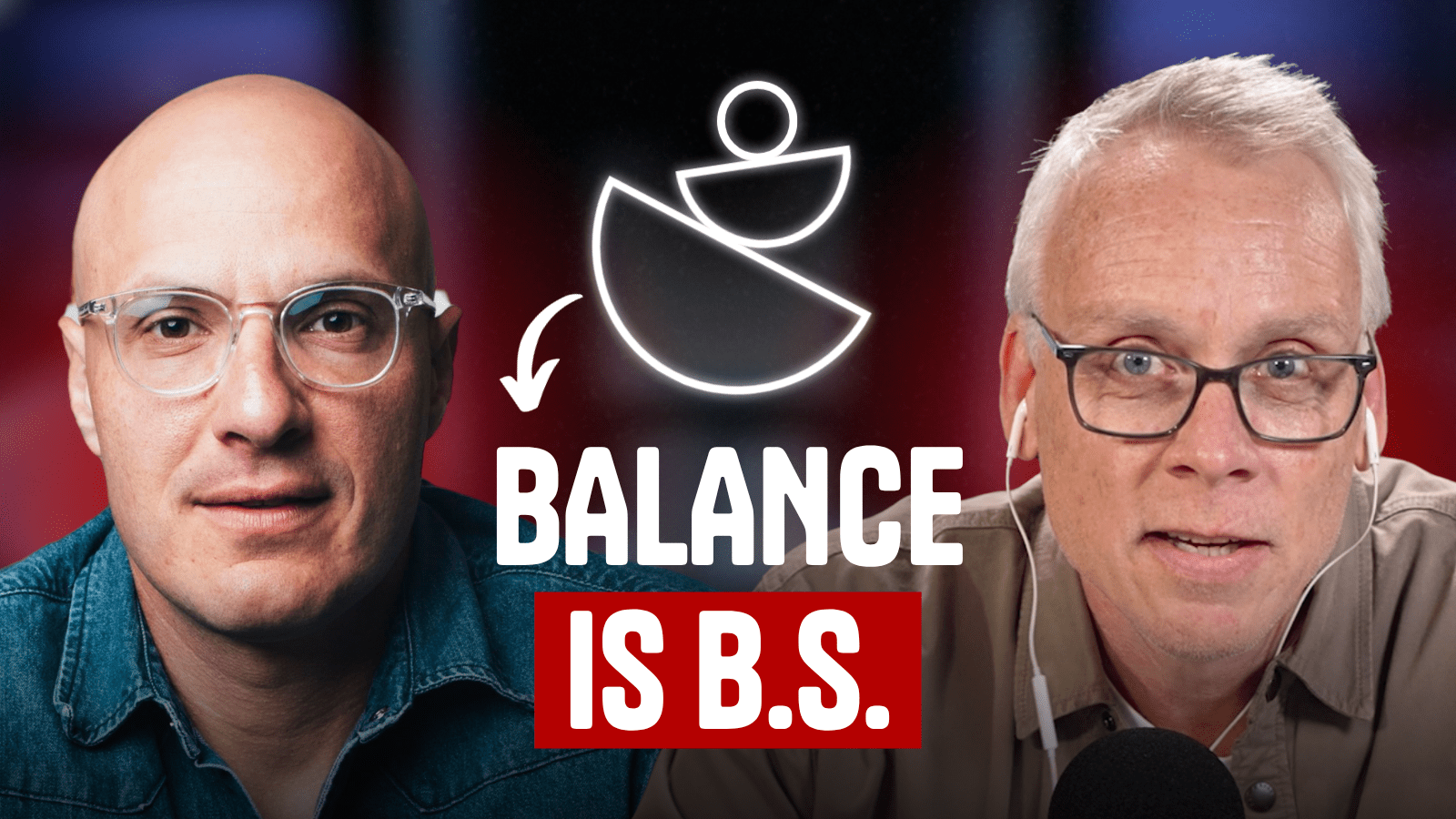
And what ends up happening is by trying to be balanced, which the self-help industrial complex says will make you stress free, you end up stressing yourself out because you feel like you’re never really giving anything your all. And I flip that on its head, just like you do, and I actually say balance is BS. What we should do is we should identify the things that matter to us and give those things our utter all.
Now, here’s where I think there’s some nuance. There is a danger, in my opinion, I’ll be curious what you have to say, there’s a danger when we only have one room in our identity house. So, when we only have one thing that we define ourself by, and we fuse our identity to that one thing.
So, if you think about a house, if a house has only one room in it, and that one room catches fire or floods, it’s very disorienting. You have to move out of the house altogether. If you have a house that has more than one room in it, and one room catches fire or floods, you can go seek refuge in the other rooms while you do what you need to do to repair the damage from the fire or flood.
And I’ve come to think about identity the same way. If you have an identity house and the only room in your identity house is athlete, then, if and when you get injured, or if and when you have to retire, or if and when you have age related decline, you’re gonna lose a sense of self. It’s gonna be extremely disorienting. But if you have more than one room in your identity house, if you have athlete as one room, and then another room might be husband or wife, another room might be book lover, another room might be volunteer coach, another room might be coffee aficionado, it doesn’t matter what the rooms are, well, then, when you face a crisis in one room, you can go seek refuge in the others.
And why I love this metaphor is the rooms don’t have to be the same size, and they won’t be. Your one thing room will be the biggest room. If you are a craftsperson, craft will be your biggest room. And, if you’re a family member, maybe it’ll be craft and family, and then you’ll have these small little rooms. You don’t have to spend the same amount of time and energy in each room either, okay? Over the course of your life, there are gonna be different seasons where you’re spending 95% of your energy in one room. That’s fine.
All that I argue is that you never wanna just have one room, and you never wanna let other important rooms get moldy. Because when I’ve reported for the last 20 years on this topic of excellence. And I take, I shouldn’t say special interest, I love all of my interviewees, but I really take special interest in old-timers because they have so much wisdom. And when I look across the life cycle of these people, when you zoom in on any one moment of their life, they don’t look balanced at all. They’re almost exclusively going all in on one or two things. But when you zoom out and you look across the entirety of their life, they actually start to look somewhat balanced.
So, they have different seasons for emphasizing different rooms of their identity house. And I think that’s key to peak performance, and I think that’s key to a good life.
Jay Papasan:
I think we very largely agree on all of that. I think when we teach people there’s places that you put your energy. You have your spiritual life, your health, mental and physical, your relationships, your work, your craft, all of those things, we try to get people to focus on the things that really matter in them because we often do have time.
If you really wanna have a great relationship with your wife, are you getting one-on-one time with her even when you have small kids, right? If you really want to be, a powerlifter, can you still make it to the gym four or five times even though you have small kids, right? How do you figure out the 20% and you rail on all of the 1% methods, like cold plunges, all the things that make marginal gains versus the foundation. We just tell people, “Focus on the foundations, so that you can be good enough, so that you’re not failing those other really important rooms of your life.”
I don’t wanna fail as a father. There may be a period of time where work took over, but then I wanna counterbalance and go be really present when I’m at the soccer game and not on my phone.
I will say, I did a research study on famous mathematicians, and what I discovered is they don’t just work on one problem. They tend to have two to three big problems they’re wrestling with. And on the days that they’re not inspired to work on the one, they find that they are inspired to work on one of the other ones. And I think that metaphor works in all of these areas. If you have more than one room for your identity, you may be really stuck. Maybe you’re an injured athlete. Maybe your business just failed, you can lean your energies into the other things you’re truly passionate about and find meaning in your life.
Brad Stulberg:
That’s 100% it. But by no means, are we striving for balance because to your point, we’re saying, “Pick the important rooms.” And you can have really small rooms. I have a very small room in my identity house for watches. I love watches, but I spend two and a half hours a year thinking about watches. So, maybe it’s not even a real room. Maybe it’s a drawer in a room.
But I think what I like about this is, again, different rooms get different sizes. And then, you spend different amounts of time in each room. And when you’re going all in one room, you can’t be all in all the time. I got this from a wonderful realtor named James Shaw, and he says, “It’s okay to be all in, but you can’t be all in all the time.” And what he meant by that is when you are pursuing a big project, that’s the room that you’re gonna spend the most time in, but you’ve gotta have a minimum effective dose for your relationship room, for your health room. It’s those foundational things. And I think that over the long haul, that’s what makes excellence sustainable.
Jay Papasan:
It’s pausing just long enough to ask not just what do I want to do, what’s worth doing. And then, within that, what actually matters. And it just takes a little bit of reflection. Most of these answers are available on Google or you read a couple of books by people who’ve gone there before you. The things they have in common tend to be the foundational things, not their unique flair for the sport or whatever it was. They’re very discoverable things that we can find.
So, I love that attitude. It would keep people from hitting dead ends in their life and having those horrible periods where they just don’t know what to do next because their identity was tied to their job, to being a parent. I’ve seen couples get divorced when their kids go to college ’cause their whole identity as a couple was around their kids. They didn’t have another room in their relationship to go to.
So, it’s great advice, and I love it. Before we wrap up, you said something, too, like the long haul here. Rest and recovery are required on the journey to excellence. And one of the quotes that we throw around here was by a guy named Ian Simpkins. He said, “If busyness is your drug, rest will feel like stress.” And so, I know a lot of people that the moment they are going to rest, they literally feel the jitters. They don’t know how to rest and recover. What advice can you give them? I know that elite athletes get this. You can’t just go to the gym and PR every day. You have to have recovery periods. How do we do this for our knowledge work, for writing, and for other pursuits?
Brad Stulberg:
Ooh, this gets back to the question about obsession and how it’s really hard because when you’re a creative or a writer or a business person, you can be at a family dinner, but your brain can be on page 11 of the business plan or on the meeting that you have to have tomorrow. So, it can be really challenging to turn it off.
A few things. The first is I would say that if you are predominantly a knowledge worker, “rest” can come in physical pursuits. So, when I go to the gym or when I go on a bike ride, that’s rest because my mind has to focus on lifting the weights or balancing the bike, so I can’t be thinking about my book or work, at least not at the same intensity as I’m accustomed to. So, rest doesn’t mean you have to lay on a couch and close your eyes and meditate. It can be that, but it can be something else. So, I think of it more as switching out of your primary domain into something different that nudges you to check out.
I think another great way to rest is to read. And if you’re a knowledge worker and every time you read a book like this, you find yourself taking notes and building on ideas, then read fiction.
Jay Papasan:
Thank you for saying that. Say that again. I know so many businesspeople who think that reading fiction’s a waste of time.
Brad Stulberg:
No, that’s how I rest. So, it’s funny because I should be selling my book, which is a nonfiction book, and I think you should read it, but the way that I rest is not by reading nonfiction. It’s by reading great fiction stories because I’m not marginalizing, “Oh, this is something that I could apply to my work.” I’m getting lost in the story. There’s so many great documentaries that you could watch.
So, I just think it’s like allowing your mind to get lost in something that is not work is very helpful. And then, the second thing I’ll say, and I have no idea where you stand on this can be a very controversial topic, I think that while it’s good that we spend a lot of time talking about rest and recovery, I think, now, there is this entire industry of all these rest and recovery products that turn rest and recovery into a job.
So, if you have to measure every single heartbeat, and not even every single heartbeat, but the space between heartbeats, and if you’re worried about your sleep score and your readiness score, and you’re going to bed literally stressed about your sleep score, then you’ve turned what is supposed to be the most replenishing part of the day, sleep, into work. You should not have to work at sleep.
And there’s nuance here. If you’re someone that has struggled with your sleep or you’re someone that’s struggled with drinking and wearing a Whoop or an Oura Ring helps you drink less and sleep better, that’s great. Keep doing it. If you’re listening and you’re like, “Oh, no, Brad’s seeing through my soul,” “I need to try to get the perfect sleep score,” then guess what? You just turned rest into something to excel at, which is not the point of rest.
So, I don’t carte blanche say let’s completely get rid of all these recovery tools. What I do say is that we need to be careful about turning rest into yet another thing to be great at. Because if you’re trying to be great at resting, then you are no longer resting.
Jay Papasan:
Okay, so there’s a famous saying out there, and I don’t know who to attribute it to. It’s when the measure becomes the target, it ceases to be a good measure. And I think that’s what we’re talking about here.
In the beginning, I know my wife struggled with perimenopause. We got an Eight Sleep, which was amazing. We started looking at our sleep scores and “Oh, wow, we ate too late last night. That’s why we had…” We were learning and getting feedback on how to sleep better.
I actually was writing in the margins in this section of your book, because I’ve experienced this. If you wake up at 2:00 a.m. to go to the bathroom or whatever, and you start wondering if that’s gonna make you have a bad sleep score, and because you’re wondering about it, you don’t sleep.
Brad Stulberg:
You don’t fall back asleep.
Jay Papasan:
Right. It actually is now working against you. And so, I think you actually wrote that very scenario on the next page. So, I was like, I wasted some margins there. But I see that a lot in the quantified life. I like to track because a lot of what I do is not measurable in the way that athletics are. So, I try to track some things, but I track them to learn, not to win. It’s not a competition in everything. And I think if we can take that attitude of a lot of these tools are great to teach us to be better, but if we’re competing in all of these areas, we’re just stressing ourselves out.
Brad Stulberg:
I think that’s 100% right. I think it’s a tool, and you just have to honestly ask yourself, “Is this tool still helping me?” And then, you also have to acknowledge that often the tools that work work until they become the very thing that get in the way.
So, the easy example in training for sport is you wear a heart rate monitor, and it teaches you so much, and it helps you get on the path, and you wear that thing for eight years, and it makes you a great athlete. And then, eventually, the best thing that you can do for your performance is ditch the heart rate monitor because, now, you just have to let the magic happen, and you don’t wanna look down at that watch and say, “Oh, no, I’m two beats over, I need to slow down,” because you might just be having a breakthrough day. But that heart rate tool is the whole thing that got you to the point that you could let go of it, and I think that’s true of so many of these tools.
Jay Papasan:
I love that. Actually-, we’re not gonna go down the watch train ’cause I think we could waste a lot of airtime, but I just gave up my Apple Watch. I still have it. I wear it only when I work out. We have a trainer that comes to the house. I’ll wear it, so I can know where my heart rate is in a particularly intense workout, but then I put it back down.
And I’ve started wearing an analog because I find that it was becoming a burden for me. Like, how many steps did I get? All of those things. I’m a huge proponent of walks. It shows up a lot in your book here. It doesn’t mean, like rest, like you said, doesn’t have to be literally, like convalescing like someone who’s ill, right? It’s not like they used to treat people who had consumption and “Sit in this Adirondack chair for the next six months until you’re better.” No, get outside, go for a walk, right?
Sometimes, just being in motion and moving to a different distraction is exactly what our body needs to have relief from the stress of overthinking and putting so much pressure on ourselves. So, I’m looking for ways to disengage with that part of my competitive brain, and I think a lot of people listening need that as well.
Brad Stulberg:
Well said.
Jay Papasan:
All right. Let’s wrap up with one thing. You have a whole chapter on community. And this idea, a lot of high achievers in their pursuit of excellence, they have chosen to be there for their business or their sport. They’ve chosen to be a good spouse, a good parent. They’ve got those core rooms, and they’re taking care of them. The pattern I see most frequently, and I’ve lived, is that the thing they neglect is keeping and building a community around them, right?
It can feel like it slows them down. Am I really going to go to that conference to see those people when I could keep doing the work? Talk to us a little bit about the importance of continuing to nurture a positive community around us, ’cause I think that gets lost in the shuffle, especially when entrepreneurs and high achievers have kids, and they get that extra thing, they start to let those relationships slide when they are so important to our long-term success.
Brad Stulberg:
Well said. So, the way that I like to think about it is in the short run, community is very inefficient because to your point, it just gets in the way of work. And oftentimes, you have to drive places to meet people, and you have to deal with scheduling, and then someone might not be late. And it’s just so inefficient to make time for relationships, especially if you’re married and have kids. Who has time for other people in one’s life?
However, in the long run, having community, having people that are there to pick you up when you fall, to provide gravity when you soar, just to be there for you Is, I think, the most efficient thing that you can do for your success. So, we have to avoid this myopic trap of what’s the most efficient thing today, and think about what’s gonna be the most efficient thing over the course of a career. What’s gonna be the best thing over the course of a career?
There’s also some fascinating research from hospice that shows that on their deathbeds, people rarely reflect on the accomplishments. They don’t say, “I remember the day I won the gold medal,” or, “I remember when I got promoted to the C-suite.” What they reflect on when it comes to work is the people that they worked with and the relationships they forged while striving.
So, my advice for a high achiever and an ambitious person, and it’s the advice that I try to follow myself, is I am not the mayor of Asheville. I’m not the most social person in town. I don’t very often just go out to drinks to shoot the breeze. But when I work toward a goal, I always try to do it with other people.
So, you can write a book alone or you can write a book with a team. You can train alone or you can train with a group of people at a gym. And when I try to work, I try to ask myself, “Unless I absolutely have to be doing this alone, can I do this with other good people?” And to me, that’s how you build that community while still pushing and while still being an ambitious person.
Jay Papasan:
If you can curate a community that has similar goals and similar values and, hopefully, similar philosophies about their process, it becomes a tailwind like no other in my experience. And that’s the advice I try to give to my kids and try to take myself. The reality is, for some of us, like you’re in Asheville, you may have to get on a plane sometimes or get on a Zoom to hang out with the people that are pursuing the same things with you.
I know a lot of female entrepreneurs don’t always look around and see a lot of people in the same lane that they are, so it’s not something that will passively happen. That would be the only thing I have to add, is yes, it’s important, we know that, but we may have to actively make it a goal and actually treat it like a goal, so that we’re actually making sure that those people are around us and we’re there for them.
Brad Stulberg:
And you’ll never regret it. So, one of my best friends in the world and a close colleague is Cal Newport. Excellent book he wrote called Deep Work.
Jay Papasan:
Oh, wow. Deep Work, one of my heroes.
Brad Stulberg:
Yes. And it’s a great book. Cal is the real deal. He’s such a good person. So Cal lives in Washington, DC, and we spend hours on the phone every week. But we just don’t see each other in person that often. And I had this book out. He has a book coming out next year, so we’re really busy. And we said, “Screw it. We need a retreat. We need three days where we’re just taking walks, we’re talking, we’re thinking about the future.”
And when I scheduled it, I was so excited. Two to three days before it, I’m like, “Cal, should we cancel? I don’t have three days during the week to do this.” We’re like, “No,” “Stay the course. We’re doing it.” So, Cal came down to Asheville, we both took three days off work, and it’s the highlight of my last year. Bar none. And did I lose some book publicity and some book sales? Was my Substack article that week not as good? Absolutely. But what I lost in one or two weeks, the compound effect of that experience and just how much joy it was and how energized I was out of it, let alone the things that we talked, to your point, that’s the wind in your sails that is gonna fuel a career.
And that gets back to exactly what I said about you sacrifice short-term efficiency – the tweets, the Instagram posts, the Substacks that week – for long-term, I don’t even wanna use the word efficiency-
Jay Papasan:
It’s effectiveness.
Brad Stulberg:
… but for long-term excellence.
Jay Papasan:
Yeah.
Brad Stulberg:
Effectiveness. Thank you. It’s effectiveness.
Jay Papasan:
I love that. All right. I could keep going. I’ve got three more pages of notes, so we may have to pick this up another time. So, for our listeners who are arriving at home or arriving at work or they’re rounding up their dog walk, however they choose to listen to this podcast, of all the things that we’ve talked about, where would be maybe a challenge they could take, a small challenge, like a 30-minute challenge just a little exercise to maybe take action on one of the things that we’ve talked about this week, Brad?
Brad Stulberg:
I like starting with “Brave new world.”
Jay Papasan:
I do, too. I’m so happy you said that.
Brad Stulberg:
So, it’s a mindset shift that you get just from listening to the podcast today, but it’s an ongoing practice, too, which is when you feel yourself having those nerves, having those doubts, a little bit scared, you can tell yourself, “Brave new world.” This is a new horizon. I’m scared because I’ve never done this before. I’ve got some evidence, hopefully, so I can have a little bit of confidence that I belong here. I don’t know if I’m gonna win or lose or if I’m gonna succeed or fail, but let’s go find out.
And just inject that into your days, into your weeks, when there are big events, into your months, and it starts to become second nature, and you start to feel less fear and more curiosity. And it doesn’t even mean that you win more. I assume you do, but I have no idea. Maybe your failure and success rate’s the exact same, but you certainly feel a lot better as you go about it.
Jay Papasan:
It’ll help everyone enjoy the journey a lot more. Brad, thanks so much for pouring into our listeners today. And if you had any doubts, your work has meaning and impact. I think today, with everything that’s happening, all the digital distractions, everything that busy professionals, parents face, what we need is a little bit more of this philosophy of excellence, mastery, meaning, values. If we can bring that to our life, I think a lot of us would feel a lot better. So, thank you for publishing this book. I hope everyone listening will go buy it, The Way of Excellence by Brad Stulberg.
Brad Stulberg:
Jay, this has been an honor and a pleasure. Thank you.
——————————
Disclaimer:
This podcast is for general informational purposes only. The views, thoughts, and opinions of the guest represent those of the guest and not ProduKtive or Keller Williams Realty LLC and their affiliates and should not be construed as financial, economic, legal, tax, or other advice. This podcast is provided without any warranty or guarantee of its accuracy, completeness, timeliness, or results from using the information