Jay Papasan:
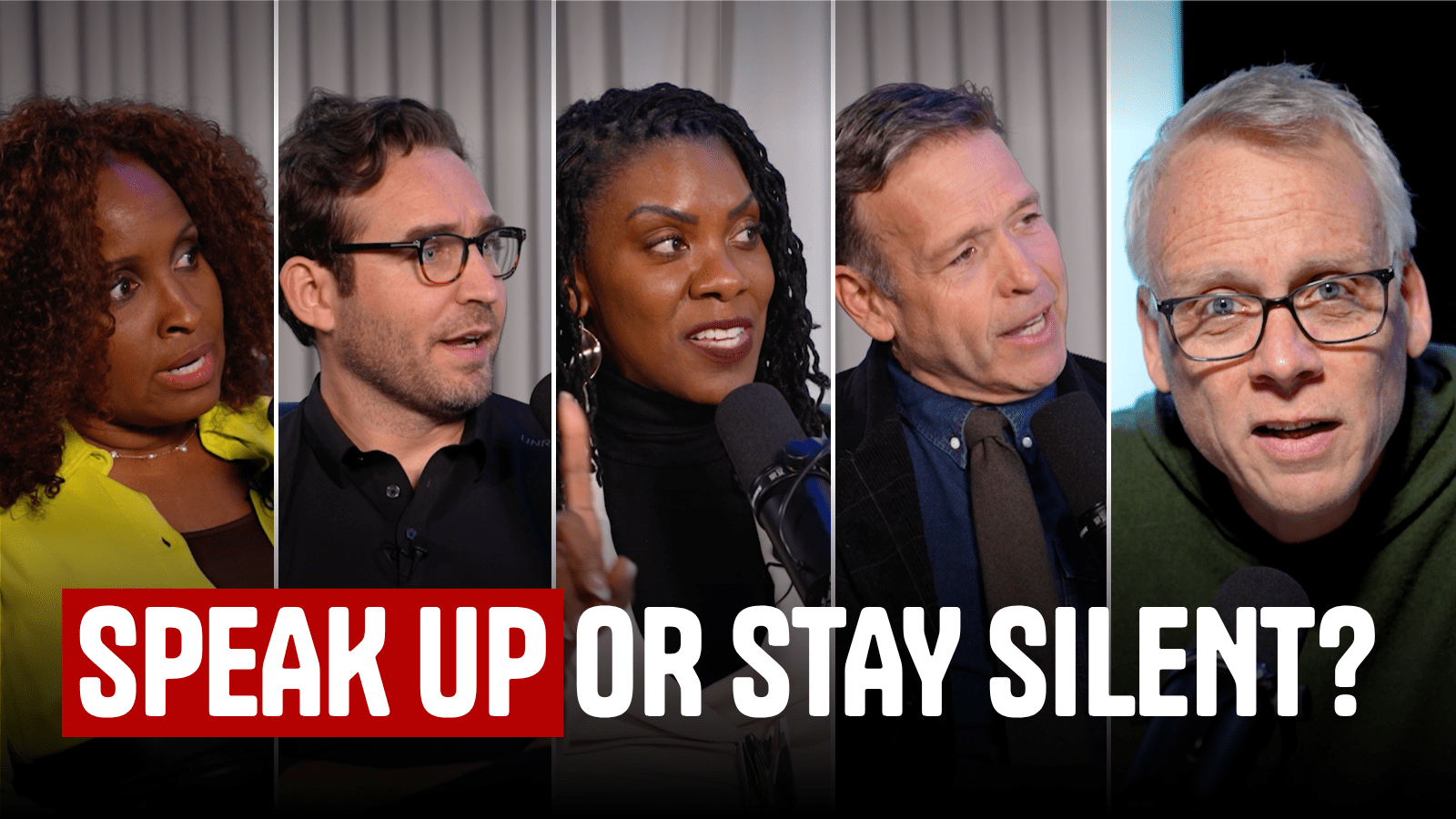
When bad things happen around the world, should we be silent or should we speak up? This is the question every business owner I know is wrestling with right now. It’s not the first time we’ll have to deal with it, and it certainly is not the last. And this decision to speak or be silent has a really big impact. It impacts our personal relationships, it impacts our careers, it impacts our business’s growth and profitability, our ability to attract and retain employees, it has an impact across all of those areas at the same time. There are strong expectations on both sides. People are looking for us to hear our voice, what is our position; and at the same time, we’ve been taught, sometimes through really hard experiences, the staying on the sidelines can be safer, that neutrality is better for business. It’s a big decision and we should make it wisely.
I wish I could tell you a definitive answer for every single person listening ’cause you’re probably wrestling with this too. Do I take to social media? Do I take to my platform and let my voice be heard? Well, the answer can be complicated. But I do promise you in this episode, I’m gonna give you some tools that you can make a great decision for you, your relationships, and your business.
————-
Jay Papasan:
I am Jay Papasan. And this is The ONE Thing, your weekly guide to the simple steps that lead to extraordinary results.
————-
Jay Papasan:
Like every great conversation, let’s start this with the right expectations. This is not gonna be an opinion piece. This is gonna be a coaching episode. Coaches don’t tell their clients what to think. They teach them how to think about the problem. When we ask the right questions, that’s how we get a great answer.
Now, this is a question, “Be silent or speak up?” that I’ve been wrestling with for a while personally. I’m in a community of authors, podcasters, YouTubers, people with literally, together, millions of followers, and we’ve been asking the question, with everything that’s going on in the world, do we have a moral obligation to speak up? And if we do, how do we decide how to do it and what’s the right framework? So, I’ve been talking to friends, I’ve been talking to coaches, I’ve been talking to people who are authorities around these areas to try to help give you an informed framework for making those decisions.
Now, The ONE Thing is built around asking great questions to get good answers. And a big part of the formula of living The ONE Thing is learning when to say no. So, the default answer you might think is silence, right? Don’t do that thing. Don’t add to the noise. Don’t add your voice to the tone that that’s already happening. At the same time, I mean, there’s ancient wisdom, and I think Plato was around 2400 years ago, he’s walking around telling us, “Silence gives consent.” And that’s like a punch in the gut if you’re really wrestling with this question. Is my silence, in fact, a statement whether I intend it to be or not?
Just today, preparing for this episode, I glanced at social media, and there was a post that was starting to trend – tens of thousands of likes, thousands of comments – and on it was listed about 12 huge people. These are people with giant podcasts. And every single one of them had millions, not just one, millions of people following them online. And the headline was, “These so-called spiritual leaders are still silent.” They’re all being judged, fairly or not, because they haven’t weighted in and commented on the issues.
So, I looked at the comments, the number one comment, the one that had been kind of… I think it was 493 likes when I looked at it, it was buried at the top, just asked a question, “What exactly do you expect them to speak up about?” And I think it was a genuine question ’cause the person then listed about 10 crises around the world — wars, conflicts (domestic and foreign) – that they could be expected to talk to. Are they expected to talk to all of them or one of these specifically? Whether we are big enough for people to be calling us out, people are judging you today for your silence, fairly or unfairly.
I think the framework that I will share with you in this episode will also apply to when we judge others. We can, at least, ask the question, should this person be one of the people who speaks up about this?
Before we dive into, kind of, the formula, let’s just talk about the stakes. Nobody here. Unless you are a politician, a parliamentarian, a public official is likely to walk out their front door or walk out of their business and be faced with a parade of reporters with cameras and microphones saying, “What is your position on ‘fill in the blank’?” That’s just not the reality. Yet, every day, and we’ve seen it for years now, a lot of our colleagues, a lot of the business owners we know have to weigh into these things and very publicly state their positions.
I don’t know if they’re being courageous or self-serving. I don’t know if it’s a protective mechanism, or they’re just getting something off their chest. They could just be venting. But the reality is the world as it is, there is no positive incentive right now for doing this. We’re feeding an algorithm. When we vent, we may feel better, but we’re actually just raising the temperature on everything. All of the algorithms that you see, whether it’d be the media or social media, they are incented to be outraged machines.
So, when we vent, we raise the level of volume for everyone, but is it really being helpful? That’s the question. Your choice to speak up ultimately, I believe, should be about making the world a better place. And is that, in fact, what we’re doing or are we just jumping in with everyone else so that we’re not seen is on the sidelines, but we’re actually not helping, we’re making the problem worse.
So, for this episode, I was not about to tackle this alone. I reached out to my coach, I reached out to my past coach, I talked about it with my team because me even doing this episode has consequences beyond just me. People can criticize my point of view. You might think that the framework I’m gonna share isn’t valid for you. That’s fine. But my employees had to give their consent too. Are they okay with me having this conversation with you? There are other people who are impacted, especially when a business owner takes to the stage to give their point of view, and we have to consider all of them.
So, I sat down. I talked to my team, I talked to my wife, I talked to my partners, my coaches, I talked to my colleagues. How are they addressing it? How do they think about it? And I even went to some thought leaders that I really respect and asked them how they would answer these questions, so that we could share those answers with you. So, I’m gonna share little snipbits in the first part of this of the answers for some really serious thought leaders who have great experience and with dealing with this over time. This is not their first rodeo, and they have real hard won experience around it.
In the second half of this episode, I’m gonna share a six-question framework that if you can ask and answer yes to all of them, your choice is very clear. You need to speak up. But if you get a no along the way, then you have to make a different choice. It doesn’t mean you’re not doing anything. It just means that you’re doing something different that could be equally effective.
So, let’s dive into the first part. Let’s hear from some great thought leaders around how we should think about this issue of being silent or speaking up.
————-
Jay Papasan:
The first person I chatted with is Julia Lashay-Israel. She and I worked together for about six years. She came in as a thought leader in our industry to help us with managing inclusion policies among all the different constituencies in our giant worldwide organization. It was a monster job, and it just happened to coincide with a lot of the social unrest that kicked in after 2020 and COVID.
So, she had a big job. She was in a lot of loud rooms. And as expected, Julia jumps right in with a framework that she uses for how to make this decision. It’s the Rotary Four-Way Test.
Julia Lashay Israel:
So, here’s what I always teach people about social media, and many people might be familiar with this concept. It’s the Rotary Four-Way Test. For people who don’t know what Rotary is, it’s a rotary club and the Four-Way Test is, “Is it the truth?”
Jay Papasan:
Okay.
Julia Lashay Israel:
Is it fair to all concerned? Will it build goodwill and better friendships? And will it… something to bring people together? I’m gonna say that last one wrong. And it starts by saying, “Of the things you think, say and do, is it the truth? Will it build goodwill? Will it build friendships and better community, you know?”
And so, I use that Four-Way Test for social media, for taking to… so not just of the things you think, say and do, but also for things you post. Is it the truth? Is it fair to all concerned? Will it build goodwill and better friendships?
Jay Papasan:
That’s a big one.
Julia Lashay Israel:
Yeah.
Jay Papasan:
Right, not just-
Julia Lashay Israel:
Because there’s a lot of things I have spoken about.
Jay Papasan:
Not just goodwill for the people who agree with me.
Julia Lashay Israel:
Correct, correct. And so because… unless your intention is to be divisive and to divide the world, which most of our intention is not, I don’t share anything that would be contradictory to building goodwill and better friendships in a better community that we all live in. We all have a perspective.
Jay Papasan:
Right.
Julia Lashay Israel:
And that’s the beauty of us being different people, the beauty of the diversity that is us. We all have a different perspective. Just because mine is different than yours doesn’t make me right and you wrong. And the only way to live in that is, will it build goodwill and better friendships by what I’m going to contribute? Is it even a contribution?
Jay Papasan:
Right.
Julia Lashay Israel:
Or am I just wanting to be heard because I think I’m right? So, I often use the Rotary Four-Way Test as also a, “Is this something that’s going to help the greater good?”
Jay Papasan:
Okay.
Julia Lashay Israel:
Yeah.
Jay Papasan:
I have a theory around that. I think that one-way communication often doesn’t.
Julia Lashay Israel:
No, absolutely not.
Jay Papasan:
Right?
Julia Lashay Israel:
Yeah.
Jay Papasan:
So, like, the other-
Julia Lashay Israel:
Yeah.
Jay Papasan:
I’ll add a fifth to that, and it’s just… is this gonna be a conversation? Or am I just trying to impose my viewpoint whether it’s true and I do believe all those other things?
Julia Lashay Israel:
Sure.
Jay Papasan:
I think that we don’t change people’s minds with slogans. We might drive people to act and to mimic or to respond, but if we’re really trying to have a dialogue, we have to be willing to have a conversation and also listen if we want to be heard.
—————–
Jay Papasan:
I love that Julia is so thoughtful about this. It’s exactly what I expected. One of the things that she said later, ’cause we end on this idea that to change people’s mind, it’s actually gotta be a conversation. A post on social media is not gonna do it. And she shared a dialogue that she had with someone who pretty much thought everything in the world was the opposite of the way she believed it, but she was curious, she used the Four-Way Test, she had a conversation. And her takeaway, and this just is the great truth, when you get to know people, even if you disagree, she said, it’s hard to hate up close. When we truly see people for who they are and why they believe what they believe, it’s really hard to have those intense negative kind of emotions. We may disagree vehemently, but we’re not attacking the person. We’re attacking the idea now.
So, I love Julia’s contribution. Let’s move on to the next, my friend, Phil M. Jones. Phil’s the author of a book that’s millions of copies now, Exactly What To Say. Hey! So, I asked Phil exactly, what do I say or not say around this issue when there’s big things happening around us? Do we, as leaders, as business owners, do we speak up or do we be silent?
—————–
Phil M. Jones:
There’s something we teach a lot in our work, which is you have to slow the process down to speed the outcome up. So, this is the mindset that I would bring to these environments. It is to be very fast to seek to understand and slow to judge.
Jay Papasan:
Yes.
Phil M. Jones:
And the older and wiser I’ve got, the less I know for sure, which has become a helpful belief when you look at some of these sort of high stakes environments. So, my actions would often be is, to when to speak up is not necessarily just a when, it’s a how to speak up and what modalities you choose.
To slow yourself down, I’d ask a few questions. This is what I’d ask myself. One is I’d ask myself, who am I?
Jay Papasan:
Right.
Phil M. Jones:
And I’d really get clear on that at that moment in time.
Jay Papasan:
What I stand for, who I am.
Phil M. Jones:
Yeah. I then go, “Who are they?” And I’d look at that too. And I’d go just as detailed. I then ask myself the question of who am I to them? And then, I’d then ask the question, who are they to me? What I then remember is the curiosity is the fuel to a great conversation. And I would assume good intent on the behavior that I believe is misinterpreted.
Jay Papasan:
Okay.
Phil M. Jones:
And I would seek to try to understand it in as public a setting as possible.
Jay Papasan:
In a dialogue?
Phil M. Jones:
In a dialogue. And I would go into those conversations knowing I don’t know enough to be able to judge that the opinion that I believe is morally in apt or not in line with the future that’s in the best interest of the country, or even if I believe it is diabolical or disgraceful, I would save enough space to think that there might be good reason for why this could be existing. And I would, with strength, look to be able to approach conversations on the side that I disagree with, to find out what I don’t know, and look to try to do that in a public setting.
So, move slow, move intentional and if there is something that you really, really feel needs to be spoken up about, build your army before you go to war.
————-
Jay Papasan:
Phil doesn’t disappoint as always. Lead with curiosity. Slow down. There are very few things that wouldn’t benefit from those two steps. Get curious. What are you waiting into? Do you really understand it? Do you really understand the person or the people you’re talking to? Do you have a good enough understanding of yourself to understand how you really feel about it? Or are you just reacting to it?
There are very, very, very few things in this life that are not gonna benefit with a good night’s sleep. So, I love that wisdom and how he articulates it. Be curious first and slow down before you speak up.
Next, I talk to my friend Donald Miller. He’s the author of StoryBrand. He is a world-renowned brand marketer. He helps people tell their stories, and he has literally helped people all over the world, including political parties, tell their story. So, he has steeped in these issues. He’s dealt with them personally, he’s dealt with them professionally. Let’s hear what Don has to say.
————-
Donald Miller:
You know what, that is such a careful algorithm to figure out because it is true that you speaking up could cost you your business, it could cost your people. That’s a calculation that you need to make. The question that I do ask myself fairly often is, you know, it’s the old, “On my deathbed, will I not regret?”
Jay Papasan:
Oh yeah.
Donald Miller:
Will I not regret saying something or speaking up? That’s question number one for me. Question number two is, am I uniquely qualified, calibrated that I can actually do something about this? And then, I would just wanna be really careful that I think as a business leader, you going on social media and complaining about something is actually never good for your brand. You know, you just saying, “I don’t like this” is not good for your brand.
So, actually, to sit down and say, “Hey, what do I think of this? What can I actually do about it? Why do I care? And what’s my plan or what plan am I joining to actually change this?” I would get all that done before you actually speak up.
——————
Jay Papasan:
Once again, you have a great thought leader leading with questions instead of answers, and those are really good questions. Will I regret this later? That’s one that if we pause to think about it, we might see is this a momentary thing or is this a big thing, right? Am I seeing it in the right context, the context of my life, or the context of the moment?
And he also talks about some of the other calibrations we do as business owners, right? What I love about that, when I read a book that is a hundred percent about identifying the problem but doesn’t offer a solution, I get very frustrated. So, he’s telling us, as thought leaders, as business leaders in these roles, if we’re going to identify the problem in our speech, have we thought through enough to point people to a solution?
So, next up is a new acquaintance. Valerie Burton is a coach. She’s also an expert on resilience. She’s worked with business leaders around the world as well. And she’s got a great answer for us to explore as well.
—————-
Valerie Burton:
I think it’s something in our current environment that everyone has to contend with, figure out their way on. I think one of the most important things you can do, this is how I approach it is, one, what is your mission? Because there’s a lot of chatter. I always wanna know, am I adding to the noise or am I providing clarity of some sort? I found for myself, sometimes that takes me a minute. I think I have a responsibility not to simply speak out of my emotion-
Jay Papasan:
Right.
Valerie Burton:
But to be able to process, so that I can then share something that’s actually going to be helpful to my audience. I think that takes a sense of empathy. I’m feeling the same things that many people who may be in my audience or maybe clients of ours are feeling. How do I help them navigate that in a more resilient way?
So, I think that’s really important. Are you adding to the noise or are you giving more clarity? Are you providing something practical or a tool that’s actually helping people? So, I think that’s one of the most important things we can ask. And I think that helps you to have a clearer voice when you decide to speak on issues that might not be directly related to your business.
Jay Papasan:
Right. If it’s directly related to your mission, it might be a clearer answer for you. But in the absence of that, I think when you talk about, “Will I add to the noise or will my voice be a part of the solution?”
Valerie Burton:
Yes.
Jay Papasan:
I think sometimes our urge to speak is more about serving ourselves than the people we serve ’cause we’re just trying to maybe remove this sense of “I have to do something” versus asking a bigger question is, what is it that I should do that it’s actually part of the solution?
Valerie Burton:
Yes. And so, speaking is one thing you can do.
Jay Papasan:
Right.
Valerie Burton:
Right. But there are other things you can do that may not appear loud. right?
Jay Papasan:
Right.
Valerie Burton:
It might not be using your megaphone but it may be serving solutions within the greater problem.
Jay Papasan:
Right.
Valerie Burton:
And those things may seem quiet because you’re not talking loudly about them, but they’re actually making a difference. So, I do think there’s a time to speak up and to be very clear but I think the answer is different for everyone.
—————
Jay Papasan:
What I love about Valerie’s answers, one, just also you can hear it in her voice where Don is coming from a place of strategy, she’s coming from a place of empathy and she actually named that, “Will my voice help my people be more resilient?”, which is a big part of her mission. So, she’s tying it first, is this a part of my mission? Can I connect it to my mission? And then, will I be adding to the noise or creating clarity? And then, she echoes a little bit of what Don says, like ultimately she wants, also, to point towards a solution. Is what I’m doing here actually going to be useful?
And if you add all of these up for experts in different realms, all of them great communicators, you have an inclusion expert, you have a storyteller, you have a communications thought leader, and you have a resilience coach, a leadership coach, but they’re all saying some versions of the same thing, right? Be curious, slow down, be thoughtful about it. The consequences of either choice – silence or speaking up – could be high and if you thought it all the way through.
So, they’re all saying different versions of the same things. They’re all asking different questions that, hopefully, lead us a little closer to the answers. And I use those interviews with them as a part of my journey of getting curious and slowing down.
Now, I took those answers, I worked with my coach, I did a lot of thoughtful reflection, and in the second half of this episode, I’m gonna share what I think I do best is take a bunch of different ideas and put them into a practical framework that you can use so that you can ask the right questions for your life. So, we’re gonna take a quick break. And on the other side, I’m gonna walk you through the three arenas that we face this question in. And then, the Six-Question Framework that you can find your answer about whether it’s right for you to be silent or to speak up.
——————
Jay Papasan:
All right. Welcome back. In the first half, we talked to some experts as a part of this journey. And now, I’m gonna walk you through some models. And just to remind you of how crazy of a time we’re living in, why this is a question we have to figure out now and also probably in the future, I just did some research. In just the last decade, here are some of the issues that we’ve all had to wrestle with. And if you’re listening, I’m just gonna rattle these off as fast as I can. Almost every position has an equal and opposite opposition, right? They’ve got one group that’s saying this, and the other group is saying almost just exactly the opposite.
So, you go back 10 years, and you’ve got Black Lives Matter or Blue Lives Matter. You’ve got DEI and Muslim bans. You’ve got immigration reform and deportations and anti-ICE movements. You’ve got Woke culture; you’ve got Cancel Culture. Book bans, grooming, QAnon, the Capitol riots, stop the steal, election denial, fake news, gaslighting, masking and anti-masking, escalation of conflicts worldwide has led to literally an endless list. Like I get exhausted just reading that because we’re faced with some version of all of those things, it seems like every time we wade into any public arena.
So, where does this show up besides when we’re digesting media? It shows up in three areas of her life. These conversations, “I’m for it,” “I’m against it” can show up in our personal life, our professional life, and obviously in our political life. We tend to think of them as political issues, but we can’t forget they impact the other ones.
So, let’s start with personal. It’s the first arena. Maybe it’s at your holiday dinner table, you’ve got an uncle, you’ve got an aunt, and you’re on opposite sides of the issue. Maybe it’s a friend, and they have a toxic relationship, and you’re asking the question, do I need to say something? And the challenge with a lot of the personal ones is the answer’s usually pretty obvious in a lot of these. I want to say something. My conscious says I need to say something. But the cost here is a personal one. I could lose a relationship. I could become estranged from a family member. I could become estranged from a friendship, right? So the cost tends to be high.
A lot of the issues that I’ve dealt with over the years, it’s not just, should I tell them they have spinach in their teeth? Should I tell this guy that his fly’s down? Generally, those answers are pretty easy. It’s not comfortable. But everybody’s like, “Well, thank you for telling me that.” But the other deeper issues, their relationships, are they dealing with an addiction of some kind? They feel like interventions and there’s a time and a place. Is it our role in the family and their relationship to do it for me? For me, I have a pretty good compass around those things, but I understand in this arena it can be the messiest because the cost is losing a relationship.
So, arena number one is personal. And the big cost, if we get it wrong, is we might lose a relationship temporarily or forever.
Arena number two, professional. So, how does that show up? Maybe your business is approaching business in a way that doesn’t jive with your values. They are taking contracts with or supporting organizations that you really strongly disagree with. Maybe you’ve got a boss that is, in some ways, toxic and anybody who’s ever had to face the question of calling out someone superior to them understands the risk that’s involved. Not only could you lose your livelihood but if you’re leading a team, your whole team could get punished, right? If I pick this battle to fight internally, what’s the cost to me professionally? What’s the cost to my team professionally?
And then, we get to add on another one. It also could impact our personal relationships at work. How do we approach those personal situations in the professional workplace? Big questions. The cost here is doublefold now. If we don’t speak up or we do, we risk not only our careers and our livelihoods, but also our personal relationships.
So, arena number three, political. It’s the big one. It’s kind of the umbrella that sits over the other two. This is what’s playing out mostly on social media. Am I for this party or this cause or am I against it? Do I want this thing to happen or that thing to happen? And it’s big and it’s wide and it’s really, really loud. And the costs here filter through all of them. If you speak up in a political fashion, we’ve seen it again and again, as the leader of an organization or a part of it, it could cost your business customers, it could cost your business employees, it could cost you your career, right? People have been fired, they’ve been let go for taking the wrong step. And then, it rolls downhill one more time. Because it’s so public, because it impacted both the political and the personal and the professional, it impacts all of those areas at the same time.
So, those are the three ways I look at it. Which arena is it in? And as you go up the ladder from personal to professional to political, you realize that everything behind it gets included. If I make a statement at the dinner table, it’s not probably gonna impact my professional or political arenas, right? But it works the opposite, the other way down.
So, with that in mind. Let’s tackle the framework that I’m gonna roll out and test with you today. And I would love to hear from you. Was this helpful? You can share in the comments. Did I miss a question? Should I be looking at it differently? But my goal here is to play the coach. If I were sitting down with a coaching client that was wrestling with this, what questions would we walk through, so that client could get the best answer? And my goal was to come up with a six-part framework, six questions that you can ask. They’re all yes or no questions. And as you work through the progression, as you answer yeses, your answers are leading you towards speaking up. If the answers are no, it’s leading you towards silence. So, that’s how to listen to these questions as I go through them, and I’ll walk you through them one at a time.
All right. So, question number one, am I actually informed about what’s happening? We heard this from our thought leaders. Have we been curious first? Have we paused and slowed down before we speak up? Here’s the reality. You’re probably reacting to something. Something bad’s happened, you feel strongly about it. You’re hurt, you’re maybe frustrated, and you want to vent that out. I totally get that. I’ve been there a million times myself. But are we about to say the right things? Are we about to get the right energy out in the world? As Valerie would say, are we adding to the noise or are we bringing clarity to it?
If the answer to “Am I informed?” is a no, then you need to stop and get informed. It’s as simple as that. It serves no one, not you and your political, professional or personal arenas for you to jump out and pour out some statement that you actually don’t understand.
We have all the resources at our fingertips. Go on your favorite AI tool. Ask the question, what are both sides of this argument? How can I get more informed? And if you still don’t feel like you have a handle on it, and you could face a few questions, pause. Take your time. It serves no one.
So, again, first question, are you informed or not? The answer is no, you do not move forward.
Question number two is, is speech the lever of change? I owe this one to my last coach, Barrett. Very wise man. I walked him through this model and that was his first thought. It’s like, is speech the lever of change? Like if I am wanting to make a change in my world to be a part of the solution, to offer a strategy, not just identify and amplify the problem, is speech the answer? The ONE Thing is about what’s the one thing I can do such that by doing it, everything else will be easier or necessary. If the answer’s not speech, then the answer to this one is a no. If the answer is, then you’ve got a yes. If speech is a part of the solution, it’s a part of an informed answer that brings clarity to the world, then I think you can move forward. If not, then I think we have to pivot.
And this is also where I believe Valerie talks about this. Speech isn’t for everyone. Every movement usually has a vocal leader. It doesn’t have to be all of us. We can support it in different ways. We can support it with our actions. We can support it in our personal and professional lives, not necessarily waiting into the larger arena. What is the lever of change that you are informed and qualified to pull to be a part of the solution? All of this is contingent on making the world a better place and bringing clarity, not just more heat.
Question number three, is this preference, principle or performance? Preference means we have to sit and think, is there really high stakes here? It’s about what you like and dislike. It’s not anything meatier than that. If it’s about principles, now, we’re talking about core values. This is something that kind of cuts you deeper. It’s something that you feel is truly wrong and you feel compelled from a deep sense that you have to do something about it, right?
The first is about opinions. As business owners. I think that’s where the silence and neutrality lives. If it’s about principle, this is where I ask the question, when does being apolitical become a moral? If I’m violating my conscious, if as Don said, I’m gonna regret this on my deathbed, we’re in principle territory.
The last one is something, maybe I’m cynical, I think some people are performative. They are joining the fray, sometimes, with a cynical agenda to attract followers or to move a different agenda than the one they’re talking about. Performative stuff here is kind of the worst place to be. This is a choice I’m making because it’s expected of me, but not because I’m called to do it.
Preference, principle, or performance. The only yes in this is actually in the principle. If it’s about principles, yes, you can move forward. If it’s about preference or performance, then you need to say no and stop.
So, question number four, do I truly understand if someone else will bear the cost of my silence? Now, this is kind of a big one. This is about thinking beyond just you and the consequences for you. It’s thinking about kind of the halo effect around your choice. And originally, it was posed to me, did someone else bear the cost of my silence, right? Is me being quiet actually causing harm, net harm versus net good? But we wanna phrase it as, “Do I truly understand if someone else will be harmed by my silence?” because it’s about understanding and making an informed choice. This is really a question generated to get to a thinking, this is bigger than just me. Especially if you’re a leader and a business owner, will this impact my team, my employees, other people who depend on me? Have I thought about that? If the answer is no, stop. If the answer is yes, we can go on to the last two questions.
Questions five and six are kind of a one-two punch. And so, I’m gonna ask them one at a time, but think of them kind of together. Question number five, do I have disproportionate influence or information? I believe if you have disproportionate influence, you can actually change things. If you have disproportionate information, you can certainly clarify things. That’s one of the reasons that whistleblowers blow the whistle. They’re on the inside, they know the truth, not the company line or the party line. They’re seeing something that’s being buried and they want to reveal it. So, if you have disproportionate influence or information, if the answer is no, then we’re now in that territory of probably not. But if the answer is yes, that’s where it gets for me to be more of a moral obligation to keep moving through. Disproportionate information, disproportionate influence kind of has a higher calling.
So, the last question, question number six, if everyone in my position stayed silent, will the situation improve or get worse? The key phrase there is “in my position.” That’s why we went back to the information and the influence. If every CEO of their company did the same thing that I’m choosing to do, does the world get better or worse? If every leader in my similar position does the same thing, does the world get better or worse? As we have earned our way through the world, it comes with different layers of responsibility, and we have to bear that in mind.
People are looking up to you people. Maybe it’s just your kids. Maybe it’s your friends who look up to you. Maybe it’s a larger team. Maybe you’re on an even bigger arena. We have to weigh these questions much more heavily because we have the information influence and we have the positional kind of power to make change happen.
And that’s why if I go all the way back to that post, I saw all of those people that were listed had a lot of influence. What they may not have had was information. It may not have been connected to their mission. So, the calling out wasn’t truly fair in that situation. Yes, we can identify one piece of the puzzle, but it’s not true for all of them.
So, think through these questions, six of them, answer them for yourselves. Is this the right choice for me? Is this the right choice for my people, my business? Is this in my personal life, my professional life, or is it in a bigger political arena? All in all, all of this is designed to help you slow down, be more curious, to not act from feeling but act from your intellect, so you can make a smart choice that doesn’t have all of the consequences that we see when people get this answer wrong.
To recap, here are the six questions. Question number one, am I actually informed about what’s happening? Question number two, is speech the lever of change? Question number three, is this preference, principle or performance? Question number four, do I understand if someone else will bear the cost of my silence and/or speech? Question number five, do I have disproportionate influence or information? And question number six, if everyone in my position stayed silent, would the situation improve or get worse?
Those six questions, if you’re answering affirmative in all the right ways through there, then I think you have an obligation to speak up. I think you have to do something because speech is the lever. You do have the right information, you do have some form of obligation to weigh in. So, for those of you wondering where I kind of stand on all of this, like this episode is kind of my answer. I’m the head of a coaching and training company. Coaches, as I explained, don’t tell you what to think but how to think about the things that you’re challenged with. And hopefully, this framework has given you some ammunition, some tools for you to find your answers to the big question, should I be silent or should I speak up?
I hope this episode served you. It was certainly my goal. Let us know in the comments, share it with other people you think need to hear it. My goal here was to ask and answer the question for myself and to let this speech be something that helped bring clarity to the world, reduce the noise in the world, and hopefully point people towards their own solutions.
Now, my one challenge to you, the challenge that kind of everybody said, including myself, I’m gonna challenge you this week, the next time you feel the urge to just be curious, don’t post, don’t shout it out, don’t jump into talk mode, speech mode, post mode, slogan mode. That doesn’t really change the world. Stop and be curious. Stop and be curious. What else do I need to know about this? Think about some of the questions we’ve explored. If you can just do that, if we could all just hit the pause button before we add to the noise, I think the world will start getting better.
Disclaimer:
This podcast is for general informational purposes only. The views, thoughts, and opinions of the guest represent those of the guest and not ProduKtive or Keller Williams Realty, LLC, and their affiliates, and should not be construed as financial, economic, legal, tax, or other advice. This podcast is provided without any warranty or guarantee of its accuracy, completeness, timeliness, or results from using the information.